Showing posts with label glucose. Show all posts

Sunday, October 10, 2021

Total joint replacement complications in patients without diabetes - is too much sugar a bad thing?

Postoperative Hyperglycemia in Patients with and without Diabetes After Major Joint Replacement The Impact of an Enhanced Glucose Management Program

These authors observe that perioperative hyperglycemia can have a detrimental effect on postoperative outcomes in patients without diabetes, but that it has not been established if the treatment of patients without diabetes is safe and effective. 


They hypothesized that sliding-scale insulin for severe postoperative hyperglycemia (glucose ≥180 mg/dL) could lower mean postoperative glucose levels and minimize short-term complications in patients without diabetes undergoing major joint replacement.


Patients had a fasting glucose measurement taken on the morning of the surgical procedure. Point-of-care finger-stick glucose samples were taken in the post-anesthesia care unit (PACU), pre-dinner, at bedtime, and in the morning after the surgical procedure. Sliding scale insulin (lispro) was used to treat severe hyperglycemia in patients without diabetes.


They compared a prospective study group of 1,398 consecutive patients, with and without diabetes, undergoing joint replacement who were monitored and treated for hyperglycemia to a group of 886 historical, less frequently monitored control patients. 


Multivariable linear regression revealed factors that contributed to elevated mean glucose after arthroplasty in patients without diabetes: preoperative fasting glucose (p < 0.001), perioperative steroid use (p < 0.001), general anesthesia (p < 0.001), procedure duration (p = 0.003), and transfusion (p = 0.008). The most important variable predicting elevated postoperative glucose for both patients with diabetes and patients without diabetes was preoperative fasting glucose.


Of 968 patients without diabetes, 203 developed severe hyperglycemia. The recommended insulin coverage was given to 129 of these patients, and 74 patients did not receive it for various clinical

reasons. They found that in comparison to the historical controls, sliding-scale insulin for severe postoperative hyperglycemia (glucose ≥180 mg/dL) lowered the mean glucose for patients without diabetes.


No patient without diabetes who received insulin experienced mild or severe hypoglycemia.


Insulin treatment reduced the frequency of positive cultures from any site (p = 0.025) and a composite of positive cultures and readmissions (p = 0.006) in comparison with no insulin treatment. 
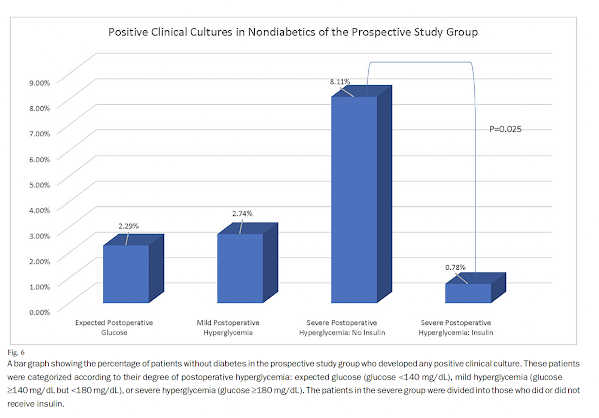


They concluded that postoperative hyperglycemia is frequent in patients without diabetes after orthopaedic surgery, but an enhanced glucose management program can lower mean postoperative glucose levels. The treatment of hyperglycemia in patients without diabetes reduced short-term complications and was associated with minimal side effects.


Comment:  The results of this study indicate the importance of measuring the preoperative fasting blood glucose.  Patients with elevated preoperative fasting glucose, perioperative steroid use, general anesthesia, long procedure duration, and transfusions should receive consideration for close postoperative monitoring and treatment of hyperglycemia.


Follow on twitter: https://twitter.com/shoulderarth

Follow on facebook: https://www.facebook.com/frederick.matsen

Follow on LinkedIn: https://www.linkedin.com/in/rick-matsen-88b1a8133/


How you can support research in shoulder surgery Click on this link.

Here are some videos that are of shoulder interest
Shoulder arthritis - what you need to know (see this link)
The smooth and move for irreparable cuff tears (see this link)
The total shoulder arthroplasty (see this link).
The ream and run technique is shown in this link.
The cuff tear arthropathy arthroplasty (see this link).
The reverse total shoulder arthroplasty (see this link).

Shoulder rehabilitation exercises (see this link).

This is a non-commercial site, the purpose of which is education, consistent with "Fair Use" as defined in Title 17 of the U.S. Code.          
Note that author has no financial relationships with any orthopaedic companies.


Monday, February 22, 2021

Postoperative glucose control may lower risk of periprosthetic infection

 Is postoperative glucose variability associated with adverse outcomes following shoulder arthroplasty?

These authors investigated the association between postoperative glycemic variability and short-term complications for 1074 patients having total shoulder arthroplasty (TSA) and reverse total shoulder arthroplasty (RTSA).


The mean patient age was 70 years, and 40% (!) of patients had a preoperative diagnosis of diabetes mellitus. 


A postoperative infection developed in 3 of 636 (0.5%) patients without diabetes compared with 9 of 424 (2.1%) patients with diabetes. Younger patient age and a preoperative diagnosis of diabetes mellitus showed statistically significant associations with postoperative infection. 


The first in-hospital glucose measurement beyond the reference tertile of 70-140 mg/dL showed a statistically significant association with postoperative infection,  whereas the second and third glucose measurements showed no association with postoperative infection.


The authors suggest that in-hospital glycemic control, as well as preoperative glycemic control and optimization, may be beneficial for reducing postoperative infections following shoulder arthroplasty.


Comment: Glycemic control before and immediately after shoulder arthroplasty may hold promise as modifiable risk factors for infection.


Interested readers should also view this related post When is a patient with diabetes safe for arthroplasty surgery?


Here are some videos that are of shoulder interest
Shoulder arthritis - what you need to know (see this link).
How to x-ray the shoulder (see this link).
The ream and run procedure (see this link).
The total shoulder arthroplasty (see this link).
The cuff tear arthropathy arthroplasty (see this link).
The reverse total shoulder arthroplasty (see this link).
The smooth and move procedure for irreparable rotator cuff tears (see this link).
Shoulder rehabilitation exercises (see this link).

Saturday, May 11, 2013

Diabetes control and wound complications after total joint surgery

Elevated Postoperative Blood Glucose and Preoperative Hemoglobin A1C Are Associated with Increased Wound Complications Following Total Joint Arthroplasty

From among 1702 patients having total joint replacements, those with wound complications within thirty days after the index arthroplasty were identified. A control group matched for exact age, sex, procedure, tourniquet use, surgical approach, and use of antibiotic cement was also created.

Patients with a mean postoperative glucose of >200 mg/dL had an odds ratio for developing a wound complication of 3.75. 
Patients with a maximum postoperative blood glucose of >260 mg/d had an odds ratio for developing a wound complication of 3.0
Patients with a preoperative hemoglobin A1C value of >6.7% had an odds ratio for developing a wound complication of 9.0.

The authors point that this study did not show that good glycemic control resulted in reduced risk. They did demonstrate that poor preoperative and postoperative glucose control is independently associated with wound complications.

These results are in contrast to those of
Surgical outcomes of total knee replacement according to diabetes status and glycemic control, 2001 to 2009, a study of Kaiser enrollees.
The authors found that of 40,491 patients who underwent total knee arthroplasty, 7567 (18.7%) had diabetes, 464 (1.1%) underwent revision arthroplasty, and 287 (0.7%) developed a deep infection. Compared with the patients without diabetes, no association between controlled diabetes (HbA1c < 7%) and the risk of revision (odds ratio [OR], 1.32; 95% confidence interval [CI], 0.99 to 1.76), risk of deep infection (OR, 1.31; 95% CI, 0.92 to 1.86), or risk of deep venous thrombosis or pulmonary embolism (OR, 0.84; 95% CI, 0.60 to 1.17) was observed. Similarly, compared with patients without diabetes, no association between uncontrolled diabetes (HbA1c ≥ 7%) and the risk of revision (OR, 1.03; 95% CI, 0.68 to 1.54), risk of deep infection (OR, 0.55; 95% CI 0.29 to 1.06), or risk of deep venous thrombosis or pulmonary embolism (OR, 0.70; 95% CI, 0.43 to 1.13) was observed.
The authors concluded that no significantly increased risk of revision arthroplasty, deep infection, or deep venous thrombosis was found in patients with diabetes (as defined on the basis of preoperative HbA1c levels and other criteria) compared with patients without diabetes in the study population of patients who underwent elective total knee arthroplasty.


===
Use the "Search" box to the right to find other topics of interest to you.

You may be interested in some of our most visited web pages including:shoulder arthritis, total shoulder, ream and run, reverse total shoulder, CTA arthroplasty, and rotator cuff surgery as well as the 'ream and run essentials'


See from which cities our patients come.


See the countries from which our readers come on this post.