Showing posts with label randomized controlled trial. Show all posts

Friday, May 23, 2025

I have a new arthroplasty implant and want to show it's better than what's out there.

There is tremendous interest in innovating new arthroplasty approaches in the hope of improving clinical outcomes for our patients.  See Does Knee Prosthesis Survivorship Improve When Implant Designs Change?  which concludes "It is difficult to predict whether a new system will demonstrate better survival than a previous one, and widespread uptake of a new design before a benefit is shown in robust clinical studies is unwise."(thanks, Seth Leopold, for this reference).

In that a lot of time, energy and money is required to bring an innovation to the market place, how do we find out whether this investment of resources has resulted in a clinically significant improvement in outcome? 

The bottom line is that it's difficult.

There are some key elements to such an analysis:  sample size and control of confounding variables

Sample Size
We know that such a study requires prospectively collected data, but how many patients with two-year followup do we need to meaningfully compare the outcomes for the new implant to those for the traditionally used system?

The answer is that it depends - among other things - on our selection of the primary outcome variable: is it revision rate, complication rate, patient reported outcomes (PRO) or range of motion (ROM)?

The authors of Systematic review of shoulder arthroplasty outcomes: what sample size is meaningful? reviewed published studies of anatomic or reverse TSA with prospectively collected data and a minimum two-year follow-up. They analyzed common clinical outcomes reported for shoulder arthroplasty and reported the sample sizes necessary to confirm a clinically meaningful and statistically significant difference for these outcome measures with the assumptions of significance at α = 0.05 and power at β = 0.20. They found that the sample size needed to detect meaningful differences was much lower for continuous measures (ROM and PROs) than for dichotomous outcomes (revisions and complications). Specifically they found the required sample sizes to be up to 100,000 patients to detect differences in complication rates, up to 10,000 for differences in revision rates, and several 100 for patient reported outcomes and range of motion. Note the orders of magnitude greater numbers required for the dichotomous variables of complication rate and revision rate in contrast to variables with scaled measures (ROM, PRO). This is related in part to the low rates of complications and revisions so that large sample sizes are needed to detect a significant difference. Some of the details of their findings are shown graphically at the end of this post.


Controlling for Covariates
When comparing two treatment groups in clinical research, surgeons often attempt to match important characteristics (covariates) so that the outcomes of the two treatments can be compared without confounding related to differences in the patients. The authors of What are We Matching On and Why?:A Systematic Review of Matched Study Designs in Shoulder Arthroplasty examined the variety and inconsistency of matching patient cohorts in studies assessing outcomes following shoulder arthroplasty. They found 110 studies encompassing 483,738 shoulder arthroplasties, 82 (74.6%) studies employed direct matching and 28 (25.5%) employed propensity score matching. [Direct matching matches the two treatment groups based on near-exact agreement of the covariates (e.g., age = 65 +/- 5 years, sex = male, BMI = 25 +/- 5); in propensity matching a logistic regression model is first built that assigns each study participant a propensity score representing the conditional probability of that patient being in one group versus the other as a function of baseline factors. Rather than individual variables, patients are then matched on their propensity score. Propensity matching has an advantage when there are a large number of covariates under consideration]

Seventy-four distinct covariates were used in at least one study, with 86 unique combinations of covariates employed. Studies used a median of 4 covariates (range 1-27). The most common covariates were age (94.5%), sex (89.1%), body mass index (26.4%), smoking (19.1%), and follow-up duration (19.1%). Only 16 (14.6%) studies reported justification for the covariates included. Sample sizes ranged from 115 to 106,114 shoulders. Thus their analysis of 110 "matched" outcome studies in shoulder arthroplasty "revealed marked discrepancies in the number and type of matched variables and in how patient matching is performed and reported. This variability may have negative implications for the reproducibility, generalizability, and transparency of matched cohort studies within shoulder arthroplasty."

Of course, in addition to age, sex, body mass index, smoking , and follow-up duration, there are many other clinically important covariates that will confound the analysis if they're not controlled for: diagnosis, cuff status, glenoid type, social determinants of health, preoperative function, implant size and position, and the surgeon performing the arthroplasty. The full list may be quite a bit longer. However, matching for each additional covariate reduces the number of shoulders that qualify for inclusion in the matched sample (because of excluding those without suitable matches) to the extent that the final colort may no longer be representative of patients being treated with the two types of arthroplasty. This effect can be assessed by comparing the characteristics and numbers of all patients prior to matching to the characteristics and numbers of those still in the study after matching.

Length of Followup
Many studies list "minimum two year followup" as an inclusion criterion. Is it reasonable to combine followups at two years with followups at 5 years 7 year, or longer? There are also issues when we extend the period of followup as reviewed in The Challenge of Long Term Followup, including that the methods used a while back may no longer be what we're using today and that a progressively smaller percent of the original cohort is lost as the period of followup is extended.

So, is there a better option? The answer is both yes and no.
In Is pyrocarbon better than a ream and run? - a randomized controlled trial, we propose a hypothetical randomized controlled trail and point out it strengths (e.g. it does not require ex ante identification of the potentially confounding covariates or trying to match the patients in each treatment group) and its weaknesses (e.g. some patients' unwillingness to have their treatment decided at random - risking an unrepresentative sample, and the cost).

A final thought is that, overall, the current results of shoulder arthroplasty are quite good with low complication and revision rates. The scores using the common PRO are within the minimal clinically important difference of a perfect score. As a result it may be difficult for any innovation to improve the current outcomes by an amount that is clinically significant.  The reader will have no problem finding articles that conclude that "while there was a statistically significant improvement, the improvement was not clinically significant). 

This does not mean that innovation is without value, but it does suggest that innovation should be directed at a specific problem, one that occurs sufficiently often and has a measurable effect so that it will be straightforward to determine whether the innovation fixes it. As Einstein is reported to have said, “If I had an hour to solve a problem, I'd spend 55 minutes thinking about the problem and 5 minutes thinking about solutions.”

We need to keep pecking at the problems

Pileated Woodpecker
Shot this week in Interlacken Park, Seattle

You can support cutting edge shoulder research that is leading to better care for patients with shoulder problems, click on this link

Follow on twitter/X: https://x.com/RickMatsen
Follow on facebook: https://www.facebook.com/shoulder.arthritis
Follow on LinkedIn: https://www.linkedin.com/in/rick-matsen-88b1a8133/

Here are some videos that are of shoulder interest
Shoulder arthritis - what you need to know (see this link).
How to x-ray the shoulder (see this link).
The ream and run procedure (see this link).
The total shoulder arthroplasty (see this link).
The cuff tear arthropathy arthroplasty (see this link).
The reverse total shoulder arthroplasty (see this link).
The smooth and move procedure for irreparable rotator cuff tears (see this link)
Shoulder rehabilitation exercises (see this link).

Figures from Systematic review of shoulder arthroplasty outcomes: what sample size is meaningful?


Wednesday, April 2, 2025

Is pyrocarbon better than a ream and run? - a randomized controlled trial


"We need a randomized controlled trial to determine whether patients with shoulder arthritis having a pyrocarbon humeral head have better outcomes than those having a ream and run".

In discussing this topic it may be worthwhile starting with a classic example of an orthopaedic RCT

A Controlled Trial of Arthroscopic Surgery for Osteoarthritis of the Knee The reader will easily see the care exerted by the investigators to define the two groups to be compared (debridement vs sham surgery, the randomization, the blinding of the evaluators, the primary outcome measure (the Knee-Specific Pain Scale), and the outcomes ("At no point did either of the intervention groups report less pain or better function than the placebo group. Furthermore, the 95 percent confidence intervals for the differences between the placebo group and the intervention groups exclude any clinically meaningful difference.") Interestingly, in spite of this result, arthroscopic debridement for knee osteoarthritis is still being performed.

Before considering a randomized controlled trial, investigators must listen to this recent presentation: American Shoulder and Elbow Surgeons webinar on randomized controlled trials. This very well done webinar was both impressive and daunting. It pointed out the organization, cost and the challenges of RCTs.

Stimulated by the above, I started making a check list of questions to be answered before considering an RCT comparing pyrocarbon humeral hemiarthroplasty to the ream and run procedure. I suspect that there are others that should be included.

I. What should be the primary outcome variable (POV)?
    A. Wear rate
    B. Patient reported outcome measure (PROM)
        1. Final PROM
        2. Change in PROM
    B. Satisfaction
    C. Complication rate (e.g. infections)
    D. Revision rate
II. How long after surgery should the POV be assessed
III. For the selected POV, what are the published mean, median, standard deviation, and 90% confidence levels for 
    A. Pyrocarbon humeral hemiarthroplasty 
    B. Ream and run procedure
IV. How much change in the selected POV would be clinically significant (effect size)
V. What sample size would be necessary to detect a clinically significant change in the POV with reasonable statistical power (e.g. 80%) (see Sample size, power and effect size revisited: simplified and practical approaches in pre-clinical, clinical and laboratory studies)
VI. What percent of the potential candidates for the study would agree to be enrolled in a study that had their surgical procedure selected at random; in what ways do consenting and non-consenting patients differ? 
VII. What percent of those enrolled are likely to drop out before the desired followup time interval; in what ways do patients not completing the study differ from those that complete it?
VIII. What are the confounding variables and how will they be documented and included in the analysis

    A. The surgeon (experience, published outcomes)
    B. The component (make, size, stem, position)
    C. Patient demographics (age, sex, comorbidities)
    D. Preoperative pathology (type of arthritis, glenoid type, version, cuff status, centering, shoulder size, prior surgery)
    E. Simultaneous procedures (glenoid reaming (accepting or correcting glenoid version), biceps management (preservation, tenotomy, tenodesis), posterior capsular plication, rotator interval plication, cuff surgery, AC joint surgery)
IX. Study details
    A. How will decisions be made
    B. Prospective involvement of statistician
    C. Initial and followup meeting of investigators
    D. Where will data be housed
    E. Human subjects clearances
        1. Locally at each study site
        2. Centrally
    F. Staffing
    G. Funding
    H. How will blinding be managed (patient, followup, etc)

Comments welcome!


You can support cutting edge shoulder research that is leading to better care for patients with shoulder problems, click on this link

Follow on twitter/X: https://x.com/RickMatsen
Follow on facebook: https://www.facebook.com/shoulder.arthritis
Follow on LinkedIn: https://www.linkedin.com/in/rick-matsen-88b1a8133/

Here are some videos that are of shoulder interest
Shoulder arthritis - what you need to know (see this link).
How to x-ray the shoulder (see this link).
The ream and run procedure (see this link).
The total shoulder arthroplasty (see this link).
The cuff tear arthropathy arthroplasty (see this link).
The reverse total shoulder arthroplasty (see this link).
The smooth and move procedure for irreparable rotator cuff tears (see this link)
Shoulder rehabilitation exercises (see this link).


Friday, November 25, 2022

Does the evidence support the use of the InSpace balloon in the treatment of irreparable rotator cuff tears?

Rotator cuff tears are one of the most common conditions of the shoulder. While many patients can accommodate the progressive age-related deterioration of the cuff with no or minimal symptoms, others have disabling symptoms and loss of function. Surgical management of symptomatic rotator cuff tears is commonly performed. For those tears that are not durably reparable, surgical options include (1) subacromial smoothing with debridement of hypertrophic bursa and the non-functioning margins of the tendon, possible biceps surgery, and manipulation as necessary to address glenohumeral stiffness, (2) partial repair, (3) superior capsular reconstruction, (4) reverse total shoulder and (5) the recently introduced Stryker InSpace subacromial balloon spacer. The InSpace device is a saline-filled biodegradable balloon that is inserted surgically in the space between the humerus and the acromion. In theory this device helps maintain the gap between the acromion and the humerus, and reduces friction.
The balloon received Food and Drug Administration (FDA) clearance in the USA in July, 2021, with approximately 29,000 devices having been implanted outside the USA before this.


The question is, in patients with symptomatic, irreparable rotator cuff tears, does adding a subacromial balloon spacer to debridement alone improve shoulder pain and function above what is achieved with debridement alone?

While small published case series have suggested encouraging clinical results, others have reported poor results or cases of inflammation and pain. For this reason, the authors of Subacromial balloon spacer for irreparable rotator cuff tears of the shoulder (START:REACTS): a group-sequential, double-blind, multicentre randomised controlled trial conducted a novel, efficient, adaptive clinical trial to assess the clinical effectiveness of a subacromial spacer balloon for people with symptomatic irreparable tears of the rotator cuff. This article was summarized in In Symptomatic Irreparable Rotator Cuff Tears, Adding a Subacromial Balloon Spacer to Debridement Resulted in Worse Shoulder Pain and Function at 12 Months.

The study was conducted by surgeons in 24 hospitals in the United Kingdom and included 117 patients (mean age, 67 years; 57% men) who had irreparable rotator cuff tears with disabling symptoms (pain and loss of function) and unsuccessful nonoperative management, and in whom surgery was warranted. Patients with reparable cuff tears, arthritis, pseudoparalysis, and subscapularis deficiency were excluded.

Eligibility was confirmed intraoperatively before randomly assigning (1:1) participants to a treatment group using a remote computer system. Using concealed allocation, patients were randomized to balloon spacer plus debridement (n = 56) or debridement alone (n = 61). Patients in the balloon spacer group received the Stryker InSpace balloon inserted by subspecialty-trained shoulder surgeons after arthroscopic debridement of the subacromial space and biceps tenotomy. Participants and assessors were masked to group assignment. Masking was achieved by using identical 1.5-cm lateral portal incisions for both procedures, blinding the operation note, and a consistent rehabilitation program offered regardless of group allocation.

The study was designed to have 90% power providing a robust answer to the clinical question.

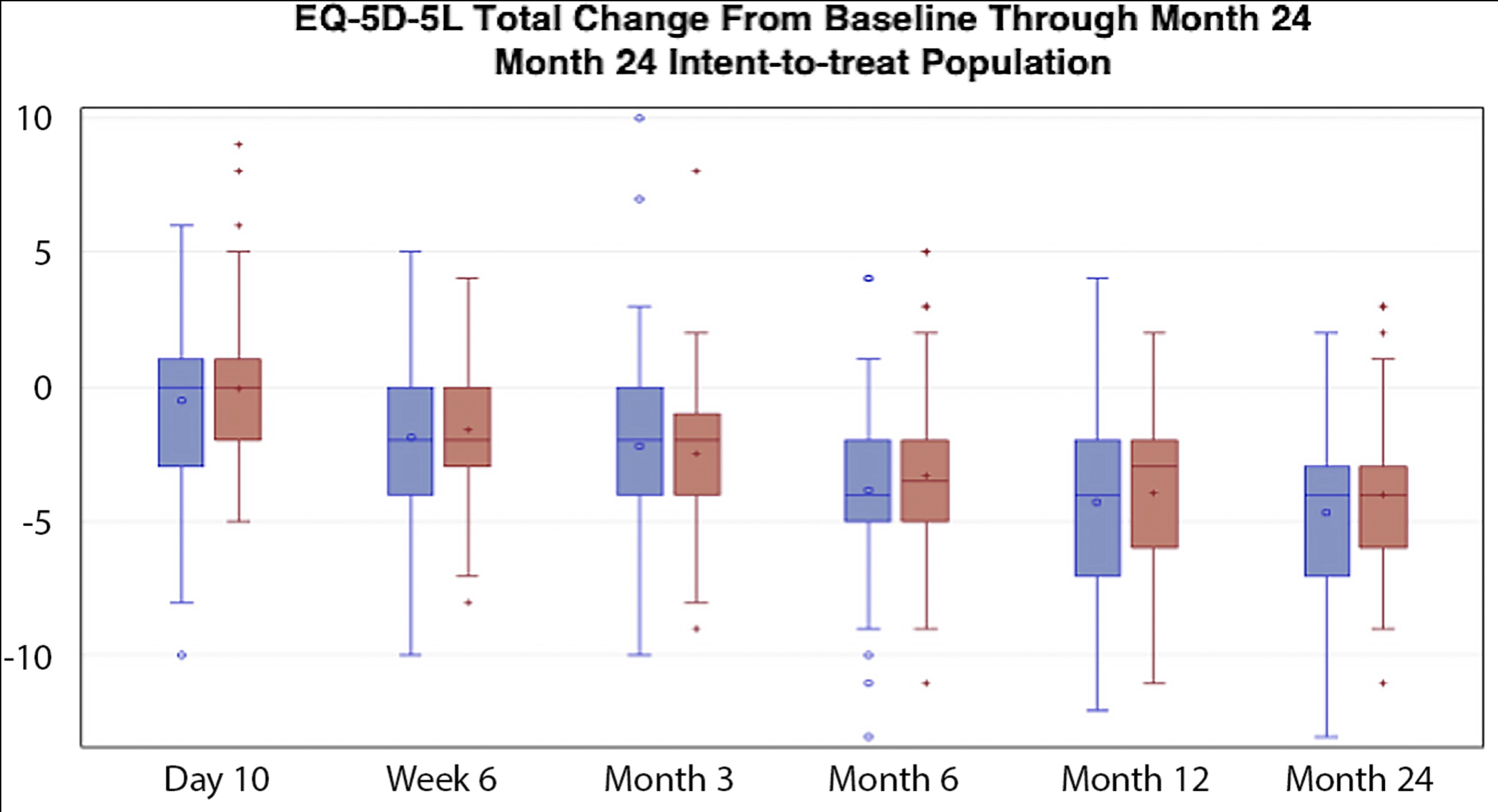
The primary outcome was shoulder-related pain and function as measured by the Oxford Shoulder Score at 12 months. Secondary outcomes included the Western Ontario Rotator Cuff Index, EuroQol-5 Dimensions-5 Levels (EQ-5D-5L), and adverse events at 12 months. 97% of patients completed follow-up for the primary outcome. The primary outcome was the Oxford Shoulder Score at 12 months.

Pre-trial simulations using data from early and late timepoints informed stopping boundaries for two interim analyses. The study was designed to be terminated either for convincing evidence of a lack of benefit (futility) or for strong clinical benefit (efficacy). This exposes fewer people to risk of harm in the trial itself, as well as preventing harm or high costs for people having the treatment in the wider community. Having both futility and efficacy stopping rules allow a study to report early if an intervention is ineffective. Recruitment to this study was stopped when the predefined boundary for futility was crossed.

As seen in the figure and table below, in patients with symptomatic irreparable rotator cuff tears, adding the InSpace balloon to debridement only resulted in worse shoulder pain and function. The mean Oxford Shoulder Score at 12 months was 34·3 (SD 11·1) in the debridement only group and 30·3 (10·9) in the debridement with device group (mean difference adjusted for adaptive design –4·2 [95% CI –8·2 to –0·26];p=0·037) favoring debridement alone.


The adverse events for the two groups are shown below.


The authors concluded that for patients with symptomatic irreparable rotator cuff tears, adding a subacromial balloon spacer to debridement resulted in worse shoulder pain and function at 12 months.

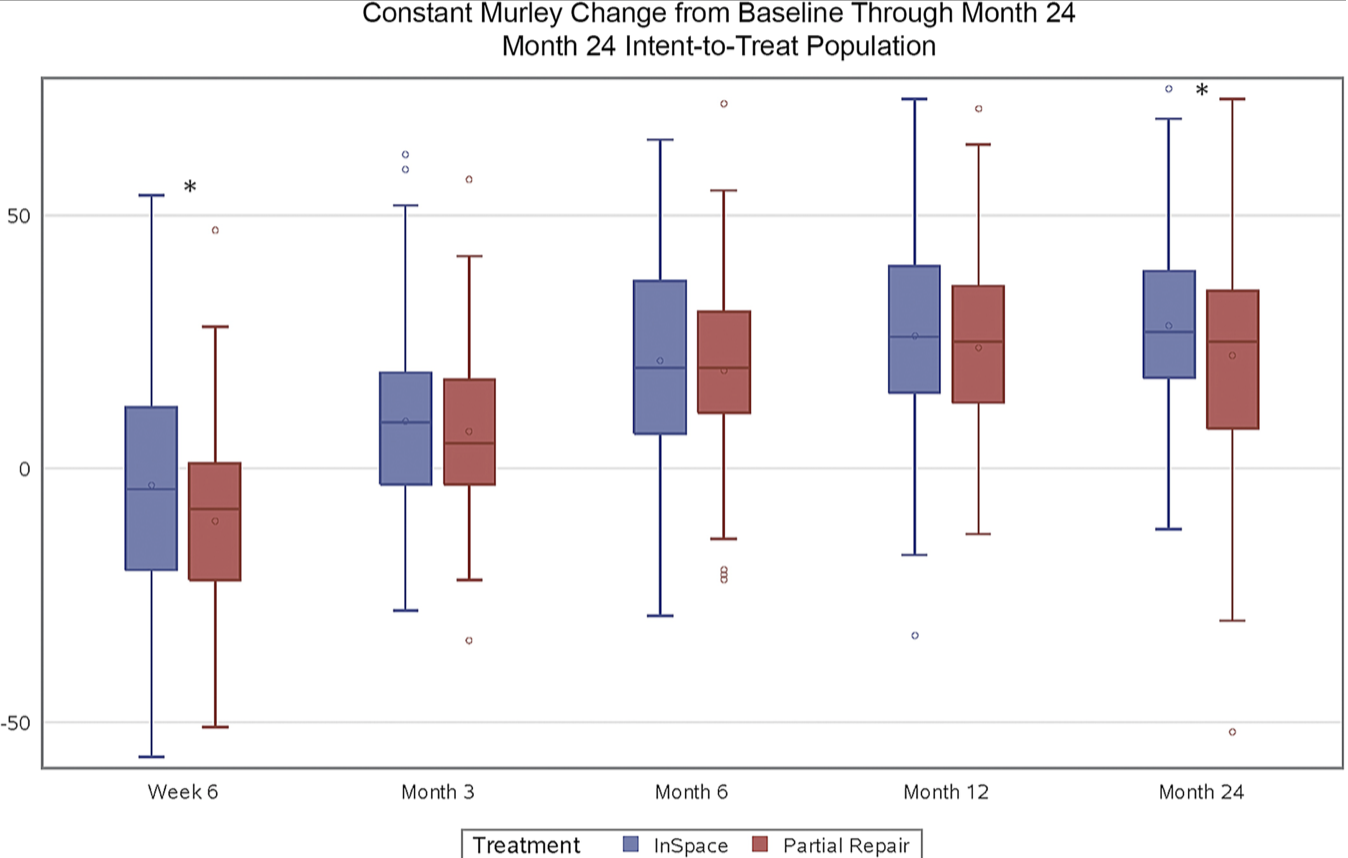
Another recent study, InSpace Implant Compared with Partial Repair for the Treatment of Full-Thickness Massive Rotator Cuff Tears A Multicenter, Single-Blinded, Randomized Controlled Trial concluded that the outcomes of the InSpace implant were not inferior to those of partial repair for the treatment of patients with irreparable, posterosuperior, massive rotator cuff tears and an intact subscapularis.


The authors of this second study described its limitations, including the fact that the evaluators of the physical examination were not blinded with respect to treatment groups.

Comment: These studies do not provide evidence of increased effectiveness of the InSpace balloon in comparison to debridement or partial cuff repair.

You can support cutting edge shoulder research that is leading to better care for patients with shoulder problems, click on this link.
To add this blog to your reading list in Google Chrome, click on the reading list icon


Follow on twitter: https://twitter.com/shoulderarth
Follow on facebook: click on this link
Follow on facebook: https://www.facebook.com/frederick.matsen
Follow on LinkedIn: https://www.linkedin.com/in/rick-matsen-88b1a8133/

Here are some videos that are of shoulder interest
Shoulder arthritis - what you need to know (see this link).
How to x-ray the shoulder (see this link).
The ream and run procedure (see this link).
The total shoulder arthroplasty (see this link).
The cuff tear arthropathy arthroplasty (see this link).
The reverse total shoulder arthroplasty (see this link).
The smooth and move procedure for irreparable rotator cuff tears (see this link).
Shoulder rehabilitation exercises (see this link).

Monday, October 21, 2013

Single-row versus double-row suture bridge repair of supraspinatus tears - a randomized study

Ultrasound evaluation of arthroscopic full-thickness supraspinatus rotator cuff repair: single-row versus double-row suture bridge (transosseous equivalent) fixation. Results of a prospective, randomized study


The authors are to be complemented in their conduction of a well-randomized clinical trial.

The purpose of this study was to compare the structural outcomes of a single-row rotator cuff repair and double-row suture bridge fixation after arthroscopic repair of a full-thickness supraspinatus rotator cuff tear (tear size less than 25 mm in their anterior to posterior dimension). Specifically the goal was to test the null hypothesis that an arthroscopic double-row repair would not produce an improvement in the tendon healing rate as determined by diagnostic ultrasound.

Randomization took place in the operating room. After the operative findings confirmed patient eligibility, the circulating nurse consulted a random number table and the patient was then assigned to one of the two study groups. Forty-three shoulders were repaired with single-row technique and 47 shoulders with double-row suture bridge technique. Postoperative rehabilitation was identical for both groups. Shoulders were immobilized in an abduction sling for 6 weeks, being allowed out of the sling for bathing, dressing, and pendulum circumduction. At 6 weeks after the operation. The sling was discontinued and the shoulder started on supine active assisted elevation.
Ultrasound criteria for healed repair included visualization of a tendon with normal thickness and length, and a negative compression test. Eighty-three patients were available for ultrasound examination (40 single-row and 43 suture-bridge). Thirty of 40 patients (75%) with single-row repair demonstrated a healed rotator cuff repair compared to 40/43 (93%) patients with suture-bridge repair (P = .024)

In their sample size estimation, the authors were seeking a 15% to 20% difference in supraspinatus integrity rates - a difference not quite achieved in this study.

It would have been of interest to know the age, gender, and tear size of the two groups so we could see how comparable they were. There were no clinical results presented for these patients so we do not know if the shoulders with retears fared worse and those with intact repairs or whether the suture-bridge shoulders had more comfort and function at followup than those having single row repairs.

The authors are to be again complemented on yet another randomized study - all too rare in our field.

===
To see the topics covered in this Blog, click here

Use the "Search" box to the right to find other topics of interest to you.

You may be interested in some of our most visited web pages including:shoulder arthritis, total shoulder, ream and run, reverse total shoulder, CTA arthroplasty, rotator cuff surgery, 'ream and run essentials' and consultation for shoulder arthritis.

See from which cities our patients come.

See the countries from which our readers come on this post.