Showing posts with label revisions. Show all posts

Saturday, July 3, 2021

Anatomic or reverse total shoulder for osteoarthritis?

A Comparison of Revision Rates for Osteoarthritis of Primary Reverse Total Shoulder Arthroplasty to Primary Anatomic Shoulder Arthroplasty with a Cemented All-polyethylene Glenoid: Analysis from the Australian Orthopaedic Association

These authors analyzed the Australian Joint Replacement Registry to compare revision rates of 3795 primary anatomic (aTSAs) using cemented all polyethylene glenoids and 8878 reverse total shoulder (rTSA) in the treatment of shoulder osteoarthritis (OA).


The characteristics of the two groups are shown below.


Overall, the authors found no differences in the 4-year cumulative percent revision rates between the groups.


The results for men are shown below


          The results for women are shown below


Comment: This is a valuable population-based study from a database that includes almost all of the arthroplasties performed in Australia. It is of surprise and interest that in this report there were over twice as many rTSAs as aTSAs. The data from this study of revision rates do not appear to justify the more expensive procedure (rTSAs) for this diagnosis.


There are a number of key considerations regarding this study.


(1) Patients having the two procedures differed in a number of important ways (see table above). 


(2) The tipping point for having an aTSA is different from that for a rTSA (see this link).


(3) The tipping point for revising an aTSA is likely to be different from that for a rTSA.


(4) Older patients and patients with high ASA scores may be less inclined to undergo another procedure even if the outcome of the index arthroplasty was not satisfactory. 


(5) The study did not compare functional outcomes of the two procedures.


Thus we agree with the conclusion of the authors that this study, "supports the continued use of aTSA with all-polyethylene glenoids for OA, despite national trends. If there is no survivorship difference between aTSA with all-polyethylene glenoids and rTSA for OA, future research should pursue other avenues such as differences in economic cost, patient-reported satisfaction, or function."


How you can support research in shoulder surgery Click on this link.

Here are some videos that are of shoulder interest
Shoulder arthritis - what you need to know (see this link).
How to x-ray the shoulder (see this link).
The total shoulder arthroplasty (see this link).
The ream and run technique is shown in this link.
The cuff tear arthropathy arthroplasty (see this link).
The reverse total shoulder arthroplasty (see this link).
The smooth and move procedure for irreparable rotator cuff tears (see this link).
Shoulder rehabilitation exercises (see this link).

Follow on twitter: Frederick Matsen (@shoulderarth)


Saturday, December 14, 2019

Total Shoulder Arthroplasty - what works? - critical observations on over 40,000 cases.

The Australian  Orthopaedic Association (see this link) provides a remarkable resource analyzing the practice and outcomes of arthroplasty across their country through a registry that captures a very high percentage of that nation's cases (see this link).

We review their recent report on the use of total shoulder joint replacement. There were 40,130 total shoulder replacements reported to the Registry.

The cumulative percent revision of primary anatomic total stemmed shoulder replacements for osteoarthritis was 14.8% at 12 years. There was no difference in the rate of revision when osteoarthritis was compared to fracture and osteonecrosis. Rheumatoid arthritis had a lower rate of revision compared to osteoarthritis.

The Registry recorded 1,055 revisions of primary total stemmed shoulder replacements. Rotator cuff insufficiency was the most common reason for revision of primary total stemmed shoulder replacement. It accounted for 24.7% of all revisions, followed by instability/dislocation (21.9%) and loosening (17.5%). The cumulative incidence of the five most common reasons for revision are presented in the figure below.


The revision rate was highest for cementless glenoids. Cementless fixation had a higher rate of revision compared to both cemented and hybrid (glenoid cemented) fixation.


A further analysis was undertaken to determine the impact of glenoid type. There were three broad glenoid types: modular metal backed, non modular metal backed and all-polyethylene. All-polyethylene glenoid prostheses were used in 71.6% of primary total stemmed shoulder replacements, the majority of which were cemented (99.5%). These prostheses have a lower rate of revision compared to modular metal backed glenoid over the entire period and non modular metal backed glenoid prostheses in the first 3 months. A modular metal backed glenoid has a higher rate of revision compared to a non modular metal backed glenoid.


Pegged and keeled all-polyethylene glenoid prostheses were also compared. The majority of all-polyethylene glenoid prostheses were pegged (86.8%). There was no difference in the rate of revision between these prostheses.


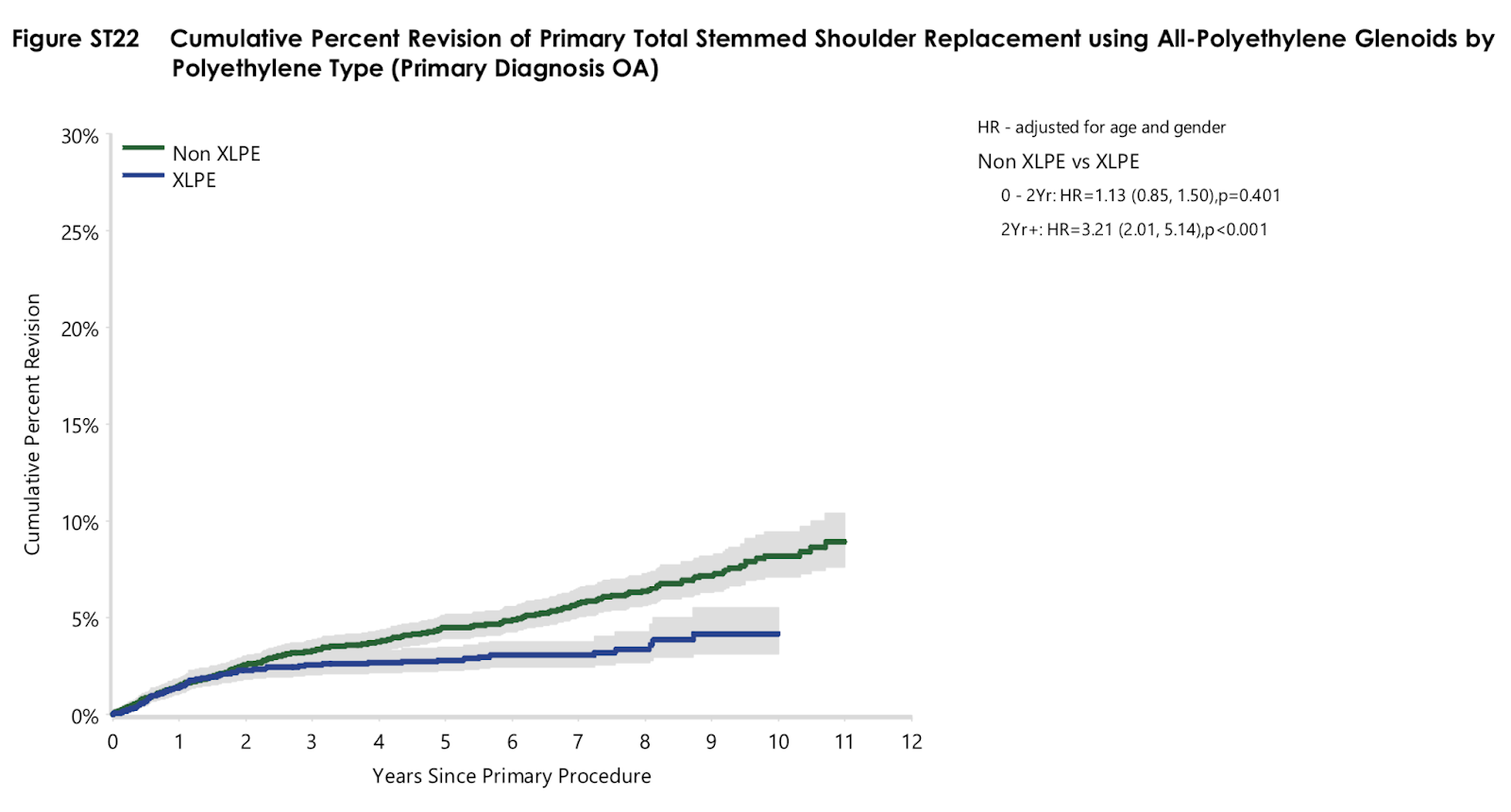
The use of cross-linked polyethylene (XLPE) glenoids increased from 10.7% in 2008 to 32.5% in 2018. When the SMR L2 glenoid prosthesis is excluded, XLPE glenoids have a lower cumulative percent revision at 10 years compared to non XLPE glenoids (4.3% compared to 11.5%, respectively)


This is also the case when only all-polyethylene glenoids are compared.

Comment: These are very important data for several reasons:
(1) They come from a broad-based national population of patients and surgeons, rather than from the practices of specialists or major centers.
(2) They are free of the conflicts of surgeon interest that confound the interpretation of level IV case series.
(3) They indicate that an XLPE all-polyethylene, cemented glenoid component has a 10 year survivorship of greater than 95% for patients with glenohumeral osteoarthritis.
(4) The preponderance of the long term follow-up data come from shoulders inserted before the recent enthusiasm for 3D planning and patient-specific instrumentation. 
(5) These data indicate that these new technologies will need to be very effective in order to have a demonstrable and cost-effective impact on total shoulder survivorship in cases of osteoarthritis. 

==
To see a YouTube of our technique for total shoulder arthroplasty, click on this link.

=====
To see our new series of youtube videos on important shoulder surgeries and how they are done, click here.

Use the "Search" box to the right to find other topics of interest to you.


You may be interested in some of our most visited web pages  arthritis, total shoulder, ream and run, reverse total shoulder, CTA arthroplasty, and rotator cuff surgery as well as the 'ream and run essentials'