Achieving the correct geometry of an anatomic total shoulder is important to the outcome.


The concept of overstuffing in shoulder arthroplasty was introduced over 30 years ago (Practical Evaluation and Management of the Shoulder p181-184): "in many conditions requiring shoulder arthroplasty, the capsule and ligaments are contracted and therefore excessively limit the range of motion. Shoulder arthroplasty tends to further tighten the capsule because the degenerated humeral head is replaced by a larger one, and because a glenoid component is added to the surface of the glenoid bone, consuming more space than the degenerated cartilage it replaces. Thus, the components "stuff" the joint. Unless sufficient capsular releases have been performed to accommodate this stuffing, the joint is "overstuffed" so that the motion is restricted."

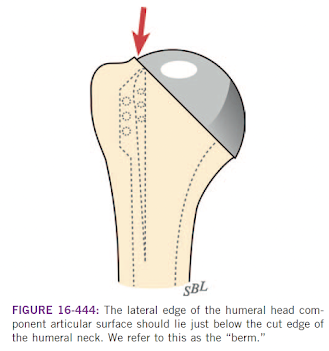
Overstuffing #2: inadequate humeral head cut


Influence of humeral position of the Affinis short® stemless shoulder arthroplasty system on long-term survival and clinical outcome that assessed the restoration of the center of rotation in patients having anatomic arthroplasty. 75 % (n = 60) of all implants were found to be anatomical and 25 % (n = 20) to be non-anatomical ( postoperative COR deviation of 2.7 ± 1.8 mm vs. 5.1 ± 3.2 mm, respectively).The reason for the non-anatomic reconstruction in all these cases were an improper humeral head resection resulting in an overstuffing with a medial-superior COR deviation of the postoperative COR from the anatomic COR Although the humeral component position did not affect the functional outcome, two of twenty shoulders with non-anatomic positioning had glenoid component loosening; none of the 60 anatomically positioned shoulders had glenoid loosening. Two patients with non anatomic positioning and one patient with anatomic positioning had cuff failure


Overstuffing #6: humeral head component too high


Overstuffing #7: medial positioning of humeral component


You can support cutting edge shoulder research that is leading to better care for patients with shoulder problems, click on this link.
Follow on twitter: https://twitter.com/RickMatsen or https://twitter.com/shoulderarth
Follow on facebook: click on this link
Follow on facebook: https://www.facebook.com/frederick.matsen
Follow on LinkedIn: https://www.linkedin.com/in/rick-matsen-88b1a8133/
Here are some videos that are of shoulder interest
Shoulder arthritis - what you need to know (see this link).
How to x-ray the shoulder (see this link).
The ream and run procedure (see this link).
The total shoulder arthroplasty (see this link).
The cuff tear arthropathy arthroplasty (see this link).
The reverse total shoulder arthroplasty (see this link).
The smooth and move procedure for irreparable rotator cuff tears (see this link).
Shoulder rehabilitation exercises (see this link).
As always, credit is due to Steve Lippitt for his amazing illustrations and who kindly provided new drawings for this post.

Adding volume to the joint tightens the soft tissues and restricts range of motion.

How to overstuff the arthroplasty
Overstuffing #1: the glenoid
While much attention is being paid to the humeral side of the arthroplasty, it is noteworthy that the thickness of the glenoid component also plays a role, particularly with metal backed components.

Overstuffing #2: inadequate humeral head cut


Overstuffing #3: too thick humeral head component

Overstuffing #4: humeral head component with too large diameter of curvature


Overstuffing #5: humeral component in varus


These causes of overstuffing relate to the glenoid, humeral head selection, humeral stem position, and the humeral neck cut. With respect to the latter, a number of jigs are marketed to guide the cut


however, it seems that most surgeons prefer to make the humeral cut freehand. This requires (1) complete resection of all osteophytes to expose the anatomic neck, (2) exposure of the cuff insertion superiorly and posteriorly, (3) drawing a line for the cut from the cuff insertion superiorly to the capsular reflection at the inferior humeral neck, and (4) simultaneously controlling four elements of the cut: (a) the depth of the cut, (b) the varus/valgus angle, (c) the degree of retroversion, and (d) the anteroposterior angulation.
You can support cutting edge shoulder research that is leading to better care for patients with shoulder problems, click on this link.
Follow on twitter: https://twitter.com/RickMatsen or https://twitter.com/shoulderarth
Follow on facebook: click on this link
Follow on facebook: https://www.facebook.com/frederick.matsen
Follow on LinkedIn: https://www.linkedin.com/in/rick-matsen-88b1a8133/
Here are some videos that are of shoulder interest
Shoulder arthritis - what you need to know (see this link).
How to x-ray the shoulder (see this link).
The ream and run procedure (see this link).
The total shoulder arthroplasty (see this link).
The cuff tear arthropathy arthroplasty (see this link).
The reverse total shoulder arthroplasty (see this link).
The smooth and move procedure for irreparable rotator cuff tears (see this link).
Shoulder rehabilitation exercises (see this link).