Showing posts with label dissociation. Show all posts

Saturday, October 21, 2017

Reverse total shoulder - failure by polyethylene dissociation from humeral stem

Polyethylene dissociation from humeral stem status after reverse total shoulder arthroplasty

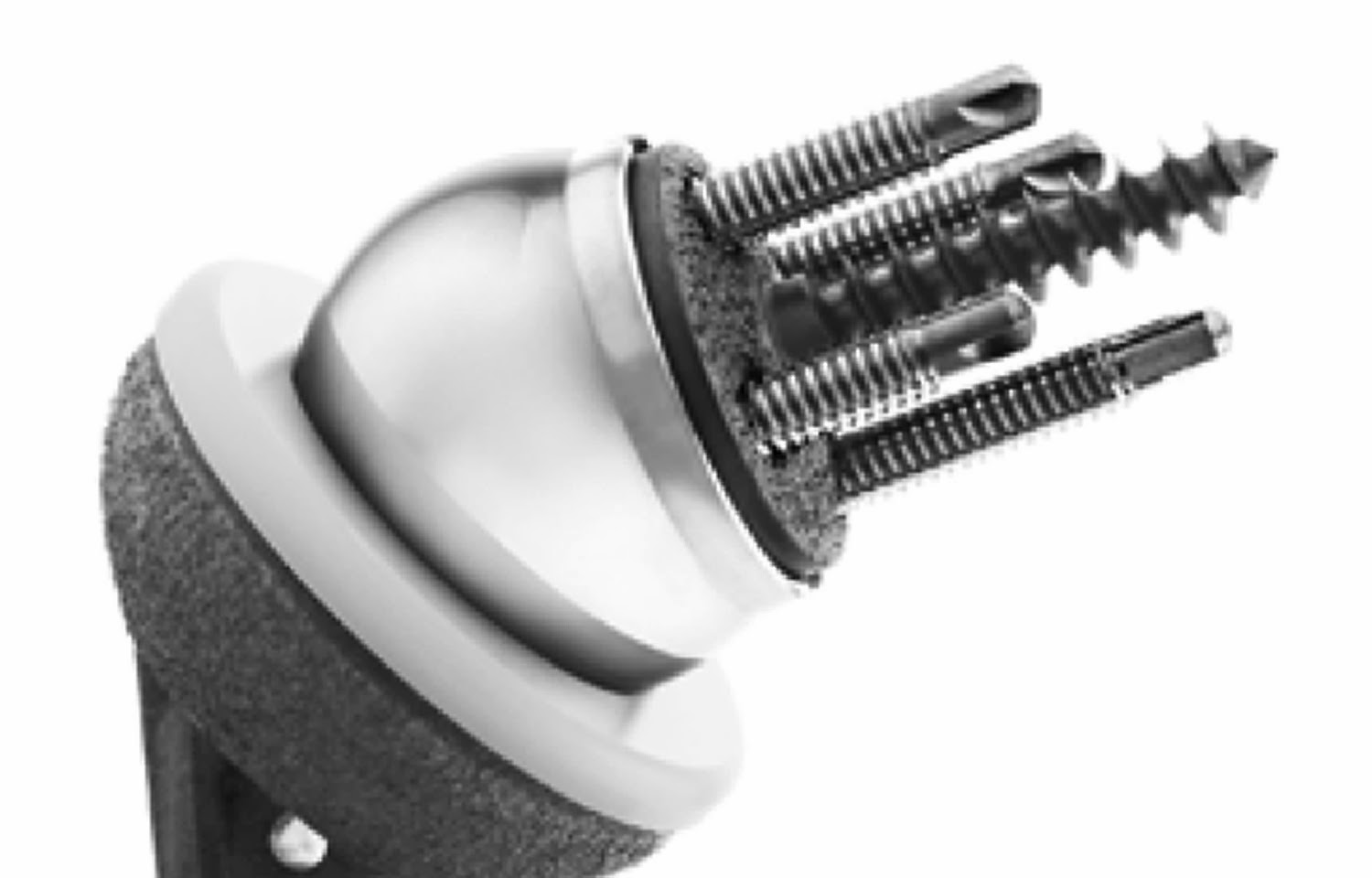
These authors present 4 cases of polyethylene dissociation from the humeral component after a Zimmer Trabecular Metal reverse total shoulder.


The manufacturer's recommended method for securing the polyethylene insert is show in this link technique.


The authors suggest that surgeons should be aware of this possibility if a closed reduction of a dislocated reverse total shoulder is not possible. They point out that dissociation may be difficult to distinguish on radiographs; however, subtle clues can be present, including decreased spacer distance between the glenosphere and humeral stem as well as a soft tissue shadow caused by the radiolucent polyethylene.

All 4 patients were male; all patients underwent surgery with the Zimmer TM RSA (although this complication has been seen with other designs). There was a design change that affected the polyethylene humeral stem junction and the ease of placement for this specific product; however, the complications occurred both before and after this design change. 

Comment: The direction of forces applied to a reverse total shoulder frequently deviate from the what is desired for concavity compression. As a result, potentially displacing loads are applied to each element of the system: the baseplate, the glenosphere, the humeral polyethylene, and spacers. These loads can challenge each component junction: "each junction is a potential disjunction". 

===
The reader may also be interested in these posts:


Information about shoulder exercises can be found at this link.

Use the "Search" box to the right to find other topics of interest to you.

You may be interested in some of our most visited web pages including:shoulder arthritis, total shoulder, ream and runreverse total shoulderCTA arthroplasty, and rotator cuff surgery as well as the 'ream and run essentials'


Sunday, July 23, 2017

Reverse total shoulder failure from polyethylene dissociation from humeral implant

Polyethylene dissociation from humeral stem status after reverse total shoulder arthroplasty

These authors present four cases of polyethylene liner dissociation from the humeral component of a  reverse shoulder arthroplasty (RSA).  In a series of 549 patients who underwent RSA, the incidence of this complication was 0.7%.  These patients presented with signs, symptoms, and imaging consistent with dislocation but were found to have a dissociation of the polyethylene from the humeral component, rendering a closed reduction impossible.

All four cases were male with a the same implant. The dissociations were recognized between 3 months and three years after surgery. The images from the four cases are shown here. The authors caution, "surgeons should be aware of this possibility if a closed reduction of an RSA dislocation is not possible."


Comment: Because the polyethylene liner of a reverse total shoulder can experience large, non-compressive loads, it is at risk for displacement from the metal humeral cup. Similar complications have occurred with other implants, so it is not clear whether the design of this system is at particular risk for this complication. With any design, it is important that the liner be vigorously and fully seated in the humeral cup after assuring that the cup is dry and free of any interposed tissue. After insertion, the security of the seating needs to be verified.
===== 
The reader may also be interested in these posts:


Information about shoulder exercises can be found at this link.

Use the "Search" box to the right to find other topics of interest to you.

You may be interested in some of our most visited web pages including:shoulder arthritis, total shoulder, ream and runreverse total shoulderCTA arthroplasty, and rotator cuff surgery as well as the 'ream and run essentials'


Thursday, November 17, 2016

How does the fillet relate to reverse total shoulder implant failure?

Not this fillet


but this one, the degree of rounding of the interior corner of a part. A larger radius dispurses the stress at the junction.


Some implant designs have a stem that can be used either for an anatomic (below left) or a reverse (below center) total shoulder. In order to adapt the stem to a polyethylene (PE) cup, some designs use a tray with a trunion that fits into the Morse taper of the stem. The junction between the tray and the trunion is a fillet (arrow below right). 


There are two articles with similar findings.

In vivo fracture of a reverse total shoulder replacement humeral tray: A case report

Failure analysis was performed for two humeral tray components in the same patient that fractured in vivo after only 6 and 9 months.


Implant retrieval analysis indicated that the components failed due to fatigue failure initiating from a small radius fillet at the interface of the Ti6Al4v trunnion and tray regions. Finite element simulations revealed the small radius fillet to have resulted in a large stress concentration and confirmed the possibility for fatigue failure in 6 months. The stress concentration caused by both the small radius fillet and the insufficient tray thickness contributed to the premature fatigue failure of the humeral trays.


Fatigue failure of reverse shoulder humeral tray components of a single design.

These authors retrieved 8 humeral trays of nearly identical designs: 4 Ti-6Al-4V (Ti) and 4 CoCrMo (CoCr). The two Ti devices were revised for in vivo fracture. All Ti humeral tray retrievals fractured in vivo or were cracked at the taper fillet.


 Scanning electron microscopy showed cracking in the other 2 Ti trays and no evidence of cracking in the CoCr components. A geometric difference in the CoCr devices resulted in a 25% decreased stress under simulated activities of daily living. Accounting for the tray material properties, the fatigue failure envelope ranged from 1000 to 1 million cycles for Ti and from 30,000 to >10 million cycles for CoCr.

They concluded  that fatigue failure is possible for some reverse shoulder components and is likely exacerbated by fillet radius, tray thickness, and material choice.

Comment: Modularity and convertibility from anatomic to reverse shoulder arthroplasty are common among currently available shoulder implants.   Each of these designs carries with it features that may expose the patient to risks of prosthetic failure. Surgeons need to be thoughtful as they try newer implants with greater number of intercalated elements, each of which carries with it unique benefits and failure modes.

===
Consultation for those who live a distance away from Seattle.

Click here to see the new Shoulder Arthritis Book.

Click here to see the new Rotator Cuff Book

Use the "Search" box to the right to find other topics of interest to you.

You may be interested in some of our most visited web pages including:shoulder arthritis, total shoulder, ream and runreverse total shoulderCTA arthroplasty, and rotator cuff surgery as well as the 'ream and run essentials'

See from which cities our patients come.

See the countries from which our readers come on this post.

Thursday, April 21, 2016

Reverse total shoulder - dissociation of the glenosphere from the base plate


These authors point to the uncommon but important risk of glenophere dissociation reverse shoulder arthroplasty.  A mechanically compromised Morse taper is thought to be the main cause of this complication, with bony abutment and soft tissue interposition being cited as the most important problems along with cantilevered engagement of the glenosphere due to impaction under a slight angle and incomplete engagement due to proud or cross-threaded baseplate screws.

They suggest that current methods for assessing the security of the Morse taper assembly require applying considerable torque to the glenosphere which may damage the quality of the taper. They proposed measuring the implant-specific angular rotation–torque curve while engaging the Morse taper by tightening the central locking screw. 

As can be seen from their graph below, in comparison to the desired (baseline) seating, the torque increase with screw tightening occurs with fewer rotations of the screw driver when there is interposition or abutment.


This is shown diagrammatically below; note that the insertion of the screw was blocked with fewer turns of the screw in cases B and C when the glenosphere is incompletely seated.


Although small interpositioning and impingement defects are difficult to detect without using an instrumented tool, such as the one presented in this study, large defects could probably be detected without an instrumented tool. The 1000-μ m and 2000-μ m defects locked the screw for both tested implants more than 1 full turn before their normal angular rotation end point. Thus the authors propose the following:  By applying moderate pressure on the glenosphere central screw while screwing in a counterclockwise direction before the start of engagement, a “click” can be sensed that indicates the starting point. From that point on, the number of turns can be counted before a considerable amount of torque needs to be applied to the screw to further tighten it. If the screw begins to tighten 1 or more full turns less than the number of turns known to completely seat the screw (approximately 6.4 full turns for the Delta CTA or Delta Xtend implant), it is time to check for peripheral bony abutment or soft tissue interposition. Note that the number of full rotations before reaching the angular rotation end point is prosthesis specific.

Comment: By virtue of its constrained kinematics, the reverse total shoulder transmits loads directly from the humeral component to the glenoid component, without the suppleness of a normal or an anatomic arthroplasty. Thus, the fixation and integrity of reverse total shoulder components may be challenged by impacts that would be unlikely to affect a conventional total shoulder. Because the reverse total shoulder components are often modular and held together by Morse tapers and because they can be loaded in directions that can challenge the Morse taper, there is a risk of dissociation with impact loading.


Glenoid component dissociation has been reported with various designs of reverse total shoulders (Sirveaux 2004)(Ekelund 2011) (Zumstein 2011) (Middernacht 2008)(Farshad 2010)(Kempton 2011)(Clark 2012).

A recent article on Glenosphere dissociation after reverse shoulder arthroplasty is of interest. These authors reviewed their reverse total shoulder arthroplasty database and identified 13 patients with glenosphere dissociation between 1999 and 2013; dissociation occurred 0.5 months to 7 years postoperatively.Incidence of dissociation was correlated to glenosphere size (p < .001). Dissociated glenosphere size distribution was as follows: 32 mm (n = 1), 36 mm (n = 4), 40 mm (n = 6), and 44 mm (n = 2).The authors noted that improper taper engagement reduced the torsional capacity of the glenosphere-baseplate interface.


The risk of dissociation can be reduced by considering the geometry of the specific implant and the instruments, by specific surgical steps, by vigorous intraoperative testing and by cautioning the patient to avoid impact loading after surgery. 

As is the case with any Morse taper, incomplete seating - even by a fraction of a millimeter - can reduce the security of the cold weld between the two parts assembled by the taper. Complete seating can be prevented by fluid in the well of the female aspect of the assembly, by tissue or bone that block complete seating, or by insufficient force applied to impact the two components together.

In the design shown below, the glenoid head (glenosphere) fits over the baseplate but does not completely cover it. thus it may be difficult to see whether or not the glenoid head is completely seated. 


Instruments, such as the rim reamer shown below help remove potentially interfering bone that may prevent the glenoid head from being completely seated.

This works well for the small glenoid head, because the outside diameter of the rim reamer is greater than that of the collar of the small glenoid head.


The rim reamer may be less effective when the collar of the glenoid head has an outside diameter greater than that of the rim reamer.


The principal method by which the seating can be verified is to pull vigorously on the glenoid head after it has been impacted into position, attempting to dissociate it from the baseplate. With some designs, vigorous traction can be applied using a t-handled instrument. An even better test can be performed by attempting to twist the glenosphere using the t-handle: if it twists on the base plate, it is not securely seated. 

After the glenosphere has been securely impacted into position, the retaining screw is inserted. The retaining screw should be tightened to the maximum number of turns that the Torque Driver allows. The Torque Driver will limit the torque to 22.5 in-lbs +/- 2.5 in-lbs. It will typically be about four full turns for all glenospheres.
After surgery, patients need to be reminded that impact loading is to be avoided.

Our current reverse total shoulder technique is shown in this link.


====

Sunday, July 12, 2015

Reverse total shoulder arthroplasty- glenosphere dissociation and how to avoid it.

Glenosphere dissociation after reverse shoulder arthroplasty.

These authors reviewed their reverse total shoulder arthroplasty database and identified 13 patients with glenosphere dissociation between 1999 and 2013; dissociation occurred 0.5 months to 7 years postoperatively.

Incidence of dissociation was correlated to glenosphere size (p < .001). Dissociated glenosphere size distribution was as follows: 32 mm (n = 1), 36 mm (n = 4), 40 mm (n = 6), and 44 mm (n = 2).

The authors noted that improper taper engagement reduced the torsional capacity of the glenosphere-baseplate interface.

Among retrieved glenospheres, the authors found limited evidence of fretting wear between the glenosphere and baseplate.

Comment: This paper re-emphasizes the risk of glenosphere dissociation that we previously posted on here and here and here - please visit these posts for additional details. We observe that to achieve a secure Morse taper lock between the glenosphere and the base plate, there must be no soft tissue or bone that prevents full seating when the glenosphere is impacted into position. Even the slightest blockage to full seating will virtually eliminate the security of the Morse taper lock. Tightening the 'set screws' that are a part of many systems cannot offset an incompletely seated Morse taper.

As the authors point out, glenospheres with large diameters provide greater opportunity for interference with complete seating. In some systems, the instrumentation removes bone for the small but not the larger sizes as shown below.


Thus if a larger glenophere is used, the surgeon must carefully remove potentially blocking bone from around the perimeter of the base plate.  The principal method by which the seating can be verified is to pull vigorously on the glenosphere after it has been impacted into position, attempting to dissociate it from the baseplate. With some designs, vigorous traction can be applied using a t-handled instrument. An even better test can be performed by attempting to twist the glenosphere using the t-handle: if it twists on the baseplate, it is not securely seated.


After surgery, patients need to be reminded that impact loading is to be avoided.

Our current reverse total shoulder technique is shown in this link.

===

Use the "Search" box to the right to find other topics of interest to you.


You may be interested in some of our most visited web pages including:shoulder arthritis, total shoulder, ream and runreverse total shoulderCTA arthroplasty, and rotator cuff surgery as well as the 'ream and run essentials'

See from which cities our patients come.

See the countries from which our readers come on this post.

Sunday, June 28, 2015

Reverse total shoulder - failure by glenosphere dissociation from base plate

A colleague sent us this instructive case:

A patient had a reverse total shoulder as shown below:


At six weeks the shoulder was functioning well and had this x-ray appearance:


Eight months after surgery, while doing some upper extremity exercises, the patient noted pain over the lateral shoulder and clicking on motion. x-rays at that time demonstrated dissociation of the glenosphere from the baseplate:


A CT scan was also obtained:


Comment: The key x-ray view is the one taken at 6 weeks, showing that glenoid bone above the base plate prevented complete seating of the glenosphere allowing it to dissociate as the subsequent films demonstrate.


We have previously discussed the issue of glenosphere dissociation as shown in this link, emphasizing that bone and soft tissue can prevent compete seating of the glenosphere.

Our current reverse total shoulder technique is shown in this link.

Seems as though glenosphere dissociation is being describe more commonly:

Glenosphere disengagement in a reverse total shoulder arthroplasty with a non-Morse taper design.


Saturday, January 25, 2014

Glenosphere dissociation in reverse total shoulder - minimizing the risk of this complication

Reverse total shoulder arthroplasty has provided a surgical option for problems that were previously insolvable, such as pseudoparalysis and anterosuperior instability of the glenohumeral joint.

By virtue of its constrained kinematics, the reverse total shoulder transmits loads directly from the humeral component to the glenoid component, without the suppleness of a normal or an anatomic arthroplasty. Thus, the fixation and integrity of reverse total shoulder components may be challenged by impacts that would be unlikely to affect a conventional total shoulder. Because the reverse total shoulder components are often modular and held together by Morse tapers and because they can be loaded in directions that can challenge the Morse taper, there is a risk of dissociation with impact loading.


Glenoid component dissociation has been reported with various designs of reverse total shoulders (Sirveaux 2004)(Ekelund 2011) (Zumstein 2011) (Middernacht 2008)(Farshad 2010)(Kempton 2011)(Clark 2012).

The risk of dissociation can be reduced by considering the geometry of the specific implant and the instruments, by specific surgical steps, by vigorous intraoperative testing and by cautioning the patient to avoid impact loading after surgery. 

As is the case with any Morse taper, incomplete seating - even by a fraction of a millimeter - can reduce the security of the cold weld between the two parts assembled by the taper. Complete seating can be prevented by fluid in the well of the female aspect of the assembly, by tissue or bone that block complete seating, or by insufficient force applied to impact the two components together.

In the design shown below, the glenoid head (glenosphere) fits over the baseplate but does not completely cover it. thus it may be difficult to see whether or not the glenoid head is completely seated. 


Instruments, such as the rim reamer shown below help remove potentially interfering bone that may prevent the glenoid head from being completely seated.

This works well for the small glenoid head, because the outside diameter of the rim reamer is greater than that of the collar of the small glenoid head.


The rim reamer may be less effective when the collar of the glenoid head has an outside diameter greater than that of the rim reamer.


The principal method by which the seating can be verified is to pull vigorously on the glenoid head after it has been impacted into position, attempting to dissociate it from the baseplate. With some designs, vigorous traction can be applied using a t-handled instrument. An even better test can be performed by attempting to twist the glenosphere using the t-handle: if it twists on the base plate, it is not securely seated.


After surgery, patients need to be reminded that impact loading is to be avoided.

Our current reverse total shoulder technique is shown in this link.