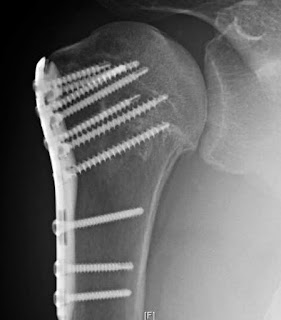
Showing posts with label fracture sequelae. Show all posts

Thursday, October 20, 2022

Fracture sequelae in an active woman.

An active woman in her mid 60's presented with pain and loss of function of her left shoulder resulting from a proximal humeral fracture sustained in a bike crash twenty years prior. Her preoperative x-rays show a malunited proximal humeral fracture with humeral head articular surface irregularity and subchondral bone resorption.


Because of her active lifestyle, she elected a hemiarthroplasty with a posteriorly eccentric humeral head and an impaction grafted standard smooth stem. No glenoid arthroplasty was needed. The rotator cuff was essentially intact.

Seven years after surgery at the age of 73 she returned for routine followup with full comfortable motion and function. Her activities ranged from playing piano and flute to swimming, shot put and discus. Her postoperative films show a securely fixed humeral stem without evidence of stress shielding, a well centered humeral head, and substantial radiographic joint space.


Her active elevation is shown below.


Comment: 
 This case demonstrates the value of a conservative hemiarthroplasty in a highly motivated patient.

You can support cutting edge shoulder research that is leading to better care for patients with shoulder problems, click on this link.

To add this blog to your reading list in Google Chrome, click on the reading list icon


Follow on twitter: https://twitter.com/shoulderarth

Follow on facebook: click on this link

Follow on facebook: https://www.facebook.com/frederick.matsen

Follow on LinkedIn: https://www.linkedin.com/in/rick-matsen-88b1a8133/

Here are some videos that are of shoulder interest
Shoulder arthritis - what you need to know (see this link).
How to x-ray the shoulder (see this link).
The ream and run procedure (see this link).
The total shoulder arthroplasty (see this link).
The cuff tear arthropathy arthroplasty (see this link).
The reverse total shoulder arthroplasty (see this link).
The smooth and move procedure for irreparable rotator cuff tears (see this link).
Shoulder rehabilitation exercises (see this link).

Thursday, November 28, 2019

Severe post traumatic arthritis managed with a ream and run

A very active man in his 50s sustained a traumatic posterior fracture dislocation.


This was treated with open reduction internal fixation. An anatomic reconstruction was achieved. The patient achieved excellent function.
 At a year after surgery the shoulder became painful and showed early signs of avascular necrosis as shown below.

Two years after surgery, the humeral head had completely collapsed.

 The axillary "truth" view shows screws penetrating the collapsed head and eroding the glenoid. His shoulder had essentially no motion at the glenohumeral joint.

Because of his active lifestyle, he elected to have a ream and run procedure. At surgery his humeral head looked like this.

The procedure was performed without a brachial plexus block. His biceps tendon was preserved.
His immediate postoperative films are shown below.


The axillary "truth" view shows his humeral head centered on the reamed glenoid.

On the morning after surgery he had regained excellent assisted motion as shown below.


It is most encouraging to see the early restoration of movement. This motivated patient should be able to maintain his motion with at home exercises.

After discharge on the second postoperative day he took his exercises outdoors


To see a YouTube video on how the ream and run is done, click on this link.

=====
To see our new series of youtube videos on important shoulder surgeries and how they are done, click here.

Use the "Search" box to the right to find other topics of interest to you.


You may be interested in some of our most visited web pages  arthritis, total shoulder, ream and runreverse total shoulderCTA arthroplasty, and rotator cuff surgery as well as the 'ream and run essentials'

Thursday, July 28, 2016

Reverse total shoulder in the treatment of proximal humeral malunited fractures

Reverse Shoulder Arthroplasty for Malunions of the Proximal Part of the Humerus (Type-4 Fracture Sequelae)

These authors conducted a retrospective study of 42 shoulders with posttraumatic sequelae of the proximal part of the humerus with malunions of the tuberosities treated with reverse shoulder arthroplasty between 2000 and 2010. The mean age at the time of arthroplasty was 68 years (range, 27 to 83 years; median, 70 years).  The mean clinical and radiographic follow-up was 4 years (range, 2 to 13 years; median, 3.5 years).

The mean Constant score increased from 19.7 points (range, 0 to 52 points) preoperatively to 54.9 points (range, 21 to 83 points) postoperatively (p < 0.0001).
In one case, loosening of the humeral and glenoid components occurred. Scapular notching was present in 22 shoulders (52%) and was grade 1 in 12 cases, grade 2 in 4 cases, grade 3 in 2 cases, and grade 4 in 4 cases. Complications occurred in 4 patients (9.5%): one intraoperative humeral shaft fracture, one traumatic dislocation complicated by an infection, one periprosthetic fracture from a fall, and one aseptic loosening at 13 years after surgery.

Eighteen patients (43%) rated their result as very good, 19 (45%) rated their result as good, 4 (10%) rated their result as satisfactory, and one (2%) rated the result as unsatisfactory.

Comment: The shoulder pathology treated in this series is most challenging. Reverse total shoulder arthroplasty is potentially capable of functional results that cannot be achieved with humeral osteotomy and/or anatomic arthroplasty.

==

Sunday, April 13, 2014

Reverse total shoulder for failed hemiarthroplasty for fracture.

The use of the reverse shoulder prosthesis for the treatment of failed hemiarthroplasty for proximal humeral fracture.

While humeral hemiarthroplasty is often used to treat fractures of the proximal part of the humerus, this procedure has a high failure rate because of the development of glenoid arthritis and rotator cuff deficiency due to tuberosity failure.

These authors treated 29 such patients (twenty-five women and four men) with a mean age of sixty-nine years (range, forty-two to eighty years) with removal of a hemiarthroplasty prosthesis and revision with a reverse total shoulder alone or in combination with a proximal humeral allograft.

The average total American Shoulder and Elbow Surgeons score improved from 22.3 preoperatively to 52.1.
The average American Shoulder and Elbow Surgeons pain score improved from 12.2 to 34.4 (p < 0.001), 
The average American Shoulder and Elbow Surgeons function score improved from 10.1 to 17.7 (p = 0.058). 
The average Simple Shoulder Test score improved from 0.9 to 2.6 (p = 0.004). 
The overall complication rate was 28% (eight of twenty-nine). 
Complications occurred in three of the eight patients who had been managed with an allograft-reverse total shoulder combination. One patient fell and sustained a periprosthetic humeral fracture distal to the humeral stem along with a fractured polyethylene socket at twenty months and later sustained a dislocation at twenty-five months requiring surgical revision. The second patient developed a postoperative infection that required surgical revision.  The third patient had a postoperative dislocation treated non operatively. 
Complications occurred in five of the twenty-one patients treated with a reverse total shoulder alone. One patient had failure of the baseplate with broken screws requiring surgical revision. A second patient had dislocation of the prosthesis at eight months requiring surgical revision.  A third patient had  humeral stem loosening at twenty-two months requiring surgical revision. A fourth patient underwent revision complicated by penetration of the cortex and a radial nerve palsy. The fifth patient had two dislocations and was successfully managed with closed reduction.

Comment: These results indicate the risk and complexity of revision reverse total shoulders, even in the hands of very experienced surgeons.

The treatment of substantial proximal humeral bone loss is a challenge in reverse total shoulder arthroplatsy. 
Furthermore, a malunited greater tuberosity and scarring of the posterior rotator cuff may block reduction and increase the risk of instability. The authors advise releasing the posterior rotator cuff from the proximal part of the humerus to enhance stability and soft-tissue balance.

In the presence of proximal humeral bone deficiency, the authors recommend consideration of a proximal humeral allograft  to add rotational and structural stability.

===
Consultation for those who live a distance away from Seattle.

Check out the new Shoulder Arthritis Book - click here.

Click here to see the new Rotator Cuff Book

To see the topics covered in this Blog, click here

Use the "Search" box to the right to find other topics of interest to you.

You may be interested in some of our most visited web pages including:shoulder arthritis, total shoulder, ream and runreverse total shoulderCTA arthroplasty, and rotator cuff surgery as well as the 'ream and run essentials'

See from which cities our patients come.

See the countries from which our readers come on this post.

To see other similar posts, click on the label of interest below.


Saturday, April 12, 2014

Reverse total shoulder - proximal humeral bone loss is associated with poorer results

The metaphyseal bone defect predicts outcome in reverse shoulder arthroplasty for proximal humerus fracture sequelae.

These authors reviewed 50 cases of reverse shoulder arthroplasty used to treat sequelae of proximal humerus fractures.The patients had a mean age of 69 (range 44-89) and a mean followup of 34 months.

Shoulders with proximal humeral metaphyseal bone loss of more than 3 cm had significantly lower clinical outcomes. In addition degenerative changes of the teres minor muscle and the number if prior surgeries also had significant negative influences on clinical results.

There were five revisions (10%) for infection (3 cases), instability (1 case), and stiffness (1 case).

Comment: The best results with reverse total shoulders are obtained when the pathology is simple, for example in cases of previously unoperated rotator cuff tear arthropathy. The results are poorer when  the pathology is complicated, for example in failed prior arthroplasty or in cases of post traumatic bone loss as pointed out in this paper. This information informs our discussions with patients considering reverse total shoulder and points to the need for careful stratification of preoperative pathology when outcomes of reverse total shoulder are compared.

It is of note that the most common complication was infection in this series.

One of the particular challenges in performing reverse total shoulders in the presence of proximal bone loss is fixation of the humeral component. As shown in the x-ray below, the stems of reverse total shoulder humeral components are essentially circular in cross section - thus the fixation is at risk for failure when torque is applied to the humeral component.


In such cases, securing humeral component fixation is critical to the success of the procedure.

===
Consultation for those who live a distance away from Seattle.

Check out the new Shoulder Arthritis Book - click here.

Click here to see the new Rotator Cuff Book

To see the topics covered in this Blog, click here

Use the "Search" box to the right to find other topics of interest to you.

You may be interested in some of our most visited web pages including:shoulder arthritis, total shoulder, ream and runreverse total shoulderCTA arthroplasty, and rotator cuff surgery as well as the 'ream and run essentials'

See from which cities our patients come.

See the countries from which our readers come on this post.

To see other similar posts, click on the label of interest below.