
These authors compared the postoperative range of motion, functional outcome, and rate of scapular notching in a randomized control trial of 100 primary reverse total shoulders with humeral inclinations of 135° and 155° at a minimum of 2 years postoperatively.
There was no difference in range of motion between the 2 groups. In the 155° group, forward flexion improved from 76° to 135° (P < .001) and external rotation remained unchanged (29° vs. 30°; P = .835). In the 135° group, postoperative forward flexion improved from 78° to 132° (P < .001) and external rotation was unchanged (28° vs. 29°; P = .814). The Simple Shoulder Test improved from 3±2.7 to 7±2.2 in the 155° group and from 3±2.8 to 8±3.0 in the 135° group.
Scapular notching was observed in 58% of cases with a 155° inclination compared with 21% with a 135° inclination (P = .009).


The complications are listed below


The complications are listed below

The authors suggest that the lack of improvement in ER and high rate of scapular notching in their 135 group may therefore be explained by their use of a neutral glenosphere lacking lateral offset.
Comment: There are many variables to consider in selecting a reverse total shoulder arthroplasty design. Inclination (discussed in this article) is one, offset of the glenosphere is another. The discussion in a prior post seems relevant here:
These authors observe that different techniques have been described to determine postoperative lengthening of the arm after reverse total shoulder arthroplasty. They evaluated the reliability of the acromiohumeral distance (AHD) in determining arm lengthening after reverse shoulder arthroplasty.
The AHD was defined as distance between the most lateral part of the undersurface of the acromion perpendicular to a line parallel to the top of the greater tuberosity.
They studied 44 patients who had received a reverse shoulder arthroplasty, examining preoperative and postoperative radiographs on anteroposterior view in neutral rotation.
Mean arm lengthening averaged 2.5 cm (range, 0.3-3.9 cm) according to AHD measurement. Significant differences in interobserver and intraobserver variability for postoperative AHD measurements were found (P < .01). The mean intrapatient difference was 0.5 cm (range, 0.02-1.5 cm). They concluded that the AHD is not a reliable measurement technique to determine arm lengthening after reverse shoulder arthroplasty.
Two patients sustaining a fracture of the scapular spine were successfully treated conservatively; postoperative arm lengthening in these cases averaged 2.5 cm.
Comment: These authors state "Reverse shoulder arthroplasty leads to arm lengthening." This is surely borne out by this study in which the average arm lengthening was one inch and the maximum lengthening was one and one half inch. This lengthening results in part from the nature of the reverse and in part from the technique of positioning the glenoid baseplate flush or below the inferior aspect of the glenoid and with some inferior inclination.

The inferior displacement of the humeral tuberosity results in an increase in the distance between the acromion and the greater tuberosity and carries the potential risk of acromial fatigue fracture (see this link) and excessive traction on the brachial plexus (see this link). A recent article (see this link) concludes "Excessive arm lengthening should be avoided, with zero to two centimeters of lengthening being a reasonable goal to avoid postoperative neurological impairment."
We note that another way of assessing inferior humeral displacement is to look at the integrity of the Arch formed by the medial proximal humerus and the lateral border of the scapula. By comparing the preoperative and postoperative views one can see the discontinuity of the Arch in this particular case of reverse total shoulder.


We will leave it to the reader to decide if the normal shoulder has a Roman Arch like the Arch of Caracalla at Volubilis

Or a Gothic Arch like the portal of Notre Dame in Paris
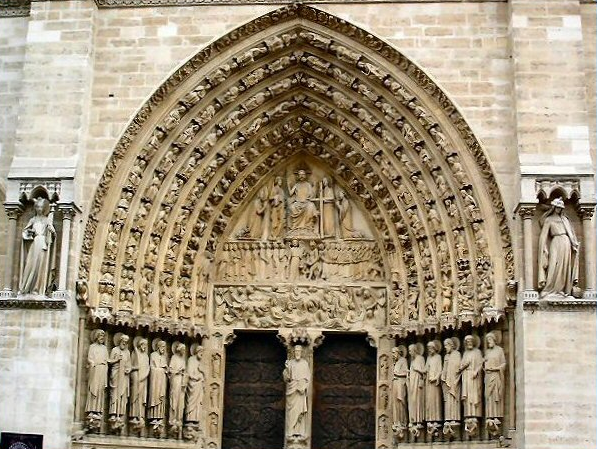
Some refer to the Arch as "Shenton's line," but we know that the Shenton line is one drawn along the inferior border of the superior pubic rams and along the inferior medial border of the neck of the femur.
We like just calling it the Arch; any disruption is apparent.

An approach to reverse total shoulder arthroplasty that relies more on "East-West" soft tissue tensioning rather than only on "Southern" deltoid tensioning may reduce the amount of arm lengthening as shown by less disruption of the Arch.

=====
We have a new set of shoulder youtubes about the shoulder, check them out at this link.
Use the "Search" box to the right to find other topics of interest to you.
You may be interested in some of our most visited web pages arthritis, total shoulder, ream and run, reverse total shoulder, CTA arthroplasty, and rotator cuff surgery as well as the 'ream and run essentials'

