Showing posts with label sleeper stretch. Show all posts

Wednesday, May 8, 2013

Successful stretching

Shoulders tend to get stiff - after an injury, after surgery or for no apparent reason. Gentle, frequent stretching is very often successful in reducing stiffness. The key to a successful stretching program is relaxing while holding the stretch for a full two minutes (by the clock) and repeating the stretches every few hours during the day. The stretching programs we favor are those that require no equipment and that can be done anywhere.

These are shown here:


Of these the ones we've found most successful in improving elevation of the arm are the forward lean (B in the list above) and the sleeper stretch (G in the list above).

Here are some videos that are of shoulder interest
Shoulder arthritis - what you need to know (see this link).
How to x-ray the shoulder (see this link).
The ream and run procedure (see this link).
The total shoulder arthroplasty (see this link).
The cuff tear arthropathy arthroplasty (see this link).
The reverse total shoulder arthroplasty (see this link).
The smooth and move procedure for irreparable rotator cuff tears (see this link).
Shoulder rehabilitation exercises (see this link).

Monday, October 10, 2011

Stretching - a key to recovery in shoulder arthritis, rotator cuff disorders, frozen shoulder

See this new post regarding stretching (link), it provides additional figures and videos of the key exercises.

Stretching exercises are important in the non-operative management of many conditions, such as shoulder arthritis, frozen shoulder (adhesive capsulitis), partial thickness rotator cuff tears and in the recovery from many shoulder surgeries.
While we've talked about about stretching before (here, here, here and here), I thought it might be useful to review some of the commonly used directions of stretching along with the medical names for each of them. Recall that all stretching needs to be done gently and often. The goal is not to cause pain but to gradually increase the flexibility of the shoulder. Check with your doctor to see if any of these stretches would be helpful for you.

Forward elevation (forward flexion, overhead reach)


External rotation with the elbow at the side


Internal rotation up the back with the elbow at the side


Cross body adduction


Internal rotation with the arm out to the side (internal rotation in abduction, the 'sleeper stretch')


The pulley


To track progress, it is often useful to measure the angles of motion and record them on a chart.

Our basic approach to rehabilitation of the shoulder is shown in the post on stretching (see this link) and in the post on strengthening (see this link).

To add this blog to your reading list in Google Chrome, click on the reading list icon


You can support cutting edge shoulder research that is leading to better care for patients with shoulder problems, click on this link.


Follow on twitter: https://twitter.com/shoulderarth

Follow on facebook: click on this link

Follow on facebook: https://www.facebook.com/frederick.matsen

Follow on LinkedIn: https://www.linkedin.com/in/rick-matsen-88b1a8133/

Here are some videos that are of shoulder interest
Shoulder arthritis - what you need to know (see this link).
How to x-ray the shoulder (see this link).
The ream and run procedure (see this link).
The total shoulder arthroplasty (see this link).
The cuff tear arthropathy arthroplasty (see this link).
The reverse total shoulder arthroplasty (see this link).
The smooth and move procedure for irreparable rotator cuff tears (see this link).

Shoulder rehabilitation exercises (see this link).


Wednesday, September 21, 2011

Rotator Cuff 12 - Partial thickness cuff tears - treatment

In the management of partial thickness cuff tears, the first line of treatment is stretching the shoulder to eliminate any tightness of internal rotation with the arm at the side


internal rotation of the arm in 90 degrees of abduction, the sleeper stretch


and cross body adduction


Often, as is the case with tennis elbow, progressive stretching exercises will eliminate the tightness and even out the distribution of force so that comfort and function are restored in the presence of a thinned tendon.

If symptoms are refractory to non-operative management, consideration can be given to a surgical release of the insecurely attached fibers at the margin of the tear – a procedure we refer to as cuff curettage (more on this later). This can be accomplished through a small deltoid split through which the location of the partial detachment can be confirmed by palpation of the thinned tendon. A small curette is inserted in the area of the detachment and used to release the weakly attached fibers around the periphery of the defect, leaving only the securely attached fibers to transmit the force of the muscle to bone. Since there is no deltoid detachment and no cuff repair, stretching and active use can be started immediately after surgery using the same exercises that were learned by the patient as a part of the non-operative program described in the previous paragraph.

In all cuff surgery, an important goal is to assure the smooth passage of the rotator cuff beneath the coracoacromial arch. Roughness can be detected at surgery by placing the fingers of one hand on the acromion while the arm is passively rotated throughout its range of motion.


The positions productive of crepitance are noted and, before wound closure, relief of this crepitance is verified. The source of subacromial crepitance is usually some combination of bursal hypertrophy, roughness on the upper surface of the cuff, and roughness around the humeral tuberosities. While it is our surgical routine to palpate the undersurface of the coracoacromial arch for sources of roughness, the acromion and the coracoacromial ligament are almost always smooth. While the presence of ‘spurs’ may be suggested on preoperative radiographs, these are usually only calcifications in the coracoacromial ligament and, as such, do not encroach on the free movement of the cuff beneath it.
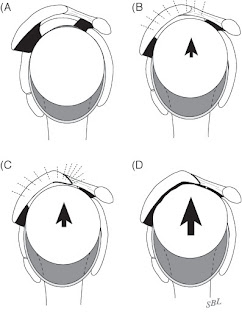


Smoothness of the humeroscapular motion interface is assured by resecting any abnormal bursa or scar in this interface from the axillary nerve inferior-medially, between the subscapularis and the coracoid muscles, under the acromion, and down to the axillary nerve posterior inferiorly – a complete ‘nerve-to-nerve’ release.

Complete release of the external surface of the supraspinatus and infraspinatus can be verified by passing a smooth elevator between each tendon and the coracoacromial arch.


--
Here are some videos that are of shoulder interest
Shoulder arthritis - what you need to know (see this link).
How to x-ray the shoulder (see this link).
The ream and run procedure (see this link).
The total shoulder arthroplasty (see this link).
The cuff tear arthropathy arthroplasty (see this link).
The reverse total shoulder arthroplasty (see this link).
The smooth and move procedure for irreparable rotator cuff tears (see this link).
Shoulder rehabilitation exercises (see this link).