Showing posts with label CTA. Show all posts

Thursday, August 24, 2023

What if the patient with an irreparable cuff tear and arthritis doesn't want a reverse total shoulder?


A 60 year old physically active electrician sustained a traumatic cuff tear in the right shoulder, which was repaired 16 years prior to presentation. The function of the shoulder deteriorated progressively to the point that he was unable to return to work or his other activities.  A series of PRP injections appeared to worsen his symptoms. Another surgeon offered a reverse total shoulder but the patient declined out of concern for complications and failure of the polyethylene liner with his hobbies of chopping wood and bee keeping.

At the time of presentation he had a painful crepitant shoulder with only 70 degrees of active elevation and 140 degrees of passive motion. He had weakness of elevation and external rotation, but strong internal rotation.  

His radiographs showed glenohumeral arthritis and retained suture anchors.


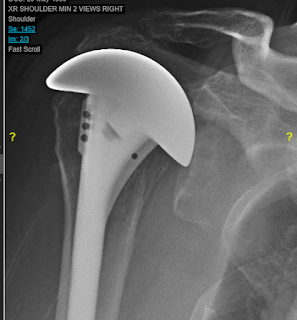
After a discussion of the alternatives, he desired to proceed with a CTA hemiarthroplasty (see this link). At surgery his supraspinatus and infraspinatus were torn and irreparable. His subscapularis was intact.

His postoperative radiograph is shown below.

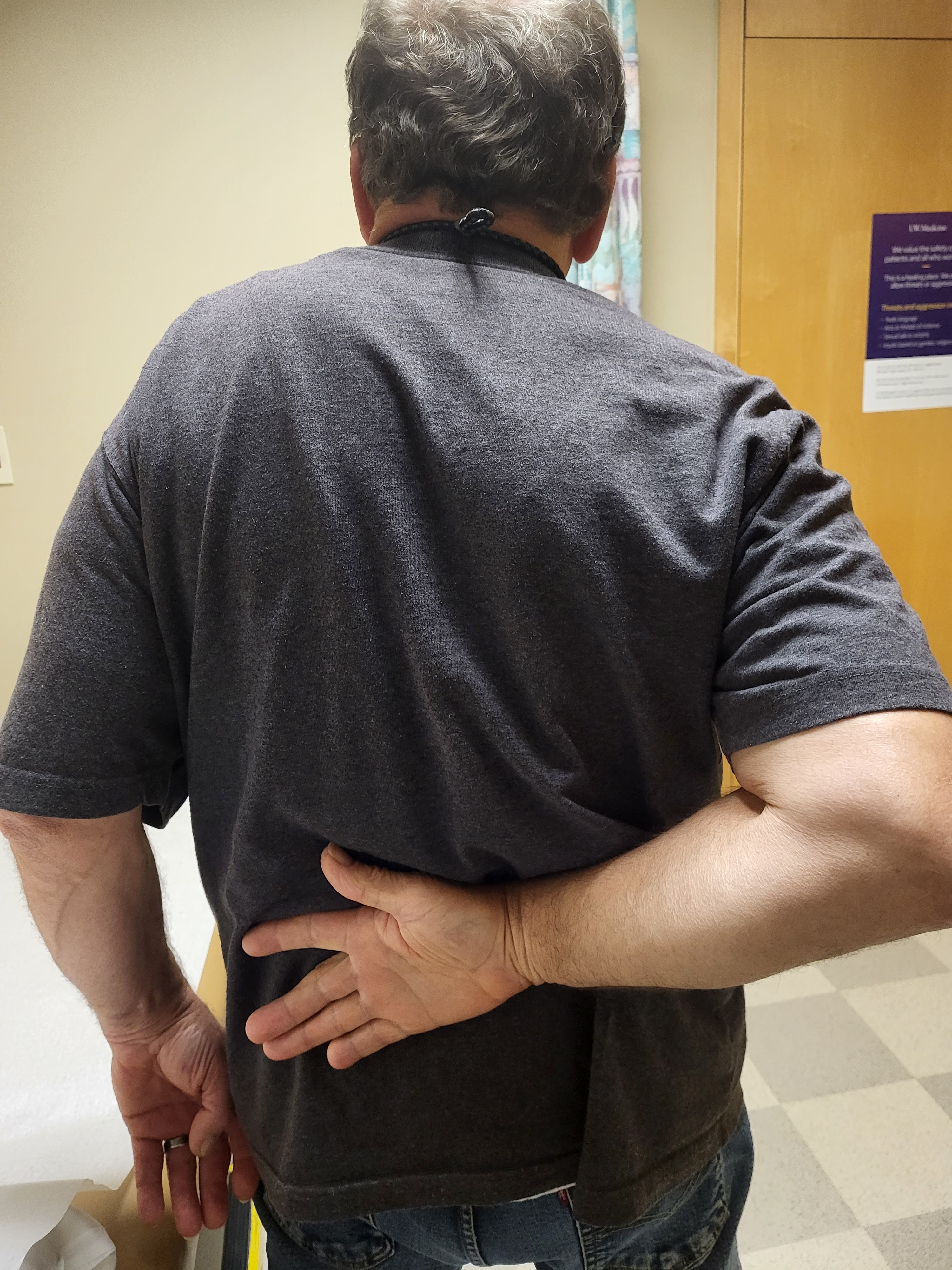
Three months after surgery he returned to work as an electrician with a comfortable functional shoulder. His active elevation at 3 months is shown below


He had no limitation of active internal rotation (which can be a problem after reverse total shoulder arthroplasty).

Comment: While this man did not meet the usual criteria for a cuff tear arthropathy hemiarthroplasty (preoperative active elevation >90 degrees with good passive elevation), his strong rehabilitation efforts enabled him to regain the function he needed for work

The chart below shows the minimum two year followup data for 45 patients having CTA hemiarthroplasty for cuff tear arthropathy with retained active elevation.


None of these patients experienced the complications that can be associated with reverse total shoulder arthroplasty (e.g. dislocation, notching, acromial/spine fracture).

See these related posts:

Mechanical failure of reverse shoulder arthroplasty

You can support cutting edge shoulder research that is leading to better care for patients with shoulder problems, click on this link.

Follow on twitter: https://twitter.com/shoulderarth
Follow on facebook: click on this link
Follow on facebook: https://www.facebook.com/frederick.matsen
Follow on LinkedIn: https://www.linkedin.com/in/rick-matsen-88b1a8133/

Here are some videos that are of shoulder interest
Shoulder arthritis - what you need to know (see this link).
How to x-ray the shoulder (see this link).
The ream and run procedure (see this link).
The total shoulder arthroplasty (see this link).
The cuff tear arthropathy arthroplasty (see this link).
The reverse total shoulder arthroplasty (see this link).
The smooth and move procedure for irreparable rotator cuff tears (see this link).
Shoulder rehabilitation exercises (see this link).

Friday, May 12, 2023

Managing cuff tear arthropathy in the active woman rancher

An active woman rancher in her early 60's, presented with pain in her right shoulder that prevented her from carrying out the necessary activities on her ranch. She had retained active elevation to 120 degrees. Her AP radiograph showed cuff tear arthropathy.


Wishing to avoid the risks and activity limitations associated with a reverse total shoulder, she elected a hemiarthroplasty with an extended humeral articular surface that articulates with the undersurface of the acromion - the CTA hemiarthroplasty (see this link for the technique).


At surgery the proximal humerus was completely devoid of articular cartilage, the long head biceps tendon, subscapularis, supraspinatus and upper infraspinatus were detached and irreparable.


Her postoperative x-ray is shown below.


At two years after her CTA hemiarthroplasty, her active motion was comfortable and full as shown below (including reach up the back).


Fifteen years after her arthroplasty, she kindly shared this series of photos showing her activities on the ranch.


Notably, in spite of her high level of daily activities, she has not experienced instability or acromial/spine fracture.

The chart below shows the minimum two year followup data for 45 patients having CTA hemiarthroplasty for cuff tear arthropathy with retained active elevation.


None of these patients experienced the complications associated with reverse total shoulder arthroplasty.

For more information, see this related post;
Treating cuff tear arthropathy in the active patient - the CTA prosthesis

You can support cutting edge shoulder research that is leading to better care for patients with shoulder problems, click on this link.

Follow on twitter: https://twitter.com/shoulderarth
Follow on facebook: click on this link
Follow on facebook: https://www.facebook.com/frederick.matsen
Follow on LinkedIn: https://www.linkedin.com/in/rick-matsen-88b1a8133/

Here are some videos that are of shoulder interest
Shoulder arthritis - what you need to know (see this link).
How to x-ray the shoulder (see this link).
The ream and run procedure (see this link).
The total shoulder arthroplasty (see this link).
The cuff tear arthropathy arthroplasty (see this link).
The reverse total shoulder arthroplasty (see this link).
The smooth and move procedure for irreparable rotator cuff tears (see this link).
Shoulder rehabilitation exercises (see this link).


Saturday, October 8, 2022

Cuff tear arthropathy in a young 60 year old woman managed with the CTA hemiarthroplasty

An active woman in her 60s with cuff tear arthropathy of the left shoulder after two failed rotator cuff repairs was referred for consideration of a reverse total shoulder arthroplasty. She has seronegative rheumatoid arthritis treated with prednisone, Avara and methotrexate. She had active, but painful elevation to 80 degrees. She had grade 4 internal and external rotation strength. 

X-rays at presentation showed glenohumeral arthritis with contact between the humeral head and acromion


The axillary "truth' view showed posterior decentering of the humeral head on the arthritic glenoid.


Because of her active lifestyle and because she wished to avoid the limitations and risks of reverse total shoulder arthroplasty - such as instability, acromial/spine fractures, and baseplate failure - she elected a cuff tear arthropathy hemiarthroplasty (CTAH). 

The procedure was performed without preoperative CT or 3D planning and without a brachial plexus block. The technique for this procedure is shown on this link. 

At surgery her supraspinatus and the upper half her infraspinatus were absent. The subscapularis was intact. There was essentially complete loss of articular cartilage over the humeral head and glenoid. After debridement of the sutures and the graft that had been used in the prior cuff surgery, the arthritic humeral head was replaced with an extended articular surface hemiarthroplasty that matched the diameter of curvature of the native humeral head. Care was taken to preserve the coracoacromial ligament and the clavipectoral fascia. The smooth, standard length humeral stem was secured with impaction autografting. At the conclusion of the procedure the subscapularis peel was repaired to the lesser tuberosity with 6 #2 non-absorbable sutures. Assisted elevation was started on the day of surgery.

At 4.5 years after her CTAH procedure she reported that she had returned to her desired activities. Her shoulder was comfortable and able to perform 10 of the 12 functions of the Simple Shoulder Test, including the ability sleep on that side, to internally rotate the arm to tuck in her shirt behind her, to wash the back of the opposite shoulder, to lift eight pounds to shoulder level, as well as to toss and throw a ball. Her SANE score was 100. She could actively elevate her arm to 140 degrees.

Her x-rays at 4.5 after surgery showed secure fixation of her implant with the extended prothetic head articulating with the undersurface of the acromion and well centered in the glenoid socket in both views.


Comment: As shown here, the CTA hemiarthroplasty can be a cost-effective surgical procedure in patients with cuff tear arthropathy and retained active elevation of the arm. Of note the CTAH does not limit internal rotation, which can be a problem with reverse total shoulders (see Reverse total shoulder: how to get the "internal rotation" needed for function).

For additional information, see these links 


To add this blog to your reading list in Google Chrome, click on the reading list icon


You can support cutting edge shoulder research that is leading to better care for patients with shoulder problems, click on this link.


Follow on twitter: https://twitter.com/shoulderarth

Follow on facebook: click on this link

Follow on facebook: https://www.facebook.com/frederick.matsen

Follow on LinkedIn: https://www.linkedin.com/in/rick-matsen-88b1a8133/

Here are some videos that are of shoulder interest
Shoulder arthritis - what you need to know (see this link).
How to x-ray the shoulder (see this link).
The ream and run procedure (see this link).
The total shoulder arthroplasty (see this link).
The cuff tear arthropathy arthroplasty (see this link).
The reverse total shoulder arthroplasty (see this link).
The smooth and move procedure for irreparable rotator cuff tears (see this link).
Shoulder rehabilitation exercises (see this link).

Wednesday, August 31, 2022

The versatile, inexpensive and safe CTA hemiarthroplasty for patients with preserved active elevation

The cuff tear arthropathy (CTA) hemiarthroplasty - using an extended humeral articular surface that articulates with the coracoacromial arch - is a versatile, effective and inexpensive reconstructive procedure for shoulders with cuff deficiency, arthritis and active elevation beyond 90 degrees. See Treating cuff tear arthropathy in the active patient - the CTA prosthesis. The technical details for this procedure are shown in this link.  In contrast to the reverse total shoulder arthroplasty, the CTA hemiarthroplasty avoids the risks of dislocation, acromial and scapular spine fractures, notching, baseplate loosening, glenoid fracture, and dissociation of the glenosphere from the baseplate.

Yesterday, we saw three patients in followup after this procedure demonstrating its application for different shoulder pathologies.

Case 1.

A man in his sixties had a proximal humeral fracture treated previously with plate fixation. This was complicated by loss of fixation and avascular necrosis. Preoperatively he had active flexion >90 degrees and the x-rays shown below.


At surgery the supraspinatus and infraspinaturs were absent. The plate and humeral head were removed and a CTA hemiarthroplasty with reconstruction of his subscapularis was performed. Eight years after surgery he returned for routine followup. His x-rays at that time are shown below.


His shoulder comfort and function were good with active elevation of 150 degrees as shown below.


Case 2. 

A man in his seventies presented with pain and stiffness of the left shoulder after a failed rotator cuff repair. He had active elevation above 90 degrees. His preoperative images showed cuff tear arthropathy, heterotopic bone and retained suture anchors.


At surgery he was found to have no supraspinatus or infraspinatus. He had a CTA hemiarthroplasty with debridement of unwanted bone and suture anchors. His subscapularis was reconstructed.

He returned six weeks after surgery with good comfort of the shoulder and active elevation greater than 90 degrees at this early stage of his rehab. His x-ray at that time is shown below.


Case 3.

A man in his seventies presented with pain and loss of function in his right shoulder. He had active elevation greater than 90 degrees. His preoperative x-rays are shown below.


At surgery he had no supraspinatus or infraspinatus. His subscapularis was reconstructed.

Three years after surgery he returned for routine followup. His x-rays at that time are shown below.


He had comfortable active elevation of 160 degrees as shown below.


Comment: As reported by the authors of  Clinical effectiveness and safety of the extended humeral head arthroplasty for selected patients with rotator cuff tear arthropathy, the CTA hemiarthroplasty is a safe and effective treatment for patients with cuff tear arthropathy and retained active elevation. It is substantially less expensive than a reverse total shoulder and does not require preoperative CT scans or 3D planning.

You can support cutting edge shoulder research that is leading to better care for patients with shoulder problems, click on this link.


Follow on twitter: https://twitter.com/shoulderarth

Follow on facebook: click on this link

Follow on facebook: https://www.facebook.com/frederick.matsen

Follow on LinkedIn: https://www.linkedin.com/in/rick-matsen-88b1a8133/

Here are some videos that are of shoulder interest
Shoulder arthritis - what you need to know (see this link).
How to x-ray the shoulder (see this link).
The ream and run procedure (see this link).
The total shoulder arthroplasty (see this link).
The cuff tear arthropathy arthroplasty (see this link).
The reverse total shoulder arthroplasty (see this link).
The smooth and move procedure for irreparable rotator cuff tears (see this link).
Shoulder rehabilitation exercises (see this link).


Saturday, July 2, 2022

CTA hemiarthroplasty or reverse total shoulder for cuff tear arthopathy? It depends.

Shoulders with cuff tear arthropathy (CTA), 


can be successfully treated with 
CTA hemiarthroplasty (CTA-H, hemiarthroplasty with an extended humeral articular surface) provided that the shoulder has active glenohumeral elevation and an intact coracoacromial arch


or with a reverse total shoulder arthroplasty (RSA) 


The RSA is more expensive and has complications including, instability, acromial and scapular fractures, baseplate failure, and scapular notching that are not seen with the CTA-H (see Mechanical Failure of Reverse Total Shoulder). As stated by the authors of The modern use of the extended humeral head (cuff tear arthropathy) hemiarthroplasty, "Today, the treatment of osteoarthritis in the rotator cuff–deficient population is largely dominated by reverse shoulder arthroplasty (RSA). Despite the popularity of and increased familiarity with this procedure, the complication rate of RSA remains significant. An extended humeral head hemiarthroplasty may provide a less invasive alternative for select patients with cuff tear arthropathy (CTA) and preserved glenohumeral active elevation. With the indications for reverse arthroplasty expanding to younger patients, there are concerns about the longevity of this implant, as well as the associated revision burden. In the setting of failed RSA, the bone stock available for glenosphere

baseplate fixation can be inadequate for reimplantation."


The authors of Drivers of Inpatient Hospitalization Costs, Joint-Specific Patient-Reported Outcomes, and Health-Related Quality of Life in Shoulder Arthroplasty for Cuff Tear Arthropathy sought to assess the hospitalization costs and improvements in comfort, function and health related quality of life (HRQoL) for these two types of shoulder arthroplasty in the management of CTA. CTA-H was selected in patients with retained active elevation, an intact coracoacromial (CA) arch, and an intact subscapularis, while RSA was selected in patients with pseudoparalysis or glenohumeral instability. Seventy-two patients (39 CTA-H and 33 RSA) were treated during the study time period.


The Simple Shoulder Test (SST) was used as a joint-specific patient-reported outcome measure of comfort and function. Improvement in quality adjusted life years (QALYs) was measured using the Short-Form 36 (SF-36). 


Costs associated with inpatient care were collected from hospital financial records.


Significant improvements in SST and SF-36 physical component scores were seen in both groups. 


Inpatient hospitalization costs were significantly higher in the RSA group compared to the CTA-H group ($15,074 ± $1,614 vs. $10,389 ± $1,948, p<0.001) driven primarily by supplies including the cost of the prosthesis ($9,005 ± $2,521 vs. $4,715 ± $2,091, p<0.001). 


Both procedures led to significant improvements in HRQoL and joint-specific measures:


SST comparison at two years after surgery:


SF36 Physical Component Summary comparison at two years after surgery:


SF 36 Mental Component Summary comparison at two years after surgery:


The revision rate for RSAs was twice that of CTA-Hs: 12% of the RSAs and 5% of the CTA-H shoulders required revision.


The diagnosis of diabetes was an independent predictor of higher inpatient hospitalization costs for both groups. 


Comment: It is of note that this study did not compare the two types of arthroplasty in patients with similar preoperative characteristics. Instead it compared the outcomes of the more conservative, less expensive CTA-H in shoulders with retained active elevation, intact coracoacromial arch, and intact subscapularis to the outcomes of RSA in shoulders that did not meet these indications for CTA-H.  


The results suggest that the cost-effectiveness of shoulder arthroplasty for cuff tear arthropathy may be optimized by reserving RSA for cases of CTA that do not meet the indications for the extended humeral head CTA-H arthroplasty. The cuff tear arthropathy arthroplasty technique is shown in this link.

You can support cutting edge shoulder research that is leading to better care for patients with shoulder problems, click on this link.

Follow on twitter: https://twitter.com/shoulderarth

Follow on facebook: click on this link

Follow on facebook: https://www.facebook.com/frederick.matsen

Follow on LinkedIn: https://www.linkedin.com/in/rick-matsen-88b1a8133/

Here are some videos that are of shoulder interest
Shoulder arthritis - what you need to know (see this link).
How to x-ray the shoulder (see this link).
The ream and run procedure (see this link).
The total shoulder arthroplasty (see this link).
The cuff tear arthropathy arthroplasty (see this link).
The reverse total shoulder arthroplasty (see this link).
The smooth and move procedure for irreparable rotator cuff tears (see this link).
Shoulder rehabilitation exercises (see this link).


Friday, May 20, 2022

70 year old active woman with irreparable rotator cuff tear and arthritis

A 70 year old woman presented with a failed rotator cuff repair and shoulder pain.

On physical examination, she had 140 degrees of active elevation, but it was painful.

Her plain radiograph showed superior translation of the humeral head on the glenoid with joint space narrowing and a retained suture anchor.


An outside MRI showed a retracted rotator cuff tear.


Because of her desire to be physically active, she elected a cuff tear arthropathy hemiarthroplasty (see this link) rather than a reverse total shoulder.


She was able to return to her activities with a comfortable and functional shoulder.

Six years after her surgery, her comfort and function remained. Her x-ray at that time is shown below.


Her range of motion is shown below.

The cuff tear arthropathy hemiarthroplasty can yield improved comfort and function without major complications. 


See Clinical effectiveness and safety of the extended humeral head arthroplasty for selected patients with rotator cuff tear arthropathy


You can support cutting edge shoulder research that is leading to better care for patients with shoulder problems, click on this link.

Follow on twitter: https://twitter.com/shoulderarth

Follow on facebook: click on this link

Follow on facebook: https://www.facebook.com/frederick.matsen

Follow on LinkedIn: https://www.linkedin.com/in/rick-matsen-88b1a8133/

Here are some videos that are of shoulder interest
Shoulder arthritis - what you need to know (see this link).
How to x-ray the shoulder (see this link).
The ream and run procedure (see this link).
The total shoulder arthroplasty (see this link).
The cuff tear arthropathy arthroplasty (see this link).
The reverse total shoulder arthroplasty (see this link).
The smooth and move procedure for irreparable rotator cuff tears (see this link).
Shoulder rehabilitation exercises (see this link).


Saturday, May 14, 2022

60 year old active man with massive irreparable rotator cuff tear and arthritis

An active 60 year old man had a 7 anchor rotator cuff repair for a massive cuff tear four years prior to presentation. Three years later was climbing out of a truck and slipped off a stair and lost his left hand grip.  He held on by his right shoulder and felt like he pulled his arm out of the socket.  One year after this he presented with shoulder pain and weakness, but with active elevation to 100 degrees.

His AP radiograph showed superior displacement of an arthritic humeral head. 

His axillary truth view showed a centered humeral head centered on the glenoid with loss of the cartilage space


His MRI showed a full-thickness tear of the supraspinatus tendon. The torn tendon end was retracted to the level of the glenoid. There was severe thinning of the nearly absent infraspinatus tendon. There was a full-thickness tear of the subscapularis tendon. Thinned torn tendon end was retracted approximately 1 cm from the lesser tuberosity footprint. Fatty infiltration was seen in all cuff muscles.


Our colleague Philippe Collin requested some a saggital images. 

Here they are


After discussion of the alternatives, the patient declined a reverse total shoulder, electing instead to proceed with a CTA arthroplasty (see this link).

At the time of surgery complete irreparable tears of the subscapularis, supraspinatus and infraspinatus were verified along with an arthritic humeral head.

At six months after surgery he had a comfortable stable shoulder with 160 degrees of active elevation.


And these radiographs showing a humeral head supported superiorly by the coracoacromial arch

and centered on the axillary truth view.


Comment: This case is of interest because of the retained stability of the CTA arthroplasty in spite of the subscapularis deficiency.


You can support cutting edge shoulder research that is leading to better care for patients with shoulder problems, click on this link.


Follow on twitter: https://twitter.com/shoulderarth

Follow on facebook: click on this link

Follow on facebook: https://www.facebook.com/frederick.matsen

Follow on LinkedIn: https://www.linkedin.com/in/rick-matsen-88b1a8133/

Here are some videos that are of shoulder interest
Shoulder arthritis - what you need to know (see this link).
How to x-ray the shoulder (see this link).
The ream and run procedure (see this link).
The total shoulder arthroplasty (see this link).
The cuff tear arthropathy arthroplasty (see this link).
The reverse total shoulder arthroplasty (see this link).
The smooth and move procedure for irreparable rotator cuff tears (see this link).
Shoulder rehabilitation exercises (see this link).