Showing posts with label adverse events. Show all posts

Sunday, September 1, 2024

What is the "sweet spot" for patient weight prior to shoulder arthroplasty?


Patients and surgeons are interested in knowing the relationship of relative body weight to the rate of adverse events following shoulder arthroplasty. Are patients who have higher BMI (click here to see how to calculate yours) at greater risk?

The authors of High and Low Body Mass Index Increases the Risk of Short-Term Postoperative Complications Following Total Shoulder Arthroplasty. reviewed the 30-day adverse events for 22,132 patients having total shoulder arthroplasty with known preoperative BMI's.

Interestingly, patients with BMI > 30 kg/meter squared did not have significantly different rates of adverse events than those with BMI < 30 kg/meter squared. Case closed, right?

No. 

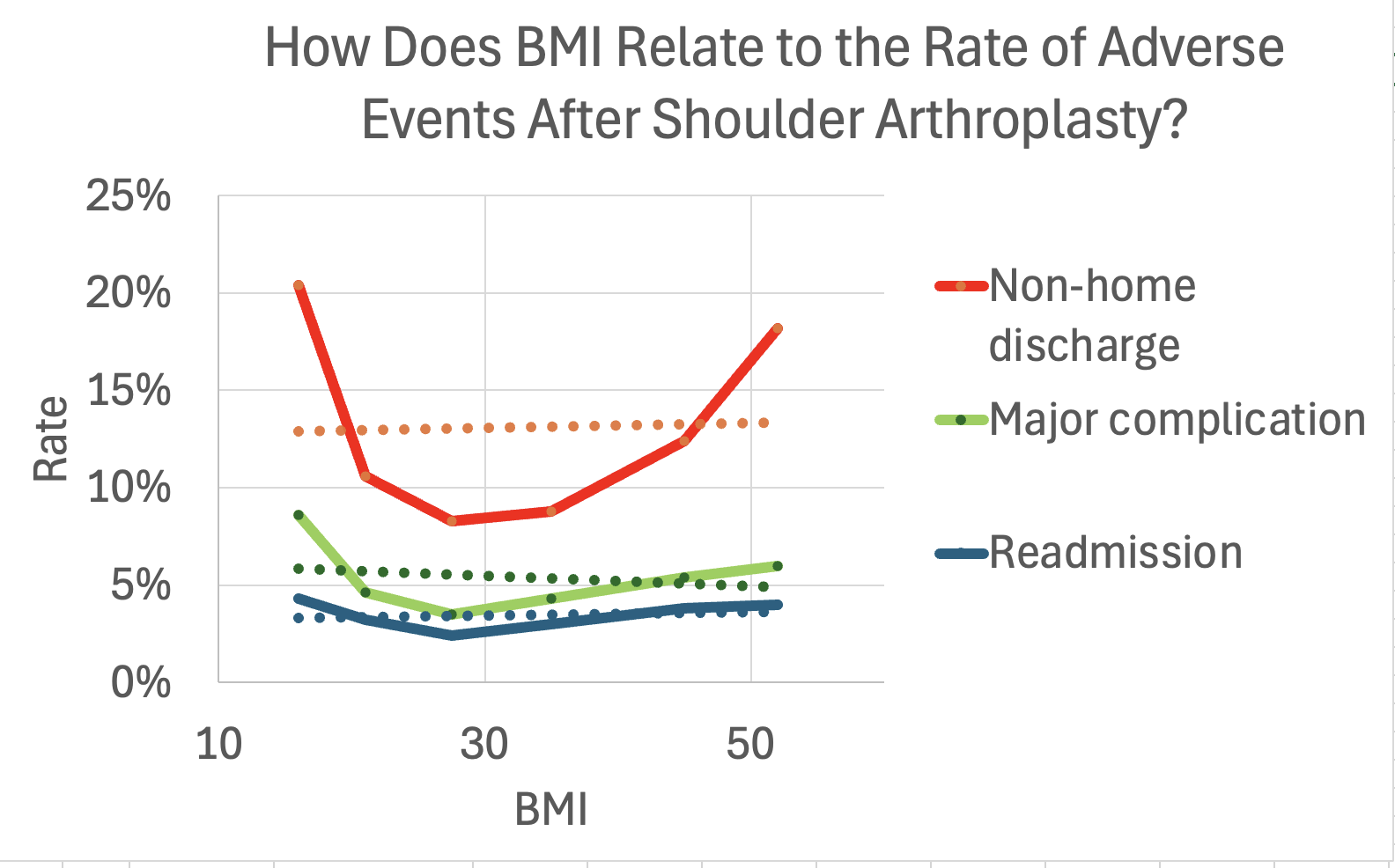
When they divided the patients into five groups: BMI <18.5, BMI 18.5-24.9, BMI 30-39.9, BMI 40-49.9, and BMI ≥ 50 a different story unfolded as seen in the scatter plot below, which shows that the overweight (BMI 30-39.9), but not obese, patients had the lowest rate of adverse events. Furthermore, the real uptick in adverse events was found only for the BMI <18.5 and the BMI ≥ 40 patients.


There is another lesson here. If we (as we often do) blindly look for a relationship between one thing and another using linear regression, we would completely miss the important relationship shown above. Note in the graph below, the linear regression trend lines are all flat as a pancake, with "no significant relationship" (sic).


Comments welcome at shoulderarthritis@uw.edu

You can support cutting edge shoulder research that is leading to better care for patients with shoulder problems, click on this link


Follow on twitter/X: https://x.com/RickMatsen
Follow on facebook: https://www.facebook.com/shoulder.arthritis
Follow on LinkedIn: https://www.linkedin.com/in/rick-matsen-88b1a8133/


Here are some videos that are of shoulder interest
Shoulder arthritis - what you need to know (see this link).
How to x-ray the shoulder (see this link).
The ream and run procedure (see this link).
The total shoulder arthroplasty (see this link).
The cuff tear arthropathy arthroplasty (see this link).
The reverse total shoulder arthroplasty (see this link).
The smooth and move procedure for irreparable rotator cuff tears (see this link).
Shoulder rehabilitation exercises (see this link). 

Monday, September 12, 2022

Surgeon and hospital shoulder arthroplasty volume affect patient outcome - more on this.

The recent article The Effects of Social and Demographic Factors on High-Volume Hospital and Surgeon Care in Shoulder Arthroplasty and the post, The complex relationship between surgeon shoulder arthroplasty volume and outcome, have stimulated much needed thought and discussion. From this article we learned that 

(1) Low-volume facilities and surgeons had higher rates of readmission, urinary tract infection, renal failure, pneumonia, and cellulitis than high volume facilities. The patients of low-volume surgeons had longer hospital lengths of stay.

and that

(2) Older, Hispanic/African American, socially deprived, non-privately insured patients were more likely to be treated by low volume facilities and surgeons.

These observations suggest that, for multiple reasons, patients treated at low volume centers and by low volume surgeons are more likely to have adverse outcomes. Furthermore, low volume centers and low volume surgeons are disadvantaged by a more complex patient population with less favorable reimbursement.

"Fixing" these disparities is a daunting task. 

Some of the important aspects to consider are listed below

    (1) High volume centers and providers have many advantages, including streamlined pathways, dedicated and experienced staff, economies of scale, marketing, favorable implant price negotiations, experience-based patient selection criteria, support systems enabling efficient and safe outpatient surgery, active research programs focused on optimizing patient outcomes and a larger share of individuals with the means and motivation to travel in the anticipation of improved outcome. These assets also lead to cost-savings associated with shorter hospital stays.

    (2) It is likely that many patients would experience increased cost and inconvenience in moving from their local providers to seek care at higher volume providers.

    (3)  There may be barriers that impair access for more complex and less well insured patients to achieving care at higher volume facilities. This and item #2 above may contribute to disparities in health care for certain socioeconomic, ethnic and racial groups of patients. As pointed out by the authors of The Effects of Social and Demographic Factors on High-Volume Hospital and Surgeon Care in Shoulder Arthroplasty "Patients without private insurance received treatment more often at low-volume facilities and from low-volume surgeons, which is another concerning finding considering that surgeon reimbursement for Medicare payments after shoulder arthroplasty has decreased substantially over the past decade. It is also important to acknowledge the possible influence of the geographic location of hospitals alongside any financial incentives for high-volume providers to attract patients with insurances which offer higher reimbursement rates, most of whom may be White"

    (4) "Volume shifting" has been suggested as an approach, however the mechanisms for accomplishing this are unclear. Furthermore,  moving patients from low volume surgeons to high volume surgeons impairs the ability of low volume surgeons (particularly those recently starting out in practice) to increase their volume. Loss of these surgical cases would also have a negative effect on the finances of the low volume surgeons. 

    (5) There is a need to investigate means by which the strategies and benefits of high volume can be shared with and implemented by lower volume centers and surgeons. For example, the increased risk of complications such as pneumonia, electrolyte imbalance, urinary tract infection and acute renal failure found in low volume centers may be addressed by educational programs for both the providers and the patients.

    (6) In that these issues are not unique to shoulder arthroplasty, our national organizations, such as the American Academy of Orthopaedic Surgeons, need to emphasize these important issues in their ongoing national meetings and educational programs. 

To add this blog to your reading list in Google Chrome, click on the reading list icon


You can support cutting edge shoulder research that is leading to better care for patients with shoulder problems, click on this link.


Follow on twitter: https://twitter.com/shoulderarth

Follow on facebook: click on this link

Follow on facebook: https://www.facebook.com/frederick.matsen

Follow on LinkedIn: https://www.linkedin.com/in/rick-matsen-88b1a8133/

Here are some videos that are of shoulder interest
Shoulder arthritis - what you need to know (see this link).
How to x-ray the shoulder (see this link).
The ream and run procedure (see this link).
The total shoulder arthroplasty (see this link).
The cuff tear arthropathy arthroplasty (see this link).
The reverse total shoulder arthroplasty (see this link).
The smooth and move procedure for irreparable rotator cuff tears (see this link).

Shoulder rehabilitation exercises (see this link).

Saturday, October 19, 2019

Total shoulder arthroplasty - avoiding adverse outcomes and complications - our first post of a Russian article!

Ways to prevent adverse outcomes and complications of total shoulder arthroplasty

Гений Ортопедии, том 25, № 3, 2019 г.
© Чирков Н.Н., Николаев Н.С., Каминский А.В., 2019
УДК 616.727.2-089.227.843-77
DOI 10.18019/1028-4427-2019-25-3-312-317


These authors sought to identify causes of poor functional outcomes and complications after total shoulder replacement. They reviewed the outcomes of 168 patients.

Reverse shoulder arthroplasty and cemented humeral fixation was employed for the majority of patients (n = 125; 74.4 %). Minimal follow-up was at least one year with an average term of 3 to 5 years.

Positive results of TSA were observed in 83.3 % of the cases and 16.7 % had poor outcomes. Patients developed implant dislocation in 9.5 %, infection in 3 %, early instability of the shoulder component in 1.2 %, intraoperative fracture of the humerus shaft in 1.8 % and injury to vascular and nerve bundle in 1.2 % of the cases.


The best results were obtained with anatomic shoulder replacement, integrity and functionality of the rotator cuff, absence of fatty degeneration verified with magnetic resonance imaging in sagittal plane.

Clear understanding of the exact nature of osseous changes using computed tomography allows adequate positioning of implant components. Preoperative deltoid evaluation is important for posttraumatic cases as well as BMD measurements are vital for severe osteoporosis patients with application of reverse shoulder arthroplasty.

Comment: It appears that we have much in common with our Russian colleagues and hopefully we will see much more exchange of experiences in the future.


=====
To see our new series of youtube videos on important shoulder surgeries and how they are done, click here.

Use the "Search" box to the right to find other topics of interest to you.


You may be interested in some of our most visited web pages  arthritis, total shoulder, ream and runreverse total shoulderCTA arthroplasty, and rotator cuff surgery as well as the 'ream and run essentials'

Wednesday, January 25, 2017

Total shoulder - adverse events

Risk factors for and timing of adverse events after total shoulder arthroplasty

These authors collected data for 5801 patients undergoing TSA from 2009 to 2014 in the American College of Surgeons National Surgical Quality Improvement Program.

146 (2.5%) suffered severe adverse events, and 158 (2.7%) had a 30-day unplanned readmission. 

The most common severe adverse events were reoperation (40%), thrombolic event (deep venous thrombosis or pulmonary embolism; 14%), cardiac event (10%), and death (8.2%). Pneumonia (8.9%) and thrombolic event (7.6%) were the most common medically related causes, whereas dislocation (7.6%) and postoperative infection or wound complication (5.1%) were the most common surgical causes for readmission. 

Multivariate analysis identified inflammatory arthritis (P = .026), male gender (P = .019), age (P < .001), functional status (P = .024), and American Society of Anesthesiologists class 3/4 (P = .01) as independent predictors for unplanned 30-day readmission and all but inflammatory arthritis for severe adverse events (P ≤ .05 for all). 

Patients with ≥3 risk factors had an 11.56 (P = .002) and 3.43 (P = .013) times increased odds of unplanned readmission and severe adverse events occurring within 2 weeks after surgery, respectively, compared with patients with 0 risk factors.

Comment: This is a cautionary tale. It suggests that we should be conservative in offering elective surgery to patients at high risk for complications (i.e. ASA score above 2, young males, those with inflammatory arthritis) and assure that these patients are informed of their increased risk for complications. 

The observation that dislocation was the major surgical adverse event suggests that surgeon experience may have been a contributing factor, although the authors did analyze this variable. 

While it has been suggested that risk stratification would lead to more cost effective care, paying increased attention to the appropriateness of elective surgery and surgeon experience may be even more effective.


===


To see the topics covered in this Blog, click here

Use the "Search" box to the right to find other topics of interest to you.

You may be interested in some of our most visited web pages including:shoulder arthritis, total shoulder, ream and runreverse total shoulderCTA arthroplasty, and rotator cuff surgery as well as the 'ream and run essentials'