Showing posts with label eccentric glenosphere. Show all posts

Thursday, December 3, 2020

Reverse total shoulder: avoiding notching

 Clinical and radiological outcomes of eccentric glenosphere versus concentric glenosphere in reverse shoulder arthroplasty

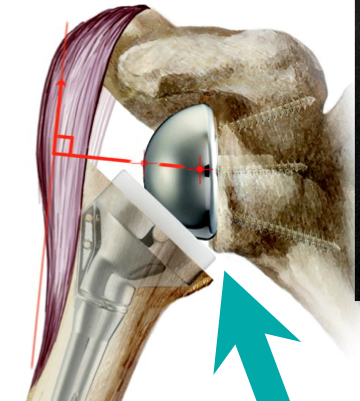
Scapular notching is an important complication of reverse total shoulder arthroplasty


It results from unwanted contact between the humeral polyethylene and the neck of the scapula


These authors conducted a retrospective analysis of 49 reverse total shoulders with an inferiorly eccentric glenoid (EG) and 49 RSAs with a concentric glenoid (CG) at a minimum 60 months. Notching was observed 2.7 times more often in the CG group (p=0.040). However the notching severity was not statistically relevant between the groups.

 Compared to a CG, an EG did not increase the percentage of radiolucent lines around the screws,


As pointed out be the authors, the eccentric glenosphere reduces the risk of notching by moving the humerus further distally away from the scapular neck.


Moving the humerus distally can result in a relatively un-anatomic reconstruction with increase tension on the deltoid, acromion and brachial plexus.


An alternative method for minimizing the risk of notching is to use a glenosphere with an extended neck  that moves the humeral component laterally (rather than inferiorly) away form the the scapular neck resulting in a more anatomic reconstruction.


Some designs of RSA create a major disruption of the normal anatomic relationships of the shoulder while others do not (see this link).  One way to look at this is to consider the arch created by the medial aspect of the humerus and the lateral aspect of the scapula. This arch can be referred to as "Bani's line", described in 1981 (Bandi W Die Läsion der Rotatorenmanschette. Helv Chir Acta 48:537-549). 


Some approaches create minimal disruption of the arch (i.e. a more "anatomic" reverse)


While other approaches create greater disruption of the normal relationships as indicated by the break in the arch.


If the arch is disrupted, several things happen: (1) increased stress is put on the acromion and scapular spine leading to an increased risk of acromial and scapular spine fractures, (2) increase stress is placed on the brachial plexus, and (3) the normal alignment of residual infraspinus and subscapularis is disrupted.


To see our technique for reverse total shoulder, click on this link.

To support our research to improve outcomes for patients with shoulder problems, click here.

To subscribe to this blog, enter your email in the box to your right

=====
How you can support research in shoulder surgery Click on this link.

To see our new series of youtube videos on important shoulder surgeries and how they are done, click here.

Be sure to visit "Ream and Run - the state of the art"  regarding this radically conservative approach to shoulder arthritis at this link and this link. Also see the essentials of the ream and run.

Use the "Search" box to the right to find other topics of interest to you.

You may be interested in some of our most visited web pages   arthritis, total shoulder, ream and run, reverse total shoulder, CTA arthroplasty, and rotator cuff surgery 


Monday, March 6, 2017

Reverse total shoulder - is an eccentric glenosphere of value?


These authors compared the clinical and radiological results of Reverse Shoulder Arthroplasty (RSA) using an eccentric glenosphere (SMR Reverse Shoulder Prosthesis) (11 patients) to those using a concentric glenosphere (9). All glenoid components were placed with 15°of inferior tilt.

There was no statistically significant difference between the two groups in clinical outcome.

9 patients with concentric glenospheres developed notching


 compared with 2 of 11 patients with eccentric glenospheres (p = 0.022).


Comment: While in the past scapular notching has been dismissed as a finding without clinical importance, more recent publications point to its association with inferior clinical outcomes. See this link.

While this report focuses on the concentricity / eccentricity of the glenosphere, it seems that the lateral offset of the glenosphere, the placement of the glenosphere on the scapula, adequate resection of potentially contacting bone, and the humeral component design are at least as important in avoiding unwanted contact between the humeral component and the scapula as described here:

Contact mechanics of reverse total shoulder arthroplasty during abduction: the effect of neck-shaft angle, humeral cup depth, and glenosphere diameter.

These authors created finite element reverse shoulder arthroplasty (RSA) models with varying neck-shaft angles (155°, 145°, 135°), sizes (38 mm, 42 mm), and cup depths (deep, normal, shallow) were loaded with 400 N at physiological abduction angles.

They found that the location of maximum contact stress were typically located inferomedially in the polyethylene humeral cup. 

Reducing the neck-shaft angle reduced the contact area and increased maximum contact stress. 

Increasing the glenosphere size increased the contact area and slightly decreased maximum contact stress. 

Decreasing the cup depth reduced the contact area  and increased maximum contact stress.

Note the tradeoff: although reducing the neck-shaft angle and cup depth can improve range of motion these changes may have negative effects on contact mechanics.

It is of interest that current practice of RSA is tending toward implant modifications that increase range of motion: reduced neck shaft angle, smaller glenosphere diameter and shallower cups, all changes that may increase the risk of cup wear.


Thus in reverse total shoulder arthroplasty, design does matter. As we pointed out in a recent post and here,  different component designs have different effects on the position of the center of rotation - both superiorinferiorly (which affects deltoid tension) and mediolaterally (which affects stability and the proximity of the medial aspect of the humeral component to the glenoid).  The design of the component also determines the shape of the glenoid polyethylene and the varus/valgus orientation of the humeral cup. Stated simply, designs that place more polyethylene beneath the glenosphere tend to be more stable on one hand while increasing the risk of notching on the other.

Contact between the polyethylene at the medial aspect of the humeral cup and the scapula is bad; it can give rise to (1) scapula notching, (2) instability from levering of the humeral component away from the glenoid, (3) limited range of motion and (4) destruction of the polyethylene as shown below and as described here and here with the production of polyethylene debris.


Consider the figures below, each of which was taken from the website of a vendor of a reverse total shoulder (please recall that we have no financial relationships with any company making orthopaedic implants). Note the relationship of the center of rotation of the glenoid component to the proximity of the medial aspect of the humeral cup to the scapula. Interestingly some illustrations show the arm in abduction, which can mask the proximity when the arm is adducted. 


Some authors have advocated modifying the medial/lateral position of the glenosphere by the insertion of a bone graft with the explicit goal of minimizing the risk of notching as shown below.
Some prosthetic designs accomplish the same effect by adding a neck to the glenosphere.
This change in design has an effect on the medial/lateral position of the center of rotation and adding distance between the humeral component and the scapula.

It is important to keep an eye on the mechanisms of reverse total shoulder failure as posted here and here and here and here

Our current approach to reverse total shoulder arthroplasty is shown in this post. 


Finally, when considering a given prosthesis design, it is important to consider its overall track record. Here is a chart from the Australian Orthopaedic Association National Joint Replacement Registry Annual Report 2015 - Shoulder Arthroplasty suggesting a higher revision rate for the prosthesis used in this study


Similar results with longer followup were reported in the 2016 report (see this link).


=


To see the topics covered in this Blog, click here

Use the "Search" box to the right to find other topics of interest to you.

You may be interested in some of our most visited web pages including:shoulder arthritis, total shoulder, ream and run, reverse total shoulder, CTA arthroplasty, and rotator cuff surgery as well as the 'ream and run essentials'