
Of the 33,470 patients in this study, 169 patients (0.50%) developed an SSI in the 30-day postoperative period. Longer operative times were associated with higher rates of SSI. There was a significant increase in the rate of SSI occurrences for operative times over 180 minutes.


The authors of The effect of surgeon and hospital volume on shoulder arthroplasty perioperative quality metrics found that surgeon case volume was inversely correlated with operative time for shoulder arthroplasty. High-volume surgeons performed shoulder arthroplasty 30 to 50 minutes faster than low-volume surgeons did.
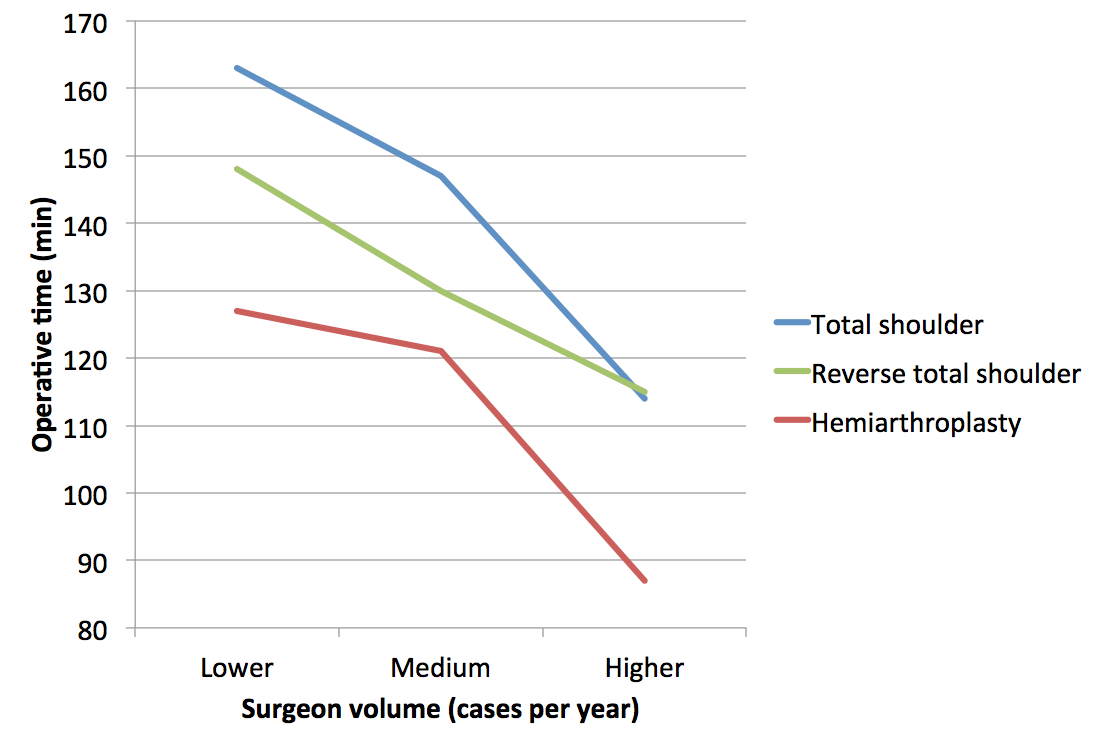
Higher surgeon case volume may reflect the efficiencies of the surgical team, more astute patient selection, and more organized pre and post surgical care. A blog post on this research (see this link) pointed out that longer surgical times mean more time at risk for contamination.
Higher surgeon case volume may reflect the efficiencies of the surgical team, more astute patient selection, and more organized pre and post surgical care. A blog post on this research (see this link) pointed out that longer surgical times mean more time at risk for contamination.
We have found that a pre-operative huddle including the surgical, anesthesia, nursing and vendor teams can substantially reduce operative time by reviewing the patient and shoulder characteristics and anticipating issues that may arise during the case (hypotension, bleeding, fracture, need for special implants, graft, intraoperative imaging, change in positioning). Allowing each person the chance to express possible concerns has proven invaluable. See The impact of a daily pre-operative surgical huddle on interruptions, delays, and surgeon satisfaction in an orthopedic operating room: a prospective study

You can support cutting edge shoulder research that is leading to better care for patients with shoulder problems, click on this link.
Follow on twitter: https://twitter.com/shoulderarth
Follow on facebook: click on this link
Follow on facebook: https://www.facebook.com/frederick.matsen
Follow on LinkedIn: https://www.linkedin.com/in/rick-matsen-88b1a8133/
Here are some videos that are of shoulder interest
Shoulder arthritis - what you need to know (see this link).
How to x-ray the shoulder (see this link).
The ream and run procedure (see this link).
The total shoulder arthroplasty (see this link).
The cuff tear arthropathy arthroplasty (see this link).
The reverse total shoulder arthroplasty (see this link).
The smooth and move procedure for irreparable rotator cuff tears (see this link).
Shoulder rehabilitation exercises (see this link).
Follow on twitter: https://twitter.com/shoulderarth
Follow on facebook: click on this link
Follow on facebook: https://www.facebook.com/frederick.matsen
Follow on LinkedIn: https://www.linkedin.com/in/rick-matsen-88b1a8133/
Here are some videos that are of shoulder interest
Shoulder arthritis - what you need to know (see this link).
How to x-ray the shoulder (see this link).
The ream and run procedure (see this link).
The total shoulder arthroplasty (see this link).
The cuff tear arthropathy arthroplasty (see this link).
The reverse total shoulder arthroplasty (see this link).
The smooth and move procedure for irreparable rotator cuff tears (see this link).
Shoulder rehabilitation exercises (see this link).


