Showing posts with label total shoulder. Show all posts

Sunday, September 1, 2024

What is the "sweet spot" for patient weight prior to shoulder arthroplasty?


Patients and surgeons are interested in knowing the relationship of relative body weight to the rate of adverse events following shoulder arthroplasty. Are patients who have higher BMI (click here to see how to calculate yours) at greater risk?

The authors of High and Low Body Mass Index Increases the Risk of Short-Term Postoperative Complications Following Total Shoulder Arthroplasty. reviewed the 30-day adverse events for 22,132 patients having total shoulder arthroplasty with known preoperative BMI's.

Interestingly, patients with BMI > 30 kg/meter squared did not have significantly different rates of adverse events than those with BMI < 30 kg/meter squared. Case closed, right?

No. 

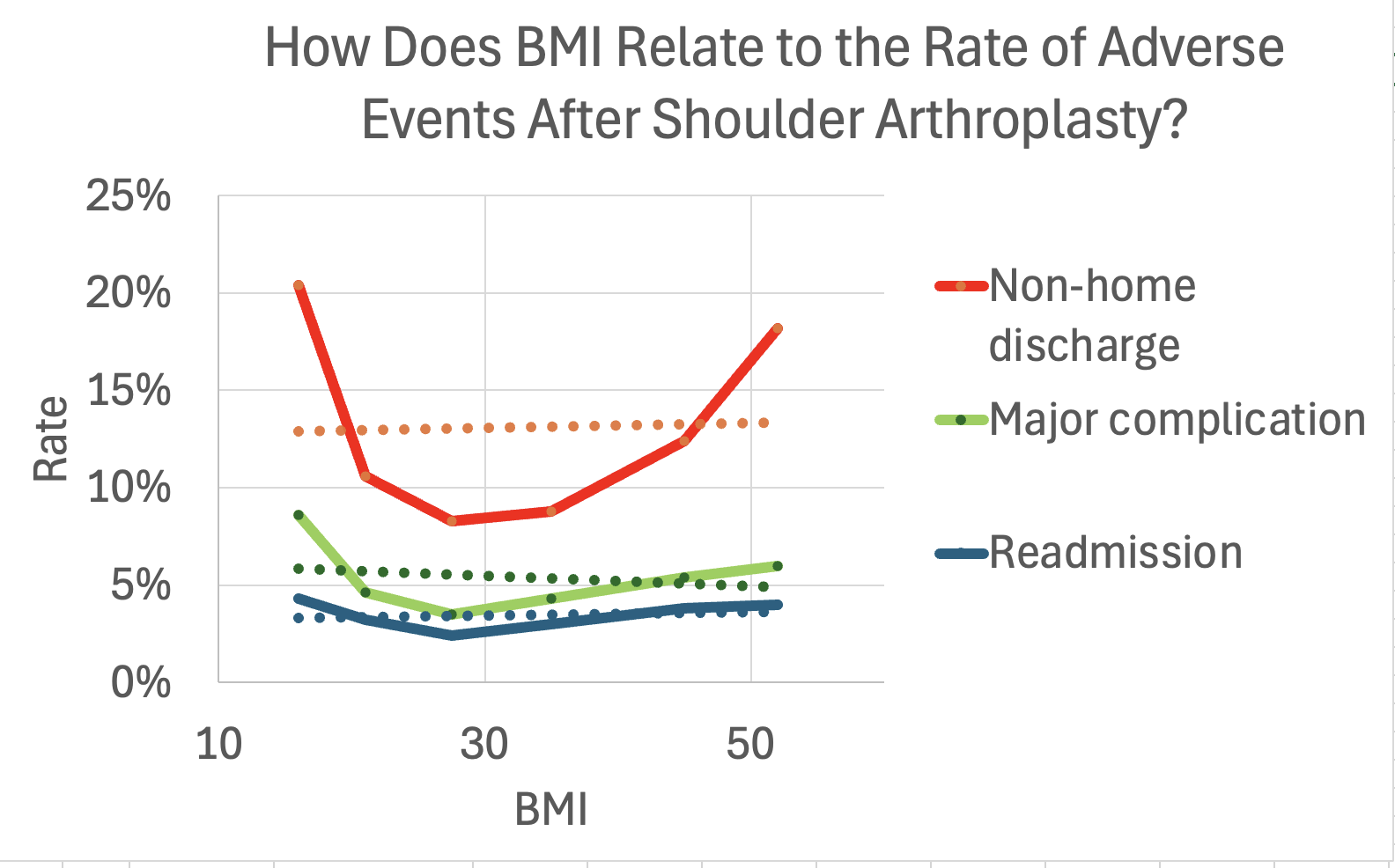
When they divided the patients into five groups: BMI <18.5, BMI 18.5-24.9, BMI 30-39.9, BMI 40-49.9, and BMI ≥ 50 a different story unfolded as seen in the scatter plot below, which shows that the overweight (BMI 30-39.9), but not obese, patients had the lowest rate of adverse events. Furthermore, the real uptick in adverse events was found only for the BMI <18.5 and the BMI ≥ 40 patients.


There is another lesson here. If we (as we often do) blindly look for a relationship between one thing and another using linear regression, we would completely miss the important relationship shown above. Note in the graph below, the linear regression trend lines are all flat as a pancake, with "no significant relationship" (sic).


Comments welcome at shoulderarthritis@uw.edu

You can support cutting edge shoulder research that is leading to better care for patients with shoulder problems, click on this link


Follow on twitter/X: https://x.com/RickMatsen
Follow on facebook: https://www.facebook.com/shoulder.arthritis
Follow on LinkedIn: https://www.linkedin.com/in/rick-matsen-88b1a8133/


Here are some videos that are of shoulder interest
Shoulder arthritis - what you need to know (see this link).
How to x-ray the shoulder (see this link).
The ream and run procedure (see this link).
The total shoulder arthroplasty (see this link).
The cuff tear arthropathy arthroplasty (see this link).
The reverse total shoulder arthroplasty (see this link).
The smooth and move procedure for irreparable rotator cuff tears (see this link).
Shoulder rehabilitation exercises (see this link). 

Friday, June 7, 2024

Overstuffing is not a radiographic diagnosis

Overstuffing is not a condition diagnosed on x-ray, rather it is a condition in which there is too much stuff in the available space. Sort of like what Lewis Carroll described in his 1865 children's novel, Alice in Wonderland. After Alice drinks from the bottle labeled "DRINK ME" she expands to where she cannot move.

In a prior post, How to overstuff an anatomic arthroplasty, we presented the origins of the term "overstuffing", its clinical significance, and the different causes. We emphasized that replacing a deformed arthritic humeral head with a round one and inserting a plastic glenoid component in a previously collapsed joint space risks putting the soft tissues around the glenohumeral joint under excessive tension. 


Unless soft tissue releases offset the tightening effect of adding volume to the joint, the result can be stiffness, pain, tendon failure, and non-healing of the subscapularis reattachment.

A recent paper, How anatomic should anatomic total shoulder arthroplasty be? Evaluation of humeral head reconstruction with the best-fit circle, agreed that "anatomic" total shoulder arthroplasty can risk overstuffing the glenohumeral joint. 

The authors evaluated 97 cases of primary glenohumeral osteoarthritis in patients treated with anatomic TSA. Coronal plane CT images in the plane of the humerus were used to determine the circle that fit the proximal humeral anatomy

The amount of thinning of the humeral head was determined as described below.


An anatomic TSA was modeled with an anatomic humeral head with a radius equal to that of the circle combined with a 4-mm polyethylene glenoid component. 

For this series of patients the average radius of the best-fit circle was 25 ± 2 mm. There was a mean thinning of 2 ± 2 mm  mean percent thinning was 9%.

With the addition of the simulated 4-mm glenoid implant, the humeral head was displaced laterally by a mean of 6 ± 2 mm relative to the preoperative position.

In this study, what appeared to be radiographic overstuffing was not associated with loss of motion, probably because sufficient soft tissue releases were performed.

Comment: Overstuffing not a radiographic measurement on an AP radiograph, it is stiffness of the glenohumeral joint resulting from putting more volume in the joint than the surrounding soft tissues can accommodate. 

The good news is that postarthroplasty motion can be assessed while the patient is still on the operating table, before the wound is closed. For this purpose we rely on meeting the "40, 50, 60" guidelines as shown below.

We also make sure that the arm can be easily passively elevated to at least 150 degrees after the subscapularis has been reattached.


If these intraoperative tests reveal excessive stiffness of the glenohumeral joint, the surgeon has the opportunity to perform additional soft tissue releases and/or modify the size of the humeral component.

At the end of the case, we like to take a photograph documenting shoulder motion to assure ourselves and the patient that the shoulder "will go". 


Finally, there are other factors that determine the size and placement of the humeral component. In this case of a 35 year old woman with the combination of instability and anchor arthropathy, "radiographically oversized" humeral and glenoid components were selected to restore mobility and stability.


You can support cutting edge shoulder research that is leading to better care for patients with shoulder problems, click on this link

Follow on twitter/X: https://x.com/RickMatsen
Follow on facebook: https://www.facebook.com/shoulder.arthritis
Follow on LinkedIn: https://www.linkedin.com/in/rick-matsen-88b1a8133/

Here are some videos that are of shoulder interest
Shoulder arthritis - what you need to know (see this link).
How to x-ray the shoulder (see this link).
The ream and run procedure (see this link).
The total shoulder arthroplasty (see this link).
The cuff tear arthropathy arthroplasty (see this link).
The reverse total shoulder arthroplasty (see this link).
The smooth and move procedure for irreparable rotator cuff tears (see this link).
Shoulder rehabilitation exercises (see this link).


Sunday, October 1, 2023

Primary glenohumeral arthritis: treatment with the ream and run in comparison to total shoulder arthroplasty - 10 year followup

Glenohumeral arthritis in shoulders with an intact rotator cuff is the most common indication for shoulder arthroplasty. 


The safety, effectiveness and durability of anatomic arthroplasty - the ream and run (RnR) or the anatomic total shoulder (TSA) - is widely recognized. 

The authors of Minimum 10-year Follow-up of Anatomic Total Shoulder Arthroplasty and Ream-and-Run Arthroplasty for Primary Glenohumeral Osteoarthritis studied the patients and the minimum 10-year outcomes for the RnR (n=34) and TSA (n=29). In this practice, the patients chose their surgical procedure after a discussion of the risks and benefits of each.

The two groups differed in a number of important preoperative characteristics. The RnR patients were significantly younger than the TSA patients (60 ± 7 vs 68 ± 8, p<0.001), predominantly male (97% vs 41%, p<0.001), and were healthier as reflected by the American Society of Anesthesiologists score (p=0.018). 


Patient-assessed preoperative and postoperative function was documented by the Simple Shoulder Test (SST)


The preoperative and the postoperative SST scores were higher for the patients having the ream and run procedure than for those having total shoulders.


Total shoulder
In the TSA group, the pain score decreased from a preoperative average of 6.6 ± 2.2 to 1.2 ± 2.3 (p < 0.001), and the SST score improved from and average of 3.8 ± 2.6 to 8.9 ± 2.6 at 10-year follow-up. (p < 0.001). The percent of maximum possible improvement averaged 64%. No patient in the TSA group required reoperation; notably there were no cuff tears or glenoid loosenings.


Ream and Run
In the RnR group, the pain score decreased from a preoperative average of 6.5 ± 1.9 to 0.9 ± 1.3 (p < 0.001), while the SST score improved from and average of 5.4 ± 2.4 to 10.3 ± 2.1 at 10-year follow-up (p < 0.001).  The percent of maximum possible improvement averaged 83%. 

Four patients  underwent single-stage exchange to another hemiarthroplasty because of painful stiffness. Two of these 4 patients had positive cultures for Cutibacterium. One patient required manipulation under anesthesia. No patients had conversion to a TSA or reverse total shoulder. 

At followup, a larger percentage of RnR patients could perform high-level shoulder functions: SST questions 7, 8, 9, 10, and 12.


As an example, a 15-year post RnR followup x-ray of the shoulder shown at the beginning of this post is shown below. Note the stable humeral fixation and the seating of the humeral head centered in the healed glenoid concavity.


This patient (now 71 years old) continues to use his arm for heavy physical work and recreation. He has excellent range of motion, comfort and function and now returns for an RnR on his opposite shoulder.


Comment: Patients with glenohumeral osteoarthritis and their surgeons have the choice of the ream and run and anatomic total shoulder. This is one of the few long term studies of the patients having each of the procedures. It is notable that young, healthy, male patients preferred the ream and run procedure after a discussion of the pros and cons of each. The RnR patients had higher levels of function both before and after surgery - particularly for the more demanding activities assessed by the Simple Shoulder Test.

As is necessary for all clinical outcome studies, this article reported the number of patients enrolled in the database and the number and reasons groups of patients were not included in the final analysis. This is the standard "Figure 1", which seems absent in many reports.


This figure shows the challenge in achieving long term followup on a high percentage of patients.

You can support cutting edge shoulder research that is leading to better care for patients with shoulder problems, click on this link.

Follow on twitter: https://twitter.com/shoulderarth
Follow on facebook: click on this link
Follow on facebook: https://www.facebook.com/frederick.matsen
Follow on LinkedIn: https://www.linkedin.com/in/rick-matsen-88b1a8133/

Here are some videos that are of shoulder interest
Shoulder arthritis - what you need to know (see this link).
How to x-ray the shoulder (see this link).
The ream and run procedure (see this link).
The total shoulder arthroplasty (see this link).
The cuff tear arthropathy arthroplasty (see this link).
The reverse total shoulder arthroplasty (see this link).
The smooth and move procedure for irreparable rotator cuff tears (see this link).
Shoulder rehabilitation exercises (see this link).


Friday, July 7, 2023

Stemless total shoulder - are the clinical outcomes better than those with stemmed implants?

There is a lot of interest in stemless humeral implants for total shoulder arthroplasty.

Some articles, such as the recent Radiographic comparison of eccentric stemmed versus concentric stemless prosthetic humeral head positioning after anatomic total shoulder arthroplasty focus on the degree to which the arthroplasty created the desired head position and concluded that "stemless and stemmed aTSA implants have similar rates of reproducing satisfactory postoperative humeral head center of rotation." 

Of course, both types of humeral arthroplasty are dependent on the surgeon "getting it right".  The example below shows overstuffing of a stemless component resulting from an improper humeral neck cut.

Another recent article Impact of Humeral Stem Length on Calcar Resorption in Anatomic Total Shoulder Arthroplasty pointed out that while resorption of calcar bone occurred with stemless, short stemmed and standard stemmed implants, higher degrees of resorption were less common with the stemless design because it directly loads the calar.


in contrast to designs where calcar is unloaded in favor of loading of the metaphysis


Clinical significance of these loading-related differences was not found by these authors: "Clinical outcomes were similar amongst all three stem designs in this study, suggesting that the boney adaptive changes observed do not influence clinical outcomes."

An important question, then, is "are the outcomes experienced by the patient better for stemless implants than for standard stems?" A look at 22 articles published over the last 10 years does not provide evidence that the clinical outcomes for stemless humeral implants are better than standard stems:

The authors of Stemless shoulder prosthesis versus conventional anatomic shoulder prosthesis in patients with osteoarthritis: a comparison of the functional outcome after a minimum of two years follow-up 2013 concluded "There was no significant difference in the Constant scores of the groups treated with the stemless shoulder prosthesis (65.0 points) and the stemmed shoulder prosthesis (73.2 points)."

Stemmed versus stemless total shoulder arthroplasty: a preliminary report and short-term results 2014 reported "No differences were detected after 2 years from surgery in the two groups in terms of functional scores and range of motion"

Are there differences between stemless and conventional stemmed shoulder prostheses in the treatment of glenohumeral osteoarthritis? 2015 found that "in patients with glenohumeral osteoarthritis, treated with TSA, the functional and the proprioceptive outcome is comparable between a stemless and a standard stemmed anatomic shoulder prosthesis at early followup".

Functional midterm follow-up comparison of stemless total shoulder prostheses versus conventional stemmed anatomic shoulder prostheses using a 3D-motion-analysis 2017. "Both types of shoulder prostheses achieve a similar and good active ROM and similar results in Constant score" .

A clinical trail, Patient-reported outcome after stemmed versus stemless total shoulder arthroplasty for glenohumeral osteoarthritis: a patient-blinded randomized clinical trial 2019 sounds promising, but the results have yet to be reported.

Radiographic restoration of native anatomy: a comparison between stemmed and stemless shoulder arthroplasty 2019 reported that "Radiographic restoration of anatomy is similar for stemmed and stemless shoulder arthroplasty implants"

Stemless shoulder arthroplasty: review of short and medium-term results 2019 "In the studies reporting similar outcome measures, there were reliable improvements on par with stemmed counterparts. Aggregate complication rates appear similar to those published in the literature for stemmed components."

The short-term survival of total stemless shoulder arthroplasty for osteoarthritis is comparable to that of total stemmed shoulder arthroplasty: a Nordic Arthroplasty Register Association study 2019 concluded "The short-term survival of total stemless shoulder arthroplasty appears comparable with total stemmed shoulder arthroplasty"    

Prospective, Blinded, Randomized Controlled Trial of Stemless Versus Stemmed Humeral Components in Anatomic Total Shoulder Arthroplasty: Results at Short-Term Follow-up 2020 "At 2 years of follow-up, the safety and effectiveness of the stemless humeral implant were noninferior to those of the stemmed humeral implant in patients managed with aTSA for the treatment of osteoarthritis."

Stemless anatomic total shoulder arthroplasty: a systematic review and meta-analysis 2020. "Stemless anatomic TSA resulted in similar functional outcomes and complication rates to stemmed TSA "

Long-term survival and failure analysis of anatomical stemmed and stemless shoulder arthroplasties 2021 reported that "The use of anatomical stemless shoulder prosthesis yielded good and reliable results and did not differ from anatomical stemmed shoulder prosthesis over a mean period of ten years. The differences in periprosthetic humeral bone adaptations between both implants have no clinical impact during the follow-up"

Assessing the Value to the Patient of New Technologies in Anatomic Total Shoulder Arthroplasty 2021 did not identify evidence that the results of TSA were statistically or clinically improved over the 2 decades of study or that any of the individual technologies, such as stemless designs were associated with significant improvement in patient outcomes.

Comparison of stemless and conventional stemmed shoulder arthroplasties in shoulder arthropathy: A meta-analysis 2021 "This meta-analysis revealed that postoperative Constant score and complication rates did not differ significantly between the 2 treatment methods, stemless shoulder prosthesis and conventional stemmed shoulder prosthesis for shoulder arthropathy."

Short-term survival and patient-reported outcome of total stemless shoulder arthroplasty for osteoarthritis are similar to that of stemmed total shoulder arthroplasty: a study from the Danish Shoulder Arthroplasty Registry 2022 found that the differences in clinical outcomes were "not clinically relevant". 

Outcomes Between Stemmed and Stemless Total Shoulder Arthroplasty: A Systematic Review and Meta-analysis of Randomized Controlled Trials 2022 reported "TSA with stemless versus stemmed humeral components was not associated with notable differences in functional and clinical outcomes, the rate of humeral fracture or risk of revision."

Stemless anatomic total shoulder arthroplasty: surgical technique and review of the literature 2022. "When compared to stemmed-implants, stemless aTSA has demonstrated similar outcomes and complication rates."

Surgical time and outcomes of stemmed versus stemless total shoulder arthroplasty 2022 Stemless TSA had equivalent functional outcomes at a minimum 2-year follow-up.

Medium-term results of stemless, short, and conventional stem humeral components in anatomic total shoulder arthroplasty: a New Zealand Joint Registry study 2023 "The medium-term survival of stemless implants for anatomic total shoulder arthroplasty appears comparable to short-stem and conventional stemmed implants."

Impact of Humeral Stem Length on Calcar Resorption in Anatomic Total Shoulder Arthroplasty. 2023  "Clinical outcomes were similar amongst all three stem designs in this study, suggesting that the boney adaptive changes observed do not influence clinical outcomes."

Comment: As pointed out in Stemless and stemmed humeral components in anatomic total shoulder arthroplasty. the value (benefit to the patient divided by cost) of stemless humeral components needs to be clarified by further clinical research - including the two randomized clinical trials that are hopefully still underway: 
and

You can support cutting edge shoulder research that is leading to better care for patients with shoulder problems, click on this link.

Follow on twitter: https://twitter.com/shoulderarth
Follow on facebook: click on this link
Follow on facebook: https://www.facebook.com/frederick.matsen
Follow on LinkedIn: https://www.linkedin.com/in/rick-matsen-88b1a8133/

Here are some videos that are of shoulder interest
Shoulder arthritis - what you need to know (see this link).
How to x-ray the shoulder (see this link).
The ream and run procedure (see this link).
The total shoulder arthroplasty (see this link).
The cuff tear arthropathy arthroplasty (see this link).
The reverse total shoulder arthroplasty (see this link).
The smooth and move procedure for irreparable rotator cuff tears (see this link).
Shoulder rehabilitation exercises (see this link).

Wednesday, September 28, 2022

The value of a standard glenoid component in anatomic shoulder arthroplasty.

There have been many attempts to improve the excellent outcomes of anatomic total shoulder arthroplasty (TSA) that have for many decades been obtained with all-polyethylene glenoid components. Such attempts include metal backed and hybrid glenoid components; data demonstrating the superiority of these innovations is lacking.

The authors of Mid- to long-term outcomes of a cemented all-polyethylene pegged glenoid component in anatomic total shoulder arthroplasty evaluated the mid- to long-term survival and outcomes of 108 total shoulders (98 patients, 18 males and 80 females) using a conventional cemented anatomic all-polyethylene pegged glenoid component (convex, roughened back surface with four fluted pegs).


There was a mean follow-up of 5.1 years (range, 2 years to 10.6 years). Included patients had symptomatic primary or secondary glenohumeral osteoarthritis with an intact cuff as well as those shoulders revised to a TSA for failed Copeland resurfacing or hemiarthroplasty for trauma. Patients were excluded if there were concerns about cuff integrity or significant bone loss with retroversion greater than >15⁰.

Survival analysis was possible in 101 shoulders (94%); only 7 patients were lost to follow-up.

Six TSAs (5.9%) were revised. Mean time from primary surgery to revision was 27.5 months (range, 1 month to 56 months). The reason for revision was rotator cuff failure in four and instability in two. Glenoid loosening was not found on radiographic review or intra-operatively in any of the cases undergoing revision surgery. No revisions were performed because of glenoid component failure.


Kaplan-Meier survival analysis revealed a six-year survival estimate of 94.1%  for all cause revision. 


Clinical outcomes were maintained at long term follow-up (>8 years) with the exception of the Pain VAS score which increased by 2.1 points.


Radiological assessment revealed that 28 patients had radiolucency consistent with a Lazarus grade of 3 and above but these findings did not affect the clinical outcomes. The 6 patients with a Lazarus Grade of 4 and the two patients with Lazarus Grade 5 were not symptomatic and had good clinical outcomes.


Comment: This study demonstrates the long term effectiveness and safety of a standard cemented all-polyethylene glenoid component in anatomic shoulder arthroplasty. This study can serve as a baseline for studies on the value of more complex glenoid components.


The post below is of relevance in this regard.

Glenohumeral osteoarthritis - what type of arthroplasty has the lowest 10 year revision rate?


Our approach to anatomic shoulder arthroplasty is shown in this link

To add this blog to your reading list in Google Chrome, click on the reading list icon


You can support cutting edge shoulder research that is leading to better care for patients with shoulder problems, click on this link.


Follow on twitter: https://twitter.com/shoulderarth

Follow on facebook: click on this link

Follow on facebook: https://www.facebook.com/frederick.matsen

Follow on LinkedIn: https://www.linkedin.com/in/rick-matsen-88b1a8133/

Here are some videos that are of shoulder interest
Shoulder arthritis - what you need to know (see this link).
How to x-ray the shoulder (see this link).
The ream and run procedure (see this link).
The total shoulder arthroplasty (see this link).
The cuff tear arthropathy arthroplasty (see this link).
The reverse total shoulder arthroplasty (see this link).
The smooth and move procedure for irreparable rotator cuff tears (see this link).

Shoulder rehabilitation exercises (see this link).


Sunday, May 15, 2022

Glenohumeral osteoarthritis - what type of arthroplasty has the lowest 10 year revision rate?

Total Shoulder Replacement Stems in 1 Osteoarthritis – short, long or reverse? An analysis of the impact of cross-linked polyethylene.


In their analysis of different types of total shoulder arthroplasty for osteoarthritis (OA) in the 2021 Australian Orthopaedic Association National Joint Replacement Registry (see this link), these authors considered five implant types separately: 

(1) stemmed anatomic total shoulder arthroplasty (aTSA) with metaphyseal or diaphyseal humeral component fixation with either cross-linked polyethylene ("total stemmed XLPE") or non-cross-linked polyethylene ("total stemmed non XLPE")

(2) stemless anatomic total shoulder arthroplasty with epiphyseal fixation with either cross-linked polyethylene ("total mid head XLPE") or non-cross-linked polyethylene ("total mid head non XLPE")

and 

(3) reverse total shoulder arthroplasty ("total reverse").


Due to the previously documented higher revision rate compared to other anatomic total shoulder replacement options, those arthroplasties using a cementless metal backed glenoid components were excluded.


Of note, this registry provided data on a substantial number of shoulders many years out from their index arthroplasty.


For the primary diagnosis of OA, aTSA with a cemented XLPE glenoid component had the lowest revision rate with a 12-year cumulative revision rate of 4.7%, compared to aTSA with cemented non-XLPE glenoid component of 8.7%, and RTSA of 6.8%. 


The principal reason for revision for the total stemmed non XLPE was component loosening.


The lower rate of revision for component loosening with cross-linked polyethylene is shown below.


Comment: In this large national database study of 28,467 primary total shoulder replacement procedures the best 10 year survivorship was seen for anatomic stemmed total shoulder replacement with a cemented cross-linked polyethylene glenoid component in comparison to reverse total shoulder and in comparison to anatomic arthroplasty with a non cross-linked polyethylene glenoid component. Results in this study for short or mid head stems were inconclusive, but initial indications were that they were not substantially better than the long stem implants utilizing crosslinked polyethylene.

We are reminded that in reading studies of arthroplasty revision rates, it is important to understand whether the study includes metal back glenoids or glenoid components with non cross-linked polyethylene.

This study of arthroplasties by all surgeons in Australia found a 10 year cumulative percent revision rate of 4.1 percent for anatomic stemmed total shoulder replacements with a cemented cross-linked polyethylene glenoid component. This is an important benchmark against which reverse total shoulder arthroplasty and future shoulder arthroplasty innovations should be compared.

You can support cutting edge shoulder research that is leading to better care for patients with shoulder problems, click on this link.

Follow on twitter: https://twitter.com/shoulderarth

Follow on facebook: click on this link

Follow on facebook: https://www.facebook.com/frederick.matsen

Follow on LinkedIn: https://www.linkedin.com/in/rick-matsen-88b1a8133/

Here are some videos that are of shoulder interest
Shoulder arthritis - what you need to know (see this link).
How to x-ray the shoulder (see this link).
The ream and run procedure (see this link).
The total shoulder arthroplasty (see this link).
The cuff tear arthropathy arthroplasty (see this link).
The reverse total shoulder arthroplasty (see this link).
The smooth and move procedure for irreparable rotator cuff tears (see this link).
Shoulder rehabilitation exercises (see this link).