Showing posts with label evaluation. Show all posts

Sunday, October 29, 2023

How much should it cost to evaluate the shoulder?

Characterizing the comfort, function, and range of motion of the shoulder before and sequentially after treatment are the cornerstones clinical shoulder practice. As is the case for most types of measurement, greater accuracy, precision, and detail can be purchased with more money. The amount of accuracy, precision, and detail needed depends on questions that need to be answered.

For example, the authors of Test-retest reliability of isometric shoulder muscle strength during abduction and rotation tasks measured using the Biodex dynamometer found that shoulder muscle strength in abduction and rotation measured with the pricey Biodex dynamometer (see this link) are reproducible and correlate with the strength assessment of the Constant Score; under what circumstances is the increased cost worth it?  Furthermore, the Constant Score itself requires the costs of travel and a clinic visit (see this Constant–Murley Score: systematic review and standardized evaluation in different shoulder pathologies).

By contrast, validated mail-in questionnaires assessing shoulder comfort and function avoid the costs of equipment, travel and an office visit and provide information on the patient's ability to perform individual shoulder functions before and sequentially after treatment (see Shoulder joint replacement arthroplasty - what outcomes do patients care about?). 

As another example, the ranges of shoulder motion can be measured using an expensive artificial intelligence-based image recognition detectable sensor (see Comparative accuracy of a shoulder range motion measurement sensor and Vicon 3D motion capture for shoulder abduction in frozen shoulder); in what circumstances is the information gained worth the cost?


 Even the use of a simple goniometer by clinical staff requires travel and an office visit. 

Travel and visit costs for clinical followup can be avoided by the use of telehealth, as emphasized by the authors of Validation of an on-screen application-based measurement of shoulder range of motion (ROM) over telehealth medium who sought to investigate the accuracy and reliability shoulder range of motion measurement through telehealth in 24 healthy volunteers and 16 symptomatic patients with shoulder range of motion (ROM) deficits. The shoulder ROM was first examined physically using the goniometer in the clinic and then over Zoom. Comparison of the two methods showed only minor mean differences for the healthy volunteers and the patients. They concluded that the telehealth method of measuring shoulder ROM was accurate and reliable when compared to the clinical goniometer method.

Even simpler and more accessible than telemedicine is asking the patient, family, or friend to email photos of the arm in selected positions to follow ranges of motion in the treatment of conditions such as frozen shoulder and during joint replacement rehabilitation. 


Patients can be sent the figures below, asking them to position the arm as far in the indicated direction as possible. By keeping the photos on file the surgeon can monitor patient progress. The advantage of this system is that the patient need not be connected in real-time via telehealth, but can send in the photos at whatever time works for them.


Here are a few examples:


This approach can demonstrate active range 

assisted range


and the relative contributions of glenohumeral to scapulothoracic motion.


While this approach to following shoulder motion during treatment may not be as accurate as direct in-person measurements, it provides a cost effective method for monitoring the progress of shoulder range of motion achieved by physical therapy and surgery. Again, because photographs can be sent at a time convenient to the patient and viewed at a time convenient for the surgeon, this simple approach is easily accessible at both ends of the communication. If problems are identified, an in-person evaluation can be arranged. 

You can support cutting edge shoulder research and education that are leading to better care for patients with shoulder problems, click on this link.

Follow on twitter: https://twitter.com/RickMatsen or https://twitter.com/shoulderarth
Follow on facebook: click on this link
Follow on facebook: https://www.facebook.com/frederick.matsen
Follow on LinkedIn: https://www.linkedin.com/in/rick-matsen-88b1a8133/

Here are some videos that are of shoulder interest
Shoulder arthritis - what you need to know (see this link).
How to x-ray the shoulder (see this link).
The ream and run procedure (see this link).
The total shoulder arthroplasty (see this link).
The cuff tear arthropathy arthroplasty (see this link).
The reverse total shoulder arthroplasty (see this link).
The smooth and move procedure for irreparable rotator cuff tears (see this link).
Shoulder rehabilitation exercises (see this link).

Sunday, October 18, 2015

Clinical evaluation of the shoulder - our approach

It is traditional for surgeons to strive for a diagnosis for the shoulder problem and to derive a treatment from the diagnosis. For us, however, the clinical evaluation is the beginning of the doctor-patient relationship. The goal is not so much to come up with a diagnosis that will drive to a specific treatment, but rather to carry out an evaluation of the patient that leads to a reasonable management plan.

We like to emphasize the importance of the 4 P’s that determine the outcome of treatment: the patient, the shoulder problem the patient is experiencing, the procedure used to treat the patient and the problem, and the physician rendering the treatment. We place the patient first on this list because as Osler is quoted as saying, “it is more important to know what patient a disease has than what disease the patient has.” When introducing ourself and shaking the patient’s hand we can sense a lot – healthy or frail, positive or negative, smelling of cigarettes or not. To learn a bit more, we ask the patient ‘where are you from and what do you do there?” In an instant we’ve done a lot to determine if the person might benefit from a surgical approach should one be appropriate for the problem.  Next, we like to ask “what can we help you with today?” giving the patient some uninterrupted time to answer. The patient with posterior instability may respond with “I can’t do my job”, “I need more pain medicine”, “my lawyer sent me” or “my shoulder keeps on slipping out when I lift something in front of me” – same diagnosis, four different problems.

We like to avoid dwelling on pain, so rather than asking ‘where does your shoulder hurt’, we prefer to ask ‘what does your shoulder problem keep you from doing?’ When does it bother you the most? Following with ‘how and when did that problem start?’ ‘how much force was applied to your shoulder in the injury and what position was it in when the force was applied? and ‘tell me about the treatment you’ve had for it up to now’.  Trying to learn more about the patient, we ask questions such as  “how is your overall health, how active are you, what medications are you on, have you had prior surgeries and how did they work out?

Our physical exam starts with a ‘no touch’ approach. “Show me what actions are difficult for your shoulder” “what does it feel like is happening when you do these things?” To check active motion we ask patients to show me with each shoulder how high they can reach overhead, how far they can externally rotate the shoulder  with the arm at the side, how far they can reach across the body, how far they can internally rotate the abducted arm, and how high they can reach up the back. If patients cannot raise the arm actively, we ask them to show how high they can raise it with the help of the opposite arm. At this point, without having ever touched the patient we usually have a fairly good understanding of the problem  and whether the patient is likely to be a good candidate for surgical intervention. The remainder of my history, physical examination and plain radiographs seek to refine this understanding.

There are many ‘tests’ that have been described for evaluating shoulder problems,  these tests are rarely capable of discriminating among the potential problems; a "Hawkins test" may be positive in  rotator cuff disease, arthritis, or frozen shoulder.  Instead our exam seeks more tangible findings, such as loss of the passive or active range of motion,  a palpable defect in the rotator cuff, minimal resistance to anterior translation of the humeral head pressed into the glenoid, palpable subacromial crepitance, muscle atrophy, loss of the biceps reflex, or an obvious ‘clunk’ on cross body adduction.

Bottom line, if the problem is not apparent on history, physical, and plain radiographs or if the patient does not appear to be an excellent surgical candidate, we're likely to recommend non-operative management.  This remains the case even if MRI’s show ‘acromioclavicular arthrosis’, ‘labral fraying’, a “HAGL” lesion, or ‘supraspinatus tendinosis’.
===

Check out the new Shoulder Arthritis Book - click here.


Use the "Search" box to the right to find other topics of interest to you.

You may be interested in some of our most visited web pages including:shoulder arthritis, total shoulder, ream and runreverse total shoulderCTA arthroplasty, and rotator cuff surgery as well as the 'ream and run essentials'


Monday, August 27, 2012

Practical Evaluation and Management of the Shoulder, Diagnosis, Treatment

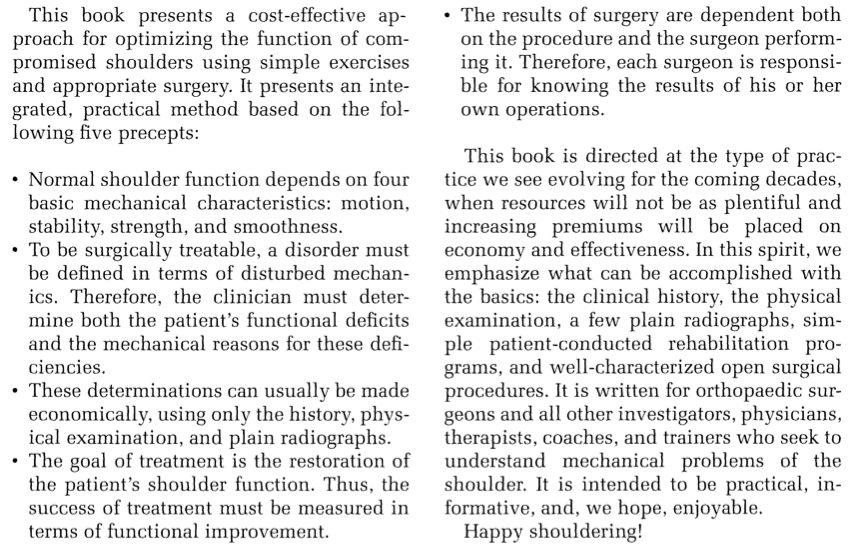
Back in 1994, John Sidles, Doug Harryman, Steve Lippitt and I published a book entitled Practical Evaluation and Management of the shoulder. In that the book is now out of print, many have asked how they might get a copy. Recently, the publisher has kindly allowed us to offer a PDF of the book here.

The philosophy and science in this book are as applicable today as they were twenty years ago. Here is our preface (click on it to enlarge):


--
Use the "Search" box to the right to find other topics of interest to you.

You may be interested in some of our most visited web pages including:shoulder arthritis, total shoulder, ream and runreverse total shoulderCTA arthroplasty,  and rotator cuff surgery.