Showing posts with label 4 Ps. Show all posts

Monday, February 17, 2020

Reverse total shoulders - which patients are satisfied?

Predictors of patient satisfaction after reverse shoulder arthroplasty

These authors sought to determine patient satisfaction and to identify predictors of satisfaction at two years after reverse shoulder arthroplasty (RSA) in 161 patients.

Improvements in ASES, Shoulder Activity Scale, VAS pain, and SF-12 physical component summary scores were associated with higher satisfaction.

On multivariate analysis, patients with higher preoperative ASES scores were less satisfied after surgery. In addition, patients with worse VAS fatigue and SF-12 mental and physical component summary scores preoperatively had lower satisfaction. 

Comment: This paper is instructive. First of all, it shows that patient factors (such as those measured by the SF-12 mental health and VAS fatigue scores) play heavily into the patients' satisfaction with this procedure (and probably with most other procedures as well).  Along with the problem, the procedure and the provider, the patient is one of the 4 Ps that determine the result of treatment.  

Secondly, while the means and medians are interesting, the variation is even more interesting as shown in the chart below. Patients with a preoperative ASES score of 100 have little room for improvement and are unlikely to be satisfied with surgery (see this link). Some patients experienced a drop of 64 points in their ASES score; these folks are likely to be unsatisfied.


Thus we come to the "tipping point"for  reverse total shoulders (see this link), i.e. when is it time to do this surgery. As shown in the link above, a recent study found that the tipping point for reverses was an ASES score of 38, a value approximately the same as the average preoperative ASES score of 35 in this paper.


The take away point is that surgeons should be cautious about offering elective surgery to patients with high levels of preoperative self-assessed comfort and function as well as those who have poor mental and physical health.

==
To see a YouTube of our technique for a reverse total shoulder arthroplasty, click on this link.

=====
To see our new series of youtube videos on important shoulder surgeries and how they are done, click here.

Use the "Search" box to the right to find other topics of interest to you.


You may be interested in some of our most visited web pages  arthritis, total shoulder, ream and run, reverse total shoulder, CTA arthroplasty, and rotator cuff surgery as well as the 'ream and run essentials'

Friday, January 17, 2020

Shoulder arthroplasty - selecting the right patient - the 4 Ps

Psychosocial factors affecting outcomes after shoulder arthroplasty: a systematic review

These authors conducted a review of sixteen article located using keywords ‘‘shoulder arthroplasty outcomes,’’ ‘‘psychosocial factors shoulder,’’ ‘‘shoulder replacement outcomes,’’ ‘‘depression shoulder arthroplasty,’’ ‘‘satisfaction shoulder arthroplasty,’’ ‘‘factors shoulder replacement,’’ ‘‘expectations shoulder arthroplasty,’’ and ‘‘predictors shoulder arthroplasty.’’

Six reviewed mental health disorders as predictors of postoperative outcome after shoulder arthroplasty. Of these, 4 found that disorders such a depression and anxiety were associated with increased risk of perioperative complications and lower final functional outcome scores. Two studies evaluated workers’ compensation status as a possible predictor of outcomes and found that patients with claims had lower satisfaction and outcome scores at final follow-up compared with those without claims. Two studies showed that preoperative opioid use was associated with lower outcome scores and overall satisfaction rate after shoulder arthroplasty. 


Three studies showed that higher patient confidence and preoperative expectations were correlated with better outcomes.

Comment: We like to point out that the outcome of shoulder arthroplasty, or any treatment for that matter, depends on for independent factors, the 4 Ps: the problem being treated, the procedure used to treat the problem, the physician rendering the treatment, and the patient reiving the treatment. This study calls our attention to the importance of the last P, the patient. Best results can be obtained by optimizing all four!

==
To see a YouTube of our technique for total shoulder arthroplasty, click on this link.

=====
To see our new series of youtube videos on important shoulder surgeries and how they are done, click here.

Use the "Search" box to the right to find other topics of interest to you.


You may be interested in some of our most visited web pages  arthritis, total shoulder, ream and run, reverse total shoulder, CTA arthroplasty, and rotator cuff surgery as well as the 'ream and run essentials'


Friday, January 25, 2019

Rotator cuff repair- the surgeon is the method

Comparison of Surgeon Performance of Rotator Cuff Repair Risk Adjustment Toward a More Accurate Performance Measure

These authors suggest that movement toward a value-based health-care system necessitates the development of performance measures to compare physicians, hospitals, and health-care systems.

They note that patient-reported outcomes (PROs) are a potential metric. However, valid use of PROs hinges on the ability to risk-adjust for baseline patient differences across a surgeon’s panel of patients. 

They proposed an approach for baseline risk adjustment and evaluate the importance of risk adjustment when comparing surgeons’ performance of rotator cuff repair.

They identified patients (n = 995) treated with arthroscopic rotator cuff repair by 34 surgeons from 2010 to 2017 from a large sports medicine clinical data registry. A linear regression model was used to adjust for baseline PROs, patient demographics, and clinical characteristics to predict American Shoulder and Elbow Surgeons (ASES) change scores for each surgeon. 

They found that the differences between unadjusted and risk-adjusted performance scores varied widely across surgeons. Use of the risk-adjusted performance scores resulted in a dramatic change in the relative ranking of surgeons, compared with the ranking based on the observed ASES change scores, with 31 of the 34 surgeons’ rank changing following risk adjustment. 

In the risk-adjustment model, male sex, Workers’ Compensation status, higher scores on the Veterans RAND 12-item Health Survey (VR-12), lower baseline ASES scores, fair and poor tendon quality, and night pain all had a significant effect on the predicted ASES change scores (p < 0.05). Higher baseline VR-12 mental and physical component summary scores and male sex had a significant, positive effect on 6-month change scores,whereas higher baseline ASES scores, poor tendon quality, and Workers’ Compensation status had a significant, negative effect on 6-month change scores.

Their results showed wide variation of nearly 25 points in the risk-adjusted 6-month ASES performance difference from the highest to the lowest-performing surgeons.

91% of surgeons’ rank changed following risk adjustment. This suggests that performance measurement that does not account for baseline patient characteristics would likely result in incorrect conclusions about a surgeon’s relative performance based on PROs. 

Comment: The result of surgery depends on the 4Ps: the patient, the shoulder problem, the procedure, and the provider performing the procedure.  The patient (smoker, steroids, motivated?), shoulder problem (chronic, tendon quality, retraction), procedure (single row, double row, TOE, patch) and provider (age, training, volume, ability to pick "winners") effects may be difficult to separate one from the other.

These authors have tried to control a substantial number of the non-surgeon factors to focus on the "surgeon effect". We suspect that the "surgeon effect" exerts itself at every level, from the initial encounter, thorough patient selection, setting patient expectations, surgical technique, rehab, and post surgical support.

Here are some related posts:

The influence of patient- and surgeon-specific factors on operative duration and early postoperative outcomes in shoulder arthroplasty

These authors asserted that increased operative duration is associated with an increase risk of adverse outcomes and complications. They sought to determine if patient- and surgeon-specific factors correlated to operative duration in shoulder arthroplasty. They conducted a retrospective review of primary and revision total and reverse shoulder arthroplasties performed at a single institution from 2012 through 2015. Patients with postoperative readmission had a longer mean operative time (163 vs. 107.1 minutes).

They found that high surgeon volume (>30 shoulder arthroplasties/year) was associated with shorter operative duration (105.9 vs. 128.3 minutes; P < .001).

Progression through a fellowship academic year was found to be associated with decreased surgical times (100.7 vs. 116.5 minutes; P < .0001).

Reverse shoulder arthroplasty for sequelae of prior fracture, total shoulder arthroplasty for dysplastic glenoid morphology, revision surgery were also associated with increased operative times.

Comment: Increased annual surgical volume has the potential not only for shortening surgical time, but also for improving patient selection, preoperative preparation, surgical technique, postoperative rehabilitation, and justifying a consistent patient-care team around the high-volume practice - all of which can contribute to improved outcomes.

The challenges for the prospective shoulder arthroplasty patient include:
(1) 'exactly what is a 'high volume surgeon?'
(2) 'how do I find a high volume surgeon?'
(3) 'in a high volume practice, will I get personalized attention?'
(4) 'what is the trade-off between the convenience of a local lower volume surgeon and the experience of a more distant higher volume surgeon'?

Some of these questions can be informed by a recent publication:

Distribution of High-Volume Shoulder Arthroplasty Surgeons in the United States: Data from the 2014 Medicare Provider Utilization and Payment Data Release.

These authors point out that high-volume TSA surgeons are reported to have superior outcomes. They studied patient access to these surgeons using 2012 Medicare Provider Utilization and Payment Data Public Use File (MPUPD-PUF). This data base provided volume and reimbursement data for procedures performed by individual physicians participating in Medicare. They studied surgeon prevalence, surgeon distribution, and factors associated with higher or lower surgeon prevalence in metropolitan areas. Data were extracted for all physicians who performed a minimum of 11 TSA procedures for Medicare beneficiaries

The MPUPD-PUF included 774 surgeons across the United States who performed an annual minimum of 11 TSA procedures covered by Medicare, with a combined total of 19,505 TSA procedures. The median annual number of Medicare service claims for TSA was 19 (range, 11 to 163), and the mean was 25 (SE, 0.7).

Of these surgeons, 45% practiced within major metropolitan areas with a population of >1 million. Surgeons who had completed an ASES fellowship had a higher volume of procedural claims (median, 26; range, 11 to 120) compared with other surgeons (median, 17; range, 11 to 163; p < 0.001). 

The distribution among major metropolitan areas was highly unequal, and more surgeons were present in cities with an ASES fellowship program.


This study points to the challenges that patients in certain geographical areas have in accessing surgeons who perform at least 11 shoulder arthroplasties per year.

An interesting question arises from the use of an annual case volume of ≥11 as the definition of a 'high volume' surgeon. Historically, 'high volume' has been defined arbitrarily:

Surgeon Experience and Clinical and Economic Outcomes for Shoulder Arthroplasty categorized surgeons according to the total number of procedures performed within the total 6 year ( 1994 to 2000) study period  with one to five procedures considered low volume; six to thirty procedures, medium volume; and more than thirty procedures, high volume.

The relationship between surgeon and hospital volume and outcomes for shoulder arthroplasty defined a 'high volume' surgeon as one who performed 5 or more cases per year.

This study defines 'high volume' as ≥ 11 cases per year. The number is creeping up.

Last month this article was published:

Meaningful Thresholds for the Volume-Outcome Relationship in Total Knee Arthroplasty

These authors used a database of 289,976 patients undergoing primary total knee arthroplasty from an administrative database, they applied stratum-specific likelihood ratio (SSLR) analysis of a receiver operating characteristic (ROC) curve to generate sets of volume thresholds most predictive of adverse outcomes. The outcomes considered for surgeon volume included 90-day complication and 2-year revision.

They identified four volume categories: 0 to 12, 13 to 59, 60 to 145, and ≥146 total knee arthroplasties per year. 
Complication rates decreased significantly (p < 0.05) in progressively higher-volume categories without a 'bottom' in sight:


Revision rates followed a similar pattern.  This study supports the use of SSLR analysis of ROC curves for risk-based volume stratification in total knee arthroplasty volume-outcomes research. SSLR analysis established meaningful volume definitions for low, medium, high, and very high-volume total knee arthroplasty surgeons.

The question then arises, 'if a high volume knee arthroplasty surgeon is defined as one performing ≥65 cases per year, shouldn't the same threshold apply to shoulder arthroplasty surgeons?' Is there any reason to believe that the annual number of cases of shoulder arthroplasty necessary to achieve and maintain excellence should be lower than that for knee arthroplasty? Is a shoulder arthroplasty easier to learn and master than a total knee?

It is apparent that the higher the standard for 'high volume', the greater the challenge of finding a high volume surgeon.  

Never the less, there is no denying the benefits of volume. More practice

increases the chances of a good result


===
We have a new set of shoulder youtubes about the shoulder, check them out at this link.

Be sure to visit "Ream and Run - the state of the art" regarding this radically conservative approach to shoulder arthritis at this link and this link

Use the "Search" box to the right to find other topics of interest to you.


Saturday, February 25, 2017

Shoulder joint replacement - is experience the great teacher?

The influence of patient- and surgeon-specific factors on operative duration and early postoperative outcomes in shoulder arthroplasty

These authors asserted that increased operative duration is associated with an increase risk of adverse outcomes and complications. They sought to determine if patient- and surgeon-specific factors correlated to operative duration in shoulder arthroplasty. They conducted a retrospective review of primary and revision total and reverse shoulder arthroplasties performed at a single institution from 2012 through 2015. Patients with postoperative readmission had a longer mean operative time (163 vs. 107.1 minutes).

They found that high surgeon volume (>30 shoulder arthroplasties/year) was associated with shorter operative duration (105.9 vs. 128.3 minutes; P < .001).

Progression through a fellowship academic year was found to be associated with decreased surgical times (100.7 vs. 116.5 minutes; P < .0001).

Reverse shoulder arthroplasty for sequelae of prior fracture, total shoulder arthroplasty for dysplastic glenoid morphology, revision surgery were also associated with increased operative times.

Comment: Increased annual surgical volume has the potential not only for shortening surgical time, but also for improving patient selection, preoperative preparation, surgical technique, postoperative rehabilitation, and justifying a consistent patient-care team around the high-volume practice - all of which can contribute to improved outcomes.

The challenges for the prospective shoulder arthroplasty patient include:
(1) 'exactly what is a 'high volume surgeon?'
(2) 'how do I find a high volume surgeon?'
(3) 'in a high volume practice, will I get personalized attention?'
(4) 'what is the trade-off between the convenience of a local lower volume surgeon and the experience of a more distant higher volume surgeon'?

Some of these questions can be informed by a recent publication:

Distribution of High-Volume Shoulder Arthroplasty Surgeons in the United States: Data from the 2014 Medicare Provider Utilization and Payment Data Release.

These authors point out that high-volume TSA surgeons are reported to have superior outcomes. They studied patient access to these surgeons using 2012 Medicare Provider Utilization and Payment Data Public Use File (MPUPD-PUF). This data base provided volume and reimbursement data for procedures performed by individual physicians participating in Medicare. They studied surgeon prevalence, surgeon distribution, and factors associated with higher or lower surgeon prevalence in metropolitan areas. Data were extracted for all physicians who performed a minimum of 11 TSA procedures for Medicare beneficiaries

The MPUPD-PUF included 774 surgeons across the United States who performed an annual minimum of 11 TSA procedures covered by Medicare, with a combined total of 19,505 TSA procedures. The median annual number of Medicare service claims for TSA was 19 (range, 11 to 163), and the mean was 25 (SE, 0.7).

Of these surgeons, 45% practiced within major metropolitan areas with a population of >1 million. Surgeons who had completed an ASES fellowship had a higher volume of procedural claims (median, 26; range, 11 to 120) compared with other surgeons (median, 17; range, 11 to 163; p < 0.001). 

The distribution among major metropolitan areas was highly unequal, and more surgeons were present in cities with an ASES fellowship program.


This study points to the challenges that patients in certain geographical areas have in accessing surgeons who perform at least 11 shoulder arthroplasties per year.

An interesting question arises from the use of an annual case volume of ≥11 as the definition of a 'high volume' surgeon. Historically, 'high volume' has been defined arbitrarily:

Surgeon Experience and Clinical and Economic Outcomes for Shoulder Arthroplasty categorized surgeons according to the total number of procedures performed within the total 6 year ( 1994 to 2000) study period  with one to five procedures considered low volume; six to thirty procedures, medium volume; and more than thirty procedures, high volume.

The relationship between surgeon and hospital volume and outcomes for shoulder arthroplasty defined a 'high volume' surgeon as one who performed 5 or more cases per year.

This study defines 'high volume' as ≥ 11 cases per year. The number is creeping up.

Last month this article was published:

Meaningful Thresholds for the Volume-Outcome Relationship in Total Knee Arthroplasty

These authors used a database of 289,976 patients undergoing primary total knee arthroplasty from an administrative database, they applied stratum-specific likelihood ratio (SSLR) analysis of a receiver operating characteristic (ROC) curve to generate sets of volume thresholds most predictive of adverse outcomes. The outcomes considered for surgeon volume included 90-day complication and 2-year revision.

They identified four volume categories: 0 to 12, 13 to 59, 60 to 145, and ≥146 total knee arthroplasties per year. 
Complication rates decreased significantly (p < 0.05) in progressively higher-volume categories without a 'bottom' in sight:


Revision rates followed a similar pattern.  This study supports the use of SSLR analysis of ROC curves for risk-based volume stratification in total knee arthroplasty volume-outcomes research. SSLR analysis established meaningful volume definitions for low, medium, high, and very high-volume total knee arthroplasty surgeons.

The question then arises, 'if a high volume knee arthroplasty surgeon is defined as one performing ≥65 cases per year, shouldn't the same threshold apply to shoulder arthroplasty surgeons?' Is there any reason to believe that the annual number of cases of shoulder arthroplasty necessary to achieve and maintain excellence should be lower than that for knee arthroplasty? Is a shoulder arthroplasty easier to learn and master than a total knee?

It is apparent that the higher the standard for 'high volume', the greater the challenge of finding a high volume surgeon.  

Never the less, there is no denying the benefits of volume. More practice

increases the chances of a good result

Thursday, November 3, 2016

Increased total shoulder complication rate for smokers and patients with ASA of III

Total shoulder arthroplasty: risk factors for intraoperative and postoperative complications in patients with primary arthritis

These authors correlated patient-specific factors in 275 patients (76 men, 199 women) with an average age of 68 years (range, 51-85 years) with the number and severity of all complications after total shoulder arthroplasty.

They identified 27  complications (9.8%) in 275 shoulder arthroplasties.


Patients with an ASA score of III showed an increased likelihood of having a surgical complication compared with the control group with ASAscores of 1 and 2 (odds ratio, 4.28; 95% confidence interval, 1.79-10.20; P < .01).


Smokers (> 10 cigarettes/day) were more prone to surgical complications than nonsmokers (odds ratio, 5.08; 95% confidence interval, 1.96-13.11; P = .02).

Comment: We often refer to the 4 Ps that affect the outcome of surgery: the Patient, the Procedure, the type of shoulder Problem, and the Physician performing the surgery. This study identifies smoking and ASA classification as two important Patient factors. 


Thursday, July 28, 2016

Will the patient be able to go home after shoulder arthroplasty?

Preoperative risk factors for discharge to a postacute care facility after shoulder arthroplasty.

These authors analyzed the Nationwide Inpatient Sample discharge records from 2011 to 2012 for patients who had a total shoulder arthroplasty (TSA) or reverse total shoulder arthroplasty (RTSA). In 2011 and 2012, 103,798 patients underwent shoulder arthroplasty procedures: 58,937 TSAs and 44,893 RTSAs were identified.

RTSA patients were 1.3 times as likely to be discharged to a post acute care (PAC) facility as TSA patients (P = .001). Medicare patients were 2 times as likely to be discharged to a PAC facility than those with private insurance (P < .001). In addition, women and patients presenting with a fracture, older age, or an increasing number of medical comorbidities were more likely to be discharged to a PAC facility (P < .001).

Comment: In most cases, shoulder arthroplasty is an elective procedure. This means that before surgery we have an opportunity to maximize the health and fitness of the patient. We also have the opportunity to anticipate a non-home discharge for patients at higher risk for this outcome. This gives us the chance to explore the options for PAC disposition, get the patient and family prepared, and assure the funding is in place.

One of the important factors influencing post discharge disposition not mentioned in this report is 'who is at home?' If the patient lives alone or if their housemate is not capable of helping assure their safety for the first few weeks after surgery, a PAC may be necessary. Other important factors not assessed in this study include ambulatory status, mental status, visual acuity and narcotic use.  In our experience these factors are often paramount in the decision making.

Sunday, April 24, 2016

Reverse shoulder arthroplasty results - the good and the bad of MCID

Causes of poor postoperative improvement after reverse total shoulder arthroplasty.

These authors analyzed 150 patients who underwent reverse total shoulder arthroplasty (RTSA) from 2007 to 2013. Patients with baseline and minimum 2-year postoperative American Shoulder and Elbow Surgeons (ASES) scores were included. Poor postoperative improvement was defined by the authors as a change in the ASES of less than 12 points using the standard deviation method (see this link). 20 patients had ASES score improvement < 12 points. 

Logistic regression revealed that male sex (adjusted odds ratio [OR], 7.9; P = .004), presence of an intact rotator cuff at the time of surgery (adjusted OR, 4.8; P = .025), depression (adjusted OR, 11.2; P = .005), a higher baseline ASES score (P < .001), and higher total number of medical comorbidities (P = .035) were associated with poor postoperative improvement after RTSA.

They concluded that evidence of better preoperative function, such as a higher baseline ASES score and intact rotator cuff at the time of surgery, correlated with poor postoperative improvement. In addition, male sex, depression, and total number of medical comorbidities also correlated with poor postoperative improvement. These results are similar to a prior study that used improvement of two in the Simple Shoulder Test as the metric for improvement (see this link).

Comment: This article again shows that the characteristics of the patient (sex, depression, comorbidities), as well as those of the shoulder (cuff integrity) have strong influences over the results of surgery.

When we talk about the results of surgery, we need to be careful to differential the outcome from the improvement (outcome-ingo). Consider the following hypothetical example of four patients having RTSA. The ingo is shown on the horizontal axis and the outcome on the vertical axis. The numbers to the left of the vertical lines indicate the difference between outcome and ingo.


The round patient and the square patient improved by the MCID used in this article and would be considered successes, but the diamond and triangle patients did not and would have been considered failures. Note however that the best outcomes were for the patients who did not improve by the MCID (the diamond and the triangle). Note also that better outcomes were observed for patients with higher ingos. We can only wonder which of the four patients would be most satisfied with the results of their surgery. This example shows the flaws in the use of MCID - (1) achieving the threshold value is likely to be less satisfactory if the ingo is low and (2) patients with a high ingo have a harder time achieving the MCID threshold for a success. In this study the baseline ASES scores were 53.7 ± 4.6 for the 'failure' group and  32.5 ± 1.6 for the 'non-failure' group. Interestingly, 68% of the "failure" group were satisfied with the outcome of surgery.

A complementary method for analyzing the results is to look at the amount of improvement (the outcome minus the ingo) divided by the maximal possible improvement (the maximum possible score  (100) minus the ingo).  Considered in this way, the round patient improved by 28% of the maximum possible in comparison to 44% for the square patient, 50% for the diamond patient and 100% for the triangle patient.

To us it seems easier to explain to a prospective patient that 'in the past patients having this procedure have regained an average of X% of their normal function back' as opposed to 'in the past Y% of patients have improved by the MCID'.


===


Check out the new Shoulder Arthritis Book - click here.

Use the "Search" box to the right to find other topics of interest to you.

You may be interested in some of our most visited web pages including:shoulder arthritis, total shoulder, ream and run, reverse total shoulder, CTA arthroplasty, and rotator cuff surgery as well as the 'ream and run essentials'


Tuesday, March 1, 2016

Rotator cuff tears - how does mental health relate to pain and function?

Mental Health Has a Stronger Association with Patient-Reported Shoulder Pain and Function Than Tear Size in Patients with Full-Thickness Rotator Cuff Tears.

These authors studied 169 patients with full-thickness rotator cuff tears using the Short Form-36, visual analog scales for shoulder pain and function, the Simple Shoulder Test (SST), and the American Shoulder and Elbow Surgeons (ASES) instrument at the time of diagnosis. These results were correlated with the MRI interpretation of the number of tendons involved, tear size, tendon retraction, and tear surface area as well as sex, body mass index, number of medical comorbidities, smoking status, and Workers' Compensation status.

The SF-36 mental component summery (MCS) had the strongest correlation with the visual analog scale for shoulder pain, the visual analog scale for shoulder function, the SST, and the ASES score. 

Tear severity by MRI only correlated with the visual analog scale for shoulder function. Tear severity did not correlate with other scores in bivariate correlations. In all multivariate models, the SF-36 MCS had the strongest association with the visual analog scale for shoulder pain, the visual analog scale for shoulder function, the SST, and the ASES score.

The authors conclude that patient mental health may play an influential role in patient-reported pain and function in patients with full-thickness rotator cuff tears.

Comment: Once again we see that the symptoms experienced by patients rotator cuff tears are related to factors other than the severity of the rotator cuff pathology. The importance of the different elements of the SF36 on shoulder comfort and function is shown by prior studies as well. Three relevant abstracts are provided here. Again we emphasize the importance of the 4Ps (patient, problem, physician, procedure): the characteristics of the patient may be more important than the characteristics of the shoulder problem. These studies help us realize that patients with poor mental health are likely to have poorer shoulder comfort and function both before and after treatment.

Correlates with comfort and function after total shoulder arthroplasty for degenerative joint disease.

Although most patients are improved after shoulder arthroplasty, the degree of improvement is variable. The factors contributing to this variability are not well understood. In particular, little information is available regarding the preoperative characteristics of the patient that may influence the quality of the result. This study correlated patient demographics, preoperative health status, and preoperative shoulder function with 3 outcome metrics: comfort, physical role function, and shoulder-specific function. One hundred thirty-four shoulders having total shoulder arthroplasty for degenerative glenohumeral joint disease had an average follow-up of 3.4 +/- 1.8 years. The SF-36 Comfort score improved from 39 to 61 (P < .0001). The SF-36 Physical Role Function score improved from 30 to 52 (P < .0001). The average number of Simple Shoulder Test functions performable (out of 12) improved from 4 to 9 (P < .0001). The strongest correlates with postoperative comfort included preoperative physical function (P < .0001), general health (P < .0001), and social function (P < .001). The strongest correlates with postoperative physical role function included preoperative physical function (P < .0001) and general health (P < .001). The strongest correlates with postoperative shoulder function included male gender (P < .0001), and preoperative physical function (P < .0001), social function (P < .0001), mental health (P < .0001) and shoulder function (P < .0001). These data indicate that the overall well-being of the patient before surgery is strongly correlated with the quality of the outcome from total shoulder arthroplasty for degenerative glenohumeral joint disease.

A prospective multipractice investigation of patients with full-thickness rotator cuff tears: the importance of comorbidities, practice, and other covariables on self-assessed shoulder function and health status.

Rotator cuff tears are among the most common conditions of the shoulder. One of the major difficulties in studying patients with rotator cuff tears is that the clinical expression of these tears varies widely and different practices may have substantially different patient populations. The goals of the present prospective multipractice study were to use patient self-assessment questionnaires (1) to identify some of the characteristics of patients with rotator cuff tears, other than the size of the cuff tear, that are correlated with shoulder function, and (2) to determine whether there are significant differences in these characteristics among patients from the practices of different surgeons.

Ten surgeons enrolled a total of 333 patients with a full-thickness tear of the supraspinatus tendon into this prospective study. Each patient completed self-assessment questionnaires that included items regarding demographic characteristics, prior treatment, medical and social comorbidities, general health status, and shoulder function.

As expected, patients who had an infraspinatus tendon tear as well as a supraspinatus tendon tear had significantly worse ability to use the arm overhead compared with those who had a supraspinatus tear alone (p < 0.005). However, shoulder function and health status were correlated with patient characteristics other than the size of the rotator cuff tear. The number of shoulder functions that were performable was correlated with the subscales of the Short Form-36 and was inversely associated with medical and social comorbidities. The patients from the ten different surgeon practices showed significant differences in almost every parameter, including age, gender, method of tear documentation, tear size, prior treatment, medical and social comorbidities, general health status, and shoulder function.

Clinical studies on the natural history of rotator cuff tears and the effectiveness of treatment must control for a wide range of variables, many of which do not pertain directly to the shoulder. Patients from the practices of different surgeons cannot be assumed to be similar with respect to these variables. Patient self-assessment questionnaires appear to offer a practical method of uniform assessment across different practices.


The correlation of comorbidity with function of the shoulder and health status of patients who have glenohumeral degenerative joint disease.

We studied the effect of comorbidities on function of the shoulder and health status in a group of eighty-five consecutive patients who had glenohumeral degenerative joint disease of sufficient severity to meet one surgeon's criteria for the performance of shoulder arthroplasty. A questionnaire was used to identify the comorbidities, such as other diseases, social factors, or a work-related injury, for each patient. The number of functions on the Simple Shoulder Test that the patient could perform had a significant negative correlation with the number of comorbidities (r = -0.32, intercept = 4.6 per cent, slope = -0.6, and p = 0.0031). Each parameter on the Short Form-36 (except for physical role function) had a significant negative correlation with the number of comorbidities (p < 0.05). This negative relationship was strongest for general health perception (r = -0.42) and vitality (r = -0.35). We concluded that the number of comorbidities has a quantitative effect on function of the shoulder. In the evaluation of the functional status of patients and the effectiveness of treatment, the effects of comorbidity must be controlled. The results of the present study demonstrate that the scores on the Short Form-36 are quantitatively related to the number of comorbidities. The six parameters that are unrelated to function of the shoulder (physical function, social function, emotional role function, mental health, vitality, and general health perception) may provide a practical way to integrate the effects of all potential comorbidities on individual patients. Future clinical research will be strengthened by efforts to measure the impact of comorbidities and by strategies to control for their effects.

=====


Use the "Search" box to the right to find other topics of interest to you.

You may be interested in some of our most visited web pages including:shoulder arthritis, total shoulder, ream and run, reverse total shoulder, CTA arthroplasty, and rotator cuff surgery as well as the 'ream and run essentials'


Wednesday, October 28, 2015

Shoulder arthroplasty in patients covered by workers' compensation

Anatomic total shoulder arthroplasty for patients receiving workers' compensation.

These authors compared 13 male patients, mean age 56 years covered by worker's compensation (WC) insurance having total shoulder arthroplasty (TSA) to 36 men and 27 women, mean age 63 years without worker's compensation insurance at a minimum of 2 years of follow-up.

The American Shoulder and Elbow Surgeons (ASES) scores at final follow-up were significantly lower in the WC cohort (73.6) compared with the control group (86.6).  Only 4 of the 13 WC patients returned to work.

Comment: While most surgeons recognize coverage by workman's compensation as a factor increasing the chance of a poor result, this study did not provide the reader with preoperative ASES scores, so the amount of improvement for the two groups cannot be compared. Furthermore this study  did not attempt to determine whether it was the insurance, the patient age, or the patient sex that exerted the predominant effect on the outcome.

=


Check out the new Shoulder Arthritis Book - click here.


Use the "Search" box to the right to find other topics of interest to you.

You may be interested in some of our most visited web pages including:shoulder arthritis, total shoulder, ream and run, reverse total shoulder, CTA arthroplasty, and rotator cuff surgery as well as the 'ream and run essentials'


Glenoid Bone-Grafting in Revision to a Reverse Total Shoulder Arthroplasty - another example of the 4 Ps

Glenoid Bone-Grafting in Revision to a Reverse Total Shoulder Arthroplasty

These authors have an extensive experience with using reverse total shoulder as a revision procedure, performing143 such cases between 2005 and 2010. 102 patients did not undergo grafting, but in 41 they used bone grafting because of glenoid bone deficiency. 40 of the shoulders had follow-up of more than two years (mean, 3.1 years). 16 had central glenoid defects, 13 had posterior defects, 10 had superior defects and 1 had an inferior defect. The arthroplasty systems used included the Comprehensive Reverse Shoulder (20 shoulders),  the Encore Reverse Shoulder Prosthesis (10 shoulders), the Delta III  (1 shoulder) Delta Xtend (7 shoulders) and the Aequalis Reversed Shoulder (2 shoulders).  Fifteen prostheses had a lateral center of rotation, and twenty-five had a medial center of rotation.

Seven of the 40 patients  required another revision surgery because of glenoid loosening (four patients), instability (two patients), or infection (one patient). Of the five structural grafts, one of them failed at 1.2 years secondary to glenoid loosening. The other three failures for glenoid loosening involved cancellous allograft only (two shoulders), or mixed cancellous autograft and allograft (one shoulder).

The two year revision-free survival (76%) and the glenoid radiographic loosening-free survival (89%) were both worse than that for patients who had not required glenoid bone grafting.

Increasing age, revision of a total anatomic or reverse shoulder arthroplasty in contrast to a hemiarthroplasty, and smoking were associated with the need for revision surgery.

Increased rates and grades of glenoid lucency were seen in patients with an increased BMI, a history of total shoulder arthroplasty, an implant with a lateral center of rotation, and in those who smoked.

Comment: The use of a reverse total shoulder in the revision of a failed arthroplasty is known to be among the most challenging applications of this type prosthesis (to whit there were 6 intraoperative humeral fractures in this series). This is a very interesting report in that it indicates the need to individualize the technique when a reverse total shoulder is used to manage a failed joint replacement. In this series five different types of prostheses with three different types of bone graft where used to mange four different types of bone defects after three different types of prior joint replacement (hemiarthroplasty, total shoulder arthroplasty or reverse total shoulder). Once again we see the effect of (1) patient factors (age, BMI, smoking status), (2) shoulder problem characteristics (type of prior arthroplasty, amount and location of the bone defect), and (3) the procedure (type of graft, type of prosthesis). We don't have data on the physician providing the treatment, but that may have had an effect on the survival rate as well.

A major takeaway is that compromised bone quantity and quality can contribute to the risk of glenoid component failure in revision reverse total shoulders: those shoulders needing bone graft, shoulders of smokers and those shoulders that had the removal of a previously placed glenoid component were at greater risk for failure of the reversed glenoid component.

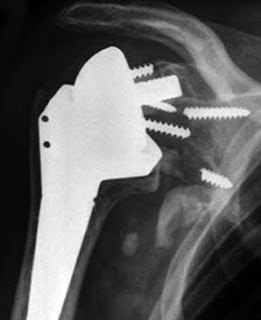
Here's a thought-provoking x-ray, not from this article.


And here's a recent case from our practice - fortunately one without a glenoid bone defect. Note the use of a glenoid component with a long screw for obtaining secure fixation of the glenosphere to the glenoid bone.


=


Check out the new Shoulder Arthritis Book - click here.


Use the "Search" box to the right to find other topics of interest to you.

You may be interested in some of our most visited web pages including:shoulder arthritis, total shoulder, ream and run, reverse total shoulder, CTA arthroplasty, and rotator cuff surgery as well as the 'ream and run essentials'