Showing posts with label management. Show all posts

Sunday, October 18, 2015

Clinical evaluation of the shoulder - our approach

It is traditional for surgeons to strive for a diagnosis for the shoulder problem and to derive a treatment from the diagnosis. For us, however, the clinical evaluation is the beginning of the doctor-patient relationship. The goal is not so much to come up with a diagnosis that will drive to a specific treatment, but rather to carry out an evaluation of the patient that leads to a reasonable management plan.

We like to emphasize the importance of the 4 P’s that determine the outcome of treatment: the patient, the shoulder problem the patient is experiencing, the procedure used to treat the patient and the problem, and the physician rendering the treatment. We place the patient first on this list because as Osler is quoted as saying, “it is more important to know what patient a disease has than what disease the patient has.” When introducing ourself and shaking the patient’s hand we can sense a lot – healthy or frail, positive or negative, smelling of cigarettes or not. To learn a bit more, we ask the patient ‘where are you from and what do you do there?” In an instant we’ve done a lot to determine if the person might benefit from a surgical approach should one be appropriate for the problem.  Next, we like to ask “what can we help you with today?” giving the patient some uninterrupted time to answer. The patient with posterior instability may respond with “I can’t do my job”, “I need more pain medicine”, “my lawyer sent me” or “my shoulder keeps on slipping out when I lift something in front of me” – same diagnosis, four different problems.

We like to avoid dwelling on pain, so rather than asking ‘where does your shoulder hurt’, we prefer to ask ‘what does your shoulder problem keep you from doing?’ When does it bother you the most? Following with ‘how and when did that problem start?’ ‘how much force was applied to your shoulder in the injury and what position was it in when the force was applied? and ‘tell me about the treatment you’ve had for it up to now’.  Trying to learn more about the patient, we ask questions such as  “how is your overall health, how active are you, what medications are you on, have you had prior surgeries and how did they work out?

Our physical exam starts with a ‘no touch’ approach. “Show me what actions are difficult for your shoulder” “what does it feel like is happening when you do these things?” To check active motion we ask patients to show me with each shoulder how high they can reach overhead, how far they can externally rotate the shoulder  with the arm at the side, how far they can reach across the body, how far they can internally rotate the abducted arm, and how high they can reach up the back. If patients cannot raise the arm actively, we ask them to show how high they can raise it with the help of the opposite arm. At this point, without having ever touched the patient we usually have a fairly good understanding of the problem  and whether the patient is likely to be a good candidate for surgical intervention. The remainder of my history, physical examination and plain radiographs seek to refine this understanding.

There are many ‘tests’ that have been described for evaluating shoulder problems,  these tests are rarely capable of discriminating among the potential problems; a "Hawkins test" may be positive in  rotator cuff disease, arthritis, or frozen shoulder.  Instead our exam seeks more tangible findings, such as loss of the passive or active range of motion,  a palpable defect in the rotator cuff, minimal resistance to anterior translation of the humeral head pressed into the glenoid, palpable subacromial crepitance, muscle atrophy, loss of the biceps reflex, or an obvious ‘clunk’ on cross body adduction.

Bottom line, if the problem is not apparent on history, physical, and plain radiographs or if the patient does not appear to be an excellent surgical candidate, we're likely to recommend non-operative management.  This remains the case even if MRI’s show ‘acromioclavicular arthrosis’, ‘labral fraying’, a “HAGL” lesion, or ‘supraspinatus tendinosis’.
===

Check out the new Shoulder Arthritis Book - click here.


Use the "Search" box to the right to find other topics of interest to you.

You may be interested in some of our most visited web pages including:shoulder arthritis, total shoulder, ream and runreverse total shoulderCTA arthroplasty, and rotator cuff surgery as well as the 'ream and run essentials'


Saturday, November 30, 2013

Treatment of rotator cuff tears in patients over the age of 70 years


Rotator cuff tears after 70 years of age: A prospective, randomized, comparative study between decompression and arthroscopic repair in 154 patients.

The incidence of cuff tears in asymptomatic shoulders increases with age.

Thus discussion of management of cuff tears in older individuals is complicated by the observation that many are asymptomatic and probably chronic and atraumatic.

These authors report the results of a prospective, comparative, multicenter study of 154 patients 70 years of age or older in which treatment was randomize to arthroscopic repair or decompression. Of the included patients, 143 (70 repair and 73 decompression) were seen at one-year follow-up; these patients had an average age of 75 years. Inclusion criteria were:

patient 70 years of age or older (no upper limit);
complete supraspinatus tear that can be reduced without tendon release;
extension limited to the upper-third of the infraspinatus,
no significant subscapularis involvement;
fatty infiltration ≤ 3;
stage 1 or 2 retraction, according to the Patte classification;
flexible shoulder, with no subacromial or glenohumeralimpingement.

The exclusion criteria were :
massive tears requiring intra-operative arthrolysis;
non-reducible tear without excessive tension;
partial rotator cuff tear;
instability associated with the cuff tear.

This was not actually a randomized study; rather the authors used a comparative design because they felt that random allocation by drawing lots was "overly restrictive and hard for patients to accept". Instead they "indirectly randomized" consecutive cohorts to simplify the decision-making and explanations during patient care, and also to allow inclusion or every patient 70 years or older. The protocol attempted to recruit two consecutive 6-month cohorts. In half the centers, every patient of at least 70 years of age seen during the first 6 months was treated with surgical repair, while every patient seen in the next 6 months received palliative decompression. In the other half of the centers, the decompression cohort was recruited in the first 6 months and the repair cohort during the second 6 months. The patients in the two groups had similar ages, preoperative scores, severity of cuff tears and ease of tendon reduction. Nevertheless a more robust experimental design would be to randomize the treatment at surgery after the arthroscopic findings were documented; proper randomization avoids the risk of selection bias.

All patients had an acromioplasty; 92% had biceps tenotomy or tenodesis. The repair technique was single or double row according to surgeon preference. Apparently the decompression group received only an acromioplasty. Shoulders having only decompression were immobilized for 10 days and those having repair for six weeks.

Overall, patients were improved: Constant +33.81 (P<0.001), ASES +52.1 (P<0.001), SST +5.86 (P<0.001).
Patients having repair faired better than those having decompression: Constant (+35.85 vs. +31.8, P<0.05), ASES (+56.09 vs. +48.17, P=0.01), SST (+6.33 vs. +5.38, P=0.02). The difference observed between repair and decompression was greater in patients with more retracted tears and lesser in patients with more severe fatty infiltration.

No data on the integrity of the repairs is available. It has been reported that a high percentage of arthroscopic repairs may retear, even though the patients experienced excellent pain relief at one year.

So without the data on the integrity of the repairs, we do not know the relationship of the success of the repair in re-establishing the attachment of the tendon to bone to the success of improving the clinical outcome and do not understand the benefit of attempting a repair if it is not durable.

A final comment is that there is a risk in performing an acromioplasty in shoulders with a cuff defect: 'decompression' of a shoulder with a significant cuff defect may lead to anterosuperior escape and pseudo paralysis.

So, the bottom line is that careful thought needs to go into the decision of when to repair and when not to repair a cuff defect, especially atraumatic chronic tears in older individuals.

===
Consultation for those who live a distance away from Seattle.

**Check out the new (under construction) Shoulder Arthritis Book - click here.**

To see the topics covered in this Blog, click here


Use the "Search" box to the right to find other topics of interest to you.

You may be interested in some of our most visited web pages including:shoulder arthritis, total shoulder, ream and run, reverse total shoulder, CTA arthroplasty, and rotator cuff surgery as well as the 'ream and run essentials'

See from which cities our patients come.

See the countries from which our readers come on this post.

Monday, August 27, 2012

Practical Evaluation and Management of the Shoulder, Diagnosis, Treatment

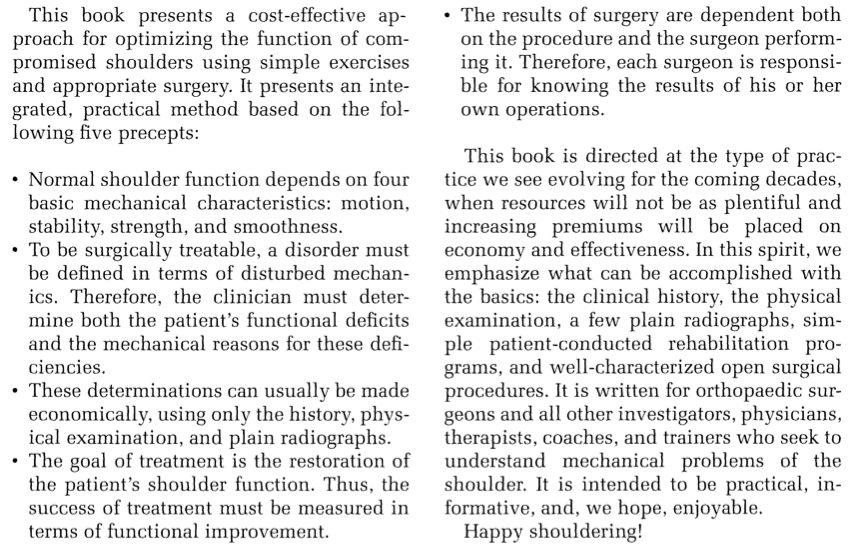
Back in 1994, John Sidles, Doug Harryman, Steve Lippitt and I published a book entitled Practical Evaluation and Management of the shoulder. In that the book is now out of print, many have asked how they might get a copy. Recently, the publisher has kindly allowed us to offer a PDF of the book here.

The philosophy and science in this book are as applicable today as they were twenty years ago. Here is our preface (click on it to enlarge):


--
Use the "Search" box to the right to find other topics of interest to you.

You may be interested in some of our most visited web pages including:shoulder arthritis, total shoulder, ream and runreverse total shoulderCTA arthroplasty,  and rotator cuff surgery.