Showing posts with label retear. Show all posts

Friday, November 22, 2024

Does it matter to the patient whether a rotator cuff repair heals or not?


A bit of context.

In large part, rotator cuff tears are a consequence of aging, increasing in prevalence in older individuals. A high percentage of these tears are asymptomatic (link, link, link). Some studies comparing non-operative and surgical treatment of cuff tears have found similar outcomes for each (linklinklink).

In 1962 McLaughlin wrote about the rotator cuff: “In youth, it is thick, strong, and elastic and can be disrupted only by great force; after middle-age it has worn thin and often becomes so weak and brittle that it ruptures with ease”. On surgical management, he added “The wise surgeon, realising that he may find little but rotten cloth to sew, will operate only by necessity and make a carefully guarded prognosis”. 

Primary Cuff Repairs

Surgeons in the United States perform over 400,000 rotator cuff repair surgeries annually, with each procedure costing between $8,400 and $56,200.  Thus the total annual expenditure on rotator cuff repair surgeries in the U.S. ranges from approximately $3.36 billion to $22.48 billion. It is important to note that these figures represent direct surgical costs and do not account for additional expenses such as preoperative evaluations, postoperative rehabilitation, or potential costs associated with surgical complications. Therefore, the overall economic impact of rotator cuff injuries and their treatment is likely higher. The rate of rotator cuff repairs per 100,000 citizens is increasing steadily (linklinklink). Rotator cuff repair remains the most commonly performed shoulder surgery.

As pointed out in Rotator cuff repair: published evidence on factors associated with repair integrity and clinical outcome,  innovations in surgical technique, instrumentation, augmentation or biologics do not appear to be leading to improved clinical outcomes perceived by the patient.


New, more expensive innovations for cuff repair are being used; for some of these there is questionable evidence of improved benefit/cost.

Editorial Commentary: Bioinductive Collagen Implants Reduce Rotator Cuff Retear, yet Cost-Effectiveness and Improvement in Clinical Outcomes Are Unclear"Unfortunately, retear rates do not appear to have improved significantly since the 1980s, despite advances in surgical technology and the biomechanics of repair."

No Short-term Clinical Benefit to Bovine Collagen Implant Augmentation in Primary Rotator Cuff Repair: A Matched Retrospective Study

Ambulatory Surgery Centers Reduce Patient Out-of-Pocket Expenditures for Isolated Arthroscopic Rotator Cuff Repair, but Patient Out-of-Pocket Expenditures Are Increasing at a Faster Rate Than Total Healthcare Utilization Reimbursement From Payers


Subacromial Balloon Spacer Versus Partial Rotator Cuff Repair in the Treatment of Massive Irreparable Rotator Cuff Tears: Facility Personnel Allocation and Procedural Cost Analysis "The facility cost of subacromial balloon spacer was significantly higher than that of partial cuff repair"


Surgeon idiosyncrasy is a key driver of cost in arthroscopic rotator cuff repair: a time-driven activity-based costing analysis "The largest cost drivers of aRCR are the use of biologic adjuncts, augments, the use of multiple suture anchors, and certain anchor brands."


Arthroscopic Transosseous Rotator Cuff Repair may be more cost effective than suture anchor repairs.


Use of intraoperative platelet-rich plasma during rotator cuff repair is correlated with increased patient-level charges across multiple categories


Measurement of value in rotator cuff repair: patient-level value analysis for the 1-year episode of care "There was a poor correlation between the clinical outcome and the cost of care."


The primary cost drivers of arthroscopic rotator cuff repair surgery: a cost-minimization analysis of 40,618 cases"Surgeon-controllable factors significantly increase cost, most notably subacromial decompression, distal clavicle excision, use of regional anesthesia, and the number of suture anchors.


Failed Cuff Repairs 


Healthcare costs of failed rotator cuff repairs are approaching one half billion dollars.


A recent article,The clinical impact of retears after repair of posterosuperior rotator cuff tears: a systematic review and meta-analysis assessed the published data on the consequences for the patient of a retear after surgical repair of a torn rotator cuff. The authors reviewed 43 studies including  3350 patients. The average age of the participants was 62 years (range, 52-78 years). 

At a median of 18 months' follow-up  844 repairs (25%) were described as retorn on imaging. 

The differences in patient assessed outcome between healed repairs and retears at follow-up were statistically significant, but the differences in pain, function, or quality of life were not clinically significantly different for healed and retorn cuff repairs.

In light of the foregoing, there is an opportunity to reconsider the approach to the patients with cuff tears, making sure that they are aware of 

(1) the factors potentially influencing the rate of successful tendon healing such as age, tear size, and severity of muscle degenerative changes as pointed in Degenerative Rotator Cuff Tears: Refining Surgical Indications Based on Natural History Data

(2) the complications that can be associated with cuff repair. The authors of Complications Within 6 Months After Arthroscopic Rotator Cuff Repair: Registry-Based Evaluation According to a Core Event Set and Severity Grading found that the cumulative risk for adverse events at 6 months after rotator cuff repair was 18.5% (21.8% for partial tears, 15.8% for full-thickness single-tendon tears, 18.0% for tears with 2 ruptured tendons, and 25.6% for tears with 3 ruptured tendons). These adverse events included shoulder stiffness, persistent or worsening pain, rotator cuff defects, neurologic lesions, surgical-site infection, device failure, and others.

(3) the recovery or "down time" period. In Functional Recovery Period after Arthroscopic Rotator Cuff Repair: Is it Predictable Before Surgery? 31% took less than 3 months, 40% took between 3 and 6 months, and 28% took greater than 6 months to achieve a score greater than 80%. Age, shoulder stiffness, and rotator cuff tear size influenced functional recovery time.

What about non-repair surgery?

The observation in  The clinical impact of retears after repair of posterosuperior rotator cuff tears: a systematic review and meta-analysis that shoulders with anatomically failed (retorn) and anatomically successful cuff (not retorn) repairs both have similar clinical outcomes makes us wonder what leads to the clinical improvement if the repair is retorn. What might happen if patients at high risk for retear, those concerned about complications and those not wishing to experience the protracted period of recovery were treated with a non-repair surgery (that is, a smooth and move / debridement). 

Smooth and Move in the Treatment of Irreparable Cuff Tears - Technique and Case Example

One of the major advantages of the smooth and move is that the patient can go back to active use of their shoulder immediately post surgery - because nothing is repaired there is no repair to protect. This is in marked contrast to the postoperative restrictions on motion during the healing period recommended for the balloon, patches, augments, partial repairs and superior capsular reconstruction. This is illustrated in the examples shown below,

The smooth and move in the management of irreparable tears or failed rotator cuff repairs

Can a subacromial balloon do this?


Here are some relevant articles from the literature on the effectiveness of the smooth and move

Significant improvement in patient self-assessed comfort and function at six weeks after the smooth and move procedure for shoulders with irreparable rotator cuff tears and retained active elevation.The smooth and move procedure provided clinically significant improvement as early as 6 weeks after surgery.

Treatment of irreparable cuff tears with smoothing of the humeroscapular motion interface without acromioplasty In 77 shoulders with irreparable tears, simple shoulder test (SST) scores improved from an average of 4.6 (range 0-12) to 8.5 (range 1-12) (p < 0.001). Fifty-four patients (70%) improved by at least the minimally clinically important difference (MCID) of 2 SST points.

Partial rotator cuff repair versus debridement for irreparable rotator cuff tears: A systematic review In 153 shoulders treated with debridement, post-operative satisfaction was 80.7 %.

Comparison of Multiple Surgical Treatments for Massive Irreparable Rotator Cuff Tears in Patients Younger Than 70 Years of Age found that most studies did not evaluate treatment with simple debridement in comparison to more complex procedures. However for studies that did, debridement had the highest P-score (probability of achieving the desired outcome), as shown below.


Forrest plot for Constant Score:


Forrest plot for range of active forward flexion:

This network meta-analysis found that simple debridement was the most effective procedure in significantly improving Constant score and active flexion for individuals with massive irreparable cuff tears when it was compared to other more complex surgical modalities. 

Comment

Of course we know that many thousands of patients benefit from rotator cuff repair surgery each year. For the majority, the procedure improves shoulder comfort and function. This is especially the case for acute tears in healthy patients with good quality cuff tendon and muscle.

For chronic cuff tears, a trial of non-operative management, including gentle stretching and strengthening can often be helpful and does not preclude surgical intervention if it becomes necessary.

For patients with large, chronic, atraumatic cuff tears, there may be a downside of attempting a rotator cuff repair with the risks of retear, complications, dissatisfaction, prolonged recovery, and cost. Evidence is currently lacking that these downsides can be eliminated by new innovative surgical approaches. Against this background a non-repair alternative, such as smooth and move/debridement, may be a cost-effective and safe consideration for selected patients with retained preoperative active elevation. Furthermore, the smooth and move does not burn bridges for other more complex procedures should they become indicated.

You can support cutting edge shoulder research that is leading to better care for patients with shoulder problems, click on this link

Follow on twitter/X: https://x.com/RickMatsen

Here are some videos that are of shoulder interest
Shoulder arthritis - what you need to know (see this link).
How to x-ray the shoulder (see this link).
The ream and run procedure (see this link).
The total shoulder arthroplasty (see this link).
The cuff tear arthropathy arthroplasty (see this link).
The reverse total shoulder arthroplasty (see this link).
The smooth and move procedure for irreparable rotator cuff tears (see this link).
Shoulder rehabilitation exercises (see this link). 

Saturday, April 6, 2024

Stump water - a risk factor for failure of rotator cuff repair

The authors of Tendon stump type on magnetic resonance imaging is a predictive factor for retear after arthroscopic rotator cuff repair investigated the tear size, Goutallier stage, and global fatty degeneration index, seeking factors associated with retear after cuff repair. They also classified the rotator cuff tendon stump (yellow circle) by preoperative oblique coronal image plane T2-weighted fat-suppressed magnetic resonance imaging (MRI), comparing its signal intensity to that of the nearby deltoid muscle (red circle) in 305 patients having arthroscopic cuff repair. 


The authors classified the value of the rotator cuff stump signal intensity (C) divided by the deltoid signal intensity (D) into 3 types defining the stump classification in terms of the C/D ratio.The stump was classified as type 1 if the stump appeared darker than the deltoid, with a C/D ratio less than 0.8; as type 2 if the stump was similar in darkness to the deltoid, with a C/D ratio of 0.8 to 1.3; and as type 3 if the stump appeared whiter than the deltoid, with a C/D ratio greater than 1.3.


The retear rates were 3.4% for type 1 stumps, 4.9% for type 2, and 17.7% for type 3. As shown below, the stump type did not appear to correlate with age, Goutallier stage, GFDI or tear size.


As shown below, multiple regression analysis identified stump type as having the strongest association with retear (odds ratio [OR], 4.28), followed by global fatty degeneration index (OR, 2.99), and anteroposterior tear size (OR, 1.06).


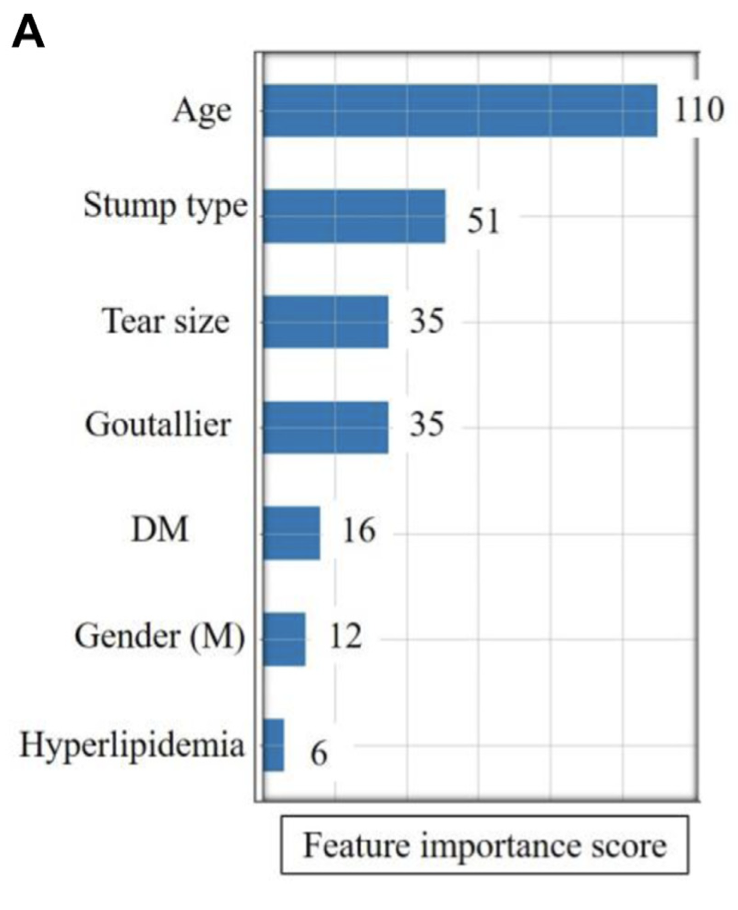
A more recent paper, Re-tear after arthroscopic rotator cuff tear surgery: risk analysis using machine learning found that the most important features predicting re-tears after cuff repair were age, stump type, tear size, and Goutallier grade. 

  1. Comment: As these studies demonstrate, the failure risk of rotator cuff repair is influenced by the quality and quantity of cuff tissue available for repair. Stump type is a relatively newly described characteristic.

    The signal intensity on T2-weighted tendon stump images is increased by three factors, each of which can affect the ability of tendon to resist cuff repair suture pull through:

    Water Content: Tissues with higher water content generally have longer T2 relaxation times and appear brighter on T2-weighted images. 

    Protein Content: Tissues with lower protein content tend to have longer T2 relaxation times and appear brighter on T2-weighted images.

    Tissue Structure: Tissues with more disorganized structures, such as muscle, exhibit longer T2 relaxation times and appear brighter compared to tissues with highly organized structures, such as normal tendons or ligaments.

    You can support cutting edge shoulder research that is leading to better care for patients with shoulder problems, click on this link.

    Follow on twitter: https://twitter.com/RickMatsen or https://twitter.com/shoulderarth
    Follow on facebook: click on this link
    Follow on facebook: https://www.facebook.com/frederick.matsen
    Follow on LinkedIn: https://www.linkedin.com/in/rick-matsen-88b1a8133/

    Here are some videos that are of shoulder interest
    Shoulder arthritis - what you need to know (see this link).
    How to x-ray the shoulder (see this link).
    The ream and run procedure (see this link).
    The total shoulder arthroplasty (see this link).
    The cuff tear arthropathy arthroplasty (see this link).
    The reverse total shoulder arthroplasty (see this link).
    The smooth and move procedure for irreparable rotator cuff tears (see this link).
    Shoulder rehabilitation exercises (see this link).


Friday, May 19, 2023

Are non-steroidal anti-inflammatory drugs (NSAIDs) appropriate after cuff repair - if so, which ones? What does ChatGPT say?


Non-steroidal anti-inflammatory drugs (NSAIDs) are powerful analgesics and can provide an important mode of pain management after surgery (see Nonsteroidal antiinflammatory drugs (NSAID) - are we using them enough?). 

There has been concern, however, that NSAIDs may interfere with healing of tendon repair to bone as in rotator cuff repair or subscapularis repair after shoulder arthroplasty (see Do anti inflammatory medications interfere with healing? and Should patients take anti-inflammatory medications after rotator cuff repair?

Selective COX-2 inhibitors are a class of NSAIDs that reduce the risk of peptic ulceration, which can be a problem with the non-selective NSAIDS. However, clinical trials have revealed that COX-2 inhibitors significantly increase the risk of heart attacks and strokes. For that reason, most COX-2 inhibitors have been removed from the market, only Celebrex (generic name of celecoxib) is still available for purchase in the United States.

In addition to concerns about heart attacks and strokes, there is a particular concern about the effect of selective COX-2 inhibitors, such as Celebrex, on tendon healing (see Does Celebrex interfere with tendon healing?).

The authors of Non-selective NSAIDs do not increase retear rates post-arthroscopic rotator cuff repair: A meta-analysis sought to investigate the effect of postoperative NSAIDs on retear rates and clinical outcomes for cuff repair.
They included 6 studies in their meta-analysis with 443 (48.3%) patients in the NSAID group and 473 (51.6%) patients in the Control group. 

There were no statistically significant differences in early and late post-operative VAS scores and latest ASES score. In the NSAID group, the pooled retear rate was 25%; in the control group, the pooled retear rate was 21%. Meta-analysis of odds ratio did not yield any statistical significance between the two groups.

However, they conducted a subgroup analysis which demonstrated that inclusion of selective COX-2 inhibitors (‘COX-2 only OR both’ subgroup) leads to significantly higher retear rates when compared to non-selective COX inhibitors (‘Non-selective COX only’ subgroup). 
The authors concluded that NSAIDs use in post-arthroscopic rotator cuff repair pain relief does not increase retear rates and can provide similar clinical outcomes compared to a non-NSAID regime.

Comment:  While selective COX-2 inhibitors may have a potential advantage over traditional, non-selective NSAIDs in terms of the risk of gastrointestinal problems, the potential impact on healing probably outweighs the benefits it offers. And, of course, there's the increased risk of heart attacks and strokes.The risk of gastritis and ulcers with non-selective NSAIDS can often be mitigated through the use of proton-pump-inhibitors (PPIs).

We asked ChatGPT "why do COX-2 drugs interfere with soft tissue healing? " Its response is quoted below

"COX-2 drugs, also known as selective COX-2 inhibitors or nonsteroidal anti-inflammatory drugs (NSAIDs), have been associated with potential interference in soft tissue healing. While the exact mechanisms are not fully understood, several factors contribute to this phenomenon:

Inhibition of prostaglandin synthesis: COX-2 inhibitors selectively block the enzyme cyclooxygenase-2 (COX-2), which is responsible for the production of prostaglandins. Prostaglandins play a crucial role in the inflammatory response and are involved in various stages of tissue healing, including inflammation, angiogenesis (formation of new blood vessels), and collagen synthesis. By inhibiting prostaglandin synthesis, COX-2 inhibitors can disrupt these processes, potentially slowing down tissue healing.

Impaired inflammation response: Inflammation is a necessary and natural part of the healing process, as it helps to clear away damaged tissues, recruit immune cells, and initiate tissue repair. COX-2 inhibitors, by reducing the production of prostaglandins, can dampen the inflammatory response. While this anti-inflammatory effect may be beneficial in controlling pain and swelling, it can also interfere with the timely and appropriate inflammatory phase of healing, potentially impacting tissue repair and regeneration.

Altered angiogenesis: Angiogenesis is a critical step in tissue healing, as it brings oxygen and nutrients to the healing site, aiding in the formation of new blood vessels. Prostaglandins, which are inhibited by COX-2 drugs, play a role in promoting angiogenesis. By reducing prostaglandin levels, COX-2 inhibitors may interfere with the proper formation of blood vessels, negatively impacting tissue healing.

Collagen synthesis disruption: Collagen is the main structural component of soft tissues, providing strength and stability. Prostaglandins are involved in collagen synthesis, and their inhibition by COX-2 drugs can disrupt the proper formation and organization of collagen fibers. This interference can affect the tensile strength and integrity of the healing tissue."

You can support cutting edge shoulder research that is leading to better care for patients with shoulder problems, click on this link.

Follow on twitter: https://twitter.com/shoulderarth
Follow on facebook: click on this link
Follow on facebook: https://www.facebook.com/frederick.matsen
Follow on LinkedIn: https://www.linkedin.com/in/rick-matsen-88b1a8133/

Here are some videos that are of shoulder interest
Shoulder arthritis - what you need to know (see this link).
How to x-ray the shoulder (see this link).
The ream and run procedure (see this link).
The total shoulder arthroplasty (see this link).
The cuff tear arthropathy arthroplasty (see this link).
The reverse total shoulder arthroplasty (see this link).
The smooth and move procedure for irreparable rotator cuff tears (see this link).
Shoulder rehabilitation exercises (see this link).


Thursday, May 18, 2023

Failure of healing after cuff repair - why are the rates so high?

The normal attachment of the rotator cuff tendons to the bone of the tuberosity is through a complicated transition from flexible tendon, to unmineralized fibrocartilage, to mineralized fibrocartilage to bone (see Assembly, maturation, and degradation of the supraspinatus enthesis)

This progressive transition from flexible tendon to stiff bone enables the insertion to manage the twisting, traction and compression loads to which it is exposed throughout life. Nature's strategy is similar to that used in the construction of an electrical plug, with progressive transition from stiff to flexible with the goal of minimizing wire breakage with use.


When we attempt to repair a torn rotator cuff, our approximation of the edge of the torn tendon to bone does not re-establish a normal enthesis; thus our repair is inferior to the normal insertion and, as such, vulnerable to failure. "Healing and repair of an injured and degenerated supraspinatus enthesis remain a challenge, as the original graded transitional tissue of the fibrocartilaginous insertion is not re-created after the tendon is surgically reattached to bone. Instead, mechanically inferior and disorganized tissue forms at the healing site because of scar tissue formation."


In addition there are other factors that challenge  the durable healing of a rotator cuff repair:

1. the tendon and bone are relatively avascular

2. tears often occur in tendons that have degenerated with compromised quantity and quality increasing the risk of sutures puling through the tendon

3. approximation of the retracted tendon to the repair site puts it under tension

4. it is difficult to completely immobilize the shoulder to protect the repair

5. the repair site is bathed in joint fluid that contain enzymes that can interfere with the healing response such as 
    *elastase (breaks down elastin and collagen fibers), 
    *plasmin (degrades fibrin clots, breaks down proteins and extracellular matrix)
    *collagenases (break down collagen), 
    *matrix metalloproteinases (degrade components of the extracellular matrix)
    *phospholipases (break down phospholipids, important components of cell membranes) 
    *cathepsin B and cathepsin D (breakdown of proteins)

As pointed out in Failure With Continuity in Rotator Cuff Repair "Healing" even when it appears that the cuff repair has healed by MRI, the tendon edge may not have actually healed to bone.

It is generally believed that early repair of acute traumatic cuff tears provides the highest chance of healing. However, the authors of Factors associated with healing failure after early repair of acute, trauma-related rotator cuff tears, found that even in this situation, healing failure occurred in more than 1 in 3 cases. They sought to identify factors associated with healing failure in 62 previously asymptomatic patients (median age 61 years, range 42 to 75) with trauma-related rotator cuff tears treated with early arthroscopic repair verified by MRI. Fatty infiltration (FI) was analyzed as global index, as well as in individual muscles separately. Surprisingly, only 79% of the individuals had a normal index for global FI preoperatively despite the fact that their cohort comprised trauma related tears in individuals without any history of shoulder dysfunction. 57 of these patients (92%) completed a 1-year follow-up and had repair integrity assessed on MR images according to Sugaya. 

In spite of the fact that these patients seemed to have optimal conditions for successful repair - traumatic tears repaired within 6 weeks of injury - 37% of the repairs were not intact at one year after surgery.

Risk factors for healing failure were a high degree of fatty infiltration of the supraspinatus muscle, disruption of rotator cable integrity, and older age. Histopathologic degeneration of the tendon at the time of repair was not significantly associated with healing failure.

Another recent study illustrates again the difficult in achieving durable integrity of the cuff tendon attachment to bone.. The authors of Massive Rotator Cuff Tears With Short Tendon Length Can Be Successfully Repaired Using Synthetic Patch Augmentation. They evaluated 15 patients having massive cuff tears with good muscle quality but short tendon length (mean age 57 years,  86.7% male) at a mean follow-up of 43.8 months (27-55 months) after repair with patch augmentation. By MRI, there were three Sugaya grade 4 and five Sugaya grade 5 re-ruptures resulting in a re-tear rate of 53%. 


In that the goal of cuff repair surgery is to durably attach the tendon to bone,  a look at the articles published in 2023 indicates that failure of tendon healing continues to be an important issue after cuff repair. The retear rates (in bold) reported in these studies are affected by the nature of the tear, the age of the patients, the method for determining the postoperative integrity of the cuff, and the length of followup. 

13-20% Outcome of Intraoperative Injection of Collagen in Arthroscopic Repair of Full Thickness Rotator Cuff Tear: A Retrospective Cohort Study
14-17% Comparison of suture-bridge and independent double-row techniques for medium to massive posterosuperior cuff tears: a two-year retrospective study
18-57% Prospective Randomized Trial of Biologic Augmentation With Bone Marrow Aspirate Concentrate in Patients Undergoing Arthroscopic Rotator Cuff Repair
23% Prospective study of 90 arthroscopic rotator cuff repairs for isolated distal supraspinatus tear, assessing the impact of cardiovascular risk factors on tendon healing
10-63% Arthroscopic Rotator Cuff Repair Results in Improved Clinical Outcomes and Low Revision Rates at 10-Year Follow-Up: A Systematic Review
13-18% Functional and Structural Outcomes After Arthroscopic Rotator Cuff Repair With or Without Preoperative Corticosteroid Injections
12-19% Comparison of cost, surgical time, and clinical results between arthroscopic transosseous rotator cuff repair with lateral cortical augmentation and arthroscopic transosseous equivalent suture bridge: A propensity score-matched analysis
17-25% Onlay patch augmentation in rotator cuff repair for moderate to large tears in elderly patients: clinical and radiologic outcomes
13-27% Efficacy of bone marrow stimulation for arthroscopic knotless suture bridge rotator cuff repair: a prospective randomized controlled trial
33-38% Functional outcomes and MRI-based tendon healing after (antero-) superior rotator cuff repair among patients under 50 years: retrospective analysis of traumatic versus non-traumatic rotator cuff tears
26-28% Local Intraoperative Marrow-Derived Augmentation for Primary Rotator Cuff Repair: An Updated Systematic Review and Meta-analysis of Studies From 2010 to 2022
21-25% Non-selective NSAIDs do not increase retear rates post-arthroscopic rotator cuff repair: A meta-analysis
17-23% Postoperative HbA1c Level as a Predictor of Rotator Cuff Integrity After Arthroscopic Rotator Cuff Repair in Patients With Type 2 Diabetes
21% Prognostic factors affecting structural integrity after arthroscopic rotator cuff repair: a clinical and histological study
14% Re-Tear Rates Following Rotator Cuff Repair Surgery
19-34% The relationship between preoperative Goutallier stage and retear rates following posterosuperior rotator cuff repair: a systematic review
18-29% The role of bone marrow stimulation in rotator cuff repair: a systematic review and meta-analysis

Are efforts to repair the tendon attachment worthwhile?  
A couple of recent articles suggest that it doesn't much matter if the tendon heals or not. If that's the case, why do we put so much effort into the repair?

The authors of The clinical impact of retears after repair of posterosuperior rotator cuff tears: a systematic review and meta-analysis state "The negative impact of retears on pain and function was statistically significant but judged to be of minor clinical importance. The results indicate that most patients may expect satisfactory outcomes despite retears."  While the authors of Functional outcomes and MRI-based tendon healing after (antero-) superior rotator cuff repair among patients under 50 years: retrospective analysis of traumatic versus non-traumatic rotator cuff tears state "Cuff integrity at follow-up was not predictive of superior scores or strength."

On the the other hand, Harryman et al (Repairs of the rotator cuff. Correlation of functional results with integrity of the cuff) evaluated the results of 105 open repairs of tears of the rotator cuff in eighty-nine patients at an average of five years postoperatively. They correlated the functional result with the integrity of the cuff, as determined by ultrasonography. Eighty per cent of the repairs of a tear involving only the supraspinatus tendon were intact at the time of the most recent follow-up, while more than 50 per cent of the repairs of a tear involving more than the supraspinatus tendon had a recurrent defect. Older patients and patients in whom a larger tear had been repaired had a greater prevalence of recurrent defects. At the time of the most recent follow-up, most of the patients were more comfortable and were satisfied with the result of the repair, even when they had sonographic evidence of a recurrent defect. The shoulders in which the repaired cuff was intact at the time of follow-up had better function during activities of daily living and a better range of active flexion compared with the shoulders that had a large recurrent defect. Similar correlations were noted for the range of active external and internal rotation and for strength of flexion, abduction, and internal rotation. In the shoulders in which the cuff was not intact, the degree of functional loss was related to the size of the recurrent defect.

The anatomic results of rotator cuff repair reported in 2023 do not seem to be much of an improvement on these results published 32 years ago

You can support cutting edge shoulder research that is leading to better care for patients with shoulder problems, click on this link.

Follow on twitter: https://twitter.com/shoulderarth
Follow on facebook: click on this link
Follow on facebook: https://www.facebook.com/frederick.matsen
Follow on LinkedIn: https://www.linkedin.com/in/rick-matsen-88b1a8133/

Here are some videos that are of shoulder interest
Shoulder arthritis - what you need to know (see this link).
How to x-ray the shoulder (see this link).
The ream and run procedure (see this link).
The total shoulder arthroplasty (see this link).
The cuff tear arthropathy arthroplasty (see this link).
The reverse total shoulder arthroplasty (see this link).
The smooth and move procedure for irreparable rotator cuff tears (see this link).
Shoulder rehabilitation exercises (see this link).