Showing posts with label total joint replacement. Show all posts

Sunday, October 10, 2021

Total joint replacement complications in patients without diabetes - is too much sugar a bad thing?

Postoperative Hyperglycemia in Patients with and without Diabetes After Major Joint Replacement The Impact of an Enhanced Glucose Management Program

These authors observe that perioperative hyperglycemia can have a detrimental effect on postoperative outcomes in patients without diabetes, but that it has not been established if the treatment of patients without diabetes is safe and effective. 


They hypothesized that sliding-scale insulin for severe postoperative hyperglycemia (glucose ≥180 mg/dL) could lower mean postoperative glucose levels and minimize short-term complications in patients without diabetes undergoing major joint replacement.


Patients had a fasting glucose measurement taken on the morning of the surgical procedure. Point-of-care finger-stick glucose samples were taken in the post-anesthesia care unit (PACU), pre-dinner, at bedtime, and in the morning after the surgical procedure. Sliding scale insulin (lispro) was used to treat severe hyperglycemia in patients without diabetes.


They compared a prospective study group of 1,398 consecutive patients, with and without diabetes, undergoing joint replacement who were monitored and treated for hyperglycemia to a group of 886 historical, less frequently monitored control patients. 


Multivariable linear regression revealed factors that contributed to elevated mean glucose after arthroplasty in patients without diabetes: preoperative fasting glucose (p < 0.001), perioperative steroid use (p < 0.001), general anesthesia (p < 0.001), procedure duration (p = 0.003), and transfusion (p = 0.008). The most important variable predicting elevated postoperative glucose for both patients with diabetes and patients without diabetes was preoperative fasting glucose.


Of 968 patients without diabetes, 203 developed severe hyperglycemia. The recommended insulin coverage was given to 129 of these patients, and 74 patients did not receive it for various clinical

reasons. They found that in comparison to the historical controls, sliding-scale insulin for severe postoperative hyperglycemia (glucose ≥180 mg/dL) lowered the mean glucose for patients without diabetes.


No patient without diabetes who received insulin experienced mild or severe hypoglycemia.


Insulin treatment reduced the frequency of positive cultures from any site (p = 0.025) and a composite of positive cultures and readmissions (p = 0.006) in comparison with no insulin treatment. 
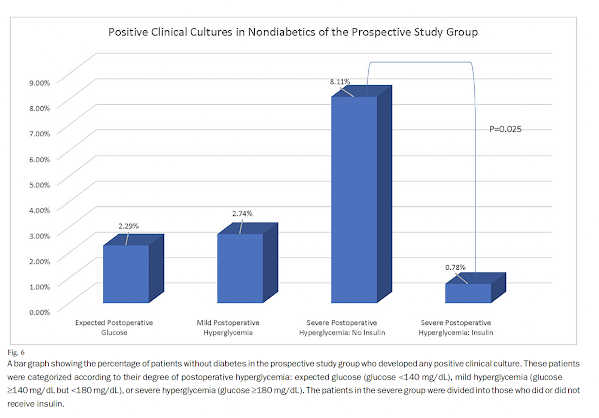


They concluded that postoperative hyperglycemia is frequent in patients without diabetes after orthopaedic surgery, but an enhanced glucose management program can lower mean postoperative glucose levels. The treatment of hyperglycemia in patients without diabetes reduced short-term complications and was associated with minimal side effects.


Comment:  The results of this study indicate the importance of measuring the preoperative fasting blood glucose.  Patients with elevated preoperative fasting glucose, perioperative steroid use, general anesthesia, long procedure duration, and transfusions should receive consideration for close postoperative monitoring and treatment of hyperglycemia.


Follow on twitter: https://twitter.com/shoulderarth

Follow on facebook: https://www.facebook.com/frederick.matsen

Follow on LinkedIn: https://www.linkedin.com/in/rick-matsen-88b1a8133/


How you can support research in shoulder surgery Click on this link.

Here are some videos that are of shoulder interest
Shoulder arthritis - what you need to know (see this link)
The smooth and move for irreparable cuff tears (see this link)
The total shoulder arthroplasty (see this link).
The ream and run technique is shown in this link.
The cuff tear arthropathy arthroplasty (see this link).
The reverse total shoulder arthroplasty (see this link).

Shoulder rehabilitation exercises (see this link).

This is a non-commercial site, the purpose of which is education, consistent with "Fair Use" as defined in Title 17 of the U.S. Code.          
Note that author has no financial relationships with any orthopaedic companies.


Monday, August 30, 2021

Smoking and total joint replacement safety


Smoking Cessation Initiatives in Total Joint Arthroplasty, An Evidence-Based Review


Smoking has been portrayed as being glamorous or macho, leading young people to take it up. Its habit-forming tendency prompts older individuals to continue.


There are many adverse physiological changes that can result from smoking, changes that can contribute to complications after joint replacement.


Smoking is a well-established risk factor for postoperative complications such as delayed wound healing, infections, and early revision following total joint arthroplasty.  Such complications can be costly to treat, with hospital costs for TJA being about $5,000 higher for smokers compared with nonsmokers.  Currently, smoking cessation programs are the only intervention demonstrated to reproducibly improve outcomes for smokers undergoing TJA. Several randomized controlled trials have shown that perioperative smoking cessation programs confer short-term quit rates between 40% and 89%.


These authors conducted a review of the literature regarding smoking cessation and its effects of total joint arthroplasty outcomes. Their bullet point conclusions are:

» As smoking increases the risk of adverse events and leads to increased hospital costs following total joint arthroplasty (TJA), many institutions have introduced perioperative smoking cessation initiatives. Although such programs have been demonstrated to improve outcomes for smokers undergoing TJA, the optimal approach, duration, and timing of smoking cessation models have not been well-defined.

» Overall, initiating a smoking cessation program 4 weeks preoperatively is likely adequate to provide clinically meaningful reductions in postoperative complications for smokers following TJA, although longer periods of cessation should be encouraged if feasible.

» Patients brought in for emergency surgical treatment who cannot participate in a preoperative intervention may still benefit from an intervention instituted in the immediate postoperative period.

» Cotinine testing may provide some benefit for encouraging successful smoking cessation and validating self-reported smoking status, although its utility is limited by its short half-life. Further study is needed to determine the value of other measures of cessation such as carbon monoxide breath testing.

» Smoking cessation programs instituted prior to TJA have been demonstrated to be cost-effective over both the short and long term.


Here are a few other questions they considered:

(1)How long a period of abstinence is needed? The evidence is that 2 to 6 weeks of abstinence would be necessary to reduce the incidence of infection, 3 to 4 weeks to reduce wound-related complications, and 6 to 8 weeks to reduce pulmonary complications. Longer periods of smoking cessation decreased the rate of postoperative complications further, with each week of cessation increasing the magnitude of the effect.

(2) How can a surgeon know if the patient has ceased smoking? Smoking status is typically measured by patient self-reporting, cotinine tests, or CO breath testing. One study found that self-reporting was accurate 97% of the time while others found that 20% falsely reported abstinence. Cotinine is the major metabolite of nicotine and may be measured in the urine or saliva using immunoassay-based test strips. It has a half-life of 7 to 14 hours. CO breath tests measure the concentration of CO in expired air. Breath CO is a good indicator of recent smoking, but it has a half-life of only 2 to 3 hours and usually becomes undetectable around 24 hours after smoking cessation.

(3) What are the other benefits of smoking cessation? Smoking adds approximately $100 billion in annual direct health-care costs annually. Thus smoking cessation programs can provide even further potential value if abstinence from smoking is maintained. Additionally, it has been observed that smoking cessation programs encourage other positive lifestyle changes such as improved exercise, eating, and drinking habits, which can further contribute to improved patient health and decreased costs.


(4) What if smoking cessation cannot be achieved before surgery (e.g. in trauma cases)? If a preoperative intervention cannot be implemented (as in the case of emergency surgery), smokers should still be offered a smoking cessation intervention during postoperative hospitalization, as a reduction in postoperative complications may still be attainable. 


Comment: This is an informative article that makes a good case for smoking cessation in individuals considering joint replacement. 


Follow on twitter: https://twitter.com/shoulderarth

Follow on facebook: https://www.facebook.com/frederick.matsen

Follow on LinkedIn: https://www.linkedin.com/in/rick-matsen-88b1a8133/


How you can support research in shoulder surgery Click on this link.


Here are some videos that are of shoulder interest
Shoulder arthritis - what you need to know (see this link)
The smooth and move for irreparable cuff tears (see this link)
The total shoulder arthroplasty (see this link).
The ream and run technique is shown in this link.
The cuff tear arthropathy arthroplasty (see this link).
The reverse total shoulder arthroplasty (see this link).
Shoulder rehabilitation exercises (see this link).