Showing posts with label complication. Show all posts

Thursday, November 3, 2016

Increased total shoulder complication rate for smokers and patients with ASA of III

Total shoulder arthroplasty: risk factors for intraoperative and postoperative complications in patients with primary arthritis

These authors correlated patient-specific factors in 275 patients (76 men, 199 women) with an average age of 68 years (range, 51-85 years) with the number and severity of all complications after total shoulder arthroplasty.

They identified 27  complications (9.8%) in 275 shoulder arthroplasties.


Patients with an ASA score of III showed an increased likelihood of having a surgical complication compared with the control group with ASAscores of 1 and 2 (odds ratio, 4.28; 95% confidence interval, 1.79-10.20; P < .01).


Smokers (> 10 cigarettes/day) were more prone to surgical complications than nonsmokers (odds ratio, 5.08; 95% confidence interval, 1.96-13.11; P = .02).

Comment: We often refer to the 4 Ps that affect the outcome of surgery: the Patient, the Procedure, the type of shoulder Problem, and the Physician performing the surgery. This study identifies smoking and ASA classification as two important Patient factors. 


Saturday, January 25, 2014

Glenosphere dissociation in reverse total shoulder - minimizing the risk of this complication

Reverse total shoulder arthroplasty has provided a surgical option for problems that were previously insolvable, such as pseudoparalysis and anterosuperior instability of the glenohumeral joint.

By virtue of its constrained kinematics, the reverse total shoulder transmits loads directly from the humeral component to the glenoid component, without the suppleness of a normal or an anatomic arthroplasty. Thus, the fixation and integrity of reverse total shoulder components may be challenged by impacts that would be unlikely to affect a conventional total shoulder. Because the reverse total shoulder components are often modular and held together by Morse tapers and because they can be loaded in directions that can challenge the Morse taper, there is a risk of dissociation with impact loading.


Glenoid component dissociation has been reported with various designs of reverse total shoulders (Sirveaux 2004)(Ekelund 2011) (Zumstein 2011) (Middernacht 2008)(Farshad 2010)(Kempton 2011)(Clark 2012).

The risk of dissociation can be reduced by considering the geometry of the specific implant and the instruments, by specific surgical steps, by vigorous intraoperative testing and by cautioning the patient to avoid impact loading after surgery. 

As is the case with any Morse taper, incomplete seating - even by a fraction of a millimeter - can reduce the security of the cold weld between the two parts assembled by the taper. Complete seating can be prevented by fluid in the well of the female aspect of the assembly, by tissue or bone that block complete seating, or by insufficient force applied to impact the two components together.

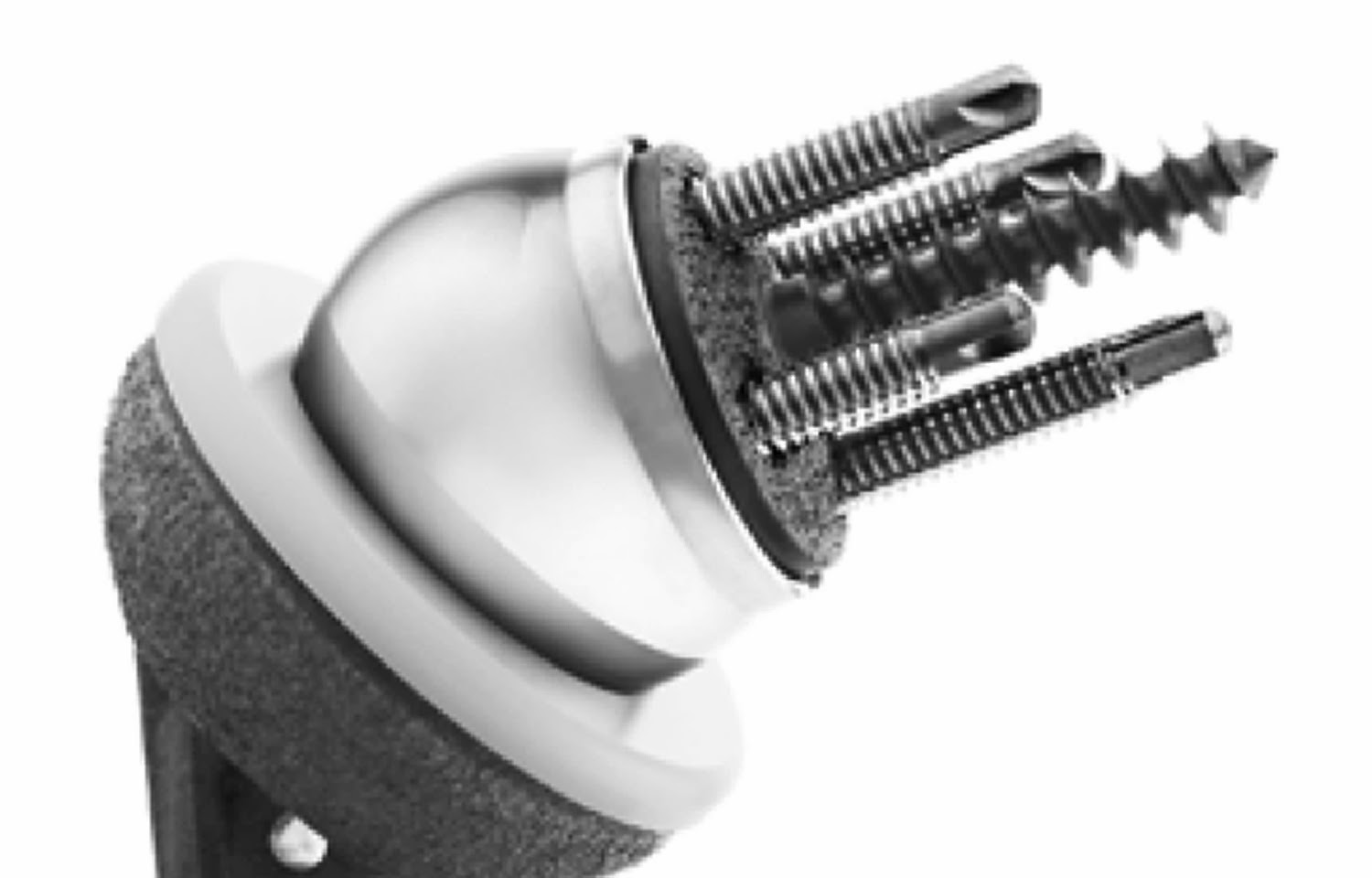
In the design shown below, the glenoid head (glenosphere) fits over the baseplate but does not completely cover it. thus it may be difficult to see whether or not the glenoid head is completely seated. 


Instruments, such as the rim reamer shown below help remove potentially interfering bone that may prevent the glenoid head from being completely seated.

This works well for the small glenoid head, because the outside diameter of the rim reamer is greater than that of the collar of the small glenoid head.


The rim reamer may be less effective when the collar of the glenoid head has an outside diameter greater than that of the rim reamer.


The principal method by which the seating can be verified is to pull vigorously on the glenoid head after it has been impacted into position, attempting to dissociate it from the baseplate. With some designs, vigorous traction can be applied using a t-handled instrument. An even better test can be performed by attempting to twist the glenosphere using the t-handle: if it twists on the base plate, it is not securely seated.


After surgery, patients need to be reminded that impact loading is to be avoided.

Our current reverse total shoulder technique is shown in this link.

Saturday, May 11, 2013

Diabetes control and wound complications after total joint surgery

Elevated Postoperative Blood Glucose and Preoperative Hemoglobin A1C Are Associated with Increased Wound Complications Following Total Joint Arthroplasty

From among 1702 patients having total joint replacements, those with wound complications within thirty days after the index arthroplasty were identified. A control group matched for exact age, sex, procedure, tourniquet use, surgical approach, and use of antibiotic cement was also created.

Patients with a mean postoperative glucose of >200 mg/dL had an odds ratio for developing a wound complication of 3.75. 
Patients with a maximum postoperative blood glucose of >260 mg/d had an odds ratio for developing a wound complication of 3.0
Patients with a preoperative hemoglobin A1C value of >6.7% had an odds ratio for developing a wound complication of 9.0.

The authors point that this study did not show that good glycemic control resulted in reduced risk. They did demonstrate that poor preoperative and postoperative glucose control is independently associated with wound complications.

These results are in contrast to those of
Surgical outcomes of total knee replacement according to diabetes status and glycemic control, 2001 to 2009, a study of Kaiser enrollees.
The authors found that of 40,491 patients who underwent total knee arthroplasty, 7567 (18.7%) had diabetes, 464 (1.1%) underwent revision arthroplasty, and 287 (0.7%) developed a deep infection. Compared with the patients without diabetes, no association between controlled diabetes (HbA1c < 7%) and the risk of revision (odds ratio [OR], 1.32; 95% confidence interval [CI], 0.99 to 1.76), risk of deep infection (OR, 1.31; 95% CI, 0.92 to 1.86), or risk of deep venous thrombosis or pulmonary embolism (OR, 0.84; 95% CI, 0.60 to 1.17) was observed. Similarly, compared with patients without diabetes, no association between uncontrolled diabetes (HbA1c ≥ 7%) and the risk of revision (OR, 1.03; 95% CI, 0.68 to 1.54), risk of deep infection (OR, 0.55; 95% CI 0.29 to 1.06), or risk of deep venous thrombosis or pulmonary embolism (OR, 0.70; 95% CI, 0.43 to 1.13) was observed.
The authors concluded that no significantly increased risk of revision arthroplasty, deep infection, or deep venous thrombosis was found in patients with diabetes (as defined on the basis of preoperative HbA1c levels and other criteria) compared with patients without diabetes in the study population of patients who underwent elective total knee arthroplasty.


===
Use the "Search" box to the right to find other topics of interest to you.

You may be interested in some of our most visited web pages including:shoulder arthritis, total shoulder, ream and run, reverse total shoulder, CTA arthroplasty, and rotator cuff surgery as well as the 'ream and run essentials'


See from which cities our patients come.


See the countries from which our readers come on this post.

Sunday, December 2, 2012

Management of peri-prosthetic fracture of the humerus with severe bone loss and loosening of the humeral component after total shoulder replacement JBJS B


Management of peri-prosthetic fracture of the humerus with severe bone loss and loosening of the humeral component after total shoulder replacement.

This article emphasizes the difficulty in managing periprosthetic fractures of the humerus. The fractures occurred in older individuals (average age 75, range up to 90 years). The great majority were in women. All but three of the 22 cases were in shoulders with cemented humeral components. 18 patients had severe osteopenia and 4 had mild osteopenia. 17 of the fractures were near the distal tip of the humeral component. While some of the fractures were treated with long stemmed prostheses, others required endoprosthetic replacement of the humerus to the level of the fracture. The authors report a 60% five-year survivorship of these revisions along with complications ranging from instability, component failure, non-union, infection, and nerve palsies.

These authors are to be commended on their valiant attempts to reconstruct these fractures in older individuals with soft bone.

Perhaps the real lesson to be derived from this study is that we need to better understand the factors that might predispose patients to this devastating complication. See our previous posts on the topic. The authors list risk factors as including female gender, revision surgery, press-fit humeral components, rheumatoid arthritis, over-reaming of the humeral canal, proximal humeral deformity or malunion, soft-tissue contracture, aggressive manipulation and osteopenia. It is apparent that any humeral technique that stiffens the upper half of an osteopenic humerus will risk fracture at the tip of the prosthesis. Thus cemented components (as shown in the study) can place the humerus at risk as can press fit components with a tight fit of the prosthetic tip in the diaphysis.


We have sought to minimize the risk of intraoperative and postoperative humeral fractures by avoiding cement (which can create a stress riser at the end of the cement), by avoiding endosteal reaming (which can create a stress riser by notching the inside of the diaphysis), by avoiding a tight cortical fit of the prosthetic stem (which can create a stress riser at the tip of the prosthesis), and by avoiding forcing a too-large prosthesis into smallish bone.

Instead we use intramedullary reamers only to size the canal, stopping as soon as the reamer engages the endosteal surface ('love a first bite') avoiding any notching of the diaphysis as shown on the right below.

We then use impaction grafting (also shown here and here) to build up the inside of the humeral shaft so that a snug fit is achieved without tight contact between the metal stem and the cortex.

Here is a recent post op films of the left shoulder of an 82 year old woman. The humeral component was securely fixed with impaction grafting leaving the tip of the component free of contact with the diaphysis - ergo no stress riser.


Our preferred method for managing periprosthetic fractures is shown here.

--

Use the "Topics" box to the right to find other posts of interest to you.

You may be interested in some of our most visited web pages including:shoulder arthritis, total shoulder, ream and run, reverse total shoulder, CTA arthroplasty, and rotator cuff surgery.

See the countries from which our readers come on this post.