Showing posts with label humeral head component. Show all posts

Sunday, December 26, 2021

Choosing the humeral head component for shoulder arthroplasty success


Anatomic prosthetic shoulder arthroplasties employ a humeral head component. Each of the many options on the market have four independent geometrical characteristics. It is important to understand these characteristics for the arthroplasty system being considered because these variables provide the surgeon with the ability to tailor the arthroplasty based on the intraoperative findings.

(1) Diameter of curvature - the diameter of a circle fit to the articular surface. The diameter of curvature is independent of the thickness of the head component (see below).


(2) Thickness - the distance between the apex of the articular surface and the base of the humeral head component. The thickness is independent of the diameter of curvature (above)


(3) Eccentricity - the offset of the taper in relation to the center of the humeral head prosthesis. Use of an eccentric head component offsets the articular surface in relation to the humeral shaft.


(4) Location of the taper: if the taper is the humeral body (red arrow) it can block access to the glenoid.


Let's consider the three types of anatomic arthroplasty: hemiarthroplasty, the ream and run, and total shoulder arthroplasty

In hemiarthroplasty (without glenoid arthroplasty), the humeral head diameter of curvature is selected to match that of the resected humeral head.


In the ream and run (see this link), the humeral head component is selected with a diameter of curvature that is 2 mm less than the diameter of curvature to which the glenoid has been reamed. For example a 56 mm diameter of curvature would be paired with a glenoid reamed to a diameter of curvature of 58 mm.


In total shoulder arthroplasty (see this link), the humeral head diameter of curvature is chosen in reference to the glenoid component which will articulate with it. We use a glenoid component that covers the prepared bony glenoid surface with a minimal amount of overhang.


We use a humeral head component that has a diameter of curvature 6 mm smaller than the diameter of curvature of the selected glenoid component. Note that in many systems the number on the glenoid component refers to the diameter of curvature of the humeral head that is to be used with it. In a commonly used system, a 6 mm difference in diameter of curvature is recommended. So a 48 diameter of curvature humeral head is paired with a "48 glenoid" that has an actual surface diameter of curvature of 48+6 or 54 mm. 


Once the humeral head diameter of curvature is selected, the surgeon can balance the shoulder's mobility and stability by adjusting the thickness of the head and possibly using eccentricity to achieve an arthroplasty that meets the 40,50,60 rules.


Changing the thickness of the the humeral component adjusts the laxity of the arthroplasty.


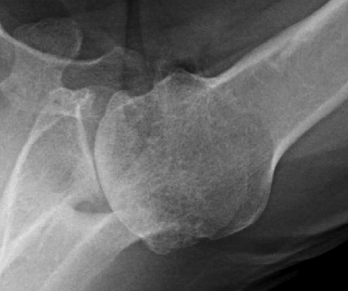
Use of an anteriorly eccentric head component can effectively manage excessive posterior translation without overstuffing the joint (see this link). 


An example of the stabilizing value of the eccentric humeral head is shown below - compare the preoperative axillary and the five year post operative axillary view.


Many thanks to Steve Lippitt for his great art work!


Follow on facebook: https://www.facebook.com/frederick.matsen

Follow on LinkedIn: https://www.linkedin.com/in/rick-matsen-88b1a8133/


How you can support research in shoulder surgery Click on this link.

Here are some videos that are of shoulder interest
Shoulder arthritis - what you need to know (see this link)
Shoulder arthritis - x-ray appearance (see this link)
The smooth and move for irreparable cuff tears (see this link)
The total shoulder arthroplasty (see this link).
The ream and run technique is shown in this link.
The cuff tear arthropathy arthroplasty (see this link).
The reverse total shoulder arthroplasty (see this link).


Saturday, February 25, 2017

Glenohumeral arthritis - management with a spherical implant.

Pyrocarbon interposition shoulder arthroplasty: preliminary results from a prospective multi center study at 2 years of follow-up

It is asserted that "Pyrocarbon has superior tribologic properties than metal because it can slide against bone and cartilage without causing pain or damage".

These authors explored the concept of a free pyrocarbon-coated interposition shoulder arthroplasty in  67 consecutive patients (mean age at surgery was 51 years). The indications for surgery were primary glenohumeral arthritis in 42, avascular necrosis in 13, and secondary arthritis in 12 patients. The criteria for the use of this implant were similar to those the authors use for hemiarthroplasty, notably young age or high activity level, or both.

In this surgery the humeral head resection was performed at the anatomic neck level then a cavity was then reamed in the center of the humeral metaphysis leaving a 2-mm-thick peripheral bony rim at the equator to accept the graphite sphere coated with pyrocarbon. The implant is freely positioned in the reamed cavity within the proximal humerus, articulating directly against the glenoid. 


Revision surgery was performed in 7 patients (10.4%), 2 (3.0%) were lost to follow-up, and the outcome assessments were incomplete in 3 (4.4%). The indications for revision to anatomic or reverse total shoulders included posterior subluxation, inferior glenohumeral impingement causing pain or stiffness, rotator cuff tears, persistent glenoid pain, stiffness and subsidence from wear related to a metal particle. 

In 55 patients at  26.8 ± 3.4 months, the Constant score improved from 34.1±15.1 preoperatively to 66.1±19.7 postoperatively. Here are the x-rays of stable components at > 2 years after surgery.


Progressive glenoid erosion was observed in 6 shoulders and thinning of the tuberosities in 3.

Here is the x-ray of component at > 2 years after surgery with medial erosion of the glenoid


The authors concluded that pyrocarbon-coated interposition shoulder arthroplasty renders clinical scores and implant survival comparable to those of hemiarthroplasty but remain inferior to those results reported for total shoulder arthroplasty. 


Comment: This is an interesting approach to treating glenohumeral arthritis with a free hemiarthroplasty. This device requires removal of metaphyseal bone that may compromise conversation to or revision to a conventional humeral implant should the sphere not provide the desired stability, motion or comfort and, like other hemiarthroplasties, does not address glenoid pathology that may be present.
.
We concur with the authors that "Until long-term results are available, this type of innovative implant should remain to be tested in a few specialized shoulder centers."

===

Sunday, April 10, 2016

Shoulder arthroplasty - centering the humeral head in the glenoid

Management of intraoperative posterior decentering in shoulder arthroplasty using anteriorly eccentric humeral head components

These authors report the use of anteriorly-eccentric humeral head components to manage posterior instability recognized at shoulder arthroplasty when standard trial components are in place. Radiographic centering was characterized before surgery and at follow-up on standardized axillary radiographs with the arm held in a position of functional elevation. Preoperative posterior humeral head decentering did not correlate with preoperative glenoid version.

In 33 shoulder arthroplasties with 2-year outcomes the preoperative radiographic humeral decentering was reduced from 10.4% ± 7.9% to 0.9% ± 2.3% postoperatively (P < .001). SST scores improved from 4.8 ± 2.3 to 10.0 ± 2.3 (P < .001).  Glenoid retroversion was 19.8° ± 8.9° preoperatively and 15.5° ± 7.5° postoperatively. Rotator interval plication was performed in 16 cases as an adjunctive stabilizing procedure.

Comment: Posterior instability after a shoulder arthroplasty can result in pain, functional loss and rocking horse loosening or rim wear of a glenoid component.

While posterior decentering can be identified before surgery by the 'truth' view (an axillary taken with the arm in a functional position of elevation in the plane of the scapula) as shown below


often this preoperative posterior instability will respond to soft tissue balancing and use of standard humeral components. In other cases, the posterior instability persists at surgery, being manifest by a posterior 'drop back' when the arm is elevated. 


Not infrequently a shoulder without apparent posterior instability before surgery becomes posteriorly unstable at surgery after osteophyte resection and soft tissue releases. 

In cases where posterior instability is identified at surgery when trial components are in place, centering of the humeral head can usually be established through the use of an anteriorly eccentric humeral head without or with a rotator interval plication.


resulting in a stabilized head without needing to change glenoid version. Below is the postoperative view of the case shown in the earlier x-ray in which these methods were used.

===


Check out the new Shoulder Arthritis Book - click here.


Use the "Search" box to the right to find other topics of interest to you.

You may be interested in some of our most visited web pages including:shoulder arthritis, total shoulder, ream and runreverse total shoulderCTA arthroplasty, and rotator cuff surgery as well as the 'ream and run essentials'