Showing posts with label hyaluronic acid injection. Show all posts

Tuesday, January 22, 2019

Are injections helpful for shoulder arthritis?

Outcomes of hyaluronic acid injections for glenohumeral osteoarthritis: a systematic review and meta-analysis

These authors conducted a literature review on the effects of hyaluronic acid (HA) in patients with glenohumeral osteoarthritis.

Injection of HA resulted in the reduction of visual analog scale pain score at 3 months by 26.2 mm and at 6 months by 29.5 mm.

However similar clinical improvements were noted with control injections (steroids, saline), suggesting that these improvements may not be related to to the HA.

One study compared the effect of HA injection vs. phosphate buffered saline; the findings did not reach statistical significance. 
Another study found a small, but statistically insignificant difference. 
Another reported an insignificant between-group difference between HA and control in the reduction of VAS pain.
Another compared HA to corticosteroid therapy and reported nonsignificant differences between
groups with respect to pain relief.

Adverse events were not common but included swelling and mild pain at the injection site, local effusion, lethargy, and face rash.

Comment: We have not found a role for injections of any kind in the management of arthritis. There is a lack of evidence that they provide sustained benefit and they carry the risk of infection and increase the risk of periprosthetic infection as well.

Here's an instructive case.

We were recently consulted by a man in his 40s who had a painful shoulder after a motor vehicle accident in the past. A year and a half ago he had these x-rays showing mild arthritis and limited motion of his shoulder.


A year ago he had an injection into his shoulder, after which his shoulder pain increased dramatically. He then underwent an arthroscopic washout for a shoulder joint infection that he thinks may have been due to staphylococcus.

He then presented to us with a completely stiff shoulder and these x-rays.
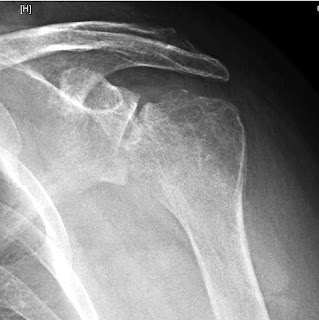

We plan a debridement with cultures, a primary hemiarthroplasty and intravenous Vancomycin and Ceftriaxone.
===

We have a new set of shoulder youtubes about the shoulder, check them out at this link.

Be sure to visit "Ream and Run - the state of the art"  regarding this radically conservative approach to shoulder arthritis at this link and this link

Use the "Search" box to the right to find other topics of interest to you.


You may be interested in some of our most visited web pages   arthritis, total shoulder, ream and runreverse total shoulderCTA arthroplasty, and rotator cuff surgery as well as the 'ream and run essentials'

Thursday, June 21, 2018

What about a cortisone shot?

Use of Intra-Articular Corticosteroids in Orthopaedics

This review of the evidence-based research on the efficacy of intra-articular corticosteroid injections of the osteoarthritic knee was inconclusive.
Combining intra-articular corticosteroid injection with a higher-dose anesthetic may compound chondrotoxic effects (that is risk the deterioration of the cartilage in the joint)
Compared with corticosteroid injections for osteoarthritis, intra-articular viscosupplements (e.g. Synvisc) have not shown a substantial difference in pain relief or functional outcomes.
Although rare and usually transient, systemic effects of intra-articular corticosteroid injections may occur and can be influenced by the type, frequency, and dosage of the corticosteroid used.
Practitioners are encouraged to use corticosteroid injections judiciously to treat pain and joint inflammation from osteoarthritis and inflammatory arthritis of large joints.

Comment: In addition to the concerns expressed above, there is concern that cortisone injections may increase the risk of infection in total joints. A common recommendation is that joint replacement should be avoided within three months of such an injection.
=====
Use the "Search" box to the right to find other topics of interest to you. 


You may be interested in some of our most visited web pages including:shoulder arthritis, total shoulder, ream and runreverse total shoulderCTA arthroplasty, and rotator cuff surgery as well as the 'ream and run essentials'

Saturday, February 25, 2017

What makes a treatment worthwhile?


We recently came across this editorial that pointed out the divergence between evidence and practice. In it the author points out that in spite of the substantial evidence that hyaluronate injections (viscosupplementation) are ineffective, the market value of these products is expected to exceed $2.6 Billion by 2021.

He points to three questions we should ask about any treatment we use: (1) is it effective? (2) is it safe? and (3) is it worth the cost? 

This editorial is recommended reading for all of us who are tempted by 'novel' approaches, drugs, and implants.

We could say that the burden of proof lies with the advocates for a new technology, perhaps restating the author's questions:  (1) is it more effective than what we are currently using? (2) is it safer than what we are currently using? and (3) is it worth the increased cost over what we are currently using?
===

Saturday, January 9, 2016

Hyaluronic acid injections - do they work? The importance of controlled trials

Viscosupplementation for Osteoarthritis of the Knee: A Systematic Review of the Evidence.

These authors sought to determine the clinical significance of injectable hyaluronic acid (HA) in the treatment of knee osteoarthritis, and to assess which trial-level factors influence the overall treatment effect of HA. They conducted a comprehensive literature search to locate randomized controlled trials that compared HA with control treatment and had a minimum of thirty patients per subgroup.

Their most consistent finding was that double-blinded, sham-controlled trials had much smaller treatment effects than trials that were not sufficiently blinded (p < 0.05). For double-blinded trials, the overall treatment effect was less than half of the minimal important difference for pain, function, and stiffness. They concluded that meta-analysis of only the double-blinded, sham-controlled trials with at least sixty patients did not show clinically important differences of HA treatment over placebo. 

Comment: While this is not study of the effect of hyaluronic acid injection for shoulder arthritis, there is every reason to believe that the results would be similar at best.
We're including this article for another reason - it shows the importance of good controls. Note in the figure below, the double blind studies show a net minimal effect, whereas the open label studies (HA vs usual care) show a stronger effect.

===


Use the "Search" box to the right to find other topics of interest to you.

You may be interested in some of our most visited web pages including:shoulder arthritis, total shoulder, ream and runreverse total shoulderCTA arthroplasty, and rotator cuff surgery as well as the 'ream and run essentials'


Monday, July 1, 2013

Synvisc (hyaluronate), glucosamine, chondroitin,arthroscopy, BMI and arthritis

Treatment of Osteoarthritis of the Knee, 2nd Edition SUMMARY OF RECOMMENDATIONS

The American Academy of Orthopaedic Surgeons recently published clinical practice guideline on osteoarthritis (OA) of the knee.  These guidelines seem, in large part, to be applicable to osteoarthritis of the shoulder as well:
(1) Participate in self-management programs, exercises, and physical activity.
(2) Weight loss for patients with BMI ≥ 25
(3) Recognize that the evidence does not support the use of acupuncture
(4) Recognize that the evidence does not support the use of glucosamine or chondroitin
(5) Recognize that the evidence does not support the use of hyaluronic acid (Synvisc) injections
(6) Recognize that the evidence does not support arthroscopic lavage and debridement

====
To see the topics covered in this Blog, click here


Use the "Search" box to the right to find other topics of interest to you.

You may be interested in some of our most visited web pages including:shoulder arthritis, total shoulder, ream and runreverse total shoulderCTA arthroplasty, and rotator cuff surgery as well as the 'ream and run essentials'


See from which cities our patients come.


See the countries from which our readers come on this post.


Thursday, April 18, 2013

Non operative treatment of shoulder arthritis - injections

Sodium hyaluronate for the treatment of chronic shoulder pain associated with glenohumeral osteoarthritis: a multicenter, randomized, double-blind, placebo-controlled trial

This is a double-blind, randomized, controlled multicenter trial of 300 patients with glenohumeral arthritis, half of which received hyaluronate injections and half of which received phosphate-buffered saline in 3 weekly injections. Inclusion criteria included age 35 years or older, initial visual analog score for shoulder pain on movement of 50 mm or greater, chronic shoulder pain lasting more than 6 months but less than 3 years, willing to discontinue all pain medication for at least 24 hours before each visit, and no modification of the pain medication regimen in the previous 4 weeks. Key exclusion criteria included severe joint effusion, structural defects requiring surgical management, corticosteroid injection in any joint(s) in the previous 3 months, surgical interventions in the trial shoulder within the previous 2 years, and inflammatory arthropathy of the trial shoulder. Patients were followed for 26 weeks.

Interestingly, both groups improved on their pain scores and their functional outcome scores. While the scores were somewhat better for the hyaluronate group, the differences were not statistically significant. The rates of adverse events were greater for the hyaluronate group, but again the differences were not significant. Neither group reported serious treatment-related adverse events.

This is a model Level one study and worthy of reading in full. 

The optimal non-operative management for patients with shoulder arthritis needs to be individualized. Our current preference in most cases is gentle range of motion exercises and non-narcotic analgesics.

===
Use the "Search" box to the right to find other topics of interest to you.

You may be interested in some of our most visited web pages including:shoulder arthritis, total shoulder, ream and runreverse total shoulderCTA arthroplasty, and rotator cuff surgery.

See from which cities our patients come.

See the countries from which our readers come on this post.


Monday, January 23, 2012

Effectiveness of hyaluronic acid injections - placebo?

A recent JBJS study, "Intra-articular injection of hyaluronic Acid is not superior to saline solution injection for ankle arthritis: a randomized, double-blind, placebo-controlled study." A strong placebo effect from injections of saline concluded that "We found that a single intra-articular injection of low-molecular-weight, non-cross-linked hyaluronic acid is not demonstrably superior to a single intra-articular injection of saline solution for the treatment of osteoarthritis of the ankle."


While the ankle is not the shoulder it is interesting that the effect of a single injection was not significantly more effective than saline. The authors did refer to a large study of hyaluronic acid for shoulder pain with 200 randomized patients that found that the improvement in the saline solution placebo group was less than that in the hyaluronic acid treatment groups for shoulders with arthritis.

We previously posted some other articles on injections for shoulder arthritis, that you may enjoy reading.

===

Use the "Search the Blog" box to the right to find other topics of interest to you.

You may be interested in some of our most visited web pages including: shoulder arthritis, total shoulder, ream and runreverse total shoulderCTA arthroplasty, and rotator cuff surgery.

Saturday, April 2, 2011

Injections for shoulder arthritis

At the outset, I should state that I don't employ injections of the shoulder in my practice. Yet, for completeness, the reader should know that injections are used by others for one of two purposes. First, some physicians inject a local anesthetic into the joint in an attempt to confirm that the symptoms are coming from the shoulder joint rather than from other sources, such as a pinched nerve in the neck. In this application, the effect of the local anesthetic wears off soon afterwards, but the temporary relief of pain from an injection in the joint indicates that the pain is coming from the joint. Second, some physicians inject the shoulder in an attempt to provide some more lasting relief of pain. Two types of injections have been used: (1) steroids (like cortisone) and (2) viscosupplementation (like hyaluronic acid). For the interested reader, two reviews of these types of injections for osteoarthritis were published in 2006:

*Stitik, T. P., A. Kumar, et al. (2006). "Corticosteroid injections for osteoarthritis." Am J Phys Med Rehabil 85(11 Suppl): S51-65
*Stitik, T. P. and J. A. Levy (2006). "Viscosupplementation (biosupplementation) for osteoarthritis." Am J Phys Med Rehabil 85(11 Suppl): S32-50.

While these injections may provide symptomatic relief, a recent review of guidelines for the treatment of shoulder arthritis (Izquierdo, R., I. Voloshin, et al. "Treatment of glenohumeral osteoarthritis." J Am Acad Orthop Surg 18(6): 375-82.) failed to find substantial evidence in favor of their effectiveness. Similarly, a Cochrane review did not find evidence supporting the use of cortisone injections for shoulder pain (Buchbinder, R., S. Green, et al. (2003). "Corticosteroid injections for shoulder pain." Cochrane Database Syst Rev(1): CD004016.).

However, several relatively recent articles have provided some indication of the benefit of viscosupplementation for shoulder arthritis:

*Brander, V. A., A. Gomberawalla, et al. "Efficacy and safety of hylan G-F 20 for symptomatic glenohumeral osteoarthritis: a prospective, pilot study." PM R 2(4): 259-67.
*Noel, E., P. Hardy, et al. (2009). "Efficacy and safety of Hylan G-F 20 in shoulder osteoarthritis with an intact rotator cuff. Open-label prospective multicenter study." Joint Bone Spine 76(6): 670-3.
*Silverstein, E., R. Leger, et al. (2007). "The use of intra-articular hylan G-F 20 in the treatment of symptomatic osteoarthritis of the shoulder: a preliminary study." Am J Sports Med 35(6): 979-85.

Finally, it is important to note that in cases of shoulder joint infection, a high percentage appear to follow injections of the shoulder, so caution is advised:

*Rhee, Y. G., N. S. Cho, et al. (2008). "Injection-induced pyogenic arthritis of the shoulder joint." J Shoulder Elbow Surg 17(1): 63-7.
*Esenwein, S. A., T. Ambacher, et al. (2002). "[Septic arthritis of the shoulder following intra-articular injection therapy. Lethal course due to delayed initiation of therapy]." Unfallchirurg 105(10): 932-8.
*Leslie, B. M., J. M. Harris, 3rd, et al. (1989). "Septic arthritis of the shoulder in adults." J Bone Joint Surg Am 71(10): 1516-22.


--

Use the "Search the Blog" box to the right to find other topics of interest to you.

You may be interested in some of our most visited web pages including: shoulder arthritis, total shoulder, ream and runreverse total shoulderCTA arthroplasty, and rotator cuff surgery.