Showing posts with label joint fluid. Show all posts

Sunday, February 26, 2023

Is the failed shoulder arthroplasty infected?

In evaluating a failed shoulder arthroplasty, patients and surgeons want to know if the failure is related to a periprosthetic infection (PJI). Unfortunately, routine preoperative assessment - physical examination and blood tests - are not reliable for the detection of the most common infecting organism, Cutibacterium.

Preoperative joint fluid aspirates are often sent for bacterial culture in the hope of determining the presence and type of organisms in failed shoulder arthroplasties.

The authors of What is the concordance rate of preoperative synovial fluid aspiration and intraoperative biopsy in detecting periprosthetic joint infection of the shoulder? sought to evaluate the utility of preoperative culture data for early pathogen identification for shoulder PJI.

Their diagnosis of PJI was determined according to the older version of Musculoskeletal Infection Society criteria established in 2014. They included only patients meeting these criteria who underwent revision for shoulder PJI with both preoperative synovial fluid culture and intraoperative tissue culture data. Notably, patients with "dry" taps were excluded - the number of cases excluded for this reason are not disclosed.

50 patients were included. Antibiotics were held 2 weeks before the aspiration. Intraoperative cultures were obtained before the administration of perioperative antibiotics. Five to 8 tissue samples were collected from multiple surgical sites.

42 (84%) preoperative synovial fluid aspirations were monomicrobial, and 8 (16%) were culture negative. Six of the 8 shoulder PJIs (75%) with negative preoperative cultures were found to have positive intraoperative cultures.

36 (72%) of the intraoperative cultures were monomicrobial, 2 (4%) were culture negative and, notably 12 (24%) were polymicrobial - these were not identified on preoperative fluid aspirate cultures.

Cutibacterium was recovered on intraoperative cultures of 50% of the cases (25/50). 82% of the cases had low virulence organisms.


High virulence pathogen (methicillin sensitive staphylococcus and gram negative bacteria) infections were detected on fluid aspirates in all 7 cases.

The sensitivity and specificity of preoperartive fluid cultures for Cutibacterium were 0.76 and 0.72. Gram-negative pathogens demonstrated the highest sensitivity and specificity, whereas polymicrobial infections exhibited the lowest sensitivity and positive predictive value.


The "concordant" group consisted of patients who had the same bacteria in both groups. For polymicrobial samples, the same bacteria needed to be present in both the preoperative and intraoperative culture to be included in the concordant group. The discordant group had at least 1 different pathogen.

Concordance between preoperative aspiration and intraoperative tissue culture was identified in only 28 of 50 patients (56%) with a discordance rate of 44%.
Preoperative cultures positive for Gram-positive species and those positive for Cutibacterium were more likely to be concordant than discordant.
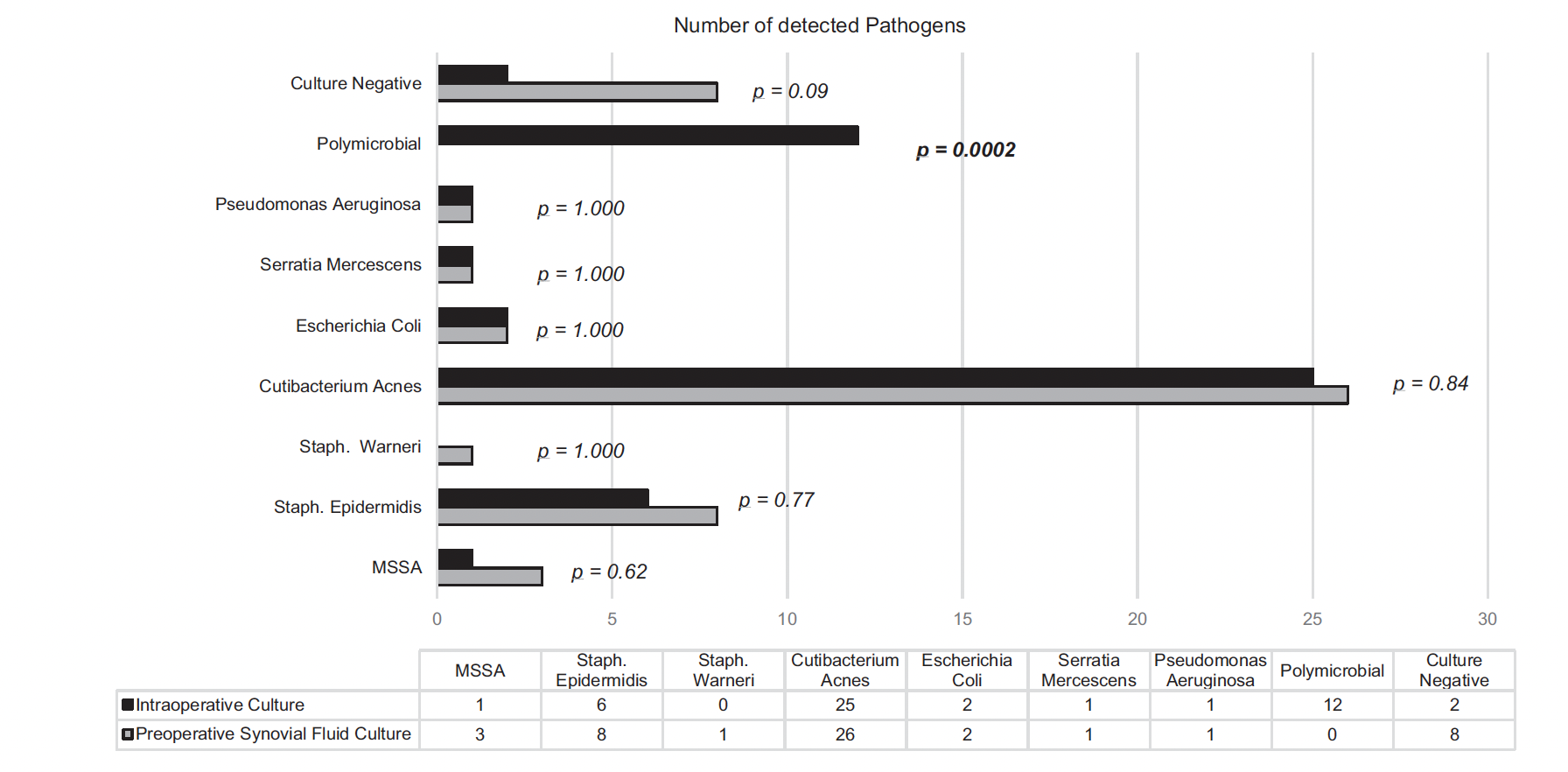


Comment: This study found that cultures of preoperative fluid aspirations often failed to predict the complete intraoperative microbiology of shoulders meeting criteria for periprosthetic infection.

Perhaps the more important question is "what is the utility of preoperative joint fluid cultures in all patients requiring shoulder arthroplasty revision?" In other words, how might these cultures change treatment? It seems that fluid aspirate cultures are most useful in the preoperative identification of high virulence organisms. The presence of high virulence organisms is suggested by systemic signs of illness combined with shoulder joint warmth, swelling and tenderness - an "obvious" infection. In such cases aspiration to identify organisms such as E. Coli, Pseudomonas, MRSA, MSSA, and Seratia is likely to be of value in planning surgery and postoperative antibiotics.

By contrast, the role of aspirate cultures for shoulders that have no obvious signs of infection is less clear. Often attempted aspiration in such cases yield no fluid - a "dry" tap. In other cases, as shown in this study, the aspirate may fail to reveal the causative organism (which is often Cutibacterium).

The authors of another recent article, The role of synovial fluid aspiration in shoulder joint infections, found that preoperative aspiration failed to yield a sufficient volume for culture in 11 of 35 cases. Even in the cases of sufficient fluid volume, they concluded that preoperative aspiration is likely to miss Cutibacterium and coagulase negative staphylococcus. However, they recommended considering aspiration as a means of possible germ identification. They felt that empiric antibiotic therapy should cover Cutibacterium and coagulase negative staphylococcus even if aspiration showed negative microbiological cultures.

One way to look at this not-uncommon clinical challenge is that a dry or culture negative tap does not provide assurance of lack of joint infection. On the other hand, a positive preoperative culture of joint fluid raises the chances of having positive intraoperative cultures. Other risk factors for PJI with low virulence organisms include the delayed "stealth"onset of unexplained pain and stiffness after an initially successful rehabilitation (a "honeymoon period"), young age, male sex, high levels of Cutibaterium on the unprepared skin of the shoulder, prior surgery, high levels of serum testosterone, and humeral component loosening. These findings may prompt consideration of a single stage prosthetic exchange followed by vigorous antibiotic therapy.


You can support cutting edge shoulder research that is leading to better care for patients with shoulder problems, click on this link.

Follow on twitter: https://twitter.com/shoulderarth
Follow on facebook: click on this link
Follow on facebook: https://www.facebook.com/frederick.matsen
Follow on LinkedIn: https://www.linkedin.com/in/rick-matsen-88b1a8133/

Here are some videos that are of shoulder interest
Shoulder arthritis - what you need to know (see this link).
How to x-ray the shoulder (see this link).
The ream and run procedure (see this link).
The total shoulder arthroplasty (see this link).
The cuff tear arthropathy arthroplasty (see this link).
The reverse total shoulder arthroplasty (see this link).
The smooth and move procedure for irreparable rotator cuff tears (see this link).
Shoulder rehabilitation exercises (see this link).

Monday, November 7, 2022

Do preoperative cultures of aspirated joint fluid agree with cultures of intraoperative tissue biopsies in cases of shoulder periprosthetic infection.

Surgeons often use cultures of aspirated joint fluid as a means of determining the presence and type of bacteria in cases of suspected periprosthetic joint infection of the shoulder (PJI).


The authors of What is the concordance rate of preoperative synovial fluid aspiration and intraoperative biopsy in detecting periprosthetic joint infection of the shoulder ? sought to evaluate the degree of agreement between preoperative synovial fluid culture results and intraoperative tissue culture results in 50 patients meeting the 2014 Musculoskeletal Infection Society criteria for shoulder PJI.

Concordance between preoperative aspiration and intraoperative tissue culture was identified in only 28 patients out of 50 (56%).

Preoperative cultures positive for Cutibacterium acnes demonstrated sensitivity, specificity, positive predictive value (PPV) and NPV lower than 0.8. More favorable concordance was observed for monomicrobial preoperative cultures, particularly for Gram-negative organisms and methicillin sensitive Staphylococcus aureus. Gram-negative pathogens demonstrated the highest sensitivity and specificity, while polymicrobial infections exhibited the lowest sensitivity and positive predictive value (PPV).


Comment: In this study there was frequent disagreement between the results of cultures of a preoperative shoulder joint fluid aspirate and the results of cultures of 5-8 intraoperative tissue samples in shoulders meeting the 2014 Musculoskeletal Infection Society criteria for shoulder PJI. The accuracy of preoperative joint fluid cultures was greater for virulent organisms; the accuracy was less for the most common organisms causing shoulder PJI: Cutibacterium and coagulase negative Staph. The reason for the discordance, especially for Cutibacterium, is due to the facts that (1) this bacterium is most commonly found in biofilms adherent to soft tissue and implants rather than freely floating in the joint fluid and (2) a single sample of joint fluid is statistically less likely to detect bacteria than multiple samples of tissue.

In our practice, joint aspiration is most helpful in the presence of an obvious periprosthetic infection where the diagnosis of PJI is not in doubt but where identifying the causative bacterium before surgery would help inform the choice of surgery and immediate postoperative antibiotic therapy (see Periprosthetic shoulder infections, single stage and two-stage revision).

You can support cutting edge shoulder research that is leading to better care for patients with shoulder problems, click on this link.
To add this blog to your reading list in Google Chrome, click on the reading list icon


Follow on twitter: https://twitter.com/shoulderarth
Follow on facebook: click on this link
Follow on facebook: https://www.facebook.com/frederick.matsen
Follow on LinkedIn: https://www.linkedin.com/in/rick-matsen-88b1a8133/

Here are some videos that are of shoulder interest
Shoulder arthritis - what you need to know (see this link).
How to x-ray the shoulder (see this link).
The ream and run procedure (see this link).
The total shoulder arthroplasty (see this link).
The cuff tear arthropathy arthroplasty (see this link).
The reverse total shoulder arthroplasty (see this link).
The smooth and move procedure for irreparable rotator cuff tears (see this link).
Shoulder rehabilitation exercises (see this link).

Sunday, January 2, 2022

Can synovial fluid white blood cell count predict shoulder periprosthetic infection?

Defining a Synovial Fluid White Blood Cell Count Threshold to Predict Periprosthetic Infection after Shoulder Arthroplasty

These authors sought to define a threshold for synovial fluid white blood cell count (WBC) and the reliability of microbiological cultures in predicting shoulder periprosthetic infection (PJI).


They conducted a retrospective study of preoperative and intraoperative fluid aspiration of 31 patients who underwent a revision of a shoulder arthroplasty (15 with PSI defined by the Infectious Diseases Society of America (IDSA) criteria (see this link) and 16 without infection).


WBC was significantly higher in patients with PSI than in other patients. A threshold of 2800 leucocytes/mm3 showed a sensitivity of 87% and a specificity of 88% (AUROC 0.92). 


Microbiological cultures showed a sensitivity of 76% and a specificity of 100%. The observation that almost one quarter of the joint aspirate cultures were negative in cases of periprosthetic infection (PJI) indicates that positive cultures of joint fluid can "rule in" a PJI but a negative culture of joint fluid cannot "rule out" a PJI.


Interestingly, joint aspirate culture was less likely to grow Cutibacterium (23%) than the tissue cultures obtained at revision surgery (40%) (see below). There may be at least two reasons for this finding (1) the joint aspirate provides a single specimen whereas multiple (at least three) tissue samples increase the chances of recovering the organism and (2) Cutibacterium is more commonly present in a biofilm on tissue and implants than in a planktonic form where it would be accessible in a fluid sample. 


Comment: Even though the number of cases in this study is small, the results are of interest and need to be confirmed in larger cohorts. This should be straightforward, in that white blood cell counts and cultures are easy to obtain and relatively inexpensive. 

One issue not addressed in this study is the rate of insufficient sample volume, that is the percentage of cases coming for revision in which the amount of fluid obtained is not enough for both a WBC count and culture. How should this result be considered? 

A second issue is that the utility of these tests should be examined in terms of the "pre-test probability". It is known that Cutibacterium PJI can present on one hand with systemic signs, increased blood markers (CRP, ESR, WBC) and on the other with only unexplained pain and stiffness.  In the former the pre test probability of PJI is high and in the latter less so. How diagnostic are joint fluid aspirate WBC counts and cultures in these two groups?

Follow on facebook: https://www.facebook.com/frederick.matsen

Follow on LinkedIn: https://www.linkedin.com/in/rick-matsen-88b1a8133/


How you can support research in shoulder surgery Click on this link.

Here are some videos that are of shoulder interest
Shoulder arthritis - what you need to know (see this link)
Shoulder arthritis - x-ray appearance (see this link)
The smooth and move for irreparable cuff tears (see this link)
The total shoulder arthroplasty (see this link).
The ream and run technique is shown in this link.
The cuff tear arthropathy arthroplasty (see this link).
The reverse total shoulder arthroplasty (see this link).


Wednesday, October 26, 2016

Propionibacterium biofilm infection - is Rifampin effective?


Role of rifampin against Propionibacterium acnes biofilm in vitro and in an experimental foreign-body infection model.

These authors began with a nice summary: "propionibacterium acnes is a facultative anaerobic Gram-positive branching rod physiologically residing in sebaceous glands of the skin. It is the major agent of inflammatory acne. In addition, in 2 to 14% of cases, it is identified as the cause of various implant-associated infections, including prosthetic-joint infections, particularly shoulder prosthesis; spine implant surgery; breast implant surgery; electrophysiological cardiac devices; and neurosurgery involving ventricular drains and ventriculoperitoneal shunts. The role of P. acnes in foreign-body infections is probably underestimated due to technical reasons. Detection of anaerobes requires rapid transport to the microbiology laboratory or special transport media and needs incubation for up to 14 days due to slow growth. Late growth and/or growth in enrichment media only is often misinterpreted as contamination. Furthermore, although P. acnes is usually introduced during surgery, clinical symptoms of lowgrade infections often manifest only months to years after implantation.
Therefore, the association between implant surgery and infection is not always obvious. Recent studies showed that P. acnes forms biofilm on a wide range of materials. However, little is known about the mechanisms involved in biofilm formation at the cellular and molecular levels. P. acnes is uniformly resistant to metronidazole but susceptible to several other antimicrobials, including penicillin G, ceftriaxone, vancomycin, and clindamycin. However, the antimicrobial susceptibility is significantly reduced in biofilms, causing chronic and persistent infections that are difficult to cure
without removal of the device. In addition, P. acnes can escape the immune response by resisting phagocytosis and surviving inside macrophages"

They investigated the activity of rifampin, alone and in combination, against planktonic and biofilm P. acnes in vitro and in a foreign-body infection model (polytetrafluorethylene (Teflon) cages with 130 regularly spaced perforations 1 mm in diameter  subcutaneously implanted in the flanks of guinea pigs).

To determine the activity against planktonic P. acnes, cage fluid was aspirated before the start of treatment, during treatment (before administration of the last dose), and 5 days after completion of treatment.  

To determine the activity against biofilm P. acnes, animals were sacrificed 5 days after completion of treatment, and the cages were explanted under aseptic conditions and incubated for 10 days in BHI. The treatment efficacy against adherent bacteria was expressed as the cure rate (as a percentage) defined as the number of cages without P. acnes growth divided by the total number of cages in the individual treatment group.

They found that MIC and the minimal bactericidal concentration (MBC) were 0.007 and 4 μg/ml for rifampin, 1 and 4 μg/ml for daptomycin, 1 and 8 μg/ml for vancomycin, 1 and 2 μg/ml for levofloxacin, 0.03 and 16 μg/ml for penicillin G, 0.125 and 512 μg/ml for clindamycin, and 0.25 and 32 μg/ml for ceftriaxone. 

The P. acnes minimal biofilm eradication concentration (MBEC) was 16 μg/ml for rifampin; 32 μg/ml for penicillin G; 64 μg/ml for daptomycin and ceftriaxone; and ≥128 μg/ml for levofloxacin, vancomycin, and clindamycin. 

In the animal model, implants were infected by injection of 10⁹ CFU P. acnes in cages. Antimicrobial activity on P. acnes was investigated in the cage fluid (planktonic form) and on explanted cages (biofilm form). 

When a high infection inoculum was injected into the tissue cage fluid of guinea pigs, P. acnes persisted on implanted cages for 50 days, despite spontaneous clearance of planktonic P. acnes from aspirated cage fluid.


This finding highlights the great ability of P. acnes to adhere to the implant surface and its change from the planktonic to the biofilm phenotype.

The MIC values of all tested drugs for this strain were low. In contrast, the MBCs of commonly used antimicrobials, such as penicillin G (16 g/ml), ceftriaxone (32 g/ml), and clindamycin (512 g/ml), were high for P. acnes infections. Interestingly, rifampin, daptomycin, and levofloxacin demonstrated low MBCs (4 g/ml), suggesting superior killing of planktonic P. acnes.

For the biofilms, the cure rates were 4% for daptomycin, 17% for vancomycin, 0% for levofloxacin, and 36% for rifampin. Rifampin cured 63% of the infected cages in combination with daptomycin, 46% with vancomycin, and 25% with levofloxacin. 


While all tested antimicrobials showed good activity against planktonic P. acnes, for eradication of biofilms, rifampin was needed. In combination with rifampin, daptomycin showed higher cure rates than with vancomycin in this foreign-body infection model.

Based on their vitro biofilm studies, the combination of rifampin and penicillin G or ceftriaxone
may represent alternative options, but they were not able to investigate this in their animal model, since guinea pigs do not tolerate Beta-lactams and clindamycin (because of gastrointestinal disturbance).

Comment: This is a very helpful study. One of the most interesting findings is the fluid around a Propionibacterium culture positive biofilm becomes sterile over time. This explains why periprosthetic joint fluid that is culture negative for Propionibacterium does not rule out the presence of Propionibacterium on the implant.

A second interesting finding is that the antibiotic levels necessary to affect the Propionibacterium in biofilms is much higher than that for planktonic bacteria.

Thirdly, Rifampin - a drug that may be challenging for patients to take - has a relatively strong effect on biofilm bacteria.

Fourthly, even with Rifampin, the 'cure rate' is not great - removal of the implant is the only way to resolve the infection.