Showing posts with label synovial fluid. Show all posts

Sunday, September 22, 2024

What information can be gathered from a synovial fluid aspirate?

Synovial fluid aspiration is often used to gather information about a possible periprosthetic infection. 


When a sufficient volume is recovered, laboratory tests may help surgeons evaluate the likelihood of a periprosthetic infection; however the aspiration attempt may not yield fluid even if it is image guided. To be clinically useful, the aspiration needs to be carried out several weeks in advance of a potential surgical revision to allow sufficient time for laboratory tests and culture results to be finalized.

The authors of Synovial Fluid Cutibacterium acnes Antigen Is Detected Among Shoulder Samples with High Inflammation and Early Culture Growth presented a three pronged analysis of 1,365 de-identified synovial fluid samples, of which 1,150 were culture-negative and 215 were culture-positive.  94 of the culture positive samples were positive for Cutibacterium and 121 for other organisms.

The samples were analyzed by (1) time to culture positivity (known to be a reflection of the load of bacteria in the sample), (2) a validated  C. acnes antigen immunoassay test, and (3) a synovial fluid inflammation score calculated from 4 tests on synovial fluid: C reactive protein,  alpha-defensin, WBC count and percent polymorphonuclear cells.  

They found that 

(1) The samples tended to cluster into high inflammation and low inflammation groups for both all specimens

and for those in specimens that were culture positive for Cutibacterium


(2) C. acnes antigen levels demonstrated moderate-strong positive correlation with inflammation, with 166-fold higher levels of C. acnes antigen in high-inflammation samples compared with low-inflammation samples. 

(3) The days to C. acnes culture positivity demonstrated weak- inverse correlation with inflammation, with 1.5-fold earlier growth among the 67 high- inflammation samples compared to the low inflammation samples. Because a positive culture depends on discernible colonies on the culture plate and because the threshold for discernability relates to the number of bacteria present, low loads of bacteria in the sample are expected to have longer time to culture positivity. 

The relationship between C acnes antigen levels (left) and days to culture positivity (right) for samples with low inflammation and high inflammation is shown below.


(4) 19.0% of high-inflammation, culture-negative fluid samples demonstrated elevated C. acnes antigen.  Elevated C. acnes antigen was observed in only 0.38% of the low-inflammation culture-negative fluid samples and in only 4.9% of the high-inflammation non-C. acnes-positive cultures. 

Here it is of note that synovial fluid cultures are not uncommonly culture negative when tissue and explant cultures are positive. This may be because there may be Cutibacterium in biofilm form in tissue but not in planktonic (free floating) form in fluid. Thus these shoulders may not have been culture negative if tissue and explant cultures had been available. Absence of evidence is not evidence of absence.

Comment: One way to put these findings together is that low loads of Cutibacterium (as indicated by longer times before cultures become positive and by low antigen levels) may be insufficient to cause a tissue damaging inflammatory response on the part of the host. If one uses the definition of infection as "bacteria doing harm", these shoulders may not meet that definition, even though there are bacteria present. On the other hand, high loads of bacteria are likely to have shorter time to culture positivity, higher antigen levels and more inflammation.

You can support cutting edge shoulder research that is leading to better care for patients with shoulder problems, click on this link

Follow on twitter/X: https://x.com/RickMatsen
Follow on facebook: https://www.facebook.com/shoulder.arthritis
Follow on LinkedIn: https://www.linkedin.com/in/rick-matsen-88b1a8133/


Here are some videos that are of shoulder interest
Shoulder arthritis - what you need to know (see this link).
How to x-ray the shoulder (see this link).
The ream and run procedure (see this link).
The total shoulder arthroplasty (see this link).
The cuff tear arthropathy arthroplasty (see this link).
The reverse total shoulder arthroplasty (see this link).
The smooth and move procedure for irreparable rotator cuff tears (see this link).
Shoulder rehabilitation exercises (see this link). 


Sunday, February 26, 2023

Is the failed shoulder arthroplasty infected?

In evaluating a failed shoulder arthroplasty, patients and surgeons want to know if the failure is related to a periprosthetic infection (PJI). Unfortunately, routine preoperative assessment - physical examination and blood tests - are not reliable for the detection of the most common infecting organism, Cutibacterium.

Preoperative joint fluid aspirates are often sent for bacterial culture in the hope of determining the presence and type of organisms in failed shoulder arthroplasties.

The authors of What is the concordance rate of preoperative synovial fluid aspiration and intraoperative biopsy in detecting periprosthetic joint infection of the shoulder? sought to evaluate the utility of preoperative culture data for early pathogen identification for shoulder PJI.

Their diagnosis of PJI was determined according to the older version of Musculoskeletal Infection Society criteria established in 2014. They included only patients meeting these criteria who underwent revision for shoulder PJI with both preoperative synovial fluid culture and intraoperative tissue culture data. Notably, patients with "dry" taps were excluded - the number of cases excluded for this reason are not disclosed.

50 patients were included. Antibiotics were held 2 weeks before the aspiration. Intraoperative cultures were obtained before the administration of perioperative antibiotics. Five to 8 tissue samples were collected from multiple surgical sites.

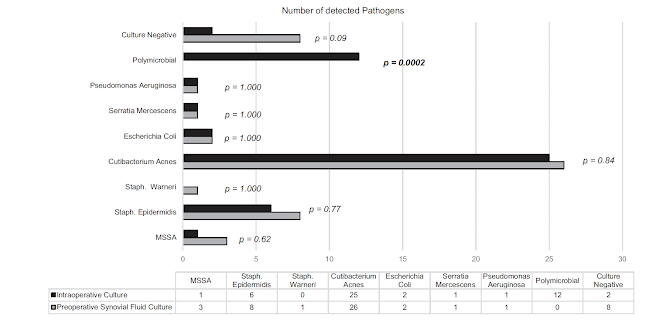
42 (84%) preoperative synovial fluid aspirations were monomicrobial, and 8 (16%) were culture negative. Six of the 8 shoulder PJIs (75%) with negative preoperative cultures were found to have positive intraoperative cultures.

36 (72%) of the intraoperative cultures were monomicrobial, 2 (4%) were culture negative and, notably 12 (24%) were polymicrobial - these were not identified on preoperative fluid aspirate cultures.

Cutibacterium was recovered on intraoperative cultures of 50% of the cases (25/50). 82% of the cases had low virulence organisms.
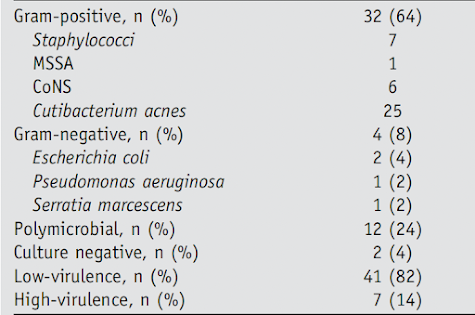


High virulence pathogen (methicillin sensitive staphylococcus and gram negative bacteria) infections were detected on fluid aspirates in all 7 cases.

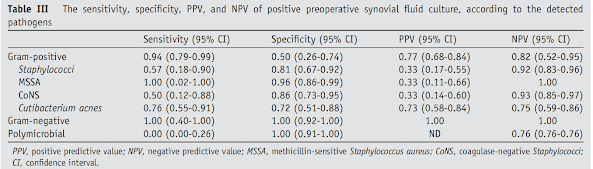
The sensitivity and specificity of preoperartive fluid cultures for Cutibacterium were 0.76 and 0.72. Gram-negative pathogens demonstrated the highest sensitivity and specificity, whereas polymicrobial infections exhibited the lowest sensitivity and positive predictive value.


The "concordant" group consisted of patients who had the same bacteria in both groups. For polymicrobial samples, the same bacteria needed to be present in both the preoperative and intraoperative culture to be included in the concordant group. The discordant group had at least 1 different pathogen.

Concordance between preoperative aspiration and intraoperative tissue culture was identified in only 28 of 50 patients (56%) with a discordance rate of 44%.
Preoperative cultures positive for Gram-positive species and those positive for Cutibacterium were more likely to be concordant than discordant.


Comment: This study found that cultures of preoperative fluid aspirations often failed to predict the complete intraoperative microbiology of shoulders meeting criteria for periprosthetic infection.

Perhaps the more important question is "what is the utility of preoperative joint fluid cultures in all patients requiring shoulder arthroplasty revision?" In other words, how might these cultures change treatment? It seems that fluid aspirate cultures are most useful in the preoperative identification of high virulence organisms. The presence of high virulence organisms is suggested by systemic signs of illness combined with shoulder joint warmth, swelling and tenderness - an "obvious" infection. In such cases aspiration to identify organisms such as E. Coli, Pseudomonas, MRSA, MSSA, and Seratia is likely to be of value in planning surgery and postoperative antibiotics.

By contrast, the role of aspirate cultures for shoulders that have no obvious signs of infection is less clear. Often attempted aspiration in such cases yield no fluid - a "dry" tap. In other cases, as shown in this study, the aspirate may fail to reveal the causative organism (which is often Cutibacterium).

The authors of another recent article, The role of synovial fluid aspiration in shoulder joint infections, found that preoperative aspiration failed to yield a sufficient volume for culture in 11 of 35 cases. Even in the cases of sufficient fluid volume, they concluded that preoperative aspiration is likely to miss Cutibacterium and coagulase negative staphylococcus. However, they recommended considering aspiration as a means of possible germ identification. They felt that empiric antibiotic therapy should cover Cutibacterium and coagulase negative staphylococcus even if aspiration showed negative microbiological cultures.

One way to look at this not-uncommon clinical challenge is that a dry or culture negative tap does not provide assurance of lack of joint infection. On the other hand, a positive preoperative culture of joint fluid raises the chances of having positive intraoperative cultures. Other risk factors for PJI with low virulence organisms include the delayed "stealth"onset of unexplained pain and stiffness after an initially successful rehabilitation (a "honeymoon period"), young age, male sex, high levels of Cutibaterium on the unprepared skin of the shoulder, prior surgery, high levels of serum testosterone, and humeral component loosening. These findings may prompt consideration of a single stage prosthetic exchange followed by vigorous antibiotic therapy.


You can support cutting edge shoulder research that is leading to better care for patients with shoulder problems, click on this link.

Follow on twitter: https://twitter.com/shoulderarth
Follow on facebook: click on this link
Follow on facebook: https://www.facebook.com/frederick.matsen
Follow on LinkedIn: https://www.linkedin.com/in/rick-matsen-88b1a8133/

Here are some videos that are of shoulder interest
Shoulder arthritis - what you need to know (see this link).
How to x-ray the shoulder (see this link).
The ream and run procedure (see this link).
The total shoulder arthroplasty (see this link).
The cuff tear arthropathy arthroplasty (see this link).
The reverse total shoulder arthroplasty (see this link).
The smooth and move procedure for irreparable rotator cuff tears (see this link).
Shoulder rehabilitation exercises (see this link).

Sunday, January 2, 2022

Can synovial fluid white blood cell count predict shoulder periprosthetic infection?

Defining a Synovial Fluid White Blood Cell Count Threshold to Predict Periprosthetic Infection after Shoulder Arthroplasty

These authors sought to define a threshold for synovial fluid white blood cell count (WBC) and the reliability of microbiological cultures in predicting shoulder periprosthetic infection (PJI).


They conducted a retrospective study of preoperative and intraoperative fluid aspiration of 31 patients who underwent a revision of a shoulder arthroplasty (15 with PSI defined by the Infectious Diseases Society of America (IDSA) criteria (see this link) and 16 without infection).


WBC was significantly higher in patients with PSI than in other patients. A threshold of 2800 leucocytes/mm3 showed a sensitivity of 87% and a specificity of 88% (AUROC 0.92). 


Microbiological cultures showed a sensitivity of 76% and a specificity of 100%. The observation that almost one quarter of the joint aspirate cultures were negative in cases of periprosthetic infection (PJI) indicates that positive cultures of joint fluid can "rule in" a PJI but a negative culture of joint fluid cannot "rule out" a PJI.


Interestingly, joint aspirate culture was less likely to grow Cutibacterium (23%) than the tissue cultures obtained at revision surgery (40%) (see below). There may be at least two reasons for this finding (1) the joint aspirate provides a single specimen whereas multiple (at least three) tissue samples increase the chances of recovering the organism and (2) Cutibacterium is more commonly present in a biofilm on tissue and implants than in a planktonic form where it would be accessible in a fluid sample. 


Comment: Even though the number of cases in this study is small, the results are of interest and need to be confirmed in larger cohorts. This should be straightforward, in that white blood cell counts and cultures are easy to obtain and relatively inexpensive. 

One issue not addressed in this study is the rate of insufficient sample volume, that is the percentage of cases coming for revision in which the amount of fluid obtained is not enough for both a WBC count and culture. How should this result be considered? 

A second issue is that the utility of these tests should be examined in terms of the "pre-test probability". It is known that Cutibacterium PJI can present on one hand with systemic signs, increased blood markers (CRP, ESR, WBC) and on the other with only unexplained pain and stiffness.  In the former the pre test probability of PJI is high and in the latter less so. How diagnostic are joint fluid aspirate WBC counts and cultures in these two groups?

Follow on facebook: https://www.facebook.com/frederick.matsen

Follow on LinkedIn: https://www.linkedin.com/in/rick-matsen-88b1a8133/


How you can support research in shoulder surgery Click on this link.

Here are some videos that are of shoulder interest
Shoulder arthritis - what you need to know (see this link)
Shoulder arthritis - x-ray appearance (see this link)
The smooth and move for irreparable cuff tears (see this link)
The total shoulder arthroplasty (see this link).
The ream and run technique is shown in this link.
The cuff tear arthropathy arthroplasty (see this link).
The reverse total shoulder arthroplasty (see this link).


Tuesday, January 16, 2018

A synovial fluid test for infected joint replacements

The Accuracy of the Alpha Defensin Lateral Flow Device for Diagnosis of Periprosthetic Joint Infection Comparison with a Gold Standard

These authors examined the accuracy for the detection of periprosthetic hip and knee infections (i.e. those meeting the criteria established by the Musculoskeletal Infection Society) of a rapid lateral flow version of the alpha defensin test in a aspirate of synovial fluid.

The study group included patients with pain after total hips or total knees. There were 119 joints with an aseptic revision and 76 joints with periprosthetic joint infection according to the MSIS criteria (Clin Orthop Relat Res (2011) 469:2992–2994)


The overall sensitivity of the Synovasure Alpha Defensin Test was 92.1%, the specificity was 100%, the positive predictive value was 100%, and the negative predictive value was 95.2%. The overall accuracy of the Synovasure test was 96.9%.

The culture results of the aspirates are shown below.

The authors conclude that the "Synovasure Alpha Defensin Test with a lateral fl ow device demonstrates encouraging results with high accuracy for diagnosing infection following total hip arthroplasty and total knee arthroplasty. However, the test is associated with high costs, which is a limiting factor. Further cost-benefit studies will determine if the high costs of this new tool are justifiable."

Comment: With respect to the use of such a study in the evaluation of patients with pain after a shoulder arthroplasty, we must recall that a high percentage of these patients have positive deep tissue and explant cultures for Propionibacterium but do not meet the MSIS criteria for a periprosthetic infection. It is well recognized that the stealth presentation of a failed shoulder arthroplasty with positive cultures can occur months or years after the joint replacement. It would be of interest to learn the sensitivity of this new test in the evaluation of these patients.