Showing posts with label metal sensitivity. Show all posts

Saturday, August 14, 2021

What is the significance of positive cultures at the time of revision? - lessons from hip arthroplasty

Prevalence and Outcomes of Unexpected Positive Intraoperative Cultures in Presumed Aseptic Revision Hip Arthroplasty

These authors reviewed all 2,288 total hip arthroplasty (THA) revisions performed at their institution from 2006 to 2019. Of these 1196 did not have preoperative evidence of infection ("presumed aseptic revision"). Three to five samples were obtained for culture at the time of revision. Positive cultures were documented for 9.2% (110) of the 1,196 presumed aseptic THA revisions.  68% of the cases had one positive culture while 32 had two or more positive cultures.  38% of the positive cultures were for Cutibacterium, 13% for Methicillin resistant Staph Epidermidis, 11% for other coagulase negative Staph, 9% for Methacilling sensitive Staph, 5% for micrococcus.


41 (38%) were treated with antibiotics (10 oral alone, 9 IV alone, 22 oral and IV).


The 2- and 5-year infection-free implant survival rates for the 1196 revisions were 93.1%  and 86.8%. 


The  2- and 5-year infection-free survival with failure due to infection with the same microorganism as identified in the initial revision as the end point were 95.8%  and 94.3%, respectively. 


Subsequent infection-related failures caused by the same microorganism as identified in the initial revision were more likely to occur after revisions with ≥2 positive culture than after those with only 1 positive culture.


They defined adverse metal reactions as any adverse local tissue reaction (ALTR), including “pseudotumors,” due to metal ions causing failure of the total joint replacement including metal-on-metal bearings, corrosion of the head-neck junction in metal-on-polyethylene bearings (“trunnionosis”), or recalled modular stems at the modular neck-stem junction. Of the variables included in multivariate Cox regression analysis, only revision for adverse metal reaction was significantly associated with an increased risk of subsequent infection-related failure; revision for adverse metal reaction was a risk factor for subsequent infection-related failure (hazard ratio [HR] = 14.4).


Patients with a single positive culture at the initial revision who were not treated with antibiotics had no subsequent periprosthetic joint infections (PJIs) caused by the same microorganism as identified in the initial revision.


Comment: Here are a few of the lessons we can learn from this study


(1) In these "apparently aseptic" cases of PJI with positive intraoperative cultures, Cutibacterium was the most common organism isolated from deep cultures. 


It is of note that most cases of shoulder PJI do not have preoperative evidence of infection and could be referred to as "apparently aseptic", i.e. "stealth" infections.  Cutibacterium is the most common organism isolated from shoulder PJI.


(2) The authors found that their increased detection of Cutibacterium compared with most

studies may be due to the extended 10-day anaerobic incubation time for their cohort. 


We hold all cultures obtained at revision shoulder arthroplasty for 14 days.


(3) An increased load of bacteria (as reflected by the number of positive cultures) found at revision arthroplasty was associated with failure of the revision to resolve the infection. 


We go one step further in determining the bacterial load by quantitating not only the number of positive cultures but also the degree of positivity of each one. See 10 points about Cutibacterium, periprosthetic infection, and revision for failed shoulder arthroplasty.


(4) Metal sensitivity may increase the likelihood of periprosthetic infection as well as the difficulty in resolving a PJI. 


The relationship of metal sensitivity to PJI surely merits further study. See Acute delayed infection: increased risk in failed metal on metal total hip arthroplasty and High rate of infection after aseptic revision of failed metal-on-metal total hip arthroplasty


How you can support research in shoulder surgery Click on this link.

Here are some videos that are of shoulder interest
Shoulder arthritis - what you need to know (see this link).
How to x-ray the shoulder (see this link).
The total shoulder arthroplasty (see this link).
The ream and run technique is shown in this link.
The cuff tear arthropathy arthroplasty (see this link).
The reverse total shoulder arthroplasty (see this link).
Shoulder rehabilitation exercises (see this link).
Follow on twitter: Frederick Matsen (@shoulderarth)


Wednesday, September 9, 2020

Total shoulder arthroplasty - what materials should we be using?

 The Biomaterials of Total Shoulder Arthroplasty Their Features, Function, and Effect on Outcomes


These authors review the materials used in total shoulder arthroplasty (TSA). They point out that the 2 main metal alloys used in TSA implants are Ti-6Al-4V (titaniumaluminum-vanadium) and CoCrMo (cobalt-chromium-molybdenum). Ti alloys are softer than CoCr alloys, making them less wear-resistant and more susceptible to damage, but they have improved osseointegration and osteoconduction properties. While some surgeons are interested in "osseointegration" of the humeral component, bone ingrowth is not necessary for secure durable fixation; furthermore, revision of an ingrowth stem carries with it a much higher complication risk than the revision of an impaction grafted smooth stem (see this link).


While metal allergy may be a concern in some patients having problems after TSA, the diagnosis of this metal allergy is difficult. This concern is not sufficiently compelling to merit the routine use of "hypoallergenic" prostheses. Prosthesis without nickel or chromium seem to be mechanically inferior, so avoiding the risk of "metal allergy" may give rise to other problems. For example, while ceramic and pyrolytic carbon humeral heads may have theoretical advantages, they also pose an increased risk of fracture - a complication unknown with cobalt chrome heads. 


On the glenoid side, cross linked polyethylene glenoids have an excellent record of survivorship as shown by the data from the Australian Orthopaedic Association. 


Comment: With the current state the art, total shoulder arthroplasty using standard implants has an established track record of excellent clinical outcomes. Efforts to improve on this track record may result in more costly implants and in unexpected outcomes (see this link).


Our time tested approach to total shoulder arthroplasty is shown in this link.


To subscribe to this blog, enter your email in the box to your right that looks like the below


===
How you can support research in shoulder surgery Click on this link.

We have a new set of shoulder youtubes about the shoulder, check them out at this link.

Be sure to visit "Ream and Run - the state of the art" regarding this radically conservative approach to shoulder arthritis at this link and this link

Use the "Search" box to the right to find other topics of interest to you.

You may be interested in some of our most visited web pages  arthritis, total shoulder, ream and run, reverse total shoulder, CTA arthroplasty, and rotator cuff surgery as well as the 'ream and run essentials'

Friday, August 23, 2019

Shoulder arthroplasty - does metal sensitivity matter?

The effect of patient-reported metal allergies on the outcomes of shoulder arthroplasty


These authors sought to determine the results, complications, and failure rate among 43 patients with a self-reported metal allergy undergoing shoulder arthroplasty. Overall 1.6% of all their shoulder arthroplasty patients reported metal allergies.

Allergies reported included nickel (37), cobalt chrome (4), copper (2), zinc (1), titanium (1), gold (1), and nonspecific metal allergy (8); 8 patients reported multiple metal allergies. All components implanted in patients with nickel allergies contained nickel. At most recent follow-up, pain was rated as none or mild in 88% of shoulders. Active elevation improved from 80 to 141and external rotation from 24 to 52. Two revisions were performed for glenoid loosening (3.8%); both were revision cases with substantial glenoid bone loss. One patient with mild pain had a radiographically loose glenoid component 12 years after anatomic shoulder arthroplasty.

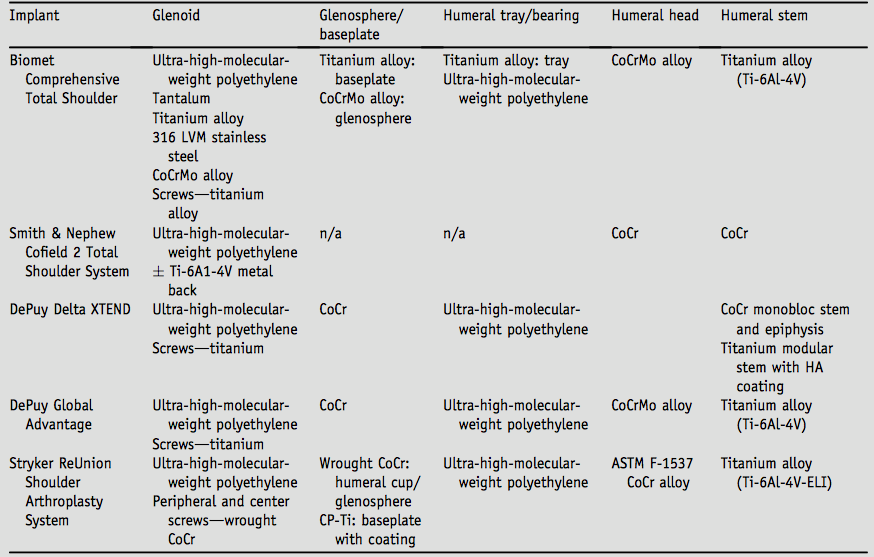
Their chart provides a useful insight into the metal content of some current arthroplasty systems


The authors point out that while skin patch testing is the gold standard for determining metal hypersensitivity and recommended for patients with a history of dermatitis prior to metallic implantation, prior studies have also shown no correlation between positive skin patch test results and outcomes in orthopedic arthroplasty surgery and that there is poor correlation between self-reported allergy and skin patch results, with only 30% of patients with a self-reported nickel allergy having a positive skin patch test.

All of the patients in this series had improvements in range of motion and pain relief after shoulder arthroplasty. This is in agreement with other arthroplasty studies, which have shown no increased complications in patients with metal allergies who have undergone hip or knee replacements with standard implants. In hip and knee patients with patch test–positive metal allergies, surgeons have reported no complications or symptoms associated with use of standard metallic implants.

Comment: Stimulated by this article, we reviewed over 100 articles discussing metal allergy and its relationship to total joint arthroplasty outcome. From this review we concluded:
(1) There is an inconsistent relationship between self reported metal allergies and skin tests.
(2) Patients with self-reported metal allergies and/or positive skin tests do not have worse outcomes when standard implants are used.
(3 There are no specific clinical tests for metal allergy that have demonstrated utility in the evaluation of patients with failed arthroplasty.
(4) No distinctive surgical findings of metal allergy have been identified at revision surgery that distinguish this proposed etiology of failure from others. 
(5) While some patients with suspected metal allergy have good results after revision with a hypoallergenic set of implants, these results have not been demonstrated to be superior to those of revision with standard implants.

A relevant article was recently published. Lymphocyte Transformation Testing (LTT) in Cases of Pain Following Total Knee Arthroplasty: Little Relationship to Histopathologic Findings and Revision Outcomes.

These authors point out that the utilization of lymphocyte transformation testing (LTT) has increased for diagnosing metal sensitivity associated with knee arthroplasty, but its validity for the diagnosis of TKA failure due to an immune reaction has not been established. They sought to characterize the relationship of a positive LTT result to histopathologic findings and clinical and functional outcomes in 27 well-fixed, aseptic, primary TKA cases in which the patient had persistent pain and/or stiffness and underwent revision due to a suspected metal allergy to nickel, as determined on the basis of positive LTT.  Periprosthetic tissue samples obtained at the time of revision surgery were scored using the aseptic lymphocyte-dominated vasculitis-associated lesion (ALVAL) scoring system. 

Eight patients were categorized as mildly reactive; 8 patients, moderately reactive; and 11 patients, highly reactive to nickel by LTT. The predominant findings on routine histopathologic analysis were fibrosis and varying degrees of lymphocytic infiltration in 17 (63%) of the 27 cases. The average ALVAL score of the cohort was 3.1 +/- 1.9, of a maximum score of 10. Average Knee Society Score (KSS) values improved post-revision, as did range of motion (all p < 0.01). 

Neither LTT stimulation index as a continuous variable nor as a categorical variable (mildly reactive, moderately reactive, highly reactive) was correlated with ALVAL score, pre-revision function (as assessed by KSS-clinical, KSS-functional, and range of motion), or change in function at the most recent follow-up (0.015 < r < 0.30, 0.13 < p < 0.95). In addition, the ALVAL score did not correlate significantly with either pre-revision or post-revision KSS or range of motion (0.061 < r < 0.365, 0.09 < p < 0.88). 

The authors concluded that LTT results alone were insufficient for the diagnosis of TKA failure due to an immune reaction. A positive LTT may not indicate that an immune reaction is the cause of pain and stiffness post-TKA. 

===
We have a new set of shoulder youtubes about the shoulder, check them out at this link.

Be sure to visit "Ream and Run - the state of the art"  regarding this radically conservative approach to shoulder arthritis at this link and this link

Use the "Search" box to the right to find other topics of interest to you.


You may be interested in some of our most visited web pages   arthritis, total shoulder, ream and run, reverse total shoulder, CTA arthroplasty, and rotator cuff surgery as well as the 'ream and run essentials'


Tuesday, January 22, 2019

What about metal allergy in joint replacement?

Metal Hypersensitivity in Total Joint Arthroplasty 

These authors thoroughly reviewed the topic of metal allergy in joint replacement.

They found that 

» Metal hypersensitivity has been reported in various case reports and cohort studies. Type-IV (delayed-type) hypersensitivity to various implant metals, most frequently nickel, has been implicated in the pathogenesis of metal hypersensitivity.

» Currently, there are no guidelines for addressing suspected or known metal allergy preoperatively and there is no evidence-based support for either preoperative testing or routine use of hypoallergenic implants.

» Multiple diagnostic modalities are available for the workup of suspected metal hypersensitivity; the 2 most common are patch testing and lymphocyte transformation testing. However, the ability of these tests to diagnose disease and predict outcomes has not yet been demonstrated.

They concluded that there are no guidelines for addressing suspected or known metal allergy preoperatively and there is no evidence based support for either preoperative testing or routine use of hypoallergenic implants. Multiple diagnostic modalities are available for the workup of suspected metal hypersensitivity; however, the ability of these tests to diagnose disease and predict outcomes has not yet been elucidated.

A variety of hypoallergenic implants are available; however, no evidence-based guidelines exist for their use.

Comment: Here is some related information from a prior blog post

Shoulder arthroplasty in the patient with metal hypersensitivity

While a number of case reports have implicated metallic implants as a source of local and systemic allergic reactions, the link between metal hypersensitivity and poorly functioning or failing implants remains uncertain.  Based on their review, these authors recommend a cautious approach to patients with a history of metal hypersensitivity. In such patients they recommend a metallic implant with low to no nickel content. The fact is that the hard cobalt chrome components (from which humeral heads and glenospheres are commonly made) have nickel and the softer titanium components (from which humeral stems are commonly made) do not.


They conclude that (1) the role of metal hypersensitivity in poorly functioning or failing implants remains uncertain, (2) there is no conclusive evidence supporting the positive or negative predictive value of dermal patch testing preoperatively, (3) there is also no consensus on the best preoperative testing modality, (4) there are multiple studies that suggest an association (but not direct causality) between metal hypersensitivity and early implant failure as well as documented dermal manifestations after implantation in patients with metal sensitivities. 

Rather than using skin patch testing (as recommended by some), these authors advocate the use of an implant system  that does not contain nickel in any patient with a history that elicits concern for cutaneous metal hypersensitivity. In patients with a failed TSA, they recommend patch testing once infection and mechanical failure have been ruled out.

The great majority of head prostheses are made of chrome cobalt for a reason. The long term effects of using titanium rather than cobalt chrome heads remains to be determined.

This review prompts consideration of a recent post:

Females with Unexplained Joint Pain Following Total Joint Arthroplasty Exhibit a Higher Rate and Severity of Hypersensitivity to Implant Metals Compared with Males Implications of Sex-Based Bioreactivity Differences 

It has been reported that the prevalence of metal hypersensitivity in 10% of the general population, in 20% of people with well-performing implants, and in 60% of those with failing implants (Metal sensitivity in patients with orthopaedic implants. J Bone Joint Surg Am. 2001 Mar;83(3):428-36.).

These authors conducted a retrospective study of the rates and levels of metal sensitization in a selected group of 1,038 male and 1,575 female subjects with idiopathic joint pain following total joint arthroplasty (TJA) who were referred for sensitivity testing for cobalt, chromium and nickel.

A “no pain” control group consisted of age-matched control subjects who were tested prior to TJA implantation and had no reported history of metal allergy (n = 318).

Females demonstrated a significantly higher rate and severity of metal sensitization compared with males (median lymphocyte stimulation index (SI) among males was 2.8 (mean, 5.4; 95% confidence interval [CI], 4.9 to 6.0) compared with 3.5 (mean, 8.2; 95% CI, 7.4 to 9.0) among females (p < 0.05). Forty-nine percent of females had an SI equal to or greater than 4 (reactive) compared with 38% of males, and the implant-related level of pain was also significantly (p < 0.0001) higher among females (mean, 6.8; 95% CI, 6.6 to 6.9) compared with males (mean, 6.1; 95% CI, 6.0 to 6.3).

Interestingly, a positive sensitivity test was much more common than a positive self-reported history.

While the patients with painful joints had higher mean simulation indices, many had values in the normal range.


Here's another related post:

What Role Does Metal Hypersensitivity Play in Implant Complications?


The place of metal sensitivity testing in the evaluation of the painful arthroplasty, the cause/effect relationship of metal sensitivity to implant failure, and the success of revision to implants with different material compositions remain to be determined. In cases of suspected metal allergy it is important to exclude the possibility of a stealth infection from Propionibacterium, which may produce similar symptoms.

===

We have a new set of shoulder youtubes about the shoulder, check them out at this link.

Be sure to visit "Ream and Run - the state of the art"  regarding this radically conservative approach to shoulder arthritis at this link and this link

Use the "Search" box to the right to find other topics of interest to you.


You may be interested in some of our most visited web pages   arthritis, total shoulder, ream and run, reverse total shoulder, CTA arthroplasty, and rotator cuff surgery as well as the 'ream and run essentials'


Thursday, June 8, 2017

Shoulder arthroplasty and metal sensitivity

Shoulder arthroplasty in the patient with metal hypersensitivity

While a number of case reports have implicated metallic implants as a source of local and systemic allergic reactions, the link between metal hypersensitivity and poorly functioning or failing implants remains uncertain.  Based on their review, these authors recommend a cautious approach to patients with a history of metal hypersensitivity. In such patients they recommend a metallic implant with low to no nickel content. The fact is that the hard cobalt chrome components (from which humeral heads and glenospheres are commonly made) have nickel and the softer titanium components (from which humeral stems are commonly made) do not.


They conclude that (1) the role of metal hypersensitivity in poorly functioning or failing implants remains uncertain, (2) there is no conclusive evidence supporting the positive or negative predictive value of dermal patch testing preoperatively, (3) there is also no consensus on the best preoperative testing modality, (4) there are multiple studies that suggest an association (but not direct causality) between metal hypersensitivity and early implant failure as well as documented dermal manifestations after implantation in patients with metal sensitivities. 

Rather than using skin patch testing (as recommended by some), these authors advocate the use of an implant system  that does not contain nickel in any patient with a history that elicits concern for cutaneous metal hypersensitivity. In patients with a failed TSA, they recommend patch testing once infection and mechanical failure have been ruled out.

The great majority of head prostheses are made of chrome cobalt for a reason. The long term effects of using titanium rather than cobalt chrome heads remains to be determined.

This review prompts consideration of a recent post:

Females with Unexplained Joint Pain Following Total Joint Arthroplasty Exhibit a Higher Rate and Severity of Hypersensitivity to Implant Metals Compared with Males Implications of Sex-Based Bioreactivity Differences 

It has been reported that the prevalence of metal hypersensitivity in 10% of the general population, in 20% of people with well-performing implants, and in 60% of those with failing implants (Metal sensitivity in patients with orthopaedic implants. J Bone Joint Surg Am. 2001 Mar;83(3):428-36.).

These authors conducted a retrospective study of the rates and levels of metal sensitization in a selected group of 1,038 male and 1,575 female subjects with idiopathic joint pain following total joint arthroplasty (TJA) who were referred for sensitivity testing for cobalt, chromium and nickel.

A “no pain” control group consisted of age-matched control subjects who were tested prior to TJA implantation and had no reported history of metal allergy (n = 318).

Females demonstrated a significantly higher rate and severity of metal sensitization compared with males (median lymphocyte stimulation index (SI) among males was 2.8 (mean, 5.4; 95% confidence interval [CI], 4.9 to 6.0) compared with 3.5 (mean, 8.2; 95% CI, 7.4 to 9.0) among females (p < 0.05). Forty-nine percent of females had an SI equal to or greater than 4 (reactive) compared with 38% of males, and the implant-related level of pain was also significantly (p < 0.0001) higher among females (mean, 6.8; 95% CI, 6.6 to 6.9) compared with males (mean, 6.1; 95% CI, 6.0 to 6.3).

Interestingly, a positive sensitivity test was much more common than a positive self-reported history.

While the patients with painful joints had higher mean simulation indices, many had values in the normal range.


Comment: The place of metal sensitivity testing in the evaluation of the painful arthroplasty, the cause/effect relationship of metal sensitivity to implant failure, and the success of revision to implants with different material compositions remain to be determined.

Here's another related post:

What Role Does Metal Hypersensitivity Play in Implant Complications?

=====


Use the "Search" box to the right to find other topics of interest to you.

Monday, April 24, 2017

Metal sensitivity - do we know enough to alter our practice?

Females with Unexplained Joint Pain Following Total Joint Arthroplasty Exhibit a Higher Rate and Severity of Hypersensitivity to Implant Metals Compared with Males Implications of Sex-Based Bioreactivity Differences

It has been reported that the prevalence of metal hypersensitivity in 10% of the general population, in 20% of people with well-performing implants, and in 60% of those with failing implants (Metal sensitivity in patients with orthopaedic implants. J Bone Joint Surg Am. 2001 Mar;83(3):428-36.). 

These authors conducted a retrospective study of the rates and levels of metal sensitization in a selected group of 1,038 male and 1,575 female subjects with idiopathic joint pain following total joint arthroplasty (TJA) who were referred for sensitivity testing for cobalt, chromium and nickel.

A “no pain” control group consisted of age-matched control subjects who were tested prior to TJA implantation and had no reported history of metal allergy (n = 318).

Females demonstrated a significantly higher rate and severity of metal sensitization compared with males (median lymphocyte stimulation index (SI) among males was 2.8 (mean, 5.4; 95% confidence interval [CI], 4.9 to 6.0) compared with 3.5 (mean, 8.2; 95% CI, 7.4 to 9.0) among females (p < 0.05). Forty-nine percent of females had an SI equal to or greater than 4 (reactive) compared with 38% of males, and the implant-related level of pain was also significantly (p < 0.0001) higher among females (mean, 6.8; 95% CI, 6.6 to 6.9) compared with males (mean, 6.1; 95% CI, 6.0 to 6.3).

Interestingly, a positive sensitivity test was much more common than a positive self-reported history.

While the patients with painful joints had higher mean simulation indices, many had values in the normal range.


Comment: The place of metal sensitivity testing in the evaluation of the painful arthroplasty, the cause/effect relationship of metal sensitivity to implant failure, and the success of revision to implants with different material compositions remain to be determined.

===


Information about shoulder exercises can be found at this link.

Use the "Search" box to the right to find other topics of interest to you.