


Because he wished to avoid the risks and limitations of a polyethylene glenoid component, he elected to proceed with a ream and run procedure.
Seven years after his ream and run arthroplasty, he provided the x-rays below showing a radiographic joint space between the ball and the reamed socket and a stable anteriorly eccentric humeral head component.

He had returned to throwing batting practice and kindly gave permission to share this video.
15 years after his ream and run at the age of 60 he sent this note: "Our youngest was 3 years old when I got my right shoulder replaced. I had my left shoulder replaced two years later. If my right arm had fallen off 5 years ago, I'd still consider the ream and run procedure a success given all the use I got out of it for the 10 years post procedure. That said, I'm stronger now than ever. I serve as the head varsity baseball coach at our high school. Inclusive in that job is throwing approximately 15,000 pitches of batting practice per year. I've been able to do that repeatedly over the last decade plus which would put me at about 150,000 pitches thrown (and that's conservative).
In addition - I play tennis, throw footballs, swim free-style, and lift weights. All things I was told not to do when I was 28 years old by my then ortho doctor. Another 16 years went by before I learned of the ream and run, I didn't mention that all activity is done pain free. Every once in a while (like 1% of the time) I'll get a flare up, but it always goes away.
Case 2: A 49 year old athletic man presented with pain and stiffness of his left dominant shoulder after an arthroscopic debridement 10 years prior. He was ASA I with a BMI of 26. His Simple Shoulder Test (SST) score was 6 positive responses out of 12. In contrast to other scoring systems, the benefit of the SST is that it identifies the specific functional impairments of the shoulder; in this case:
shoulder not comfortable at side,
shoulder did not allow comfortable sleep,
inability to reach the back to tuck in a shirt,
inability to lift 8 pounds to shoulder level,
inability to throw overhand.
inability to throw underhand.
His preoperative x-rays showed glenohumeral osteoarthritis

The axillary "truth" view showed the humeral head to be posteriorly decentered on a biconcave glenoid.
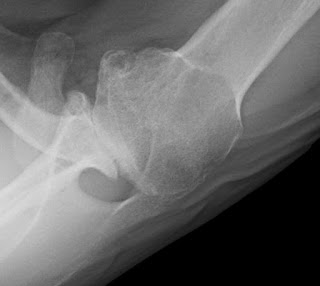
Because he wished to avoid the risks and limitations of a prosthetic glenoid component, he elected to have a ream and run procedure. CT scans and preoperative planning were not used. A general anesthetic was used without a brachial plexus block. His glenoid was conservatively reamed to create a single concavity with a diameter of curvature of 58 mm. A 12 mm canal-sparing stem was secured with impaction autografting. An 56 mm diameter of curvature, 21 mm thick, anteriorly eccentric humeral head was used to optimize posterior stability. A rotator interval plication was used to manage excessive posterior translation. See How to do a ream and run arthroplasty.
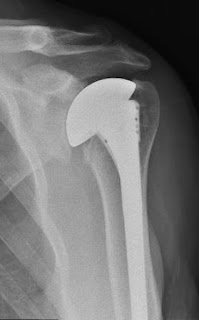
His six week postoperative x-rays showed a securely fixed humeral stem and an anteriorly eccentric humeral head centered on a monoconcave glenoid surface.
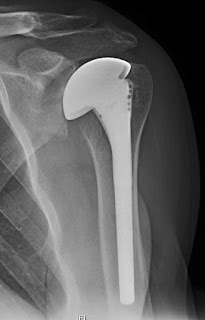
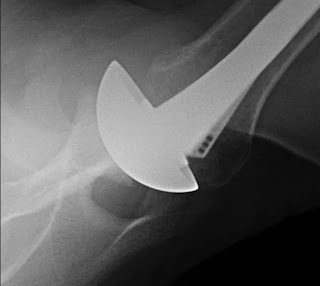
His four year postoperative films showed stability of the stem and glenohumeral relationships without glenoid wear. There was no evidence of stress shielding, subsidence or loosening of the stem. He had full motion and function of his shoulder with a Simple Shoulder Test indicating the ability to perform all twelve functions.

Five years after surgery he sent this video of his pitching form along with a note “I hadn’t been able to throw for 25 years”



It is worth noting that while this patient had many of the risk factors for a Cutibacterium periprosthetic infection (young male, low BMI, low ASA), he fortunately has shown no evidence of this complication. At the time of his surgery, prophylaxis consisted of chlorhexidine showers before surgery, chlorhexidine skin prep, ceftriaxone and vancomycin intravenous antibiotics as well as topical in-wound vancomycin at the time of surgery. Now patients at high risk for Cutibacterium PJI would be considered for additional prophylaxis, such as povidone-iodine irrigation and a three week course of postoperative antibiotics such as Doxycycline or Augmentin.
You can support cutting edge shoulder research that is leading to better care for patients with shoulder problems, click on this link.
Follow on twitter: https://twitter.com/shoulderarth
Follow on facebook: click on this link
Follow on facebook: https://www.facebook.com/frederick.matsen
Follow on LinkedIn: https://www.linkedin.com/in/rick-matsen-88b1a8133/
Here are some videos that are of shoulder interest
Shoulder arthritis - what you need to know (see this link).
How to x-ray the shoulder (see this link).
The ream and run procedure (see this link).
The total shoulder arthroplasty (see this link).
The cuff tear arthropathy arthroplasty (see this link).
The reverse total shoulder arthroplasty (see this link).
The smooth and move procedure for irreparable rotator cuff tears (see this link).
Shoulder rehabilitation exercises (see this link).
