Showing posts with label polyethylene. Show all posts

Saturday, October 9, 2021

Reverse total shoulder failure and the issue of polyethylene wear

 Backside Polyethylene Wear in Reverse Shoulder Arthroplasty

These authors point out that the particles from polyethylene wear may result in osteolysis and component loosening in reverse shoulder arthroplasty (RSA) - this wear may occur on either the articular side of the polyethylene (PE) or on the backside of the PE liner. 

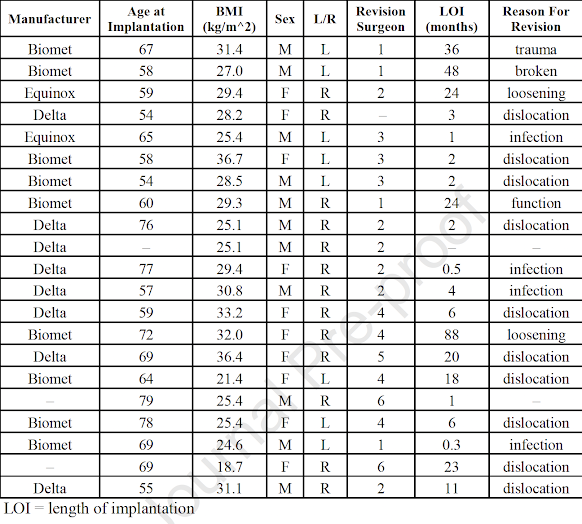
They sought to characterize the damage to the backside and articular surfaces in 21 explanted RSA components.


The mean time between implantation and extraction was 16 months (10 days–88 months). Diagnoses at the time of revision included dislocation (10), infection (4), mechanical failure (3), loosening (2), and unknown (2). 


Damage was noted on the articular surfaces of all 21 liners and on the backside surface of 20 liners. The total damage in all the quadrants was higher on the articular surface than on the backside of the component. The articular side exhibited greater scratching, abrasion, and surface deformation than the backside.The inferior anatomical aspect showed the greatest amount of wear.


It is of interest that dislocation was the most common reason for RSA revision in this series, followed by infection. The length of implantation ranged from 0.3 to 88 months. 


The photo below shows pitting, typical of backside wear.


The photo below shows major wear (lower left). 

Comment: Polyethylene wear in RSA sheds particles of polyethylene into the shoulder throughout the life of the patient. These particles can lead to inflammation, osteolysis and loosening. While this study did not attempt to measure the amount of polyethylene lost from the surface, it is apparent from examples like the one above that this can be substantial. It is possible that the reported deterioration in RSA function observed over time may be related to polyethylene wear and the effect of the released particles. 

This issue is addressed in the paper, which was not referenced in the publication above: Analysis of Polyethylene Wear of Reverse Shoulder Components: A Validated Technique and Initial Clinical Results


These authors used a coordinate measurement machine (CMM) and custom computer algorithms to quantify the volumetric wear of polyethylene humeral bearings. This technique was validated using two

never-implanted polyethylene humeral liners with a controlled amount of wear in clinically relevant locations. The technique was determined to be accurate to within 10% of the known value and within 5mm^3 of the gravimetrically determined values. 


Following validation, ten retrieved polyethylene humeral liners were analyzed to determine a baseline for future clinical tests. Four of the ten polyethylene humeral liners showed visible and measureable wear volumes ranging from 40 to 90mm^total with a maximum wear rate as high as 470mm^3/year in one short duration and significantly damaged humeral liner. 


They found dosages of shed polyethylene were well within the osteolytic thresholds that have been suggested, indicating that osteolysis may be a clinical concern in the shoulder.


Further clinical research is needed to determine whether polyethylene wear in vivo can be minimized by using different types of polyethylene, by RSA design and by component positioning.


Follow on twitter: https://twitter.com/shoulderarth

Follow on facebook: https://www.facebook.com/frederick.matsen

Follow on LinkedIn: https://www.linkedin.com/in/rick-matsen-88b1a8133/


How you can support research in shoulder surgery Click on this link.

Here are some videos that are of shoulder interest
Shoulder arthritis - what you need to know (see this link)
The smooth and move for irreparable cuff tears (see this link)
The total shoulder arthroplasty (see this link).
The ream and run technique is shown in this link.
The cuff tear arthropathy arthroplasty (see this link).
The reverse total shoulder arthroplasty (see this link).

Shoulder rehabilitation exercises (see this link).

This is a non-commercial site, the purpose of which is education, consistent with "Fair Use" as defined in Title 17 of the U.S. Code.          
Note that author has no financial relationships with any orthopaedic companies.


Thursday, January 28, 2021

Shoulder arthroplasty - prosthetic bearing surfaces

Prosthetic Bearing Surfaces in an Anatomic and Reverse Total Shoulder Arthroplasty

Perhaps the most robust clinical data comparing total shoulder bearing surfaces comes from the Australian Orthopedic Association (see this link). The graph below shows less than 5% revision rate at 11 years using cross linked polyethylene in comparison to a greater than two-fold increased revision rate for non cross linked poly. These data provide a sound benchmark for comparison of alternative bearing surfaces.


This review describes some of the newer types of bearing surfaces, including those treated with vitamin E processing, ceramic heads, and pyrolytic carbon surfaces. The preponderance of this information comes from in vitro wear testing and so far no clinical data have been presented demonsrating superiority of the newer approaches over the outcomes shown in the graph above.


(1) Vitamin E-enhanced cross-linked polyethylene in model anatomic TSA had a 36% reduction in wear rates in the vitamin E-enhanced components compared with those without vitamin E processing.

(2) Although some evidence exists showing improved wear rates using ceramic heads, further data are needed to establish recommendations for both anatomic and reverse total shoulder arthroplasty.  N.B., these components are not approved by the Food and Drug Administration.

(3) No published literature exists on the use of metal-on-metal interface in anatomic shoulder arthroplasty.

(4) There is little information regarding the use of a pyrocarbon bearing surface in either anatomic and reverse TSA


To put this information in perspective we should remember that glenoid component failure is determined by a number of factors that are more important than wear ratesincluding surgical technique (bone preparation, seating, cementing, glenohumeral stability, humeral component positioning), rotator cuff integrity, diametral mismatch of the articular surfaces, and presence or absence of metal-backing.


Here are some videos that are of shoulder interest
Shoulder arthritis - what you need to know (see this link).
How to x-ray the shoulder (see this link).
The ream and run procedure (see this link).
The total shoulder arthroplasty (see this link).
The cuff tear arthropathy arthroplasty (see this link).
The reverse total shoulder arthroplasty (see this link).
The smooth and move procedure for irreparable rotator cuff tears (see this link).
Shoulder rehabilitation exercises (see this link).

Thursday, March 19, 2020

Reverse total shoulder - the polyethylene wears with time.

In vivo volumetric and linear wear measurement of reverse shoulder arthroplasty at minimum 5-year follow-up

The authors point out that reverse shoulder arthroplasty is quickly becoming the most frequently performed glenohumeral joint replacement, being used to treat cases that previously would have been successfully managed with a conventional anatomic total shoulder.

In 15 patients with at least an average of 8 years after surgery, they evaluated the volumetric and linear wear rates of ultrahigh-molecular-weight polyethylene humeral liners in vivo using radiostereometric analysis to image 15 patients at terminal range of motion in forward flexion, abduction, external rotation, and internal rotation and with the arm at the side. The relative position and orientation of the glenosphere and polyethylenewere identified for each arm position.

The apparent intersection of the glenosphere into the polyethylene was recorded as wear. 


The mean volumetric and linear wear rates for the 13 shoulders with  36-mm liners were 42 mm^3/yr and 0.11 mm/yr, respectively. The graph below shows the progression with time.


The mean volumetric and linear wear rates for the two shoulders with 42-mm liners were substantially greater than for the smaller liner: 114 mm^3/yr and 0.17 mm/yr, respectively. 

Comment: The polyethylene wear particles resulting from this wear can stimulate an inflammatory response (see this link). These results may help explain the reported deterioration in reverse total shoulder clinical outcomes with time. 

See this related article 

Long-term results of the Delta Xtend reverse shoulder prosthesis

These authors reviewed 126 primary Delta Xtend reverse total shoulder prostheses implanted in our center by an individual surgeon from October 2006 until December 2009. Of these, 38 patients died, 12 were lost to follow-up, and 2 needed early revision of the prosthesis.

Follow-up of at least 8 years was available for 74 patients. The mean follow-up in our population was 113.1 months. 

The mean adjusted Constant Score was 44.6% preoperatively. It increased significantly to 75.8% after surgery and to 91.1% at 5 years. At the latest follow-up, the mean aCS had declined to 79.9%. 


=====
To see a YouTube of our technique for a reverse total shoulder arthroplasty, click on this link.


===

To see our new series of youtube videos on important shoulder surgeries and how they are done, click here.

Use the "Search" box to the right to find other topics of interest to you.


You may be interested in some of our most visited web pages  arthritis, total shoulder, ream and runreverse total shoulderCTA arthroplasty, and rotator cuff surgery as well as the 'ream and run essentials'

Tuesday, October 9, 2018

Can notching be a problem after reverse total shoulder? Yes!

Eight years ago, a patient had this type of reverse total shoulder implanted in the right shoulder. Note the close proximity between the humeral polyethylene and the inferior screw (arrow).


Seven years later the patient was complaining of shoulder pain and had the x-ray shown below. The arrow points to scapular notching from contact of the bone of the scapular with the polyethylene of the humeral cup. This notching has exposed the inferior screw.


Eight months later, the shoulder dislocated and could not be stably reduced. The x-ray below shows the dislocated reverse with the notched scapula.


At revision surgery, the polyethylene was seen to be eroded so that it no longer functioned as a complete cup - this allowed the shoulder to dislocate. The appearance of the polyethylene is show below.


We revised this shoulder by removing the prominent screw, replacing the glenosphere with one of a larger diameter of curvature, and using humeral spacers to improve stability by increasing the compressive force at the joint.


This case demonstrates that notching can be a problem and that the resulting loss of the polyethylene concavity can allow the reverse total shoulder to dislocate.

=====
Use the "Search" box to the right to find other topics of interest to you.


You may be interested in some of our most visited web pages   arthritis, total shoulder, ream and runreverse total shoulderCTA arthroplasty, and rotator cuff surgery as well as the 'ream and run essentials'

Saturday, October 21, 2017

Reverse total shoulder - failure by polyethylene dissociation from humeral stem

Polyethylene dissociation from humeral stem status after reverse total shoulder arthroplasty

These authors present 4 cases of polyethylene dissociation from the humeral component after a Zimmer Trabecular Metal reverse total shoulder.


The manufacturer's recommended method for securing the polyethylene insert is show in this link technique.


The authors suggest that surgeons should be aware of this possibility if a closed reduction of a dislocated reverse total shoulder is not possible. They point out that dissociation may be difficult to distinguish on radiographs; however, subtle clues can be present, including decreased spacer distance between the glenosphere and humeral stem as well as a soft tissue shadow caused by the radiolucent polyethylene.

All 4 patients were male; all patients underwent surgery with the Zimmer TM RSA (although this complication has been seen with other designs). There was a design change that affected the polyethylene humeral stem junction and the ease of placement for this specific product; however, the complications occurred both before and after this design change. 

Comment: The direction of forces applied to a reverse total shoulder frequently deviate from the what is desired for concavity compression. As a result, potentially displacing loads are applied to each element of the system: the baseplate, the glenosphere, the humeral polyethylene, and spacers. These loads can challenge each component junction: "each junction is a potential disjunction". 

===
The reader may also be interested in these posts:


Information about shoulder exercises can be found at this link.

Use the "Search" box to the right to find other topics of interest to you.

You may be interested in some of our most visited web pages including:shoulder arthritis, total shoulder, ream and runreverse total shoulderCTA arthroplasty, and rotator cuff surgery as well as the 'ream and run essentials'


Sunday, July 23, 2017

Reverse total shoulder failure from polyethylene dissociation from humeral implant

Polyethylene dissociation from humeral stem status after reverse total shoulder arthroplasty

These authors present four cases of polyethylene liner dissociation from the humeral component of a  reverse shoulder arthroplasty (RSA).  In a series of 549 patients who underwent RSA, the incidence of this complication was 0.7%.  These patients presented with signs, symptoms, and imaging consistent with dislocation but were found to have a dissociation of the polyethylene from the humeral component, rendering a closed reduction impossible.

All four cases were male with a the same implant. The dissociations were recognized between 3 months and three years after surgery. The images from the four cases are shown here. The authors caution, "surgeons should be aware of this possibility if a closed reduction of an RSA dislocation is not possible."


Comment: Because the polyethylene liner of a reverse total shoulder can experience large, non-compressive loads, it is at risk for displacement from the metal humeral cup. Similar complications have occurred with other implants, so it is not clear whether the design of this system is at particular risk for this complication. With any design, it is important that the liner be vigorously and fully seated in the humeral cup after assuring that the cup is dry and free of any interposed tissue. After insertion, the security of the seating needs to be verified.
===== 
The reader may also be interested in these posts:


Information about shoulder exercises can be found at this link.

Use the "Search" box to the right to find other topics of interest to you.

You may be interested in some of our most visited web pages including:shoulder arthritis, total shoulder, ream and runreverse total shoulderCTA arthroplasty, and rotator cuff surgery as well as the 'ream and run essentials'


Saturday, February 13, 2016

Total shoulder - isn't an all poly glenoid good enough? does glenoid type matter?

Radiographic and clinical outcomes of total shoulder arthroplasty with an all-polyethylene pegged bone ingrowth glenoid component: prospective short- to medium-term follow-up.

These authors reviewed 80 total shoulders using an all polyethylene glenoid component.  The glenoid was reamed minimally to preserve subchondral bone, which was given priority above correcting retroversion.

1 of 80 shoulders was revised for aseptic glenoid loosening.  81.6% had a radiolucency grade of 0 or 1. Nearly 90% had a glenoid seating grade of A or B. Grade 2 or 3 bone around the central peg was seen in 88.2%. 

No statistical association existed between Walch glenoid types and radiolucency grades, bone grades around the central peg, perfect radiolucency grade, seating grade, and grade 3 bone around the central peg.


Comment: We previously posted on this article here, emphasizing the importance of register (see link).

We'd like to add a few additional thoughts. These authors use a technique similar to the one used in our practice (see link).  No patient-specific instrumentation or complex 3D reconstructions were used. The glenoid was reamed conservatively to a single concavity without emphasizing a change in version. 

Using the all poly glenoid after careful glenoid preparation with minimal reaming yields consistently better results than those achieved with metal backed components (see link). The DePuy and the Tornier versions of the modern all-poly glenoids are shown below. Other relevant links are here and here


The quality of fixation and the bone ingrowth into the pegs is substantial as shown in some of our cases below.


Against this background, we wonder whether more complex components, such as the one shown below and discussed here, provide additional value.


Saturday, August 8, 2015

Total shoulder arthroplasty with an all polyethylene glenoid component


Five- to ten-year follow-up with a partially cemented all-polyethylene bone-ingrowth glenoid component.

These authors evaluated 42 total shoulder arthroplasties performed from 2003 to 2007 using an all polyethylene glenoid component.


Omitted from the study were 34 patients that were either deceased (n . 15 [19.7%]) or could not be contacted for final follow-up (n . 19 [25%]). The average follow-up was 80 months (63-114);

81% of the central fluted pegs had complete incorporation with no lucent lines. Lucent lines correlated with lower ASES scores.Vault penetration of the central fluted peg was found in 5 cases. Four of these went on to develop lucent lines (80%) compared with the average for the study, which was 19%.
Glenoid lucent lines strongly correlated with the grade of humeral calcar osteolysis.

Comment: Hopefully the authors will follow these patients along to see if the radiolucent lines are progressive with time. The relationship of glenoid lucent lines to humeral osteolysis suggests the possibilities of low grade infection from Propionibacterium or reaction to polyethylene debris.  This study had only 1 revision, and at the time of the surgery, 5 tissue culture specimens were obtained and held for 3 weeks in 3 different media including broth, and all were negative.

These are encouraging results with a system that avoids metal backing and removes a relatively small amount of humeral bone.

==

Check out the new Shoulder Arthritis Book - click here.


Use the "Search" box to the right to find other topics of interest to you.

You may be interested in some of our most visited web pages including:shoulder arthritis, total shoulder, ream and runreverse total shoulderCTA arthroplasty, and rotator cuff surgery as well as the 'ream and run essentials'


Thursday, July 23, 2015

Reverse total shoulder arthroplasty - the polyethylene wears!

Wear rates of retentive versus nonretentive reverse total shoulder arthroplasty liners in an in vitro wear simulation.

These authors performed in vitro testing of 6 nonretentive and 6 retentive reverse total shoulder (rTSA) non-cross-linked polyethylene liners, subjecting them to 4.5 million cycles of alternating cycles of abduction-adduction and flexion-extension motion. The rTSA liners were assessed for gravimetric wear loss, 3-dimensional volumetric loss, and particulate wear debris analysis. Wear took place for both retentive and non-retentive liners, increasing essentially linearly with the number of cycles.  Retentive liners underwent significantly greater volume loss and greater surface deviation than non retentive liners, especially after high numbers of cycles. The authors suggest that the additional stability afforded by retentive liners should be balanced against the potential for increased wear and potential for subsequent polyethylene wear-induced aseptic loosening.

Comment: The real story here is  that the polyethylene of a reverse total shoulder wears increasingly with increasing use as shown in the figure below. However by their method volumetric wear was not detectable with fewer that 250,000 cycles under loading conditions approximating body weight. It seems likely that wear rates in patients would depend on the number of cycles, the excursion of each cycle, the compressive load across the joint, and the presence of abrasive particles within the articulation.

It is recognized that polyethylene debris can cause inflammation, accelerated wear, and bone resorption.


====

Use the "Search" box to the right to find other topics of interest to you.


You may be interested in some of our most visited web pages including:shoulder arthritis, total shoulder, ream and runreverse total shoulderCTA arthroplasty, and rotator cuff surgery as well as the 'ream and run essentials'


Monday, July 7, 2014

Clinical perfomance of metal backed glenoids in comparison to all polyethylene components

Metal-Backed Glenoid Components Have a Higher Rate of Failure and Fail by Different Modes in Comparison with All-Polyethylene Components A Systematic Review

We conducted a comprehensive systematic review of twenty-one studies on radiolucency, radiographic failure, and revision after arthroplasty with metal-backed glenoid components and twenty-three studies with all-polyethylene components. Our analysis included data on 1571 metal-backed and 3035 all-polyethylene components. The mean duration of follow-up was 5.8 years in the studies with metal-backed components and 7.3 years with all-polyethylene components.

All-polyethylene components had a 42.5% rate of radiolucency compared with 34.9% for metal-backed components (p = 0.0026) and a 21.1% rate of radiographic loosening or failure compared with 16.8% for metal-backed components (p = 0.0005).
However, the rate of revision was more than three times higher with metal-backed components (14.0%) than with all-polyethylene components (3.8%, p < 0.0001). 
Although 77% of the revisions of all-polyethylene components were for loosening, 62% of the revisions of metal-backed components were for other reasons, such as component fracture, screw breakage, component dissociation, polyethylene wear, metal wear, and rotator cuff tear (p < 0.0001).

Comment: The published evidence indicates that metal-backed glenoid components require revision at a significantly higher rate and for different reasons in comparison with all-polyethylene components. It is important that the majority of cases of lucency, loosening, and revision became evident 7 years after the index surgery. 

One of the intrinsic difficulties with metal backed relate to the difference in elastic modulus for the different materials that are relevant to the use of these glenoids.
The key values for Young's modulus are
Cancellous bone     0.4  GPa
Cortical bone          8.0 GPa
PMMA cement       2.0 GPa
Titanium             112.0 GPa
Cobalt chrome    200.0 GPa
Polyethylene          0.5 GPa
The wide differences in these values indicate that the different materials will deform differently under load leading to shear at the interfaces.  These challenges cannot be avoided when glenoids are made of different materials. Note also that the closest match is between polyethylene and bone.

Some examples of metal backed glenoids are shown below. These are not necessarily the types of components represented in the study.


===
Consultation for those who live a distance away from Seattle.

Click here to see the new Shoulder Arthritis Book

Click here to see the new Rotator Cuff Book

To see the topics covered in this Blog, click here

Use the "Search" box to the right to find other topics of interest to you.

You may be interested in some of our most visited web pages including:shoulder arthritis, total shoulder, ream and runreverse total shoulderCTA arthroplasty, and rotator cuff surgery as well as the 'ream and run essentials'


To see other similar posts, click on the label of interest below.