Showing posts with label revision rotator cuff repair. Show all posts

Saturday, April 6, 2024

Stump water - a risk factor for failure of rotator cuff repair

The authors of Tendon stump type on magnetic resonance imaging is a predictive factor for retear after arthroscopic rotator cuff repair investigated the tear size, Goutallier stage, and global fatty degeneration index, seeking factors associated with retear after cuff repair. They also classified the rotator cuff tendon stump (yellow circle) by preoperative oblique coronal image plane T2-weighted fat-suppressed magnetic resonance imaging (MRI), comparing its signal intensity to that of the nearby deltoid muscle (red circle) in 305 patients having arthroscopic cuff repair. 


The authors classified the value of the rotator cuff stump signal intensity (C) divided by the deltoid signal intensity (D) into 3 types defining the stump classification in terms of the C/D ratio.The stump was classified as type 1 if the stump appeared darker than the deltoid, with a C/D ratio less than 0.8; as type 2 if the stump was similar in darkness to the deltoid, with a C/D ratio of 0.8 to 1.3; and as type 3 if the stump appeared whiter than the deltoid, with a C/D ratio greater than 1.3.


The retear rates were 3.4% for type 1 stumps, 4.9% for type 2, and 17.7% for type 3. As shown below, the stump type did not appear to correlate with age, Goutallier stage, GFDI or tear size.


As shown below, multiple regression analysis identified stump type as having the strongest association with retear (odds ratio [OR], 4.28), followed by global fatty degeneration index (OR, 2.99), and anteroposterior tear size (OR, 1.06).

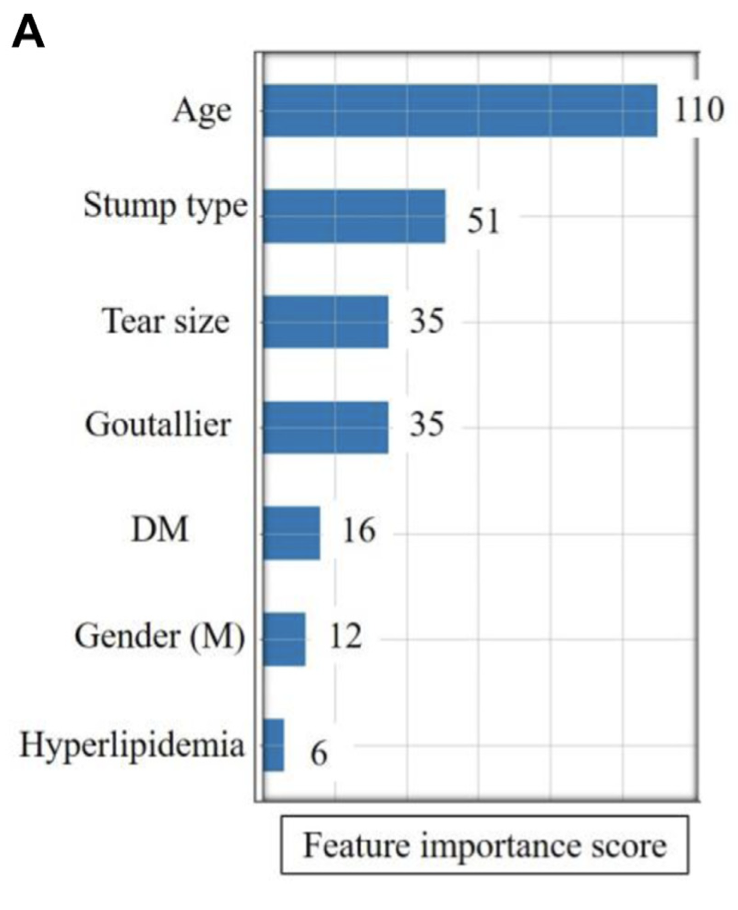


A more recent paper, Re-tear after arthroscopic rotator cuff tear surgery: risk analysis using machine learning found that the most important features predicting re-tears after cuff repair were age, stump type, tear size, and Goutallier grade. 

  1. Comment: As these studies demonstrate, the failure risk of rotator cuff repair is influenced by the quality and quantity of cuff tissue available for repair. Stump type is a relatively newly described characteristic.

    The signal intensity on T2-weighted tendon stump images is increased by three factors, each of which can affect the ability of tendon to resist cuff repair suture pull through:

    Water Content: Tissues with higher water content generally have longer T2 relaxation times and appear brighter on T2-weighted images. 

    Protein Content: Tissues with lower protein content tend to have longer T2 relaxation times and appear brighter on T2-weighted images.

    Tissue Structure: Tissues with more disorganized structures, such as muscle, exhibit longer T2 relaxation times and appear brighter compared to tissues with highly organized structures, such as normal tendons or ligaments.

    You can support cutting edge shoulder research that is leading to better care for patients with shoulder problems, click on this link.

    Follow on twitter: https://twitter.com/RickMatsen or https://twitter.com/shoulderarth
    Follow on facebook: click on this link
    Follow on facebook: https://www.facebook.com/frederick.matsen
    Follow on LinkedIn: https://www.linkedin.com/in/rick-matsen-88b1a8133/

    Here are some videos that are of shoulder interest
    Shoulder arthritis - what you need to know (see this link).
    How to x-ray the shoulder (see this link).
    The ream and run procedure (see this link).
    The total shoulder arthroplasty (see this link).
    The cuff tear arthropathy arthroplasty (see this link).
    The reverse total shoulder arthroplasty (see this link).
    The smooth and move procedure for irreparable rotator cuff tears (see this link).
    Shoulder rehabilitation exercises (see this link).


Saturday, March 7, 2020

Failed cuff repair - is attempting re-repair worthwhile?

Medium-term outcomes of a cohort of revision rotator cuff repairs

These authors conducted a multicenter, prospective cohort study of 125 revision rotator cuff repairs undertaken between March 2009 and December 2010.

The patient-reported retear rate was 32.6%, and the reoperation rate was 34.7%. Reasons for reoperation in the revision group included retear (48%), stiffness (42%), and infection (10%).

Better clinical outcomes are seen in nonsmokers, those with only 1 tendon affected, and those who underwent tenotomy instead of tenodesis for a damaged long head of biceps tendon.

Comment: These patients did not have followup MRI's so we cannot know the true retear rate, which is likely to be substantially higher than the already quite high patient-reported rate of 33%. Furthermore, the authors were not able to compare the clinical outcomes for the retorn and the intact re-repairs. In that over one-third of the revision cuff repairs had yet another surgery, it the value of this surgery to patients is unclear.

As has been well demonstrated (see this link and this link) patients with rotator cuff tears - even massive, irreparable ones - can be improved by a simple surgical procedure that does not involve an attempted repair and does not require post operative limitation of use of the arm during a healing period. To see a video of the smooth and move procedure, click on this link.

===
To see our new series of youtube videos on important shoulder surgeries and how they are done, click here.

Use the "Search" box to the right to find other topics of interest to you.


You may be interested in some of our most visited web pages  arthritis, total shoulder, ream and run, reverse total shoulder, CTA arthroplasty, and rotator cuff surgery as well as the 'ream and run essentials'

Total shoulder - complications and revisions

Outcomes of total shoulder arthroplasty for instability arthropathy with a prior coracoid transfer procedure: a retrospective review and matched cohort

These authors identified 11 primary anatomic total shoulder arthroplasties performed for instability arthropathy with a prior coracoid transfer procedure with a minimum of 2 years’ follow-up. A matched cohort of 33 patients with a total shoulder arthroplasty for primary osteoarthritis served as the control group.

The coracoid transfer cohort showed no significant difference in the final ASES score or SANE score in comparison to the matched cohort. The postoperative ASES pain score was higher in the coracoid transfer cohort, but the mean improvement from preoperative to postoperative values for the ASES score, ASES pain score were not different between cohorts. Both cohorts had high patient satisfaction without a statistically significant difference.

Comment: It was interesting to note that between 1 in 4 and 1 in 5 patients in both groups had complications.  Overall, the total complication rates were 27.2% in the coracoid transfer group and 21.2% in the primary osteoarthritis group.

In the coracoid transfer cohort, there were a total of 3 complications in 3 different patients, for a total complication rate of 27.2%. Two early complications included a stitch abscess and a deep infection at 2 weeks requiring surgical debridement. A third patient in the prior coracoid transfer group was found to have aseptic glenoid loosening and polyethylene wear at 9 years. 

In the matched cohort, there were 7 complications in 4 patients, for a 21.2% total complication rate. The early complications included 2 neurapraxia injuries, a stitch abscess, and a small intraoperative glenoid fracture that did not require fixation or further treatment. The late complications included 2 cases of aseptic glenoid loosening and a late deep infection.

In the coracoid transfer group, 2 patients had undergone revision at final follow-up, for an 18.2%revision rate. The first case was a revision to RSA at 9.5 months for instability due to subscapularis failure after serial debridement following an acute deep infection at 2 weeks. The second case was a revision to RSA with iliac crest bone grafting at 9 years after TSA for aseptic glenoid loosening.

In the matched cohort, there were 2 revisions at final follow-up, for a 6.1% revision rate. The first case was a 2-stage revision to RSA at 5 years after TSA because of a deep methicillin-resistant Staphylococcus aureus infection. The second revision case was treated with RSA at 4 years postoperatively owing to aseptic glenoid loosening.

Here's a related article

Analysis of 4063 complications of shoulder arthroplasty reported to the US Food and Drug Administration from 2012 to 2016

Most of the literature on shoulder arthroplasty failure comes from high-volume centers. These reports tend to exclude the experience of community orthopedic surgeons, who perform most of the shoulder joint replacements.

These authors analyzed the failure reports mandated by the US Food and Drug Administration for all hospitals. Each reported event from 2012 to 2016 was characterized by implant, failure mode, and year of surgery.

For the 1673 anatomic arthroplasties, the most common failure modes were glenoid component failure (20.4%), rotator cuff/subscapularis tear (15.4%), pain/stiffness (12.9%), dislocation/instability (11.8%), infection (9%), and humeral component loosening (5.1%). 


For anatomic shoulder arthroplasties, the failure modes have not appreciably changed over recent years


For the 2390 reverse arthroplasties, the most common failure modes were dislocation/instability (32%), infection (13.8%), glenosphere-baseplate dissociation (12.2%), failed/loosened baseplate (10.4%), humeral component dissociation/tray fracture (5.5%), difficulty inserting the baseplate (4.8%), and difficulty inserting the glenosphere (4.2%). 


For reverse shoulder arthroplasties, the failure modes have not appreciably changed over recent years


Although the percentage distribution among the different failure modes was relatively consistent over the years of this study, the percentage distribution of these failure modes differed substantially among different implant manufacturers.

The authors conclude that the Food and Drug Administration database reveals modes of shoulder arthroplasty failurethat are not emphasized in the published literature, such as rotator cuff tear, infection, and postoperative pain/stiffness for anatomic total shoulder arthroplasty and implant dissociation and baseplate failure for reverse shoulder arthroplasty. Knowledge of these failure modes may help inform surgical technique and implant design in ways that will lower the risk of implant failure in the future.


===

To see a YouTube of our technique for total shoulder arthroplasty, click on this link.


=====
We have a new set of shoulder youtubes about the shoulder, check them out at this link.


To see our new series of youtube videos on important shoulder surgeries and how they are done, click here.

Use the "Search" box to the right to find other topics of interest to you.


You may be interested in some of our most visited web pages  arthritis, total shoulder, ream and run, reverse total shoulder, CTA arthroplasty, and rotator cuff surgery as well as the 'ream and run essentials'

Monday, February 17, 2020

Revision rotator cuff repair - is this a good thing to do?

Revision rotator cuff repair: a systematic review

These authors performed  a systematic review of 22 studies to analyze the clinical outcomes of revision rotator cuff repair (RCR) and to identify prognostic factors that may influence postoperative outcomes. Articles were included if they were original studies reporting clinical outcomes of revision RCR via an open or arthroscopic technique.


Revision RCR was performed via an open technique in 44% of cases and via an arthroscopic technique in 56% of cases (n . 452). Revision RCR was performed in conjunction with patch augmentation in 12% of cases.

Open revisions were performed in younger patients than arthroscopic revisions 
Compared with arthroscopic revisions, open revisions were less frequently performed in patients with 1 previous operation and more frequently performed in patients with multiple prior surgeries.
Open revisions were more frequently performed in patients with massive or large retears than in patients with medium or small retears.
Patients undergoing arthroscopic revision had greater mean preoperative forward flexion than those undergoing open revision.

Preoperative forward flexion was positively correlated with the postoperative ASES
score and with postoperative forward flexion.

The preoperative VAS pain score was positively correlated with the postoperative VAS pain score and negatively with the postoperative ASES score. 

The preoperative ASES score was positively correlated with the postoperative ASES score.

 Open revision improved forward flexion from 96 to 125 degrees
 Arthroscopic revision improved forward flexion from 125 to 146

Open revisions improved ASES scores from 41 to 76.  
Arthroscopic revisions improved ASES scores from 47 to 76

The overall complication rate with revision RCR was 12% (97 complications in 809 revisions). 
The complication rates for open and arthroscopic revisions were 8%  and 16%, respectively. 

The highest complication rate of 17% was noted with open or arthroscopic revision RCR with concomitant graft augmentation. 

The most frequent complication was revision RCR failure (88%), followed by persistent shoulder stiffness (5%) and infection (4%). 

Complications necessitated reoperations in 7 patients managed by open revision RCR and 30 patients managed by arthroscopic revision RCR. Reoperations included the following: revision RCR in 14, reverse total shoulder arthroplasty in 9, debridement in 5, arthrodesis in 3, subacromialdecompression in 2, capsular release in 1, biceps tenodesis in 1, acromioclavicular joint excision in 1, and pectoralis major transfer in 1.

Comment: The results showed that the better the shoulder's motion, function and comfort were before revision, the better the shoulder after revision. Arthroscopic surgery and graft augmentation had significantly higher rates of complications. No data are presented about cuff integrity after revision RCR.

Patients can experience failure of attempted cuff repair for several distinct reasons. In our experience, stiffness is most common, followed by painful crepitus, weakness and instability. Trying to regain anatomic integrity of the cuff after a prior attempted repair is challenging because at that point the cuff has torn at least twice, rendering it less likely to heal than at the first repair. 

However, we know that achieving cuff integrity is not essential to improving the comfort and function of a failed repair. For patients with stiffness or painful crepitus after a failed cuff repair, a simple smooth and move procedure can be effective. The technique for this procedure is shown in  this link.

=====
To see our new series of youtube videos on important shoulder surgeries and how they are done, click here.

Use the "Search" box to the right to find other topics of interest to you.


You may be interested in some of our most visited web pages  arthritis, total shoulder, ream and run, reverse total shoulder, CTA arthroplasty, and rotator cuff surgery as well as the 'ream and run essentials'