Showing posts with label scapula. Show all posts

Thursday, May 13, 2021

The scapula of our ancestor, Littlefoot, a social climber

From Science News, April 30, 2021.


"Little Foot, a nearly complete hominid skeleton painstakingly excavated from rock inside a South African cave, shouldered a powerful evolutionary load.

This 3.67-million-year-old adult female sports the oldest and most complete set of shoulder blades and collarbones of any ancient hominid. Those fossils also provide the best available model for what the shoulders of the last common ancestor of humans and chimpanzees looked like, say Kristian Carlson, a paleoanthropologist at the University of Southern California in Los Angeles, and his colleagues. Their results provide new insights into how both Little Foot and a human-chimp last common ancestor climbed in trees.

Little Foot belonged to the Australopithecus genus, but her species identity is in dispute(SN: 12/12/18). The shape and orientation of her shoulder bones fall between corresponding measures for humans and present-day African apes, but most closely align with gorillas, Carlson reported April 27 at the virtual annual meeting of the American Association of Physical Anthropologists. His talk was based on a paper published online April 20 in the Journal of Human Evolution.

Little Foot lived roughly half-way between modern times and the estimated age of a human-chimp common ancestor, says paleobiologist David Green of Campbell University in Buies Creek, N.C., a member of Carlson’s team. If that ancient ancestral creature was about the size of a chimp, as many researchers suspect, shoulders resembling those of gorillas would have supported slow but competent climbing, Green says. Gorillas spend much of the time knuckle-walking on the ground. These apes climb trees with all four limbs, reaching up with powerful shoulders and arms to pull themselves along.

“The maintenance of a gorilla-like shoulder in Little Foot offers clues that climbing remained vital for early [hominids],” Green says. It’s possible, he added, that Little Foot’s shoulder design represented “evolutionary baggage” among hominids evolving bodies more suited to upright walking.
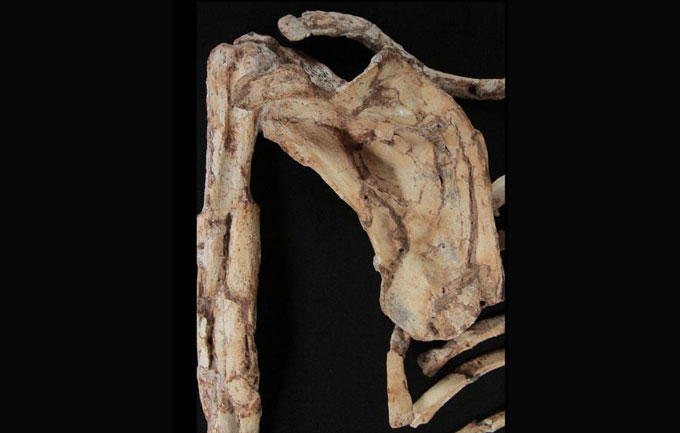
digital reconstruction of Little Foot's shoulder bones
Researchers used a digital reconstruction of Little Foot’s nearly complete right shoulder blade, shown here, to determine that this ancient hominid climbed more like gorillas than like chimps, orangutans or humans.K. CARLSON  

The new analysis makes Little Foot’s shoulders “our best candidate for hypothesizing the appearance of the human-chimp last common ancestor,” says anatomist Susan Larson of Stony Brook University School of Medicine in New York, who wasn’t involved in the research. Ancestral shoulders that supported capable tree climbing would have provided a foundation for the evolution of human shoulders aligned with a two-legged stride and chimp shoulders designed for hanging and swinging from tree branches, she suggested.

In the new study, a digital, 3-D reconstruction of Little Foot’s more complete right shoulder blade was compared with right shoulder blades of chimps, gorillas, orangutans and present-day people. Further comparisons were made with partial shoulder blades of 11 ancient hominids. Those hominids included four South African Australopithecusspecimens and East African finds from two members of Lucy’s speciesA. afarensis, that date to around 3.3 million and 3.6 million years ago (SN: 10/25/12). Little Foot’s collarbones were compared with those of humans, chimps, gorillas, orangutans and seven ancient hominids.

Carlson’s analysis provides preliminary but still uncertain evidence that Little Foot had the most gorilla-like shoulders of any ancient hominid, says paleoanthropologist Stephanie Melillo of the Max Planck Institute for Evolutionary Anthropology in Leipzig, Germany. Melillo, who did not participate in the new study, considers it most striking that Little Foot shares many shoulder similarities with the other Australopithecus fossils studied by Carlson’s team.

Some researchers consider a 4.4-million-year-old Ardipithecus ramidus skeleton, dubbed Ardi, the best hominid model for a human-chimp last common ancestor (SN: 12/31/09). Ardi could have moved slowly in trees while holding onto branches above her head, in a manner unlike any modern ape, they contend. But Ardi’s remains lack shoulder blades and collarbones."


Here are some videos that are of shoulder interest
Shoulder arthritis - what you need to know (see this link).
How to x-ray the shoulder (see this link).
The total shoulder arthroplasty (see this link).
The ream and run technique is shown in this link.
The cuff tear arthropathy arthroplasty (see this link).
The reverse total shoulder arthroplasty (see this link).
The smooth and move procedure for irreparable rotator cuff tears (see this link).
Shoulder rehabilitation exercises (see this link).


Thursday, November 29, 2018

How is the motion of the scapula on the chest wall affected in common shoulder conditions?

The contribution of the scapula to active shoulder motion and self-assessed function in three hundred and fifty two patients prior to elective shoulder surgery

These authors determined the contribution of the scapula to active shoulder motion in control subjects and patients with loss of shoulder function.

They used the Kinect motion capture system to assess active scapulothoracic (ST) and humerothoracic (HT) abduction in 12 controls and in 352 patients before elective shoulder surgery.


For the controls, ST abduction averaged 26 ± 7° or 19% of the active HT abduction (135 ± 5°). 

For the 352 patients prior to elective surgery, active ST abduction averaged 12 ± 10°, or 17% of the active HT abduction (72 ± 38). 


For 10 of the 12 Simple Shoulder Test functions, patients unable to perform the function had significantly less scapulothoracic abduction, e.g., shoulders unable to lift one pound to shoulder level had 9 ± 8° of ST abduction in contrast to 17 ± 10 for those able to perform this function (p < .001). 

They concluded that scapulothoracic motion is an important component of active shoulder motion and function in both healthy shoulders and in those compromised by common pathologies. 

They suggested that rehabilitation directed at improving active scapulothoracic motion may improve the function of shoulders with loss of glenohumeral motion.

Comment: This study shows that in common conditions that involve the glenohumeral joint, such as osteoarthritis, rotator cuff tear, and cuff tear arthropathy, motion at both the glenohumeral and the scapular articulations are compromised. After surgery to address the glenohumeral pathology, rehabilitation directed at the scapulothoracic joint may enhance the outcome.

===

We have a new set of shoulder youtubes about the shoulder, check them out at this link.

Be sure to visit "Ream and Run - the state of the art"  regarding this radically conservative approach to shoulder arthritis at this link and this link

Use the "Search" box to the right to find other topics of interest to you.


You may be interested in some of our most visited web pages   arthritis, total shoulder, ream and runreverse total shoulderCTA arthroplasty, and rotator cuff surgery as well as the 'ream and run essentials'

Wednesday, March 9, 2016

Subluxation, "You keep using that word. I do not think it means what you think it means"

Most of us recall this movie segment in which the Sicilian Vizzini keeps using the word “inconceivable" to refer to events unfolding while Inigo Montoya says “You keep using that word, I do not think it means what you think it means”.


Some authors use the term 'subluxation' to refer to the position of the humeral head in relation to the body of the scapula, whereas subluxation actually means separation of the joint surfaces as in incomplete or partial dislocation of the joint.

The difference is nicely demonstrated on an axillary x-ray of a patient with glenoid dysplasia. One can see that the humeral head center (blue dot) lies well posterior to the plane of the scapula (red line), but is quite well centered (not subluxated) on the retroverted face of the glenoid (the blue line was constructed perpendicular to the center of the face of the glenoid socket).


Our view is that it is the glenohumeral and not the scapulohumeral relationship that is key: a goal of reconstructive surgery is to keep the humeral ball centered in the glenoid socket.


===

Check out the new Shoulder Arthritis Book - click here.


Use the "Search" box to the right to find other topics of interest to you.

You may be interested in some of our most visited web pages including:shoulder arthritis, total shoulder, ream and runreverse total shoulderCTA arthroplasty, and rotator cuff surgery as well as the 'ream and run essentials'