Showing posts with label stability. Show all posts

Thursday, October 23, 2025

Reverse total shoulder stability and instability - the role of concavity compression

As is the case for the normal shoulder and the anatomic total shoulder, the stability of the reverse total shoulder (rTSA) depends on concavity compression. In the rTSA the concavity of the humeral liner is compressed onto the glenosphere by soft tissue tension and active muscle constraction.


The authors of Computational Analysis of Compressive Joint Stability and Acromial StressAssociated with Varied Rotator Cuff Integrity after Reverse Shoulder Arthroplasty used finite element analysis (FEA) to evaluate changes in joint compressive stability and acromial stress with varied rotator cuff integrity, glenoid component lateralization, and humeral distalization after rTSA. 


Glenohumeral contact force (compression) decreased with progressive cuff removal. Compared to the intact rotator cuff state, compression decreased 59% when the subscapularis was absent, 11% when the infraspinatus was absent, and 67% when both subscapularis and infraspinatus were absent. 

Compression increased with progressive levels of glenoid lateralization.  The table below shows compression (Newtons) for various degrees of cuff integrity and various amounts of glenosphere lateralization.

Six mm lateralization increased compression by two-fold when the subscapularis was intact (red arrow).


Six mm lateralization with an inlay stem resulted in a small (0.2% to 1.8%) increase in the proportion of acromial and scapular spine cortical bone regions exceeding the yield stress threshold. 

Addition of an onlay humeral stem, though resulting in larger improvements in joint compressive stability, had a considerable (23.0% to 30.4%) increase in the acromial and scapular spine cortical bone regions exceeding the yield stress threshold compared to inlay humeral configurations.

This study illustrates the important role that compression from the rotator cuff plays in the stability from concavity compression with the rTSA.

It also points out that when the rotator cuff is compromised, joint compression can be recovered by increasing glenoid lateralization and humeral distalization. However, the improvement in joint stability comes at the cost of increases in acromial/scapular spine stress. 

----

I'm taking the liberty of reposting a post from April so that the reader has much of the rTSA stability/instability story in one spot. 

Instability and dislocation are major complications of reverse total shoulder arthroplasty (RSA) and are not easily solved by revision.


To help understand reverse shoulder stability and instability I will use some diagrams by Steve Lippitt from the 5th Edition of The Shoulder.  Steve was also critical to the understanding of concavity compression and describing the stability ratio. See Glenohumeral stability from concavity-compression: A quantitative analysis

The reverse total shoulder is stabilized by conconcavity compression in which the concavity of the humeral polyethylene is pressed onto the glenosphere by the vector sum of muscle action, gravity and other forces (red arrow).

Dislocation can result when the compressive forces or the concavity of the humeral cup are insufficient to manage a displacing load, such as that from pushing one's self up from an armchair. 

Dislocation can result when the vector sum of the forces acting on the humerus is not aligned with the glenosphere,


When unwanted contact occurs between the scapula and humeral component, displacing forces can misalign the compressive force required for stability.


To start, I'd like to direct the reader to several classic articles on this topic: 


I'll pick up the story from 2024 to the time of this writing (April 2025).


*Dislocation of the reverse total shoulder continues to be a major and prevalent issue for patients and surgeons

Mitigating the Risk of Instability After Reverse Shoulder Arthroplasty: A Critical Analysis Review of Patient and Surgical Factors  Instability and dislocation after reverse shoulder arthroplasty may occur in up to 31% of patients. Clinical risk factors for instability include younger age, male sex, increased body mass index, preoperative diagnosis of proximal humerus fracture or rotator cuff pathology, history of instability of the native shoulder or after surgery, and a medical history of Parkinson's disease. In patients at a high risk of instability, surgeons should consider a more lateralized prosthesis (particularly in patients with an incompetent rotator cuff), repairing the subscapularis (particularly when using a medialized prosthesis), and upsizing the glenosphere (>40 mm in male and 38-40 mm in female patients). While potentially useful, less evidence exists for the use of a constrained liner.


Midterm outcomes of primary reverse shoulder arthroplasty: a systematic review of studies with minimum 5-year follow-up The rate of shoulder dislocation was 3.7% (0%-20.4%),


Instability after reverse shoulder arthroplasty: a retrospective review of thirty one cases The most frequent etiology for RSA instability was loss of compression, followed by impingement and loss containment.


Revision of reverse total shoulder arthroplasty: A scoping review of indications for revision, and revision outcomes, complications, and re-revisions 22% of the complications were dislocations or instability. 30% of the revisions were for dislocation or instability.


Predictors of dislocations after reverse shoulder arthroplasty: a study by the ASES complications of RSA multicenter research group Patients with a primary diagnosis of glenohumeral osteoarthritis with an intact rotator cuff had an overall lower rate of dislocation than patients with other diagnoses (0.8% vs. 2.5%. Patient-related factors independently predictive of dislocation, in order of the magnitude of effect, were a history of postoperative subluxations before radiographically confirmed dislocation (odds ratio [OR]: 19.52), primary diagnosis of fracture nonunion (OR: 6.53), revision arthroplasty (OR: 5.61), primary diagnosis of rotator cuff disease (OR: 2.64), male sex (OR: 2.21), and no subscapularis repair at surgery (OR: 1.95). 


Complications following reverse total shoulder arthroplasty for proximal humeral fractures: a systematic review The most common postoperative complication was prosthetic instability/dislocation: 2.3%


Complications after reverse shoulder arthroplasty for proximal humerus nonunion The most common postoperative complication was prosthetic instability/dislocation: 12%


Poor clinical outcomes and high rates of dislocation after modular reverse shoulder arthroplasty for proximal humeral oncologic resection Dislocations occurred in 40%


Intraoperative repair of functional subscapularis during RSA by deltopectoral approach could improve internal rotation but does not prevent anterior dislocationIn the functional repair group, three shoulders (1.2%) reported subjective instability and 1 (0.4%) dislocated.None occurred in in either the non-functional repair or non-repair groups. 


Reverse shoulder arthroplasty with a 155 degrees neck-shaft angle inlay implant design without reattachment of the subscapularis tendon results in satisfactory functional internal rotation and no instability: a cohort studyOne out of 210 prostheses was revised for dislocation within the first month after primary surgery.


Impact of morbid obesity on postoperative outcomes in reverse total shoulder arthroplasty: A national inpatient sample analysis Morbid obesity (BMI >/=40 kg/m(2)) was associated with a periprosthetic dislocation rate of 2.60 % in comparison to 1.59 % in controls


Impact of accumulating risk factors on the incidence of dislocation after primary reverse total shoulder arthroplasty using a medial glenoid-lateral humerus onlay prosthesis1.4% of the patients experienced dislocation with a medialized glenoid-lateralized humerus onlay rTSA prosthesis. The greatest risk factors for dislocation were male sex, age <68 years at the time of surgery, patients with body mass index >30, patients who received glenospheres having a diameter >40 mm, and patients who received expanded or laterally offset glenospheres.

Low success rate of closed reductions when treating dislocations after reverse shoulder arthroplasty: a study by the ASES Complications of RSA Multicenter Research Group a closed reduction was initially attempted in the majority of patients, but only about one-third were successful and required no further intervention. Unsuccessful closed reductions were associated with higher patient BMI. Revision surgery for dislocations was complicated by a high rate of recurrent dislocations and rerevision surgery.


*The diameter, depth and orientation of the humeral cup affect stability of the reverse total shoulder. However, it must be remembered that the ability of the RSA to resist dislocation depends not only on the shape and orientation of the cup, but also on the direction and magnitude of the net force as shown by the red arrows in the first two diagrams at the start of this post.


From Grammont to a New 135 degrees Short-Stem Design: Two-Hand Lever Test and Early Superior-Lateral Dislocations Reveal Critical Role of Liner Stability Ratio and Stem Alignment


.

Illustration of a reverse total shoulder arthroplasty: radius (r) of the glenosphere and concavity depth (d) or jump height of the liner are required to calculate the liner stability ratio (LSR). Yellow area: the extent of the glenosphere covered by the liner; yellow striped line: angle of coverage (degree of glenosphere coverage by the liner).


Patients having receiving RSA had an 8% dislocation rate for standard liners and a 0% dislocation rate for retentive liners. The authors attribute this difference to the jump height for the 36 mm standard implant of 8.1 and a linear stability ratio (LSR) of 152%; whereas the 36 mm retentive liner had a jump height of 10.1 and linear stability ratio of 195 to 202%


For this design, the most stable liner type was the 36 retentive:


They also found that the mean effective neck-shaft angle was 133 degrees (127-144 degrees) for short stems and 135 degrees (129-143 degrees) for long stems. Long stems significantly reduced varus outliers


which may have an increased risk for instability.


Varus-valgus alignment of humeral short stem in reverse total shoulder arthroplasty: does it really matter? The utilization of short humeral stems in reverse total shoulder arthroplasty has gained attention, however, concerns exist regarding the risk of misalignment with implant insertion. In this cadaver study, anterior dislocation forces were considerably lower in the varus group compared to the neutral group.  Valgus positioning did not significantly impact instability compared to the neutral position.


*Know the implants you're using


Large variability in degree of constraint of reverse total shoulder arthroplasty liners between different implant systems There were variations in jump height between rTSA systems at a given size, resulting in large differences in stability ratio. Standard liners exhibited a stability ratio range from 126% to 214% (mean 158% (SD 23%)) and constrained liners a range from 151% to 479% (mean 245% (SD 76%)). The angle of coverage showed a range from 103 degrees to 130 degrees (mean 115 degrees (SD 7 degrees) for standard liners and a range from 113 degrees to 156 degrees (mean 133 degrees (SD 11 degrees )) for constrained liners.


Four arthroplasty systems had constant stability ratios for standard liners (within 5%) across different sizes, while one system showed slight inconsistencies (within 10%), and ten arthroplasty systems showed large inconsistencies (range 11% to 28%). The stability ratio of constrained liners was consistent across different sizes in two arthroplasty systems and inconsistent in seven systems (range 18% to 106%). 


Impact of constrained humeral liner on impingement-free range of motion and impingement type in reverse shoulder arthroplasty using a computer simulation The humeral liner may be changed to a constrained type when stability does not improve by increasing glenosphere size or lateralization with implants, and patients, particularly women with obesity, have risks of periprosthetic instability that may be secondary to hinge adduction on the thorax. This RSA computer simulation model demonstrated that constrained humeral liners led to decreased impingement-free ROM. 


From Dr Stefan Bauer I received the most interesting response below.


Maintaining Stability


Harlequin Duck Stabilized Against the Surf
Rosario Beach
2021

Sunday, January 8, 2023

How does the glenohumeral joint maintain stability while allowing such a great range of motion?

As pointed out three decades ago in Mechanics of Shoulder Stability, the function of the glenohumeral joint depends on some unique stabilizing mechanisms (illustrations below are by Steve Lippitt in Practical Evaluation and Management of the Shoulder).

While the hip is stabilized by a deep socket, the glenohumeral joint has a shallow socket that allows a wide range of motion without the ball abutting against the rim of the socket.

While the knee is stabilized by isometric ligaments, the glenohumeral joint's ligaments and capsule are lax in its functionally important mid range positions


As pointed out in In vivo quantification of the laxity of normal and unstable glenohumeral joints laxity is not the same as instability; healthy subjects without symptoms may have as much laxity as patients needing surgical repair for symptomatic shoulder instability.

We must, therefore, ask how can the relatively large humeral head be stabilized in the small glenoid socket while still allowing a greater range of motion than any other joint and amazing feats of strength as shown in these classic videos by our late partner Douglas Harryman (see Shoulder Stability 1 and Shoulder Stability 2)

One of the special mechanisms of glenohumeral stability is concavity compression as first described in Mechanisms of Glenohumeral Stability. In concavity compression, the direction of the sum of the forces applied to the humeral head is contained within the glenoid socket.


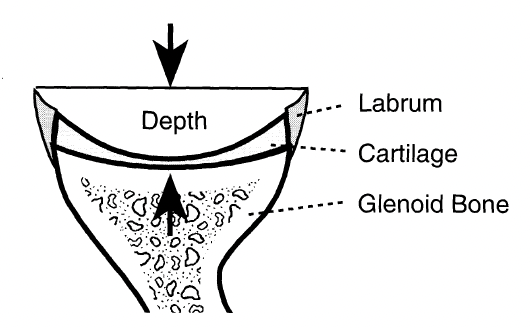
Concavity compression is enhanced by increasing the force compressing the head into the glenoid and by the deepening of the glenoid concavity by the concave cartilage and the labrum.


One of the other contributions of the glenoid labrum is the creation of the glenohumeral suction cup effect.

The compliant labrum allows the socket to seal to the humeral head much as the compliant edges of a suction cup allow it adhere to a man's forehead


See Doug Harryman's video on suction cup effect; while the quality of the video is not great, the message is clear.


The suction cup is not only important in the normal shoulder: in performing a ream and run procedure for arthritis, stability is enhanced by preserving the glenoid labrum. When a healthy labrum can be preserved, the stabilizing effect of the suction cup can be observed at the time of surgery. Turn your volume up, so you can hear the 'kiss' sound as the suction is broken by applying a strong posteriorly directed force on the humerus.


Recently, our colleagues at the University of Utah and Japan revisited A stabilizing role of the glenoid labrum: the suction cup effect

Using a cadaver model, they sought to quantify the effect of the anteroinferior and posterosuperior labrum to glenohumeral stability.

They measured the peak force required to translate the humeral head in the anterior, anteroinferior, posterior, and posteroinferior directions was measured under 5 conditions:
intact labrum,
an anteroinferior labral tear,
a posterosuperior labral tear,
combined labral tear, and
no labrum.


The stability ratio was defined as the peak translational force divided by the compressive force. Within force-translation curves, they defined the suction cup effect as the force required to release the negative pressure created by an intact labrum.

They found that the suction cup effect was usually present with the intact labrum and disappeared after removal of the labrum for anterior and posterior translations. After creation of an anteroinferior labral tear, the stability ratio for posterior direction decreased and the suction cup effect disappeared. After creation of a posterosuperior labral tear, stability ratios in the anterior and anteroinferior directions decreased and the suction cup effect disappeared. The stability ratio for anterior and anteroinferior testing was more diminished by posterosuperior labral tears than anteroinferior labral tears, and the stability ratio for posterior testing was more diminished by anteroinferior labral tears than posterosuperior labral tears.

They concluded that anteroinferior labral tears decreased posterior stability and posterosuperior labral tears decreased anterior and anteroinferior stability, largely because of loss of the suction cup effect.

Comment: In order to achieve its amazing mobility and stability, the shoulder requires some specialized stabilizing mechanisms - such as concavity compression and the suction cup effect - that are not as important in other articulations. Understanding these special mechanisms provides insight into the functioning of the normal shoulder and the management of shoulder instability.

You can support cutting edge shoulder research that is leading to better care for patients with shoulder problems, click on this link.

Follow on twitter: https://twitter.com/shoulderarth
Follow on facebook: click on this link
Follow on facebook: https://www.facebook.com/frederick.matsen
Follow on LinkedIn: https://www.linkedin.com/in/rick-matsen-88b1a8133/

Here are some videos that are of shoulder interest
Shoulder arthritis - what you need to know (see this link).
How to x-ray the shoulder (see this link).
The ream and run procedure (see this link).
The total shoulder arthroplasty (see this link).
The cuff tear arthropathy arthroplasty (see this link).
The reverse total shoulder arthroplasty (see this link).
The smooth and move procedure for irreparable rotator cuff tears (see this link).
Shoulder rehabilitation exercises (see this link).

Monday, January 23, 2017

Managing posterior instability with an anteriorly eccentric humeral head component

Effects of Anterior Offsetting of Humeral Head Component in Posteriorly Unstable Total Shoulder Arthroplasty: Finite Element Modeling of Cadaver Specimens

The technique of using anteriorly eccentric humeral head components to manage intraoperative posterior instability was published in a 2009 Journal of Bone and Joint Surgery article "Current Technique for the Ream-and-Run Arthroplasty for Glenohumeral Osteoarthritis" and the clinical utility of this method in a more recent publication "Management of intraoperative posterior decentering in shoulder arthroplasty using anteriorly eccentric humeral head components."

The authors of this article sought to characterize the changes in joint mechanics associated with anterior offsetting with various amounts of glenoid retroversion using cadaver specimen-specific 3-dimensional finite element models. They developed specimen specific computational finite element models by importing digitized locations of six musculotendinous units of the rotator cuff and deltoid muscles based off three cadaveric shoulder specimens implanted with total shoulder arthroplasty in either anatomic or anterior humeral head offset. 

In this model, anterior offsetting was associated with significant anterior shift of center of pressure and humeral head displacement upon muscle loading (p<0.05).

The authors concluded that the use of an anteriorly eccentric humeral head may contribute to joint stability in posteriorly unstable shoulder arthroplasty and may reduce eccentric loading on glenoid components although the long term clinical results are yet to be investigated in future.

Comment: We use anteriorly eccentric humeral heads without or with rotator interval plication routinely to optimize the centering of the humeral head on the glenoid. This approach enables posterior stability without specifically attempting to change glenoid retroversion.


If after insertion of the glenoid component, there is excessive posterior translation of the trial humeral head, we use an anteriorly eccentric humeral head prosthesis


without or with a rotator interval plication.


===


To see the topics covered in this Blog, click here

Use the "Search" box to the right to find other topics of interest to you.

You may be interested in some of our most visited web pages including:shoulder arthritis, total shoulder, ream and runreverse total shoulderCTA arthroplasty, and rotator cuff surgery as well as the 'ream and run essentials'

Sunday, May 15, 2016

Is the Propionibacterium in my skin today the same that was there previously?

Temporal Stability of the Human Skin Microbiome.

This article addresses a topic important for shoulder surgeons and their patients. Propionibacterium is the most common organism found at surgical revision of failed shoulder surgery. The source of these organisms is the patient's skin (dermal sebaceous glands). These investigators found that the strains of skin microbes (bacteria, fungi, and viruses) are shaped by the host's physiology and are stable over time in spite of the external exposures shown in this cartoon.


Their abstract: "Biogeography and individuality shape the structural and functional composition of the human skin microbiome. To explore these factors' contribution to skin microbial community stability, we generated metagenomic sequence data from longitudinal samples collected over months and years. Analyzing these samples using a multi-kingdom, reference-based approach, we found that despite the skin's exposure to the external environment, its bacterial, fungal, and viral communities were largely stable over time. Site, individuality, and phylogeny were all determinants of stability. Foot sites exhibited the most variability; individuals differed in stability; and transience was a particular characteristic of eukaryotic viruses, which showed little site-specificity in colonization. Strain and single-nucleotide variant-level analysis showed that individuals maintain, rather than reacquire, prevalent microbes from the environment. Longitudinal stability of skin microbial communities generates hypotheses about colonization resistance and empowers clinical studies exploring alterations observed in disease states."

Both P. acnes and Propionibacterium phage (the virus associated with it) are abundant in sebaceous sites (such as the shoulder, chest and back). They observed a strong anti correlation in sebaceous communities that contain both P. acnes and its phage; this anti-correlation together with the observed phage-host dynamics over time suggests antagonism (see the green graph below). Note the abundance of both the Propi phage and Propi in the sebaceous areas.


They found that individuals have distinct microbial SNV signatures that are stable over time across body sites for time periods of a year (see figure below). Temporal stability, short- or long-term, surpassed the similarity between individuals, indicating that P. acnes stability likely derives from maintaining an individual’s strains over time and less from the acquisition of new strains from the environment or other individuals. "B" shows the relative abundance plots for different strains of Propi for the chest of three different individuals.


The authors surmise that despite the continuous perturbation that human skin undergoes in daily life and in the absence of major perturbations, dominant characteristics of skin microbial communities would remain stable indefinitely as is the case for gut communities. However, extrinsic perturbations (probiotics, prebiotics, antimicrobials, antibiotics, long-term environmental relocations, diet, immunosuppression, illness, or the occurrence of disease) can alter the skin microbiota. Do these changes make a person more or less likely to acquire Propionibacterium in and around their shoulder arthroplasty components?

Can the Propi Phage virus be used to treat Priopi infection, as suggested by Ian Whitney (see link)(one of our past shoulder fellows)?