Showing posts with label treatment. Show all posts

Friday, September 6, 2019

Periprosthetic infections - how do we know when our treatment has been successful?

Definition of Successful Infection Management and Guidelines for Reporting of Outcomes After Surgical Treatment of Periprosthetic Joint Infection

These authors have defined four tiers of outcome after treatment of periprosthetic infections:

Tier 1. Infection control with no continued antibiotic therapy (“infection control” defined as  a patient not having or needing any additional surgery and not meeting the MSIS criteria for a PJI (New Definition for Periprosthetic Joint Infection: From the Workgroup of the Musculoskeletal Infection Society)

Tier 2. Infection control with the patient on suppressive antibiotic therapy

Tier 3. Need for reoperation and/or revision and/or spacer retention (assigned to subgroups A, B, C, D, E, and F basedon the type of reoperation)
   A. Aseptic revision at >1 year from initiation of PJI treatment
   B. Septic revision (including debridement, antibiotics, and implant retention [DAIR]) at >1 year from initiation of PJI treatment (excluding amputation, resection arthroplasty, and arthrodesis)
   C. Aseptic revision at 1 year or less from initiation of PJI treatment
   D. Septic revision (including DAIR) at 1 year or less from initiation of PJI treatment (excluding amputation, resection arthroplasty, and arthrodesis)
   E. Amputation, resection arthroplasty, or arthrodesis
   F. Retained spacer

Tier 4. Death (assigned to subgroups A or B).
   A. Death 1 year or less from initiation of PJI treatment
   B. Death >1 year from initiation of PJI treatment

Comment: These are well thought-out definitions of outcomes after the treatment of periprosthetic infections. The challenge we face as shoulder surgeons is that patients meeting the criteria for Tier 1 "Infection Control" (see above) after treatment of Cutibacterium periprosthetic shoulder infection may have persistent or recurrent pain and stiffness - in these situations one cannot be sure if the symptoms are due to persistence of Cutibacterium in the wound. As stated in the MSIS criteria "PJI may be present if fewer than four of these criteria are met." This is particularly the case for Cutibacterium infections that are known for their "stealth" presentations months or years after a procedure.

===
We have a new set of shoulder youtubes about the shoulder, check them out at this link.

Be sure to visit "Ream and Run - the state of the art"  regarding this radically conservative approach to shoulder arthritis at this link and this link

Use the "Search" box to the right to find other topics of interest to you.


You may be interested in some of our most visited web pages   arthritis, total shoulder, ream and runreverse total shoulderCTA arthroplasty, and rotator cuff surgery as well as the 'ream and run essentials'

Sunday, October 18, 2015

Clinical evaluation of the shoulder - our approach

It is traditional for surgeons to strive for a diagnosis for the shoulder problem and to derive a treatment from the diagnosis. For us, however, the clinical evaluation is the beginning of the doctor-patient relationship. The goal is not so much to come up with a diagnosis that will drive to a specific treatment, but rather to carry out an evaluation of the patient that leads to a reasonable management plan.

We like to emphasize the importance of the 4 P’s that determine the outcome of treatment: the patient, the shoulder problem the patient is experiencing, the procedure used to treat the patient and the problem, and the physician rendering the treatment. We place the patient first on this list because as Osler is quoted as saying, “it is more important to know what patient a disease has than what disease the patient has.” When introducing ourself and shaking the patient’s hand we can sense a lot – healthy or frail, positive or negative, smelling of cigarettes or not. To learn a bit more, we ask the patient ‘where are you from and what do you do there?” In an instant we’ve done a lot to determine if the person might benefit from a surgical approach should one be appropriate for the problem.  Next, we like to ask “what can we help you with today?” giving the patient some uninterrupted time to answer. The patient with posterior instability may respond with “I can’t do my job”, “I need more pain medicine”, “my lawyer sent me” or “my shoulder keeps on slipping out when I lift something in front of me” – same diagnosis, four different problems.

We like to avoid dwelling on pain, so rather than asking ‘where does your shoulder hurt’, we prefer to ask ‘what does your shoulder problem keep you from doing?’ When does it bother you the most? Following with ‘how and when did that problem start?’ ‘how much force was applied to your shoulder in the injury and what position was it in when the force was applied? and ‘tell me about the treatment you’ve had for it up to now’.  Trying to learn more about the patient, we ask questions such as  “how is your overall health, how active are you, what medications are you on, have you had prior surgeries and how did they work out?

Our physical exam starts with a ‘no touch’ approach. “Show me what actions are difficult for your shoulder” “what does it feel like is happening when you do these things?” To check active motion we ask patients to show me with each shoulder how high they can reach overhead, how far they can externally rotate the shoulder  with the arm at the side, how far they can reach across the body, how far they can internally rotate the abducted arm, and how high they can reach up the back. If patients cannot raise the arm actively, we ask them to show how high they can raise it with the help of the opposite arm. At this point, without having ever touched the patient we usually have a fairly good understanding of the problem  and whether the patient is likely to be a good candidate for surgical intervention. The remainder of my history, physical examination and plain radiographs seek to refine this understanding.

There are many ‘tests’ that have been described for evaluating shoulder problems,  these tests are rarely capable of discriminating among the potential problems; a "Hawkins test" may be positive in  rotator cuff disease, arthritis, or frozen shoulder.  Instead our exam seeks more tangible findings, such as loss of the passive or active range of motion,  a palpable defect in the rotator cuff, minimal resistance to anterior translation of the humeral head pressed into the glenoid, palpable subacromial crepitance, muscle atrophy, loss of the biceps reflex, or an obvious ‘clunk’ on cross body adduction.

Bottom line, if the problem is not apparent on history, physical, and plain radiographs or if the patient does not appear to be an excellent surgical candidate, we're likely to recommend non-operative management.  This remains the case even if MRI’s show ‘acromioclavicular arthrosis’, ‘labral fraying’, a “HAGL” lesion, or ‘supraspinatus tendinosis’.
===

Check out the new Shoulder Arthritis Book - click here.


Use the "Search" box to the right to find other topics of interest to you.

You may be interested in some of our most visited web pages including:shoulder arthritis, total shoulder, ream and runreverse total shoulderCTA arthroplasty, and rotator cuff surgery as well as the 'ream and run essentials'


Saturday, November 9, 2013

Shoulder arthritis - what you should know about it.

What are the parts of the shoulder and how do they work?


I. What is shoulder arthritis?

II. What are the types of shoulder arthritis?

III. How is shoulder arthritis diagnosed?

IV. What can be done for shoulder arthritis without surgery?

V. What are the important surgical options for treating shoulder arthritis?

VI. What can be done if a shoulder replacement fails to give the desired result?

The Cliff Notes about shoulder arthritis


You can support cutting edge shoulder research that is leading to better care for patients with shoulder problems, click on this link.

Follow on twitter: https://twitter.com/shoulderarth
Follow on facebook: click on this link
Follow on facebook: https://www.facebook.com/frederick.matsen
Follow on LinkedIn: https://www.linkedin.com/in/rick-matsen-88b1a8133/

Here are some videos that are of shoulder interest
Shoulder arthritis - what you need to know (see this link).
How to x-ray the shoulder (see this link).
The ream and run procedure (see this link).
The total shoulder arthroplasty (see this link).
The cuff tear arthropathy arthroplasty (see this link).
The reverse total shoulder arthroplasty (see this link).
The smooth and move procedure for irreparable rotator cuff tears (see this link).
Shoulder rehabilitation exercises (see this link).

Wednesday, January 2, 2013

Humeral fractures after shoulder replacement


Surgically Treated Humeral Shaft Fractures Following Shoulder Arthroplasty

This is a report regarding 36 patients with humeral periprosthetic fractures treated surgically. 19 had loose humeral components and were treated with revision arthroplasty; the remainder were treated with internal fixation leaving the prosthesis in place. 17 had fractures around the humeral component of reverse total shoulders. 16 had severe osteopenia. After treatment 35 had healed in 3 to 14 months. The average ASES score was 50. Fourteen of the surgically managed fractures had complications including prosthesis failure, non union, radial nerve plasy, infection, and prosthesis loosening.

The authors emphasize the need for careful preoperative evaluation and presurgical planning in that a wide variety of surgical techniques were required.

It is of note that many of these fractures appear to have involved the tip of a cemented or press fit prosthesis where an abrupt transition in structural properties of the humerus takes place.

On the one hand we need to explore ways for humeral component fixation that avoid this critical stress riser and on the other hand we need to advise our patients about minimizing the risk of falling, especially when they have soft bone into which a stiff prosthesis has been inserted.


---
Use the "Search" box to the right to find other topics of interest to you.

You may be interested in some of our most visited web pages including:shoulder arthritis, total shoulder, ream and runreverse total shoulderCTA arthroplasty,  and rotator cuff surgery.


Monday, August 27, 2012

Practical Evaluation and Management of the Shoulder, Diagnosis, Treatment

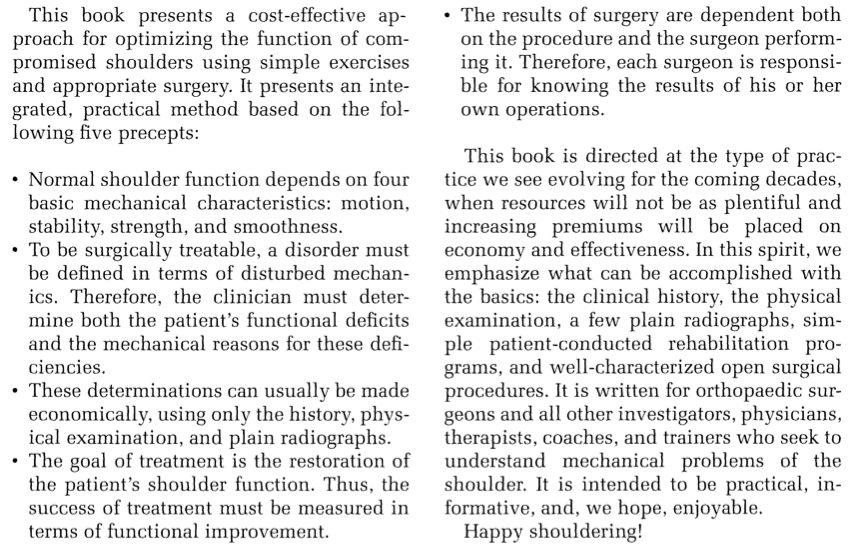
Back in 1994, John Sidles, Doug Harryman, Steve Lippitt and I published a book entitled Practical Evaluation and Management of the shoulder. In that the book is now out of print, many have asked how they might get a copy. Recently, the publisher has kindly allowed us to offer a PDF of the book here.

The philosophy and science in this book are as applicable today as they were twenty years ago. Here is our preface (click on it to enlarge):


--
Use the "Search" box to the right to find other topics of interest to you.

You may be interested in some of our most visited web pages including:shoulder arthritis, total shoulder, ream and runreverse total shoulderCTA arthroplasty,  and rotator cuff surgery.


Thursday, May 3, 2012

Evolution of Nonoperatively Treated Symptomatic Isolated Full-Thickness Supraspinatus Tears - JBJS

Rotator cuff tear

JBJS will soon publish Evolution of Nonoperatively Treated Symptomatic Isolated Full-Thickness Supraspinatus Tears. This article provides another important contribution to our understanding of the natural history and management of rotator cuff tears.

This Level IV study followed twenty-four patients with isolated full-thickness supraspinatus tears that had been diagnosed by means of magnetic resonance arthrography who were offered rotator cuff repair and elected nonoperative treatment. At a median of forty-two months the mean subjective shoulder score was 74% of that for a normal shoulder and the mean Constant score was 75 points (relative Constant score, 86%). The mean rotator cuff tear size did not change significantly over time. In two shoulders, the tear was no longer detectable on magnetic resonance imaging, in nine shoulders the tear was smaller than it had been at the time of the initial diagnosis, in nine patients the tear had not changed, and in six patients the tear had increased in size. There was a slight but significant progression of fatty muscle infiltration of the supraspinatus, but no patient had fatty infiltration beyond stage 2 at the time of the latest follow-up.

This study reveals that the size of a cuff tear does not necessarily increase with time and that such patients can realize surprisingly high clinical satisfaction.


It is of interest to compare this study with that in a recent post regarding non-operative management of cuff tears, which also indicates that patients can achieve a good outcome without surgery.

This information is consistent with the observations that cuff integrity after cuff repair does not seem to correlate with the clinical result as shown here and here.


--

Use the "Search the Blog" box to the right to find other topics of interest to you.

You may be interested in some of our most visited web pages including:shoulder arthritis, total shoulder, ream and runreverse total shoulderCTA arthroplasty,  and rotator cuff surgery.

Wednesday, September 21, 2011

Rotator Cuff 12 - Partial thickness cuff tears - treatment

In the management of partial thickness cuff tears, the first line of treatment is stretching the shoulder to eliminate any tightness of internal rotation with the arm at the side


internal rotation of the arm in 90 degrees of abduction, the sleeper stretch


and cross body adduction


Often, as is the case with tennis elbow, progressive stretching exercises will eliminate the tightness and even out the distribution of force so that comfort and function are restored in the presence of a thinned tendon.

If symptoms are refractory to non-operative management, consideration can be given to a surgical release of the insecurely attached fibers at the margin of the tear – a procedure we refer to as cuff curettage (more on this later). This can be accomplished through a small deltoid split through which the location of the partial detachment can be confirmed by palpation of the thinned tendon. A small curette is inserted in the area of the detachment and used to release the weakly attached fibers around the periphery of the defect, leaving only the securely attached fibers to transmit the force of the muscle to bone. Since there is no deltoid detachment and no cuff repair, stretching and active use can be started immediately after surgery using the same exercises that were learned by the patient as a part of the non-operative program described in the previous paragraph.

In all cuff surgery, an important goal is to assure the smooth passage of the rotator cuff beneath the coracoacromial arch. Roughness can be detected at surgery by placing the fingers of one hand on the acromion while the arm is passively rotated throughout its range of motion.


The positions productive of crepitance are noted and, before wound closure, relief of this crepitance is verified. The source of subacromial crepitance is usually some combination of bursal hypertrophy, roughness on the upper surface of the cuff, and roughness around the humeral tuberosities. While it is our surgical routine to palpate the undersurface of the coracoacromial arch for sources of roughness, the acromion and the coracoacromial ligament are almost always smooth. While the presence of ‘spurs’ may be suggested on preoperative radiographs, these are usually only calcifications in the coracoacromial ligament and, as such, do not encroach on the free movement of the cuff beneath it.


Smoothness of the humeroscapular motion interface is assured by resecting any abnormal bursa or scar in this interface from the axillary nerve inferior-medially, between the subscapularis and the coracoid muscles, under the acromion, and down to the axillary nerve posterior inferiorly – a complete ‘nerve-to-nerve’ release.

Complete release of the external surface of the supraspinatus and infraspinatus can be verified by passing a smooth elevator between each tendon and the coracoacromial arch.


--
Here are some videos that are of shoulder interest
Shoulder arthritis - what you need to know (see this link).
How to x-ray the shoulder (see this link).
The ream and run procedure (see this link).
The total shoulder arthroplasty (see this link).
The cuff tear arthropathy arthroplasty (see this link).
The reverse total shoulder arthroplasty (see this link).
The smooth and move procedure for irreparable rotator cuff tears (see this link).
Shoulder rehabilitation exercises (see this link).