Showing posts with label anteriorly eccentric humeral head. Show all posts

Sunday, February 1, 2026

The Bad B2 Pandemic Continues - by now, you can guess the treatment we selected.

Here's a case from last week: 40 year old very active man with these x-rays 


From the white board in the OR, ROM under general anesthesia

Thus we have the familiar B2 paradox: a posteriorly decentered, unstable shoulder that is also stiff (FE -forward elevagion; ER - external rotation at the side; ERA - external rotation in abduction; IRA - internal rotation in abduction; CBA - cross body adduction (distance from antecubital fossa of surgical arm to contralateral acromion in cm)).

From the responses to the Jan 29 post, many surgeons would consider a reverse total shoulder, or an anatomic total shoulder with a posterior augment.

Our preop preview suggested a 50 20 humeral head. A preoperative CT was not obtained.


As usual the procedure was performed under a general anesthesia without nerve block. The shoulder was approached through a subscapularis peel, preserving the long head tendon of the biceps.

At surgery, the glenoid was biconcave in the posterior inferior direction (ellipse) rather than directly posterior with respect to superior / inferior axis (yellow line). This pathoanatomy would have been difficult to fit using an augmented glenoid component without excessive bone removal.


The glenoid was conservatively reamed to a monoconcavity without attempting to change glenoid version.


A short humeral stem was inserted.
As pointed out in prior posts, the key is not a preoperative plan or attempting to match a preoperative plan with expensive technology (e.g. robotics, patient specific instruments, virtual reality, or augmented reality). These approaches do not recognize the importance of soft tissue balancing. 
Instead, we use intraoperative decision-making after osteophyte resection and appropriate tissue releases that recognize the soft tissues' and the implants' combined contributions to the shoulder's mobility and stability.

Trialing with the standard 50 20 head revealed excessive soft tissue tightness on the 150, 40, 50, 60 tests. Trialing with the strandard 50 18 head revealed excessive posterior translation.

Trialing with the anterioly eccentric 50 18 head revealed excellent balance of stability and mobility (160 FF, ER 20, IRA 60, 50% posterior translation). 

His postoperartive range of flexion is shown here


His recovery room films are shown here


For comparison, here's his preoperative axillary 'truth' view (note the standardization of the projection and arm position)


We will start assisted flexion at 2 weeks post op.

See also the case at the top of this page under the W

It's all about balance


Black-necked Stilt

Malheur National Wildlife Refuge

Spring 2025


Here are some videos that are of shoulder interest
Shoulder arthritis - what you need to know (see this link).
How to x-ray the shoulder (see this link).
The ream and run procedure (see this link)
The total shoulder arthroplasty (see this link)
The cuff tear arthropathy arthroplasty (see this link).
The reverse total shoulder arthroplasty (see this link).
The smooth and move procedure for irreparable rotator cuff tears (see this link)
Shoulder rehabilitation exercises (see this link). 


Thursday, January 29, 2026

The Bad B2 in active patients - the ream and run using the anteriorly eccentric humeral head to recenter the joint.

The Bad B2 glenoid is frequently encountered in our arthroplasty practice. In a previous post I presented the two cases of quality of life limiting Bad B2 pathoanatomy below for thoughts on management. Options included reverse total shoulder, anatomic total shoulder without or with augmented glenoids or bone grafting, and various types of hemiarthroplasty. 

Each patient was treated with the classic ream and run using an anteriorly eccentric humeral head to re-center the posteriorly unstable articulation. No preoperative CT scan or 3D planning were used in either case. The procedures were performed under general anesthesia without a plexus block. The long head tendon of the biceps was preserved in both cases. The subscapularis was peeled and repaired with six fiberwire sutures and a mild rotator interval closure.

Coincidentally, both patients returned for their two-year followups on the same day. Both reported the ability to perform each of the 12 functions of the Simple Shoulder Test. Both had strong subscapularis function.


51 year old active man


64 year old active man


Cutting to the chase


Scissor-tailed Flycatcher

Austin, Texas
 2025


Sunday, April 20, 2025

Severe B2 glenoid in an active 51 year old man

 A 51 year old general contractor, competitive bow hunter and swimmer presented with persistent and limiting left shoulder pain and grinding that has been refractory to arthroscopic "debridement" and intraarticular steroid injections.  On examination he had limited motion with 80 degrees of glenohumeral flexion, 0 degrees of external rotation, and internal rotation to the gluteal area. His x-rays at presentation show osteoarthritis with inferior and posterior decentering and severe B2 pathoanatomy.


After discusscion of the alternatives of non-operative management, an anatomic total shoulder and reverse total shoulder, he elected to proceed with a ream and run arthroplasty to avoid the risks and limitations of a plastic glenoid component.
CT scanning and the use of planning software were avoided. The procedure was performed under general anesthesia without a nerve block. A subscapularis peel was performed, preserving the long head tendon of the biceps. A standard free-hand anatomic neck cut was made in 30 degrees of retroversion and at a 135 degree angle with the humeral shaft.
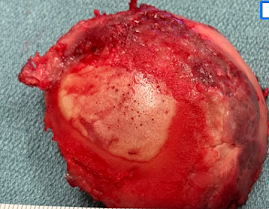
His humeral head showed the "Friar Tuck" pattern of central cartilage loss.


Conservative glenoid reaming was performed without attempt to modify glenoid version. Patient-specific instrumentation and augmented reality were not used. Intraoperative trialing indicated that a 54 20 anteriorly eccentric humeral head provided the optimal balance of mobility and stability.  Neither a plastic glenoid component or bone cement was used. The postoperative x-rays are shown below.


Five months after surgery he reported " Shoulder doing good saw great improvements this month. Strength is improving and have resumed construction work with some limitations. Haven’t started shooting a bow yet but soon I think.  Thanks for a great shoulder" and provided the video shown below of his active motion.


House finch in cherry blossoms


You can support cutting edge shoulder research that is leading to better care for patients with shoulder problems, click on this link

Follow on twitter/X: https://x.com/RickMatsen
Follow on facebook: https://www.facebook.com/shoulder.arthritis
Follow on LinkedIn: https://www.linkedin.com/in/rick-matsen-88b1a8133/

Here are some videos that are of shoulder interest
Shoulder arthritis - what you need to know (see this link).
How to x-ray the shoulder (see this link).
The ream and run procedure (see this link).
The total shoulder arthroplasty (see this link).
The cuff tear arthropathy arthroplasty (see this link).
The reverse total shoulder arthroplasty (see this link).
The smooth and move procedure for irreparable rotator cuff tears (see this link)
Shoulder rehabilitation exercises (see this link).