Showing posts with label eccentric. Show all posts

Sunday, April 20, 2025

Severe B2 glenoid in an active 51 year old man

 A 51 year old general contractor, competitive bow hunter and swimmer presented with persistent and limiting left shoulder pain and grinding that has been refractory to arthroscopic "debridement" and intraarticular steroid injections.  On examination he had limited motion with 80 degrees of glenohumeral flexion, 0 degrees of external rotation, and internal rotation to the gluteal area. His x-rays at presentation show osteoarthritis with inferior and posterior decentering and severe B2 pathoanatomy.


After discusscion of the alternatives of non-operative management, an anatomic total shoulder and reverse total shoulder, he elected to proceed with a ream and run arthroplasty to avoid the risks and limitations of a plastic glenoid component.
CT scanning and the use of planning software were avoided. The procedure was performed under general anesthesia without a nerve block. A subscapularis peel was performed, preserving the long head tendon of the biceps. A standard free-hand anatomic neck cut was made in 30 degrees of retroversion and at a 135 degree angle with the humeral shaft.
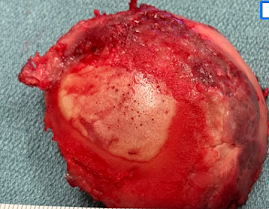
His humeral head showed the "Friar Tuck" pattern of central cartilage loss.


Conservative glenoid reaming was performed without attempt to modify glenoid version. Patient-specific instrumentation and augmented reality were not used. Intraoperative trialing indicated that a 54 20 anteriorly eccentric humeral head provided the optimal balance of mobility and stability.  Neither a plastic glenoid component or bone cement was used. The postoperative x-rays are shown below.


Five months after surgery he reported " Shoulder doing good saw great improvements this month. Strength is improving and have resumed construction work with some limitations. Haven’t started shooting a bow yet but soon I think.  Thanks for a great shoulder" and provided the video shown below of his active motion.


House finch in cherry blossoms


You can support cutting edge shoulder research that is leading to better care for patients with shoulder problems, click on this link

Follow on twitter/X: https://x.com/RickMatsen
Follow on facebook: https://www.facebook.com/shoulder.arthritis
Follow on LinkedIn: https://www.linkedin.com/in/rick-matsen-88b1a8133/

Here are some videos that are of shoulder interest
Shoulder arthritis - what you need to know (see this link).
How to x-ray the shoulder (see this link).
The ream and run procedure (see this link).
The total shoulder arthroplasty (see this link).
The cuff tear arthropathy arthroplasty (see this link).
The reverse total shoulder arthroplasty (see this link).
The smooth and move procedure for irreparable rotator cuff tears (see this link)
Shoulder rehabilitation exercises (see this link).


Monday, September 9, 2024

What's important in anatomic total shoulder arthroplasty?

Anatomic total shoulder arthroplasty reliably provides long term comfort and function for patients with osteoarthritis and an intact rotator cuff, even in patients with deficiencies in glenoid bone (see Anatomic Total Shoulder Arthroplasty with All-Polyethylene Glenoid Component for Primary Osteoarthritis with Glenoid Deficiencies). While some surgeons attempt to "correct" the patient's glenoid version, others "accept" it (see Glenoid Version, Acceptors and Correctors). It either case, one of the most important technical goals of anatomic total shoulder arthroplasty is excellent seating of the glenoid component (see Edge displacement and deformation of glenoid components in response to eccentric loading. The effect of preparation of the glenoid bone).

Good seating is achieved by reaming the glenoid bone to a single concavity


that matches the backside of the glenoid component
so that no cement is placed between the bone and the backside of the prosthesis to fill in the gaps,


backside cement indicates poor seating and risks cement failure


below is an example of a well-seated glenoid component. The only cement visible is in the peg holes.


To further investigate the technical factors associated with anatomic total shoulder (aTSA) outcomes, the authors of Anatomic total shoulder arthroplasty for posteriorly eccentric and concentric osteoarthritis: a comparison at a minimum 5-year follow-up evaluated 210 patients at a minimum of five years after aTSAs performed with conservative glenoid reaming with no attempt at version correction. 

Preoperatively, 98 (47%) had posteriorly decentered humeral heads and 108 (51%) had centered humeral heads. There were 77 shoulders with Walch type A glenoids and 122 with Walch type B glenoids. 

At a mean 8-year follow-up, the final SST score, change in SST score, and percentage of maximal improvement were not correlated with preoperative or postoperative humeral head centering, Walch classification, or glenoid version. 

Two patients (1%) underwent open reoperations during the study period. 

In patients with Walch B1 and B2 glenoids (n = 110), there were no differences in outcome measures between patients that had postoperative retroversion of more or less than 15°. 

Although 15 of 51 patients (29%) with minimum 5-year radiographs had glenoid radioluciences, these radiographic findings were not associated with inferior clinical outcomes. 

On multivariable analysis, glenoid component radiolucencies were most strongly associated with incomplete component seating.


Careful preparation of the glenoid bone

From the authors of Edge displacement and deformation of glenoid components in response to eccentric loading. The effect of preparation of the glenoid bone we learn that the wobble and warp of the polyethylene component is minimized by spherically reaming the bone to precisely match the back of the component.


Glenoid bone stock is preserved by reaming only enough to create a single concavity, rather than trying to "correct" glenoid version.


The adequacy of glenoid reaming can be evaluated by using a pegless trial with the same backside curvature as the actual component and assuring that there is no rocking with eccentric loading. The goal is complete congruency.


Assuring optimal seating and cementing of the component. 

From the authors of The radiographic evaluation of keeled and pegged glenoid component insertion we learn that poor seating and poor cement technique contribute to poor fixation as evidenced by radiolucent lines on the immediate postoperative x-rays. 

Poor seating is evidenced by the presence of cement between the glenoid bone and the backside of the component. 


Good seating is indicated by the absence of cement between the component and bone (below top), rather than using cement as putty in an attempt to compensate for inadequate reaming.


A thin layer of cement between the bone and component is brittle and subject to cracking, displacement and loss of support for the glenoid implant.

Optimal cementing is reflected by the absence of radiolucent lines on postoperative radiographs.


We have learned that this can be achieved by drying each fixation hole with a CO2 spray


Immediately before pressurizing the cement into the hole


Comment: The survivorship of cemented, pegged, all-polyethylene glenoid components has yet to be surpassed by other types of glenoid implants (see Total shoulder replacement stems in osteoarthritis-short, long, or reverse? An analysis of the impact of crosslinked polyethylene). Attention to the details of bone-preserving bone preparation, complete seating of the component and modern cement technique may further improve the clinical outcomes of anatomic total shoulder arthroplasty. Our technique for this procedure is shown in this link.


Tuesday, June 16, 2015

Fixed posterior subluxation - management with an anteriorly eccentric humeral head component

These preoperative x-rays are of the left shoulder of an active 50 year old.


While some surgeons may choose to manage this situation with a reverse total shoulder, we chose to manage this example of the BAT (bad arthritic triad) by reaming the glenoid to a single concavity and using an anteriorly eccentric humeral head component with the result shown below. At the time of surgery the shoulder was stable against posteriorly directed loads applied to the proximal humerus.


On rounds the first day post surgery she demonstrated 130 degrees of passive elevation with no sensation of posterior instability. This is in comparison to 80 degrees of elevation preoperatively.

For a related post describing our approach to the Bad Arthritic Triad see here.
===

Use the "Search" box to the right to find other topics of interest to you.


You may be interested in some of our most visited web pages including:shoulder arthritis, total shoulder, ream and run, reverse total shoulder, CTA arthroplasty, and rotator cuff surgery as well as the 'ream and run essentials'


See from which cities our patients come.


See the countries from which our readers come on this post.

Sunday, December 14, 2014

Total shoulder outcomes and value for arthritis with concentrically and eccentrically eroded glenoids

The effects of glenoid wear patterns on patients with osteoarthritis in total shoulder arthroplasty: an assessment of outcomes and value

These authors conducted a comparative cohort study of 309 patients with a total of 344 TSA procedures for primary glenohumeral osteoarthritis. 196 had concentric wear by CT scan and 148 had eccentric wear.

Notably in performing the arthroplasty, these authors did not try to make a major change in glenoid version, rather they only reamed until a concentric surface was obtained. In concentric cases, increased native retroversion of the glenoid was left uncorrected. In reaming the eccentric glenoids, a compromise in version was made between the pathological and the normal version. Anterior highside reaming was minimized in an attempt to preserve as much subchondral bone as possible. Bone graft was not used in cases of eccentric biconcavity.

At an average of over 4 years of followup, there was no significant difference in American Shoulder and Elbow Surgeons (ASES) score in the concentric group (80.8 ± 20.8) compared with the eccentric group (77.6 ± 21.2). Range of motion and final visual analog scale for pain score were similar between the 2 groups. 

However, radiographic evidence of gross glenoid loosening was significantly lower in the concentric group [11 of 195 (5.6%)] compared with the eccentric group [18 of 147 (12.2%)] 

The average total hospital costs for a primary total shoulder (with either a concentric or eccentric glenoid) was $15,900.

A value assessment also showed no significant difference between the concentric and eccentric groups [concentric 26.1 vs. eccentric 25.5 (ΔASES score/$10,000 hospital cost) . The cost included preoperative, intraoperative, and postoperative hospital costs associated with the admission, but apparently not the surgeon's fee.

Revision rates were similar between the concentric group [4 of 195 (2.0%)] and the eccentric group [3 of 147 (2.0%)]. The average total hospital costs for a revision were $37,449.

Comment: This is an interesting study that points to the difficulties in managing the posteriorly eroded glenoid.

While the discussion includes the statement that for eccentric glenoids, "... greater economic value could be gained by investing in advanced surgical instrumentation (i.e., patient specific) and new implant options (i.e., augmented glenoids, reverse shoulder arthroplasty)." - it remains to be seen if any of these options yield superior outcomes for the eccentrically eroded glenoid.

Finally, the terms 'concentric' and 'eccentric' do not fully describe the pathoanatomy. For example,  the authors state that "concentric glenoid wear demonstrates a symmetric distribution of bone sclerosis, cyst formation, and bone erosion. It is considered uniconcave only and is independent of glenoid version and glenohumeral subluxation measurements, as shoulders with increased native retroversion or subluxation are still considered concentric as long as there are no signs of asymmetric wear." Thus it would appear that the highly abnormal glenoid shown on the image below would reconsidered 'concentric'.


===


To see the topics covered in this Blog, click here

Use the "Search" box to the right to find other topics of interest to you.

You may be interested in some of our most visited web pages including:shoulder arthritis, total shoulder, ream and runreverse total shoulderCTA arthroplasty, and rotator cuff surgery as well as the 'ream and run essentials'

Friday, November 21, 2014

"be vigilant in rehab" : Ream and run - patient observations at four years after the procedure for the bad arthritic triad

Report received this week from a man who had a ream run four years ago for a particularly severely arthritic glenoid with biconcavity, retroversion and posterior humeral subluxation (Walch B2+!). Here's a video of his function at two years after surgery.

Preop films


Post op flims at 3 months


Four Year Anniversary
Hello !
I am writing to you again, on this my four year anniversary from “ream and run” surgery on my left shoulder.  I will not go into the detail that I have done before regarding what I can now do with my shoulder that I could not for some 10-15 years prior to the surgery but I will say that I just finished 4 games of full court basketball.  My left shoulder feels great and after all that basketball, I just wish the rest of my body was holding up as well as my shoulder.
Even though I was feeling stronger every year after surgery, I did have the nagging thought in the back of my mind about the possibility of arthritis returning to the glenoid joint after it had been reamed.  However, I do not ever feel stiffness in my left shoulder.  When I wake up in the morning, it feels great even after nights I somehow end up on my left side during sleep.
If I could give any of your perspective patients any advice as they ponder having this surgery, I would tell them that they must be vigilant in rehab.  Be persistent but also patient in working through those first 3 months after surgery when it feels like your shoulder is just not getting much better.  During the first 3 months, every time you begin your exercises it feels like you did not do them 2-3 hours before.  Such stiffness, but it gets better.  I would tell them months 3-6 are when they will start to see great improvement but they must stick to the program and although it’s difficult, do not do too much (although doing not enough is also not acceptable).  Exercising in the pool is the way to go!  I would also tell them to keep working even beyond 1 year as they will still see improvement.  But the best news I can tell them is that after 4 years, they can expect to feel great. 
Thank you again!  Any happy anniversary!

Three Year Anniversary.
Even though you advised me that my shoulder would never be completely the way it was when I was younger, I really think it’s about 90 or 95% there.  I just wish the rest of my body was doing that well!  LOL
My shoulder has continued to improve over the last year and for the most part, I have completely forgotten that it was once my “bad” shoulder.  For those of you with injuries, you will know what I mean in that even when an injury has healed, you “favor” that injured limb or joint for a long time to come.  For 15 years, I favored my left shoulder and had to do it more and more every year as the deterioration increased.  Being left-handed only made living with my arthritic shoulder worse.
Now three years after the surgery, I have no limitations and only my cool looking scar reminds me that I once could not use my left arm for much of anything.  My wife and I just returned from a vacation in Costa Rica where we rappelled, went zip-lining, white water rafting and also kayaked, played volleyball and tennis, hit the gym and swam.  I could have done none of that in 2010 before the surgery with the exception of tennis (but at that time I had learned to play right handed) and really limited gym work-outs.
Not much to add (see year one and two comments below) other than to say thank you Dr. Matsen and staff!  You have truly improved the quality of my life several fold and please let me know if I can ever talk to any of your prospective or current patients about the recovery they will face after surgery and the results I have enjoyed!

Two Year Anniversary.
If I was happy with my shoulder at one year after surgery, I am ecstatic after two years.  While I was able to have nearly fully range of motion at one year, over the last year I have added strength and with it more speed and quickness in my shoulder versus a year ago.  I could really see this in hitting a baseball or softball.  Improved bat speed in the summer of 2012 versus the summer of 2011 led to a great increase in power.  In basketball, I can now easily shoot from outside the three point line and in flag football, I can extend my left arm without thinking about it first, something I really couldn’t get myself to do naturally after one year.
The good news for prospective patients is that you can expect continued improvement after 1 year if you keep working on it.
In my one year summary (listed below), I did point out that my goal was to play volleyball which I have recently been able to do.  As timing would have it, I strained my Achilles tendon and it really plagued me all summer so I did not have a chance to force my son to enter a volleyball tournament with me.  However, in the Fall I have been able to play volleyball and can hit hard overhead serves and spike left-handed.  Rick, the good news here is that since I can’t jump well anymore, I do not spike very often so will unlikely stress my shoulder too much. 
Due to my sore Achilles, I worked on my throwing strength this summer.  That has come around pretty slowly.   Throwing a baseball or softball still does not cause any shoulder joint pain, but there is discomfort but mainly in the soft tissues of the shoulder (muscle atrophy).  This summer I decided to work on throwing a football instead since it felt a little better on my shoulder.  I have now got to the point where I can throw an NFL football 30 yards.  I think a year ago I could maybe throw it 15-20 yards at most.  To give you some perspective on this, I could throw a football 55 yards when I was in my twenties but was probably down to 25 yards by the time I was 35 and had to start throwing right handed by the age of 38.  It’s been a very long time since I could throw at all so at age 52, it is very exciting to me to see where I am today.  Can I get to 40 yards by my third anniversary?
Currently I try to get into the gym around 3-4 times a week and work out no more than about 45 minutes per workout, so I am really not spending a great deal of time on this but it is the consistency that I think is so important.  I also typically stretch a couple times a day as it has become a habit.  I do not do the lever/pulley stretch or the table stretch anymore but I will do the three basic rotator cuff stretching exercises especially before, during and after hitting the gym or playing a sport.  Also I regularly stretch my shoulder against a wall.
Again, I would greatly encourage your patients to get into the water.  Working on your range of motion and strength in the pool really helps bring about improvement.
Please call me if you have any questions and thank you again for making me left-handed again!

One Year Anniversary
One year ago, November 16, 2010, I had surgery on my shoulder and today my shoulder is doing great.  At 1 year, I am playing basketball, flag football, tennis, swimming, going to the gym, golfing, ping-pong and just about anything I want to do.  Some of that may not sound like much but please recall my left shoulder (and I am left handed) had very limited range of motion for around 10 to 15 years with the last couple of years being so bad I could not even play darts left handed.  I could not comb my hair left handed without support from my right hand.  I could not raise my hand more than 1 foot above my head.  Needless to say, I could not do any of the sports lift above.  I even found I could no longer bowl left-handed and golf had become too painful to play toward the last could of years. 
For months 0-3, I did the exercises you gave me religiously.  I would do the shoulder stretch using a table and then the rope and pulley stretches 6 times a day.  Sleeping was a little rough but not bad.  There were times where I would wake up with pain and just go do my stretches.  Please warn future patients that each time you do your stretches it feels like you have never done them before.  It can seem like your shoulder will never get better and that the painful stretches you just went through 2-3 hours earlier had no benefit.  But day by day, things slowly get better.  On the exact 3 month anniversary of my shoulder, I was able to lift my arm completely vertical over my head for the first time.

Months 3-6 were also pretty difficult but I think I was pushing too hard.  My goal was to be back to 90% by 6 months but since my range of motion had been so limited for so long, I think I should have been more patient.  As a result, I had a couple of set-backs with rotator cuff muscle strains but the joint has never had an issue.  At that point I had a couple of appointments with different physical therapist down here in So CA.  The concern I have about PT is that sometimes they want you to just keep coming back to them.  I made it clear to them that I was no stranger to the gym and was just looking for guidance.  I learned from both of them to be more patient with my progress.  The soft tissue in my shoulder had atrophied significantly over the past 15 years and even though some of the stronger muscles of the shoulder were ready to go, I really had to focus on doing the rotator cuff muscles exercises (doing the colored rubber band stuff) and rotator cuff stretches.

Even after month 6, I have continued to see improvement up through today.  At 6 months I was not quite at 60 feet for throwing the software.  I really wanted to be there for my 6 month survey but today I can throw over 90 feet.   My arm still feels pretty weak in terms of soft tissue when I throw (but there is no joint pain) so I am taking it very easy.   Eventually I want to play in a softball league but I want to be able to throw hard without issue before that happens.  At 6 months I was still playing tennis right handed but by month 10 I could tennis left handed including serving left-handed.  My most visible improvement is in basketball.  I gave that up 14 years ago because I could no longer shot left handed or rebound with two hands.  Today, I am playing without pain and can extend my left arm without pain or resistance.  Please note that my skill level is pretty bad but I can no longer blame it on my shoulder.

The interesting thing is that some of the planes of motion are completely better while others have come around much more slowly.  For instance I can do 12 pull-ups easily and am back to full strength for many exercises in the gym (curls, rows, tricep extensions, etc…) but I am still pretty weak when benching or doing flies (while lying on my back).  Don’t worry; I am not doing any military press or any exercises involving lifting weights repetitiously over-head.  One motion that I have not improved in is raising my left hand behind my back.  It just does not go but I have not really worked on that motion too much.

In closing I just wanted to thank you and your team again for giving me back my shoulder and increasing the quality of my life.  It has really allowed me to get back into many things that I had long ago given up.  I just can’t thank you enough and please let me know if you ever need me as a reference patient or if there is any way I can ever assist you.
I also would like you to re-enforce to prospective patients that they have to commit 100% to rehab.  You actually have to like it.  Interesting that many of your survey questions touch on depression since I can see going through rehab does have its ups and down.  But if you keep a long term focus, the progress you make can definitely put a bounce in your step.  Rehab can actually give one a purpose and a break for the ordinary.  I think you need to set goals (3 month, 6 month, 12 month goals) and have a final picture of how you want things to be.  For me, my goal is to still be able to play in 2 man volleyball tournaments with my son.  I still cannot swing hard left-handed to hit a volleyball and that may not be a motion that would be recommended but I want to be able to do that.

I will keep you posted as to when that finally takes place.  The other difficult part of that equation is getting my 19 year old son to agree to do it.

===


Use the "Search" box to the right to find other topics of interest to you.

You may be interested in some of our most visited web pages including:shoulder arthritis, total shoulder, ream and runreverse total shoulderCTA arthroplasty, and rotator cuff surgery as well as the 'ream and run essentials'