Showing posts with label anteriorly eccentric. Show all posts

Sunday, April 20, 2025

Severe B2 glenoid in an active 51 year old man

 A 51 year old general contractor, competitive bow hunter and swimmer presented with persistent and limiting left shoulder pain and grinding that has been refractory to arthroscopic "debridement" and intraarticular steroid injections.  On examination he had limited motion with 80 degrees of glenohumeral flexion, 0 degrees of external rotation, and internal rotation to the gluteal area. His x-rays at presentation show osteoarthritis with inferior and posterior decentering and severe B2 pathoanatomy.


After discusscion of the alternatives of non-operative management, an anatomic total shoulder and reverse total shoulder, he elected to proceed with a ream and run arthroplasty to avoid the risks and limitations of a plastic glenoid component.
CT scanning and the use of planning software were avoided. The procedure was performed under general anesthesia without a nerve block. A subscapularis peel was performed, preserving the long head tendon of the biceps. A standard free-hand anatomic neck cut was made in 30 degrees of retroversion and at a 135 degree angle with the humeral shaft.
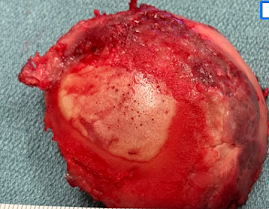
His humeral head showed the "Friar Tuck" pattern of central cartilage loss.


Conservative glenoid reaming was performed without attempt to modify glenoid version. Patient-specific instrumentation and augmented reality were not used. Intraoperative trialing indicated that a 54 20 anteriorly eccentric humeral head provided the optimal balance of mobility and stability.  Neither a plastic glenoid component or bone cement was used. The postoperative x-rays are shown below.


Five months after surgery he reported " Shoulder doing good saw great improvements this month. Strength is improving and have resumed construction work with some limitations. Haven’t started shooting a bow yet but soon I think.  Thanks for a great shoulder" and provided the video shown below of his active motion.


House finch in cherry blossoms


You can support cutting edge shoulder research that is leading to better care for patients with shoulder problems, click on this link

Follow on twitter/X: https://x.com/RickMatsen
Follow on facebook: https://www.facebook.com/shoulder.arthritis
Follow on LinkedIn: https://www.linkedin.com/in/rick-matsen-88b1a8133/

Here are some videos that are of shoulder interest
Shoulder arthritis - what you need to know (see this link).
How to x-ray the shoulder (see this link).
The ream and run procedure (see this link).
The total shoulder arthroplasty (see this link).
The cuff tear arthropathy arthroplasty (see this link).
The reverse total shoulder arthroplasty (see this link).
The smooth and move procedure for irreparable rotator cuff tears (see this link)
Shoulder rehabilitation exercises (see this link).


Wednesday, February 26, 2025

The severely B2 glenoid in active patients

 The B2 glenoid is characterized by posterior decentering of the humeral head on a biconcave glenoid. This pathoanatomy can be managed by anatomic total shoulder (without or with an augmented glenoid component) or by a reverse total shoulder arthroplasty. However, neither of these options may be suitable for active individuals who wish to avoid the risks and limitations of a prosthetic glenoid component. 

Here are two such cases.

Case 1 - A 64 year old active carpenter with shoulder pain, stiffness and symptoms of posterior instability. His preoperative axillary "truth" view demonstrated severe posterior decentering of the humeral head on a posteriorly eroded glenoid.


He elected to have a ream and run procedure. At surgery a concentric humeral head was not stable on the reamed glenoid. However, an anteriorly eccentric humeral head was stably centered on the reamed glenoid.


Three months after surgery his shoulder was comfortable and clinically stable. At that time he was returning to his trade. He kindly gave us permission to show his active range of flexion.


Case 2 - A 51 year old general contractor presented with pain, stiffness and instability of his left shoulder after previous arthroscopic shoulder debridement. His shoulder condition prevented him from swimming and archery. His preoperative axillary "truth" view showed his humeral head was posteriorly decentered on a convex glenoid. 


He elected to have a ream and run procedure. At surgery a concentric humeral head was not stable on the reamed glenoid. However, an anteriorly eccentric humeral head was stably centered on the reamed glenoid.


Three months after surgery his shoulder was comfortable and clinically stable. At that time he was returning to his trade. He kindly gave us permission to show his active range of flexion.


Comment: We've found that the anteriorly eccentric humeral head is a reliable solution to achieving humeral head centering when intraoperative assessment reveals that a concentric humeral head allows excessive posterior translation.  See Management of intraoperative posterior decentering in shoulder arthroplasty using anteriorly eccentric humeral head components.  While some surgeons have expressed concern that the anterior eccentric head may jeopardize the subscapularis repair. We have not found this to be the case as long as the subscapularis is well released and secured to the lesser tuberosity. 


You can support cutting edge shoulder research that is leading to better care for patients with shoulder problems, click on this link

Follow on twitter/X: https://x.com/RickMatsen
Follow on facebook: https://www.facebook.com/shoulder.arthritis
Follow on LinkedIn: https://www.linkedin.com/in/rick-matsen-88b1a8133/

Here are some videos that are of shoulder interest
Shoulder arthritis - what you need to know (see this link).
How to x-ray the shoulder (see this link).
The ream and run procedure (see this link).
The total shoulder arthroplasty (see this link).
The cuff tear arthropathy arthroplasty (see this link).
The reverse total shoulder arthroplasty (see this link).
The smooth and move procedure for irreparable rotator cuff tears (see this link)
Shoulder rehabilitation exercises (see this link).


Friday, February 14, 2025

Anatomic total shoulder - preoperative planning and intraoperative decision making.

 Preoperative planning is helpful in anticipating what might be needed to reconstruct an arthritic shoulder; however the final choice of implants is determined at the time of surgery.

A 43 year old man presented with pain and stiffness of his left shoulder. He had a prior CT scan showing an arthritic humeral head centered on a somewhat retroverted glenoid.


We obtained our standard set of plain radiographs: an AP in the plane of the scapula and an axillary "truth" view taken with the arm in a functional arm position of elevation. The truth view showed posterior decentering of the humeral head that was not evident on the CT scan taken with the patient's arm at his side. No 3D CT planning was used.


At surgery, a standard glenoid component was well seated after conservative glenoid reaming. "Corrective" reaming and a posteriorly augmented glenoid component were not used.
 Trialing with an anatomic humeral head component revealed posterior instability when the arm was flexed forward. As a result, a short stemmed humeral component with an anteriorly eccentric humeral head was selected. 
Postoperatively, his shoulder is clinically and radiographically stable when the arm is elevated to a functional position (as seen on the postoperative "truth" view).


Comment: This case illustrates (1) the value of the "truth" view before and after surgery and (2) the importance of tailoring implant selection based on intraoperative testing of motion and stability. NB: when we do an arthroplasty, the shoulder we have after soft tissue releases and osteophyte resection is different from the shoulder before surgery; that's why intraoperative assessment is more important than preoperative planning.

You can support cutting edge shoulder research that is leading to better care for patients with shoulder problems, click on this link

Follow on twitter/X: https://x.com/RickMatsen
Follow on facebook: https://www.facebook.com/shoulder.arthritis
Follow on LinkedIn: https://www.linkedin.com/in/rick-matsen-88b1a8133/

Here are some videos that are of shoulder interest
Shoulder arthritis - what you need to know (see this link).
How to x-ray the shoulder (see this link).
The ream and run procedure (see this link).
The total shoulder arthroplasty (see this link).
The cuff tear arthropathy arthroplasty (see this link).
The reverse total shoulder arthroplasty (see this link).
The smooth and move procedure for irreparable rotator cuff tears (see this link)
Shoulder rehabilitation exercises (see this link).


Saturday, November 16, 2024

Using humeral head geometry to establish immediate postoperative mobility and stability in a B2 glenoid

A man in his 50s from another state presented with a grinding and aching pain in his left shoulder after prior arthroscopic surgery and cortisone injections. 

On his Simple Shoulder Test he reported the inability to tuck in his shirt behind his back, to place his hand behind his head with his elbow out to the side, to lift a gallon of milk, to toss under hand, to throw overhand, and had difficulty doing his work as a general contractor.  He was previously a competitive archer, however he was currently unable to hold his bow properly given the range of motion deficits and pain in his left shoulder.

His examination revealed 140 degrees of humerothoracic motion of which only 80 degrees was humeroscapular. External rotation was limited to 0 degrees at the side and 10 degrees with the arm in abduction. Internal rotation with the arm abducted was 10 degrees. Reach up the back was to the gluteal area. 

His preoperative x-rays are shown below. The axillary truth view showed severe posterior decentering of the humeral head on a biconcave glenoid. 

After discussion of the options of an anatomic and a reverse total shoulder, the patient elected a ream and run procedure

The surgical challenge was to manage the posterior instability while loosening this tight shoulder (avoiding overstuffing).  Without using a preoperative CT or 3D planning, it was anticipated that the posterior decentering would require the use of an anteriorly eccentric humeral head component with a short stem to provide secure fixation that would resist eccentric loading.

At surgery, the stiffness of the shoulder was confirmed on examination under general anesthesia, no nerve block was used. The shoulder was approached through a deltopectoral incision and a subscapularis peel. The long head of the biceps was preserved. 

The humeral head was deformed as anticipated.

Extensive subscapularis and anterior / inferior capsular releases were performed as shown in these diagrams from Steve Lippitt.


The glenoid was conservatively reamed to a single concavity without attempting to "correct" glenoid retroversion.

The sizing of the humeral head component was determined by trialing, paying attention to the 40, 50, 60 rules and assuring that easy flexion to at least 150 degrees could be achieved.

Implant manufacturers typically describe the size of their humeral head components in terms of diameter of curvature and height.

It is useful to recognize that the humeral head component is a spherical cap (shown in blue below) with a height of h and a radius of r (half the diameter of curvature).

The volume of the humeral head is an important factor in determining the degree of stuffing of the joint. The humeral head volume is determined by 

The effect of changing the diameter curvature and the height of the humeral component are show in diagrams below. As pointed out by Jason Hsu, increasing the height has a greater effect on humeral head volume than increasing the diameter of curvature.

This effect is quantitatively demonstrated in the table below showing the humeral head volume for a commonly used range of prosthetic humeral head diameters and radii. The different component geometries are arranged in order of decreasing head volume. Note that it is the head height that is the primary driver of joint volume.


In this case a 54 20 head provided the necessary stability and mobility as demonstrated by this photo taken after wound closure.


His immediate postoperative x-rays show the impaction grafted humeral stem with an anteriorly eccentric humeral head centered in the conservatively reamed glenoid. 

Four days after his surgery he reported that he was taking only Tylenol for his shoulder and sent this report:


You can support cutting edge shoulder research that is leading to better care for patients with shoulder problems, click on this link

Follow on twitter/X: https://x.com/RickMatsen

Here are some videos that are of shoulder interest
Shoulder arthritis - what you need to know (see this link).
How to x-ray the shoulder (see this link).
The ream and run procedure (see this link).
The total shoulder arthroplasty (see this link).
The cuff tear arthropathy arthroplasty (see this link).
The reverse total shoulder arthroplasty (see this link).
The smooth and move procedure for irreparable rotator cuff tears (see this link).
Shoulder rehabilitation exercises (see this link). 


Thursday, October 31, 2024

Cost saving techniques vs technology: bilateral osteoarthritis in an active 60 year old man. 7 year followup and sad news

An active man from a state on the opposite side of the country presented with pain and limited function in both shoulders. His Simple Shoulder Tests are shown below.


Standard plain x-rays of the right shoulder showed severe osteoarthritis, loose bodies, and posterior humeral decentering on a biconcave retroverted (B2) glenoid seen on the axillary truth view.


Standard plain x-rays of the left shoulder showed severe osteoarthritis, loose bodies, and humeral head centering on a monoconcave, non-retroverted (A2) glenoid as seen on the axillary truth view.


After discussion of the alternatives of anatomic and reverse total shoulder, he elected a ream and run procedure to avoid the risks and limitations associated with the other two procedures.

The procedures were performed 6 months apart with no preoperative CT or MRI and no 3D planning. General anesthesia was used without a nerve block. The biceps tendons were preserved. The glenoids were conservatively reamed to a single concavity. No attempt was made to change or "correct" glenoid version on either side. Smooth standard length humeral stems were fixed with impaction autografting. On the right side an anteriorly eccentric humeral head component was used to manage posterior  humeral decentering. 

He returned for routine followup 7 years after his ream and run procedures. He could perform 11/12 Simple Shoulder Test functions on each side. 

His 7 year followup x-rays are shown below. Note the absence of the stress shielding that has been associated with other stem designs. Note the absence of glenoid erosion with this standard chrome-cobalt humeral head. Note also the centering of the anteriorly eccentric humeral head on the retroverted glenoid of the right shoulder. 


The patient was pleased with the outcome. 


Of note the costs of CT scans, 3-D planning, brachial plexus blocks, polyethylene glenoids, cement, pyrocarbon humeral heads, special ingrowth humeral stems and reverse total shoulders were avoided without compromise of the clinical outcome.

Sadly, the DePuy Global Advantage simple, standard-length, uncoated humeral stem that had reliably served patients like this man for decades 
is no longer manufactured, in spite of its excellent service record, low cost, and lack of implant related complications. It has been "replaced" by more complex and more expensive stems, some of the many "options" are shown here.


You can support cutting edge shoulder research that is leading to better care for patients with shoulder problems, click on this link

Please join us for the AAOS Infection course!!!


Follow on twitter/X: https://x.com/RickMatsen
Follow on facebook: https://www.facebook.com/shoulder.arthritis
Follow on LinkedIn: https://www.linkedin.com/in/rick-matsen-88b1a8133/

Here are some videos that are of shoulder interest
Shoulder arthritis - what you need to know (see this link).
How to x-ray the shoulder (see this link).
The ream and run procedure (see this link).
The total shoulder arthroplasty (see this link).
The cuff tear arthropathy arthroplasty (see this link).
The reverse total shoulder arthroplasty (see this link).
The smooth and move procedure for irreparable rotator cuff tears (see this link).
Shoulder rehabilitation exercises (see this link). 


Friday, June 28, 2024

A 31 year old with a severe type B2 glenoid after prior labral surgery.

 A 31 year old athletic man was referred from the opposite corner of the U.S. with a history of shoulder problems since the age of 16 having been diagnosed with a torn posterior labrum from pitching baseball. He continued to participate in weight training, golf and football. A decade later he had progressive and substantial pain and difficulty raising his arm. His symptoms were aggravated by a motorcycle accident. At that point he had a "posterior labrum slap tear surgery".  Five years later he had increased shoulder pain and limitation that had not responded to dedicated physical therapy. His shoulder images at that time are shown below.


On his initial visit with us, his shoulder examination showed stiffness and pain on motion but excellent muscle strength.


His Simple Shoulder Test at that visit is shown below


Our standard series of plain films (including the axillary "truth" view) showed substantial posterior decentering when the arm was placed in a functional position of elevation.


After discussion of the risks and benefits of the surgical alternatives, he elected to proceed with a ream and run procure to avoid the potential issues with a plastic glenoid component. Preoperative CT planning was not used. The procedure was performed under general anesthesia without a nerve block. The shoulder was approached through a deltopectoral interval with a subscapularis peel rather than a lesser tuberosity osteotomy. The biceps tendon was preserved as was the glenoid labrum. The glenoid was conservatively reamed just enough to create a single concavity and without attempting to change glenoid version. A thin (8 mm) smooth stem was impaction grafted into the medullary canal. A 56 mm anteriorly eccentric humeral head was selected to manage the posterior laxity. 

He did a superior job of his rehabilitation, keeping in close touch with us, although he lives over 3,000 miles away. A year after surgery he reported that he could perform 12/12 of the functions of the Simple Shoulder Test.


At two years after surgery he provided these x-rays showing no evidence of stress shielding, a stable thin smooth humeral component, a centered anteriorly eccentric humeral head, and a completely remodeled stable glenoid articular surface. 


Recently, at four years after surgery, he shared a couple of videos of his workouts.


Comment: Managing shoulder arthritis in a young active person is a challenge for some important reasons: the pathology is more complex (as seen in this case) than what is usually found in degenerative arthritis in older patients, the patient has a long projected postoperative lifespan, and the patient generally has high activity aspirations. Each of these factors places special demands on the procedure selected, on the surgical technique, the rehabilitation program, and on the patient-surgeon partnership.

You can support cutting edge shoulder research that is leading to better care for patients with shoulder problems, click on this link

Follow on twitter/X: https://x.com/RickMatsen
Follow on facebook: https://www.facebook.com/shoulder.arthritis
Follow on LinkedIn: https://www.linkedin.com/in/rick-matsen-88b1a8133/

Contact: shoulderarthritis@uw.edu

Here are some videos that are of shoulder interest
Shoulder arthritis - what you need to know (see this link).
How to x-ray the shoulder (see this link).
The ream and run procedure (see this link).
The total shoulder arthroplasty (see this link).
The cuff tear arthropathy arthroplasty (see this link).
The reverse total shoulder arthroplasty (see this link).
The smooth and move procedure for irreparable rotator cuff tears (see this link).

Shoulder rehabilitation exercises (see this link).