Showing posts with label chondrolysis. Show all posts

Thursday, October 24, 2024

Innovation gone bad. A sad beginning and happy ending: return to rock climbing after a ream and run plus an informative story of chondrolysis


In the early 2000s the innovation of using intra-articular pain pumps (devices for administering local anesthetics) were being marketed to manage post arthroscopic pain see The effectiveness of an anesthetic continuous-infusion device on postoperative pain control and The pain control infusion pump for postoperative pain control in shoulder surgery. It was not until a decade later that it was conclusively demonstrated that intra-articular pain pumps caused a devastating type of arthritis in young patients known as chondrolysis: 
Published evidence demonstrating the causation of glenohumeral chondrolysis by postoperative infusion of local anesthetic via a pain pump

=>

This is a poignant example of a technological innovation gone bad. We use the term "future shock" to refer to devastating complications from new technologies that are only discovered years after these devices are sold in the marketplace and used in patients. Chondrolysis remains one of the principal indications for shoulder arthroplasty in young individuals.

Consider a 21 year old active male who had a labral repair followed by the implantation of a pain pump. Ten years later he presented to us with progressive pain and stiffness of his shoulder; however he was still able to perform all 12 of the Simple Shoulder Test Functions. His x-rays at that time are shown below.

We advised him that he need not consider arthroplasty until his symptoms progressed.

Another decade later when he was in his early 40s, his symptoms had progressed as indicated by his Simple Shoulder Test


The radiographic appearance of his shoulder had substantially progressed as well.


To avoid the risks and limitations associated with a polyethylene glenoid component he elected to have a ream and run procedure. This was performed without preoperative CT scan, preoperative 3D planning, a nerve block, or an ingrowth humeral component. The long head tendon of the biceps was preserved, the glenoid was reamed conservatively to a single concavity, the thin humeral stem was fixed with impaction autografting.

Shown below are his follow-up x-rays.


As a part of his one year report he indicated, "I can do all my sports, and handle the kids with little and only temporary pain, and am even climbing at around the highest level I've ever climbed."  He kindly gave us permission to show some videos of his climbing.


You can support cutting edge shoulder research that is leading to better care for patients with shoulder problems, click on this link


Follow on twitter/X: https://x.com/RickMatsen
Follow on facebook: https://www.facebook.com/shoulder.arthritis
Follow on LinkedIn: https://www.linkedin.com/in/rick-matsen-88b1a8133/


Here are some videos that are of shoulder interest
Shoulder arthritis - what you need to know (see this link).
How to x-ray the shoulder (see this link).
The ream and run procedure (see this link).
The total shoulder arthroplasty (see this link).
The cuff tear arthropathy arthroplasty (see this link).
The reverse total shoulder arthroplasty (see this link).
The smooth and move procedure for irreparable rotator cuff tears (see this link).
Shoulder rehabilitation exercises (see this link). 

Sunday, August 4, 2024

Ream and run for post arthroscopic glenohumeral chondrolysis - 9 year followup.

An athletic young woman in her mid 20s was diagnosed with multidirectional instability of her right shoulder. She was treated elsewhere with an arthroscopic anterior and posterior capsulorrhaphy. Three years later she had a repeat surgery after which a pain pump was used to infuse local anesthetics. Eight years later she had a painful stiff shoulder treated with a subacromial decompression and biceps tenodesis. At that time glenohumeral chondromalacia was identified. The shoulder was debrided and the repair sutures removed. Five months later another subacromial decompression was performed along with a distal clavicle excision. She had persistent stiffness and pain. At the time of her presentation to us - twelve years after her first surgery - she had flexion limited to 90 degrees, pain ranging from 7-10 on a scale of 10, and reported the inability to perform any of the twelve functions of the Simple Shoulder Test.

Her radiographs showed bone on bone contact in both the AP and the axillary views as shown below, suggesting chondrolysis.


After a discussion of the surgical options, she elected to have a ream and run procedure to avoid the risks and limitations associated with the glenoid component used in a conventional a total shoulder arthroplasty.


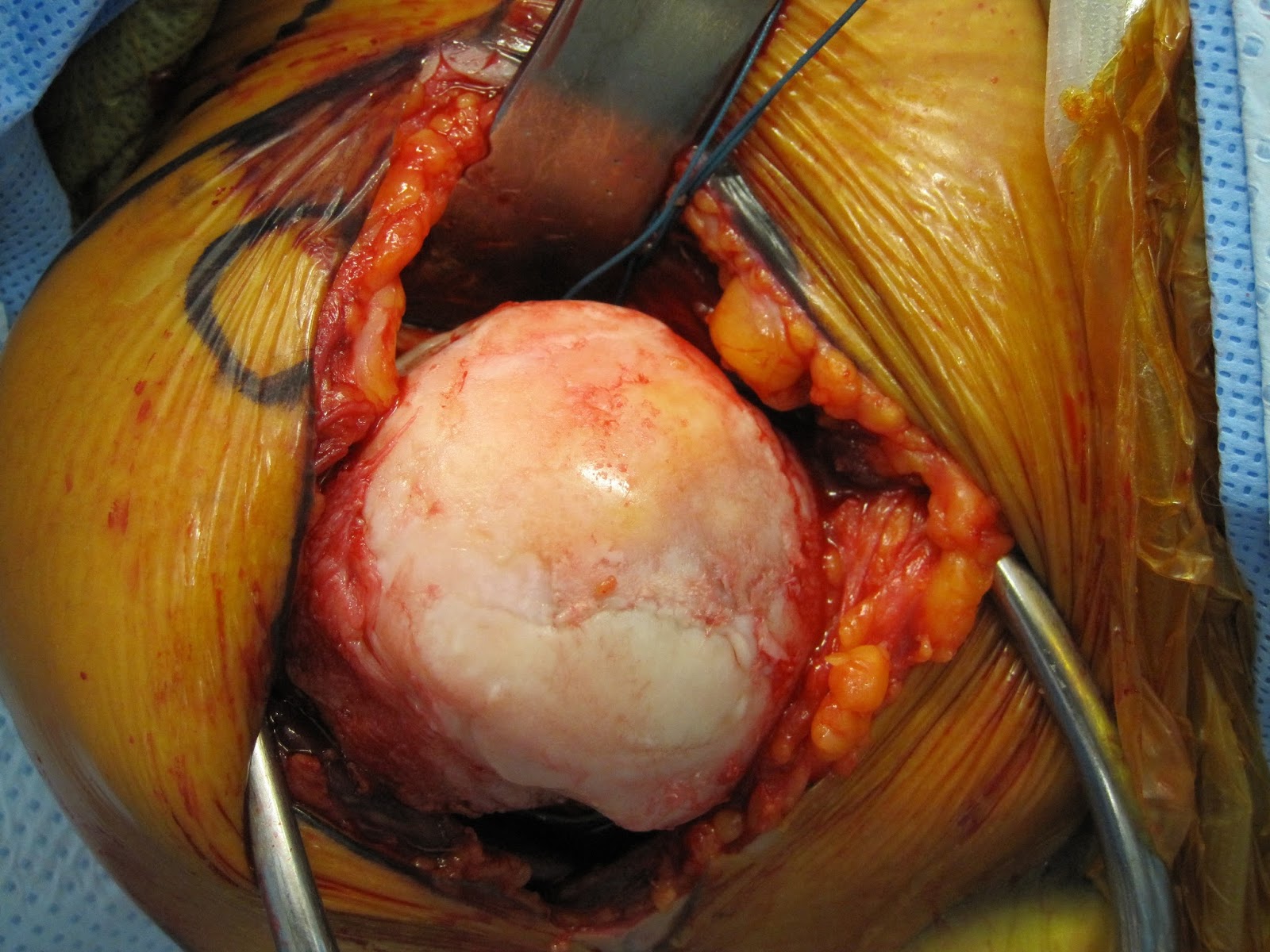
At surgery, the loss of cartilage over the humeral head was evident.


Her postoperative films are shown below. Note the smooth standard length humeral stem was secured using impaction auto grafting with bone harvested from the humeral head resulting in a low filling ratio.


Although her motion was improved at 6 weeks after surgery, she and her local orthopaedic surgeon decided to proceed with a manipulation under anesthesia in that she had lost some of her early range of motion

She demonstrated the highest level of dedication to her rehabilitation program, taking it to trackside. She has generously allowed us to post some of her photos here.

Here are the photos she sent in at 4 months after surgery, stating that she can now perform 8 of the 12 functions of the Shoulder Test in contrast to 0/12 before surgery.


At two years out from the procedure and fully functional as shown by these images she recently sent to us along with this message "Today is my two year anniversary of my ream and run surgery! We did it! I am so happy and proud to say that my shoulder feels better and stronger than it has in 15 years, since before my very first surgery in 2003!"

She adds "I can now perform all 12 functions of the Simple Shoulder test :) (the 8lb one is challenging but I can do it!)"


Recently she posted, "I am recently six years out from my ream and run surgery and I have to say it was one of the best decisions I’ve made. My story is a little different from some others so I wanted to share it in case it can help someone who may be on the fence. At age 23 I worked in the bars and would dislocate my shoulder so much I could Lethal Weapon it back in place myself lol. I had surgery to tighten loose tendons and ligaments. At age 26, after a bad car accident, the laxity returned. After months and months of physical therapy it was determined I needed surgery again. Following this surgery, in 2006, my surgeon put a pain pump with a catheter directly into my chest for pain management. It looked like a little battery pack. After 3 days I had a friend help me pull the catheter out of my chest, as instructed. Shortly after that surgery I knew something felt very different. Quarterly cortisone injections and 9 years of corrective surgeries including but not limited to clavicle resection, biceps tenodesis, AC joint repair, you name I feel like I had it. Not to mention the countless manipulations under anesthesia. At age 29, a different surgeon told me I had the shoulder of an 80 year old but “you’re too young for a replacement.” No one could tell me how my shoulder had gotten so bad. It got to the point it was painful moving a computer mouse. At age 34, I saw a new surgeon here in Hawaii. He knew right away what I had…Chondrolysis…from that pain pump in 2006. Chondrolysis is a severe type of shoulder arthritis in which the cartilage of the joint is abruptly lost. He referred me to the UW and at age 35 I had my ream and run. The recovery was tough but 9 years with no resolution was tougher! It’s all about Quality of Life 💕 I am so thankful and have a shoulder that I am no longer aware of every single day, a shoulder that is pain-free, and able to do all that I need it to do without hesitation. Happy I don’t do any power lifting or have a physically demanding career or anything like that but I’m 120lbs and just helped lift a gazebo roof that was at least my body weight. The r&r was the absolute best thing I ever did! I was just telling my husband that for nearly a decade I was aware of my shoulder every single day...now I’m never aware of it and haven’t been to a doctor for over three years! "

At six years after surgery she reported, "I am doing well! I am completely pain free and able to do everything I want to do with no limits. I actually forget that I have a metal shoulder most of the time" Her x-rays six years after surgery are shown below. Note the stability of the impaction grafted humeral component, the absence of glenoid erosion, and the remodeling of the glenoid surface.


Recently she emailed, "My shoulder works beautifully, still no pain whatsoever. This October will be 9 years since my ream and run. I can’t believe it’s been 9 years! I am so happy with the outcome. My only regret is not doing it sooner :)"

She sent these images of her 9 year old ream and run. Note the remodeling of her glenoid joint surface and the secure fixation of the impaction grafted smooth humeral stem without evidence of stress shielding.


Comments welcome at shoulderarthritis@uw.edu

You can support cutting edge shoulder research that is leading to better care for patients with shoulder problems, click on this link


Follow on twitter/X: https://x.com/RickMatsen
Follow on facebook: https://www.facebook.com/shoulder.arthritis
Follow on LinkedIn: https://www.linkedin.com/in/rick-matsen-88b1a8133/


Here are some videos that are of shoulder interest
Shoulder arthritis - what you need to know (see this link).
How to x-ray the shoulder (see this link).
The ream and run procedure (see this link).
The total shoulder arthroplasty (see this link).
The cuff tear arthropathy arthroplasty (see this link).
The reverse total shoulder arthroplasty (see this link).
The smooth and move procedure for irreparable rotator cuff tears (see this link).
Shoulder rehabilitation exercises (see this link). 


Friday, February 17, 2023

Why do patients under the age of 50 do less well after anatomic total shoulder arthroplasty?

The reported outcomes of shoulder arthroplasty in patients under the age of fifty years are worse than those in patients over fifty. While a number of factors, such as differences in activity level, patient longevity, and differences in expectations, have been proposed as the reason for this difference, the authors of Comparison of Patients Undergoing Primary Shoulder Arthroplasty Before and After the Age of Fifty explored the possibility that patients under fifty years of age had differences in their pre-arthroplasty self-assessed comfort and function, sex distribution, and specific type of arthritis in comparison to their more senior counterparts. Patients under the age of fifty years were not more likely than those over fifty to be female or to have a lower prearthroplasty self-assessed comfort and function score. However, they did have more complex pathological conditions, such as capsulorrhaphy arthropathy (arthritis after surgery for instability), rheumatoid arthritis, and posttraumatic arthritis. Only 21% of the younger patients had primary degenerative joint disease, whereas 66% of the older patients had that diagnosis.


They suggested that the pathoanatomy in these younger patients can complicate the surgery, the rehabilitation and the outcome of the shoulder arthroplasty. The preoperative diagnosis may have at least as much influence on the outcome of the procedure as does the age of the patient.

Recently, the authors of A History of Shoulder Instability is More Common in Young Patients Undergoing Total Shoulder Arthroplasty sought to evaluate whether a history of shoulder instability was more common in patients under 50 years old undergoing TSA. They identified 489 patients undergoing primary TSA within the Military Health System. 

Patients under 50 years old were matched 1:2 with patients 50 years and older based on sex, race, and military status; the final study population comprised 240 patients. 

The groups differed significantly in type of shoulder arthritis, with the older group having significantly more primary osteoarthritis (78% vs. 51%), while the younger group had significantly more patients with a history of shoulder instability (48% vs. 12%), prior ipsilateral shoulder surgery of any type (74% vs. 34%), and prior ipsilateral shoulder stabilization (31% vs. 5%). In the resultant logistic regression model, a history of shoulder instability (OR 5.0) and a history of any prior ipsilateral shoulder surgery (OR 3.5) were associated with TSA prior to the age of 50 years old.

Comment: From the foregoing, it is evident that the shoulder pathoanatomy of young patients having shoulder arthroplasty is different from that of older patients - a fact that may contribute to inferior results in these individuals after shoulder joint replacement.

Shoulder instability and its treatment can predispose the shoulder to arthritis observed in young patients. Below are some of the many reasons why this can happen.

Recurrent instability can contribute to the development of glenohumeral arthritis from the forced translation of the humeral head over the lip of the glenoid can wear the articular cartilage

exposing the bone beneath


Surgery performed to manage instability can risk secondary arthritis from overtightening, leading to pathological translation and eccentric wear of cartilage (capsulorrhaphy arthropathy).


The use of pain pumps for the intra-articular infusion of local anesthetics after instability surgery can lead to chondrolysis (see Published evidence demonstrating the causation of glenohumeral chondrolysis by postoperative infusion of local anesthetic via a pain pump).


Prominent suture anchors used in instability surgery can lead to anchor arthropathy


Cutibacterium infection after instability surgery can lead to septic arthritis


In contrast to the situation with straightforward osteoarthritis, these conditions can complicate arthroplasty surgery and lead to suboptimal outcomes because of pathological alterations in bone and soft tissue quality and heightened risk of complications, such as periprosthetic infection. 

Recognizing factors such as these can help patients and surgeons understand some of the differences in shoulder arthritis in younger patients and their effect on the success of joint replacement.

You can support cutting edge shoulder research that is leading to better care for patients with shoulder problems, click on this link.

Follow on twitter: https://twitter.com/shoulderarth
Follow on facebook: click on this link
Follow on facebook: https://www.facebook.com/frederick.matsen
Follow on LinkedIn: https://www.linkedin.com/in/rick-matsen-88b1a8133/

Here are some videos that are of shoulder interest
Shoulder arthritis - what you need to know (see this link).
How to x-ray the shoulder (see this link).
The ream and run procedure (see this link).
The total shoulder arthroplasty (see this link).
The cuff tear arthropathy arthroplasty (see this link).
The reverse total shoulder arthroplasty (see this link).
The smooth and move procedure for irreparable rotator cuff tears (see this link).
Shoulder rehabilitation exercises (see this link).


Tuesday, January 25, 2022

Ream and run for chondrolysis - 6 year followup.

An athletic young woman in her mid 20s was diagnosed with multidirectional instability of her right shoulder. She was treated elsewhere with an arthroscopic anterior and posterior capsulorrhaphy. Three years later she had a repeat surgery after which a pain pump was used to infuse local anesthetics. Eight years later she had a subacromial decompression and biceps tenodesis. At that time glenohumeral chondromalacia was identified. The shoulder was debrided and the repair sutures removed. Five months later another subacromial decompression was performed along with a distal clavicle excision. She had persistent stiffness and pain. At the time of her presentation to us - twelve years after her first surgery - she had flexion limited to 90 degrees, pain ranging from 7-10 on a scale of 10, and reported the inability to perform any of the twelve functions of the Simple Shoulder Test


Her radiographs showed bone on bone contact in both the AP and the axillary views as shown below, suggesting chondrolysis (noting that primary degenerative joint disease would be very unusual in such a young woman).


At surgery, the loss of cartilage over the humeral head was evident.


She elected to have a ream and run procedure to avoid the potential risks and limitations associated with a total shoulder arthroplasty (glenoid component wear and loosening).

Her postoperative films are shown below. Note the absence of a plastic glenoid and the absence of bone cement. Note the humeral stem was secured using impaction auto grafting with bone harvested from the humeral head.


Although her motion was improved at 6 weeks after surgery, she and her local orthopaedic surgeon decided to proceed with a manipulation under anesthesia in that she had lost some of her early range of motion

She demonstrated the highest level of dedication to her rehabilitation program, taking it to trackside. She has generously allowed us to post some of her photos here.

Here are the photos she sent in at 4 months after surgery, stating that she can now perform 8 of the 12 functions of the Shoulder Test in contrast to 0/12 before surgery.


At two years out from the procedure and fully functional as shown by these images she recently sent to us along with this message "Today is my two year anniversary of my ream and run surgery! We did it! I am so happy and proud to say that my shoulder feels better and stronger than it has in 15 years, since before my very first surgery in 2003! Thank you both from the bottom of my heart for giving me the chance at a much greater quality of life! Aloha, "

She adds "I can now perform all 12 functions of the Simple Shoulder test :) (the 8lb one is challenging but I can do it!)" 


Recently she posted, "I am recently six years out from my ream and run surgery and I have to say it was one of the best decisions I’ve made. My story is a little different from some others so I wanted to share it in case it can help someone who may be on the fence. At age 23 I worked in the bars and would dislocate my shoulder so much I could Lethal Weapon it back in place myself lol. I had surgery to tighten loose tendons and ligaments. At age 26, after a bad car accident, the laxity returned. After months and months of physical therapy it was determined I needed surgery again. Following this surgery, in 2006, my surgeon put a pain pump with a catheter directly into my chest for pain management. It looked like a little battery pack. After 3 days I had a friend help me pull the catheter out of my chest, as instructed. Shortly after that surgery I knew something felt very different. Quarterly cortisone injections and 9 years of corrective surgeries including but not limited to clavicle resection, biceps tenodesis, AC joint repair, you name I feel like I had it. Not to mention the countless manipulations under anesthesia. At age 29, a different surgeon told me I had the shoulder of an 80 year old but “you’re too young for a replacement.” No one could tell me how my shoulder had gotten so bad. It got to the point it was painful moving a computer mouse. At age 34, I saw a new surgeon here in Hawaii. He knew right away what I had…Chondrolysis…from that pain pump in 2006. Chondrolysis is a severe type of shoulder arthritis in which the cartilage of the joint is abruptly lost. He referred me to the UW and at age 35 I had my ream and run. The recovery was tough but 9 years with no resolution was tougher! It’s all about Quality of Life ðŸ’• I am so thankful and have a shoulder that I am no longer aware of every single day, a shoulder that is pain-free, and able to do all that I need it to do without hesitation. Happy  I don’t do any power lifting or have a physically demanding career or anything like that but I’m 120lbs and just helped lift a gazebo roof that was at least my body weight.  The r&r was the absolute best thing I ever did! I was just telling my husband that for nearly a decade I was aware of my shoulder every single day...now I’m never aware of it and haven’t been to a doctor for over three years! "

At six years after surgery she reports, "I am doing well! I am completely pain free and able to do everything I want to do with no limits. I actually forget that I have a metal shoulder most of the time"  Her x-rays six years after surgery are shown below. Note the stability of the impaction grafted humeral component, the absence of glenoid erosion, and the remodeling of the glenoid surface.


Comment: Chondrolysis is a very challenging type of shoulder arthritis. Some patients continue to have problems with postoperative pain and stiffness after either a total shoulder or a ream and run procedure. Not infrequently a manipulation is needed to address stiffness. In some cases the glenoid bone may not respond with the same degree of strong remodeling seen in this case.


Follow on facebook: https://www.facebook.com/frederick.matsen

Follow on LinkedIn: https://www.linkedin.com/in/rick-matsen-88b1a8133/


How you can support research in shoulder surgery Click on this link.

Here are some videos that are of shoulder interest
Shoulder arthritis - what you need to know (see this link)
Shoulder arthritis - x-ray appearance (see this link)
The smooth and move for irreparable cuff tears (see this link)
The total shoulder arthroplasty (see this link).
The ream and run technique is shown in this link.
The cuff tear arthropathy arthroplasty (see this link).
The reverse total shoulder arthroplasty (see this link).

Wednesday, September 1, 2021

Ream and run for chondrolysis in an active woman

An athletic young woman in her mid 20s was diagnosed with multidirectional instability of her right shoulder. She was treated elsewhere with an arthroscopic anterior and posterior capsulorrhaphy. Three years later she had a repeat surgery after which a pain pump was used to infuse local anesthetics. Eight years later she had a subacromial decompression and biceps tenodesis. At that time glenohumeral chondromalacia was identified. The shoulder was debrided and the repair sutures removed. Five months later another subacromial decompression was performed along with a distal clavicle excision. She had persistent stiffness and pain. At the time of her presentation to us - twelve years after her first surgery - she had flexion limited to 90 degrees, pain ranging from 7-10 on a scale of 10, and reported the inability to perform any of the twelve functions of the Simple Shoulder Test

Her radiographs showed bone on bone contact in both the AP and the axillary views as shown below, suggesting chondrolysis (noting that primary degenerative joint disease would be very unusual in such a young woman).


At surgery, the loss of cartilage over the humeral head was evident.


She elected to have a ream and run procedure to avoid the potential risks and limitations associated with a total shoulder arthroplasty (glenoid component wear and loosening).

Her postoperative films are shown below. Note the absence of a plastic glenoid and the absence of bone cement. Note the humeral stem was secured using impaction auto grafting with bone harvested from the humeral head.


Although her motion was improved at 6 weeks after surgery, she and her local orthopaedic surgeon decided to proceed with a manipulation under anesthesia in that she had lost some of her early range of motion

She demonstrated the highest level of dedication to her rehabilitation program, taking it to trackside. She has generously allowed us to post some of her photos here.

Here are the photos she sent in at 4 months after surgery, stating that she can now perform 8 of the 12 functions of the Shoulder Test in contrast to 0/12 before surgery.


At two years out from the procedure and fully functional as shown by these images she recently sent to us along with this message "Today is my two year anniversary of my ream and run surgery! We did it! I am so happy and proud to say that my shoulder feels better and stronger than it has in 15 years, since before my very first surgery in 2003! Thank you both from the bottom of my heart for giving me the chance at a much greater quality of life! Aloha, "

She adds "I can now perform all 12 functions of the Simple Shoulder test :) (the 8lb one is challenging but I can do it!)" 


Recently she posted, "I am almost six years out. I had mine done at 35 years old. I don’t do any power lifting or have a physically demanding career or anything like that but I’m 120lbs and just helped lift a gazebo roof that was at least my body weight ðŸ˜Š Prior to my r&r I struggled for 9 years with a total of 9 shoulder surgeries/manipulations under anesthesia. The r&r was the absolute best thing I ever did! I was just telling my husband that for nearly a decade I was aware of my shoulder every single day...now I’m never aware of it and haven’t been to a doctor for over three years! "

Chondrolysis is a very difficult diagnosis to treat. It is characteristically found in young individuals (especially young women) who had arthroscopic labral surgery followed by an intra-articular pain pump that infused local anesthetics. Many motivated patients have a challenging post arthroplasty course after a ream and run or a total shoulder. In this case hard work and a good measure of good fortune has led to a good outcome.


Follow on twitter: https://twitter.com/shoulderarth

Follow on facebook: https://www.facebook.com/frederick.matsen

Follow on LinkedIn: https://www.linkedin.com/in/rick-matsen-88b1a8133/


How you can support research in shoulder surgery Click on this link.


Here are some videos that are of shoulder interest
Shoulder arthritis - what you need to know (see this link)
The smooth and move for irreparable cuff tears (see this link)
The total shoulder arthroplasty (see this link).
The ream and run technique is shown in this link.
The cuff tear arthropathy arthroplasty (see this link).
The reverse total shoulder arthroplasty (see this link).
Shoulder rehabilitation exercises (see this link).