Showing posts with label younger patient. Show all posts

Friday, October 24, 2025

When should we consider anatomic total shoulder arthroplasty in patients under 50 years of age?

It is well recognized that patients under the age of 50 often have risk factors for inferior clinical outcomes from shoulder arthroplasty: 

(1) more complex arthritis (avascular necrosis, capsulorrhaphy arthropathy, chondrolysis, rheumatoid arhritis, anchor arthropathy, post traumatic arthritis, failed non-arthroplasty surgery, post infectious arthritis, etc.), 

(2) higher activity levels, 

(3) higher expectations, 

(4) increased longevity, 

(5) increased risk of cutibacterium periprosthetic infection.

The arthroplasty options for managing arthritis in younger patients include: hemiarthroplasty, ream and run, total shoulder arthroplasty and reverse total shoulder arthroplasty.  The choice among these options needs to be made by shared patient-surgeon decision making. Because of the many factors that weigh on this decision, it is unlikely that randomized controlled trials or propensity matching will yield patient-specific guidelines on "the best" approach for young patients with arthritis. Because the surgeon is the method, different surgeons will lean toward certain options based on their experience and training.

The authors of Anatomic Total Shoulder Arthroplasty Indications, Outcomes, and Survivorship in Patients Younger Than 50 Years of Age: A Systematic Review reviewed articles published in last 44 years and found 9 that met their inclusion criteria representing 184 shoulders in 173 patients with a mean age ranging from 33 to 44 years of age. As indicated above, a minority (38%) had primary osteoarthritis, while 35% had rheumatoid arthritis, 9% post-traumatic arthritis,  7% chondrolysis, 6% avascular necrosis, and 5% other. This spectrum is quite different from that of patients over the age of 50. 

While patient reported outcomes were improved on average, the improvements were substantially less than those reported by older patients having primary osteoarthritis.

Implant survivorship ranged from 95 to 100% at 0 to 10yrs, 71% to 84% at 11 to 15yrs, and 61% to 84% at > 15yrs postoperatively. These data suggest that over one-third of patients having had an anatomic TSA at the age of 40 years of age had a revision for failure by the time they were over 55 years of age.

Revision rates and followup durations varied widely: 1/26 at 2.3yrs to 7/17 at 14.5yrs.  The indications for revision are shown in this table below drawn from the data in the paper.


  1. Comment: As is the case in all reviews and longer term followup studies, it is likely that the implants and techniques used in these papers do not represent current practice. Longer term data on what is being done today will become available a decade from now, but at that time techniques and implants will be different than those used in current practice. As pointed out in Objective ignorance - a problem in predicting outcomes in climbing and in orthopaedic surgery we can't predict future outcomes from past data.

  2. The one element that we do not expect to change is that, as pointed out by the authors of Comparison of patients undergoing primary shoulder arthroplasty before and after the age of fifty, younger patients have more complex pathological conditions, such as capsulorrhaphy arthropathy, rheumatoid arthritis, and posttraumatic arthritis. Only 21% of the younger patients had primary degenerative joint disease, whereas 66% of the older patients had that diagnosis. 


  3. With some of these diagnoses, such as rheumatoid and other inflammatory arthropathies, a glenoid component is commonly indicated. 
    However when a glenoid component fails it typically leaves a large, difficult to manage defect in the glenoid bone. 

  1. Therefore, for diagnoses such as capsulorrhapy arthropathy, secondary arthritis, AVN and primary osteoarthritis in patients with increased longevity and higher desired activity levels, there is a rise in interest in bone-preserving procedures that do not involve insertion of a glenoid component. Such procedures include a hemiarthroplasty alone or a ream and run (hemiarthroplasty with non-prosthetic glenoid arthroplasty).  

Sometimes simpler is better

American Avocet
Malheur
May 2025


Follow on twitter/X: 
https://x.com/RickMatsen
Follow on facebook: https://www.facebook.com/shoulder.arthritis
Follow on LinkedIn: https://www.linkedin.com/in/rick-matsen-88b1a8133/

Here are some videos that are of shoulder interest
Shoulder arthritis - what you need to know (see this link).
How to x-ray the shoulder (see this link).
The ream and run procedure (see this link)
The total shoulder arthroplasty (see this link)
The cuff tear arthropathy arthroplasty (see this link).
The reverse total shoulder arthroplasty (see this link).
The smooth and move procedure for irreparable rotator cuff tears (see this link)
Shoulder rehabilitation exercises (see this link).

Thursday, October 2, 2025

Managing the severe B2 glenoid in a 40 year old active man.

  A 40 year old very physically active man presented with pain, stiffness and feelings of instability of the right shoulder.  His axially "truth" view showed almost complete posterior decentering of the huneral on a retroverted biconcave glenoid. 


No additional imaging was deemed necessary.

The surgical options for this patient would seem to include (1) anatomic total shoulder without or with an augmented glenoid component, (2) reverse total shoulder, or (3) a ream and run procedure.

Because of his active lifestyle and young age, he wished to avoid the risks and limitations of a glenoid component and selected the ream and run option. After non-corrective glenoid reaming, an impaction-grafted smooth stem with an anteriorly eccentric humeral head was used to re-center the humeral head on the reamed glenoid,

He came back to the office fourteen years after his ream and run procedure reporting full function of this shoulder for all this athletic activities. His 14 year films (below) show centering of the anteriorly eccentric humeral head on the glenoid with no evidence of glenoid wear or erosion.


Now at the age of 54 he desires a ream and run for his progressively symptomatic left shoulder.


Since many patients are now using AI queries to answer health questions,  I asked ChatGPT, "what is the best treatment for a severe B2 glenoid in an active 40 year old man?" 


"I said:
what is the best treatment for a severe B2 glenoid in a 40 year old active man

ChatGPT said:

A severe B2 glenoid in a 40-year-old active man is one of the most challenging scenarios in shoulder arthroplasty. The goals in this patient are (1) durable correction of posterior subluxation, (2) preservation of bone stock, and (3) avoidance of early component loosening or the need for revision while maintaining activity tolerance.

Here’s how current thinking and evidence break down:

1. Joint Preservation vs. Arthroplasty
* Joint-preserving options (e.g., posterior bone grafting, biologic resurfacing, corrective osteotomy) have historically had poor mid- to long-term outcomes and high revision rates. They are rarely used in this age group today except in very select situations (e.g., low-demand, early arthritis).
* For a 40-year-old active patient, most surgeons will lean toward some form of anatomic arthroplasty if the rotator cuff is intact.

2. Anatomic TSA Options
A. Eccentric Reaming
* Indicated if posterior bone loss is <15° retroversion and correction can be achieved without excessive subchondral bone removal.
* In severe B2 (often >15–20° retroversion), eccentric reaming risks medialization, joint line shift, and instability.
B. Augmented Glenoid Components
* Posteriorly augmented polyethylene glenoid (e.g., stepped or wedge) corrects version without excessive reaming.
* Early/midterm studies: improved stability and function, lower risk of loosening compared with eccentric reaming.
* Limitation: long-term durability in young active patients remains under investigation.
C. Bone Grafting
* Posterior structural bone grafting with a standard glenoid component can restore version while preserving bone.
* Historically high risk of graft resorption and loosening, but newer techniques with rigid fixation have shown improved results.
* Best reserved for younger patients where bone preservation is paramount.

3. Reverse TSA
* Reverse is sometimes proposed in severe B2, especially in older patients or when cuff integrity is uncertain.
* In a 40-year-old active man with intact cuff, reverse is generally avoided because of concerns about implant longevity, scapular notching, and difficulty revising to another option later in life.


Sometimes the simplest solution is best


Female House Finch
Matsen Back Yard 
2022

Follow on twitter/X: https://x.com/RickMatsen
Follow on facebook: https://www.facebook.com/shoulder.arthritis
Follow on LinkedIn: https://www.linkedin.com/in/rick-matsen-88b1a8133/

Here are some videos that are of shoulder interest
Shoulder arthritis - what you need to know (see this link).
How to x-ray the shoulder (see this link).
The ream and run procedure (see this link)
The total shoulder arthroplasty (see this link)
The cuff tear arthropathy arthroplasty (see this link).
The reverse total shoulder arthroplasty (see this link).
The smooth and move procedure for irreparable rotator cuff tears (see this link)
Shoulder rehabilitation exercises (see this link).

You said:
ChatGPT said:


Monday, June 2, 2025

Why is there a high complication rate of shoulder arthroplasty in young patients?

In a recent post, Learning from Surgical Failure, I presented Codman's argument that in order to improve our own, personal  outcomes for our surgical procedures each of us need to follow each of our patients long enough to learn whether the treatment was a success or not, and, if not, to ask why not? This argument is especially relevant to younger patients who have many years to live with adverse outcomes of surgery should they occur. As an example, I saw a 40 year old patient recently who was requesting a ream and run for complications of a surgery he had 25 years ago. Here are the films we obtained. 


Apparently when the patient developed postoperative pain and stiffness and a grinding sensation in his shoulder, he was treated with physical therapy, a second procedure to drive the anchors in deeper, and then a series of cortisone injections. I don't know if his prior surgeon is aware of the patient's current condition (essentially no glenohumeral motion) so that he could learn from this adverse outcome.

Young patients with shoulder arthritis are not only more active and live longer than their older counterparts, but the distribution of their diagnoses is different as shown by the authors of Comparison of Patients Undergoing Primary Shoulder Arthroplasty Before and After the Age of Fifty. Only 21% of the younger patients had primary degenerative joint disease, whereas 66% of the older patients had that diagnosis.


The authors of Complication Rates after Shoulder Arthroplasty in Patients Ages 45 and Younger point out that while shoulder arthroplasty can be effective for reducing pain and improving shoulder function, younger patients with arthritis appear to have a very high risk of arthroplasty failure and revision. They evaluated the minimum two-year complication rates for 70 patients aged 45 years and younger having anatomic total shoulder arthroplasty (TSA n=35), hemiarthroplasty (HA n=30), and reverse total shoulder arthroplasty (RTSA n=5).

One out of every five patients had a complication and one out of every seven had a reoperation. TSA patients had a 29% complication rate with infection being the most frequent issue. RTSA patients had a complication rate of 20%. HA patients had a complication rate of 7%. These data need to be interpreted with caution because (1) the number of patients in this study was small and (2) the inclusion criterion was 2 or more years of followup; 2 years is a small percentage of the remaining lifetime of 45 year old patients that have many more years to experience complications of the arthroplasty.

Because "the surgeon is the method", we would like to know the relationship of the surgeon to complications and re-operations in  multi-surgeon studies. In the words of Kahneman, we would like to assess the system noise in surgical outcome attributable to the individual surgeon.

To accomplish this goal, we'd need to explore the relationship of the number and type of complications to the individual surgeon performing the procedures, controlling for variables including patient demographics, diagnosis, and type of arthroplasty. This would require a multivariable analysis that would include perhaps thousands of patients.

A metric that is important to the interpretation of studies of this type is the PPPI - the percentage of patients included from those potentially included - i.e. of all the young patients with arthritis having arthroplasty performed by each participating surgeon two or more years ago, what percent were included in this study? Only with this number can the reader assess the "loss of followup" bias for each surgeon. Unfortunately, this metric can only be determined in prospective studies and not in retrospective studies such as this one.

In order to understand the importance of the individual surgeon to the rate of complication, we'd like to know the answer to questions such as

(1) among the patients included for each surgeon, what was the distribution of diagnoses (what was the diagnosis mix for each of the diagnoses included in this study: primary osteoarthritis, capsulorrhaphy arthropathy, avascular necrosis, post-traumatic arthritis, inflammatory arthropathy, fracture, cuff tear arthropathy, tumor)?

(2) among the patients included for each surgeon, what was the complication rate for each of the three types of arthroplasty (TSA, RSA, and HA)?

(3) among the patients included for each surgeon, what was the distribution of the different types of complications (this study included infection, subscapularis failure, glenoid component loosening, humeral component loosening, rotator cuff tear, fracture, instability, revision)?

With analyses such as these we can get closer to identifying the factors associated with the unacceptably high complication rate for shoulder arthroplasty in young patients: what is the relative importance of the surgeon, the patient, the diagnosis, the procedure or other factors? Such an approach holds promise for learning why so many arthroplasty complications occur in young patients and how we might prevent these adverse outcomes in the future.


Caring for the young

White headed woodpecker

Leavenworth, Washington 

June 2022

You can support cutting edge shoulder research that is leading to better care for patients with shoulder problems, click on this link

Follow on twitter/X: https://x.com/RickMatsen
Follow on facebook: https://www.facebook.com/shoulder.arthritis
Follow on LinkedIn: https://www.linkedin.com/in/rick-matsen-88b1a8133/

Here are some videos that are of shoulder interest
Shoulder arthritis - what you need to know (see this link).
How to x-ray the shoulder (see this link).
The ream and run procedure (see this link).
The total shoulder arthroplasty (see this link).
The cuff tear arthropathy arthroplasty (see this link).
The reverse total shoulder arthroplasty (see this link).
The smooth and move procedure for irreparable rotator cuff tears (see this link)
Shoulder rehabilitation exercises (see this link).

Sunday, September 15, 2024

Ream and run for selected patients or "reverse for everything"? RnR vs RFE.

Some surgeons hold the view that all types of arthritis should be treated with a reverse total shoulder to avoid the risk of subscapularis, rotator cuff and glenoid component failure, accepting the risks associated with reverse total shoulder, such as baseplate failure, dislocation and acromion/spine fractures.

Some active patients are not comfortable with this approach, however, and wish to pursue the ream and run procedure. 

Consider the example of an athletic man, high school football coach, and firefighter in his early 40s who had a surgical procedure on his left shoulder for instability while he was a collegiate football player two decades earlier. At the time of that surgery, early arthritic changes were noted.

At the time of presentation he reported the Simple Shoulder Test results shown below.


His shoulder was stiff:


His x-rays showed secondary arthritis.


After discussion of the treatment options, he elected to proceed with the ream and run. The procedure was performed without a preoperative CT scan and under general anesthesia without a brachial plexus block. The long head tendon of the biceps was preserved. 

In that he lives on the opposite side of the U.S. we have not seen him in person since surgery. However, he has kept us posted regarding his progress.

To track his rehab culminating in a half-ironman 8 months after surgery see this link.

One year after surgery, he sent us these videos.


He is excited to be returning to his favorite activities.

Comments welcome at shoulderarthritis@uw.edu

You can support cutting edge shoulder research that is leading to better care for patients with shoulder problems, click on this link


Follow on twitter/X: https://x.com/RickMatsen
Follow on facebook: https://www.facebook.com/shoulder.arthritis
Follow on LinkedIn: https://www.linkedin.com/in/rick-matsen-88b1a8133/


Here are some videos that are of shoulder interest
Shoulder arthritis - what you need to know (see this link).
How to x-ray the shoulder (see this link).
The ream and run procedure (see this link).
The total shoulder arthroplasty (see this link).
The cuff tear arthropathy arthroplasty (see this link).
The reverse total shoulder arthroplasty (see this link).
The smooth and move procedure for irreparable rotator cuff tears (see this link).
Shoulder rehabilitation exercises (see this link). 


Tuesday, May 16, 2023

Comparing revision rates for anatomic and reverse total shoulders - the glenoid component design matters

Young patients with glenohumeral arthritis are more likely to live longer, to have more complex pathology, and to have higher expectations than their older counterparts. As emphasized in The younger patient with shoulder arthritis - things to consider. and Why do patients under the age of 50 do less well after anatomic total shoulder arthroplasty? the management of glenohumeral arthritis requires careful preoperative consideration and excellent surgical technique.

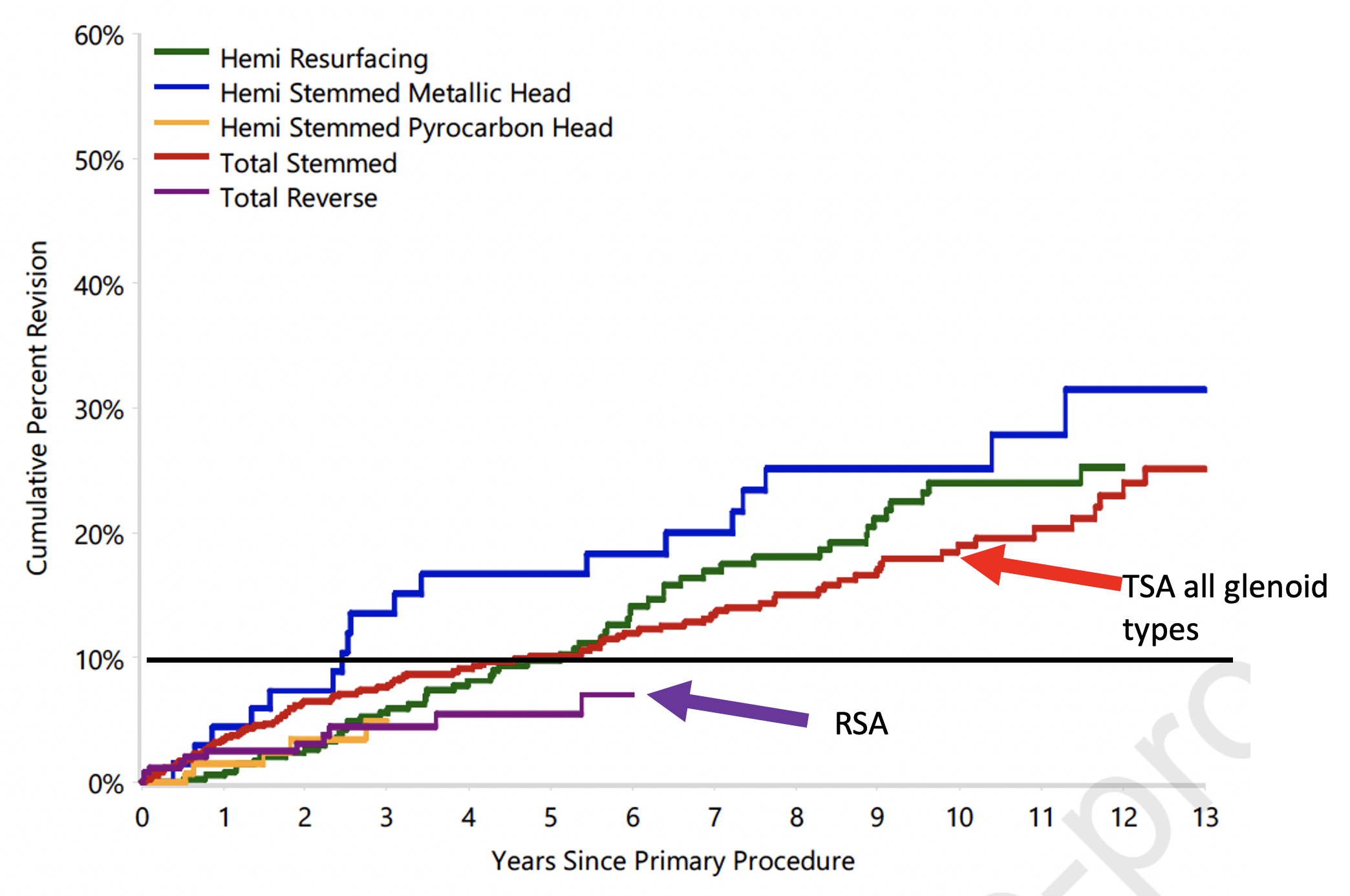
The authors of Survivorship of shoulder arthroplasty for young patients with osteoarthritis: An Analysis of the Australian Orthopaedic Association National Joint Replacement Registry sought to compare the survivorship and reasons for revision in 1,564  patients aged <55 years with a primary diagnosis of osteoarthritis having one of five types of shoulder arthroplasty between April 2004 to December 2020: total shoulder arthroplasty (TSA)(45.7%), hemiarthroplasty resurfacing (HRA) (23.1%), hemiarthroplasty stemmed metal head (HSMH)(4.5%), reverse total shoulder arthroplasty (RTSA)(16.6%) and  hemiarthroplasty stemmed pyrocarbon head (HSPH) (10.2%) (see Does the innovation of pyrocarbon humeral head prostheses add value for young patients with arthritis?).

The cumulative percent revision for the different types of implant are shown below,


These results can be compared to those of another study based again on the Australian Orthopaedic Joint Replacement Registry for patients having shoulder arthroplasty during the same time period April 2004 to December 2020) Total Shoulder Replacement Stems in Osteoarthritis – short, long or reverse? An analysis of the impact of cross-linked polyethylene. The ages of these patients were not reported.


If attention is focused on RSA and stemmed TSA, one can see that the cumulative percent revision for RSA is similar in the two analyses. However, the cumulative percent revision for the stemmed TSA is about five times higher in the first study, even though both analyses were done on Australian Orthopaedic Joint Replacement Registry data from the same time period. There are several possible reasons for the observed differences.

(1) The first analysis apparently included glenoid components of all types. A commonly used system during the period of analysis in the Australian registry was the Lima SMR L1 and L2 which is known to have a high revision rate (see red box below).


The SMR L1 and L2 had revision rates 5 to 10 times that of an all-polyethyene glenoid. Inclusion of failures with this prosthesis would greatly exaggerate the cumulative revision rate for TSA in the first study.The SMR L1 and L2 were recalled in 2015 (see this link).


(2) The second analysis separated the revision rates for all-polyethylene glenoid components into cross-linked (XLPE) and non cross-linked (non XLPE). As can be seen in the second graph above, the cumulative revision rates for XLPE were about half of those for non XLPE.

(3) The patients in the two analyses were different: in the first patient age was <55 years and the patients were predominantly male. The patient ages and sex are not presented in the second analysis.

Comment: These two analyses provide important information on the revision rates for different types of arthroplasty in a defined national population. A comparison of the two studies indicates that the glenoid prosthesis type matters in the study of shoulder arthroplasty revision rates. Future analyses would be most meaningful if the important characteristics of the implants, patients and shoulders were identified so that subgroups could be studied separately.

Comparing these two studies reveals characteristics of the national arthroplasty practice in Australia, where there has been substantial use of metal backed glenoids as well as pyrocarbon humeral heads. These differences merit consideration when comparing the revision rates to other practice settings.

There are many options for managing arthritis in the challenging young patient with arthritis. While revision rates are an important metric, others important measures include the improvement in patient self-assessed comfort and function, patient satisfaction, the ability of patients to return to their desired activity levels, and the potential for revision surgery if the first arthroplasty fails.

Much clinical research remains to be done.

You can support cutting edge shoulder research that is leading to better care for patients with shoulder problems, click on this link.

Follow on twitter: https://twitter.com/shoulderarth
Follow on facebook: click on this link
Follow on facebook: https://www.facebook.com/frederick.matsen
Follow on LinkedIn: https://www.linkedin.com/in/rick-matsen-88b1a8133/

Here are some videos that are of shoulder interest
Shoulder arthritis - what you need to know (see this link).
How to x-ray the shoulder (see this link).
The ream and run procedure (see this link).
The total shoulder arthroplasty (see this link).
The cuff tear arthropathy arthroplasty (see this link).
The reverse total shoulder arthroplasty (see this link).
The smooth and move procedure for irreparable rotator cuff tears (see this link).
Shoulder rehabilitation exercises (see this link).