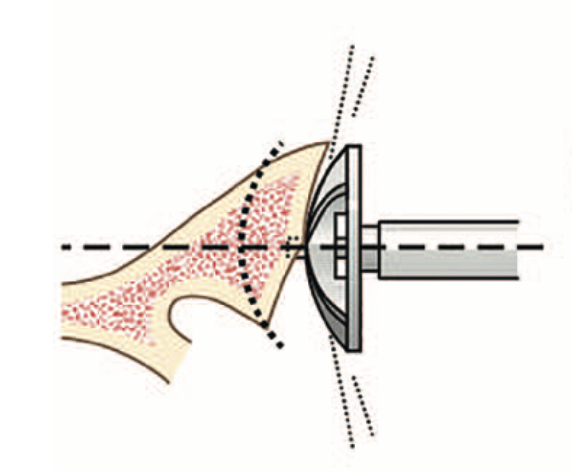
There is a current trend to spend substantial time and money in measuring and attempting to "correct" glenoid retroversion when performing anatomic shoulder arthroplasty. Preoperative CT scans and proprietary three dimensional planning software are often recommended to assess the amount of retroversion. Patient specific instrumentation, eccentric glenoid reaming, augmented glenoid components, bone grafting and reverse total shoulder arthroplasty are frequently used when preoperative glenoid retroversion exceeds an arbitrarily defined value of 15 degrees. All of this increases the cost of shoulder arthroplasty while the value of these innovations to the patient has yet to be demonstrated.
Following Total Shoulder Arthroplasty with Minimal, Non-Corrective Reaming
an experienced arthroplasty surgeon reports 90% followup, 4.6 year outcomes (range, 2-12 years) for 151 anatomic total shoulders (aTSA) performed with minimal, non-corrective glenoid reaming.
Minimal non-corrective reaming was defined as reaming until there was concentricity of the reamer and the native glenoid and thus a stable concentric fit of the glenoid implant on the bone.
A pegged, all-polyethylene glenoid component was used in all cases.
The mean preoperative retroversion was 15.6 degrees (range, 0.2-42.1). All outcome scores improved significantly from pre- to postoperatively. Median satisfaction was 10/10. Linear regression analysis found no negative association between retroversion and any postoperative outcome measure.
A total of 5 (3.3%) failures occurred due to glenoid implant loosening (3 patients) and Cutibacterium acnes infection (2 patients) with no association between failure causation and increased retroversion.
No correlation could be found between the Walch classification and postoperative outcome measures.
The authors concluded that anatomic total shoulder replacement with minimal and non-corrective glenoid reaming demonstrated reliable increases in patient satisfaction and clinical outcomes at a mean 4.6 years follow-up in patients with up to 40 degrees of preoperative retroversion. Higher values of retroversion were not associated with early deterioration of clinical outcomes, revisions, or failures.
Comment: This study does not support the routine use of preoperative CT scans, proprietary three dimensional planning software, patient specific instrumentation, eccentric glenoid reaming, augmented glenoid components, bone grafting or reverse total shoulder arthroplasty in retroverted glenoids. It seems that substantial time and money might be saved by reserving these more complex approaches for cases with unusual pathology.
While the a study above did not measure the postoperative glenoid version, the conclusions are the same as a recent study that did measure both pre and postoperative glenoid version: Does Postoperative Glenoid Retroversion Affect the 2-Year Clinical and Radiographic Outcomes for Total Shoulder Arthroplasty?
These authors studied a population of patients undergoing anatomic total shoulder arthroplasty (TSA) stratified into two groups: those with the glenoid implanted in ≥ 15 degrees of retroversion and those with the glenoid implanted in <15 degrees of retroversion. The technique used is shown in this link.
The mean improvement in the SST (6.7) for the retroverted group was comparable to that for the nonretroverted group (5.8). The percent of maximal possible improvement (%MPI) for the retroverted glenoids (70%) was comparable to that for the nonretroverted glenoids (67%). The 2-year SST scores for the retroverted (9.3) and the nonretroverted glenoid groups (9.4) were similar
The radiographic results for the retroverted glenoid group were similar to those for the nonretroverted group with respect to
No patient in either group had subluxation or dislocation after surgery.
The results for type B glenoids were comparable for the retroverted and non retroverted components.

Another recent paper evaluated the ability of shoulder arthroplasty using a standard glenoid component without corrective glenoid reaming to improve patient self-assessed comfort and function and to correct preoperative humeral-head decentering on the face of the glenoid in patients with primary glenohumeral arthritis and type-B2 or B3 glenoids: Anatomic Total Shoulder Arthroplasty with All-Polyethylene Glenoid Component for Primary Osteoarthritis with Glenoid Deficiencies
These authors identified 66 shoulders with type-B2 glenoids (n = 40) or type-B3 glenoids (n = 26) undergoing total shoulder arthroplasties with a non-augmented glenoid component inserted without attempting to normalize glenoid version and with clinical and radiographic follow-up that was a minimum of 2 years. The Simple Shoulder Test (SST), the percentage of humeral-head decentering on the glenoid face, and bone ingrowth into the central peg were the main outcome variables of interest. Similar analyses were made for concurrent patients with type-A1, A2, B1, and D glenoid pathoanatomy to determine if the outcomes for type-B2 and B3 glenoids were inferior to those for the other types.

The SST score (and standard deviation) improved from 3.2 ± 2.1 points preoperatively to 9.9 ± 2.4 points postoperatively (p < 0.001) at a mean time of 2.8 ± 1.2 years for type-B2 glenoids and from 3.0 ± 2.5 points preoper- atively to 9.4 ± 2.1 points postoperatively (p < 0.001) at a mean time of 2.9 ± 1.5 years for type-B3 glenoids; these results were not inferior to those for shoulders with other glenoid types.
Postoperative glenoid version was not significantly different (p > 0.05) from preoperative glenoid version.

The mean humeral-head decentering on the glenoid face was reduced
for type-B2 glenoids from 214% ± 7% preoperatively to 21% ± 2% postoperatively (p < 0.001)
and for type-B3 glenoids from 24% ± 6% preoperatively to 21% ± 3% postoperatively (p = 0.027).
The rates of bone integration into the central peg for type-B2 glenoids (83%) and type-B3 glenoids (81%) were not inferior to those for other glenoid types.
While anterior penetration of the central peg did occur, it did not ,interfere with osseous integration or the clinical outcome.

The authors concluded that total shoulder arthroplasty with a standard glenoid inserted without changing version can significantly improve patient comfort and function and consistently center the humeral head on the glenoid face in shoulders with type-B2 and B3 glenoids, achieving >80% osseous integration into the central peg. These clinical and radiographic outcomes for type- B2 and B3 glenoids were not inferior to those outcomes for other glenoid types.
Below is an example of a severely retroverted B2 glenoid in a young active patient managed with a ream and run procedure without attempting to change glenoid version. On the left is the preoperative axillary and the right the axillary at three months after surgery when the patient had 150 degrees of comfortable shoulder elevation. Note the lack of change of glenoid version and the use of an anteriorly eccentric humeral head component.
A second example is a man in his mid 70's presented with a stiff painful shoulder. These x-rays were obtained a the time of office evaluation, showing osteoarthritis
and a B2 glenoid.
He elected a total shoulder arthroplasty with a standard glenoid component and impaction grafting of the humeral component. The arthroplasty was carried out without a specific attempt to change glenoid version.
He returned for routine followup at 2.5 years after surgery with full shoulder function and the x-rays below
His AP view shows bony integration into the central peg and no evidence of lucent lines around his glenoid component.
His axillary view showed centering of an anteriorly eccentric humeral component on a secure glenoid component placed in retroversion with some penetration of the cortex of the glenoid neck.
He allowed us to take a short movie of his shoulder function two and one half years after surgery.
Another example is this active man who presented with a painful, stiff left shoulder. His plain films are shown below.
His axillary "truth" view, shows a retroverted type B2 glenoid
This was treated using a total shoulder arthroplasty with the glenoid component inserted without changing the retroversion.
His x-rays at two years after surgery show bone ingrowth into the central peg of the component with no evidence of loosening.
He kindly gave us permission to show a video of his function at two years after surgery.
Two other recent publications support the concept that conventional anatomic total shoulder arthroplasty (TSA) without augmented glenoid components can yield outcomes for type B2, type C and retroverted glenoids that are equivalent to those for type A1 glenoids.
(1) Outcomes of anatomic shoulder arthroplasty performed on B2 vs. A1 type glenoids
These authors compared outcomes of TSA performed on A1 glenoids (n=178) and B2 glenoids (n-111) treated with asymmetric glenoid reaming at a minimum of 2-years (mean 40 months).
More men presented with a B2 glenoid (80 of 111; 72%) compared with A1 (101 of 178; 57%).
Both groups had similar Constant Strength scores preoperatively but the B2 group improved significantly more at final follow-up.
The Total Constant score was also significantly better at follow-up in the B2 glenoid group.
All other Constant subscales, American Shoulder and Elbow Surgeons Standardized Shoulder Assessment Form (ASES), and Single Assessment Numerical Evaluation (SANE) measures showed no significant differences between the A1 and B2 glenoid groups.
A similar proportion of patients rated their satisfaction as either very satisfied or satisfied between the A1 and B2 (glenoid types.
Lazarus scores were also similar between the A1 and B2 groups as were the rates of humeral radiolucent lines and humeral osteolysis.
Postoperative complications occurred in 8 shoulders (7%) in the B2 group and 8 shoulders in the A1 group (5%). The revision rates were also similar between the B2 (6 patients; 5%) and A1 (6 patients; 3%) groups.
(2) Early to midterm outcomes of anatomic shoulder arthroplasty performed on dysplastic (type C)
glenoids
These authors hypothesized that TSA performed for Walch type C dysplastic glenoids with standard glenoid components can reliably produce successful results at short to midterm follow-up. They identified 29 patients that met inclusion criteria of a preoperative Walch type C dysplastic glenoid, treatment with TSA using standard (non-augmented) glenoid components and a minimum of 2-years clinical. These patients were matched to a cohort of 58 patients with a type A1 glenoid and minimum of 2-years clinical follow-up. The mean follow-up for this study was 4.5 years.
Baseline measures were not significantly different between the Walch type C dysplastic group and the matched type A1 cohort.
The Walch type C group had no significant differences in ASES score, ASES pain, or SANE score compared to the matched type A1 cohort.
The complication rate of patients with a type C glenoid was 14% (4 of 29) with a 7% (2 of 29) revision rate. Similarly, the complication rate for the A1 matched cohort was 17% (10 of 58) with a 12% (7 of 58) revision rate.
Both groups had high patient satisfaction without statistical differences.
There were no differences in the rate of radiographic lucencies or Lazarus scores.
You can support cutting edge shoulder research that is leading to better care for patients with shoulder problems, click on this link.
Here are some videos that are of shoulder interest
Shoulder arthritis - what you need to know (see this link). How to x-ray the shoulder (see this link). The ream and run procedure (see this link). The total shoulder arthroplasty (see this link). The cuff tear arthropathy arthroplasty (see this link). The reverse total shoulder arthroplasty (see this link). The smooth and move procedure for irreparable rotator cuff tears (see this link). Shoulder rehabilitation exercises (see this link).