Showing posts with label superior capsular reconstruction. Show all posts

Sunday, July 24, 2022

Superior capsular reconstruction - osteolysis, cost, retears and bias in systematic reviews

Superior capsular reconstruction - some recent articles.


Acromial and humeral head osteolysis following superior capsular reconstruction using autologous tensor fascia lata graft

These authors reported the occurrence of acromial and humeral head osteolysis after superior capsular reconstruction (SCR) using autologous tensor fascia lata graft. In 57 patients with a minimum followup of 2 years, 35.1% (20 of 57 cases) demonstrated osteolysis: acromial osteolysis in 7, humeral head osteolysis in 3, and acromial and humeral head osteolysis in 10). 


Compared with the group with no osteolysis, the osteolysis group were not noted to have inferior clinical outcomes or higher graft tear rates. 


Classification system of graft tears following superior capsule reconstruction

These authors evaluated graft integrity after superior capsular reconstruction in 42 patients at a mean of 14 ± 7 months. MRIs demonstrated graft failure in 26 (62%) of the shoulders. Of the 26 graft tears, 14 (54%) were from the glenoid, 5 (19%) mid-substance, 6 (23%) from the tuberosity, and 1 (3.8%) had complete graft absence.

graft intact (upper left), graft tear from glenoid (upper right), mid substance tear (lower left), graft tear from tuberosity (lower right).

Cost comparison and complication profiles of superior capsular reconstruction, lower trapezius transfer, and reverse shoulder arthroplasty for irreparable rotator cuff tears

These authors assessed the cost, complications, and readmission rates of three common surgical treatment options for IRCTs: superior capsular reconstruction (SCR), arthroscopically assisted lower trapezius tendon transfer (LTTT), and reverse shoulder arthroplasty (RSA). The cost analysis included a period of 60 days preoperatively, the index surgical hospitalization, and 90 days postoperatively, including costs of any readmission or reoperation.

With the numbers available, differences among the 3 surgical procedures with respect to complication (P = .223), reoperation (P = .999), and readmission rates (P = .568) did not reach statistical significance. The mean standardized costs for the treatment of 3 common IRCT procedures inclusive of 60-day workup and 90-day postoperative recovery were $16,915, $17,210, and $20,837 for LTTT, RSA (average added cost $295), and SCR (average added cost $3922), respectively. 

Evaluation of spin in systematic reviews and meta-analyses of superior capsular reconstruction


"Spin" is the reporting of data in a manner that emphasizes beneficial effects or deemphasizes negative effects despite insufficient evidence to support those conclusions.  Spin has been separated into 3 categories: misleading representation, misleading reporting, and inappropriate extrapolation.


This study’s primary objective was to identify, describe, and account for the incidence of spin in systematic reviews of superior capsular reconstruction SCR. At least 1 form of spin was observed in all 17 studies meeting the inclusion criteria.

The most common types of spin were ‘The conclusion claims the beneficial effect of the experimental treatment  despite a high risk of bias in primary studies’’ and ‘‘Conclusion claims the beneficial effect of the experimental treatment despite reporting bias’’, both of which were observed in 11 studies (11 of 17, 65%). 

A statistically significant association was observed between lower level of evidence and ‘The conclusion claims the beneficial effect of the experimental treatment despite a high risk of bias in primary studies’’.

A statistically significant association was also found between more recent year

of publication and the spin category misleading interpretation.


The authors concluded that spin is highly prevalent in abstracts of SCR systematic reviews and meta-analyses. An association was found between the

presence of spin and lower level of evidence, year of publication, and lower ratings of study quality.


To add this blog to your reading list in Google Chrome, click on the reading list icon


You can support cutting edge shoulder research that is leading to better care for patients with shoulder problems, click on this link.


Follow on twitter: https://twitter.com/shoulderarth

Follow on facebook: click on this link

Follow on facebook: https://www.facebook.com/frederick.matsen

Follow on LinkedIn: https://www.linkedin.com/in/rick-matsen-88b1a8133/

Here are some videos that are of shoulder interest
Shoulder arthritis - what you need to know (see this link).
How to x-ray the shoulder (see this link).
The ream and run procedure (see this link).
The total shoulder arthroplasty (see this link).
The cuff tear arthropathy arthroplasty (see this link).
The reverse total shoulder arthroplasty (see this link).
The smooth and move procedure for irreparable rotator cuff tears (see this link).

Shoulder rehabilitation exercises (see this link).

Saturday, October 23, 2021

Superior capsular reconstruction with autograft: the importance of the subscapularis

Clinical outcomes and temporal changes in the range of motion following superior capsular reconstruction for irreparable rotator cuff tears: comparison based on the Hamada classification, presence or absence of shoulder pseudoparalysis, and status of the subscapularis tendon

These authors report their outcomes for 54 consecutive patients with irreparable rotator cuff tears or pseudoparalysis (PPS) who underwent superior capsular reconstruction (SCR) using autologous tensor fascia lata with an average graft thickness of 8.3 mm.


The inclusion criterion for SCR was an irreparable rotator cuff tear or PPS with failed conservative treatment, supervised by physiotherapists, for >6 months. In all patients, the Hamada classification was grade 2 in 11 patients and grade 3 in 43 patients.


Included shoulders had a Goutallier grade 3 or higher fatty infiltration of the tendon with the tendon retracted to the glenoid level as evaluated on magnetic resonance imaging and torn tendons that could not reach the original footprint after the release of soft tissues at the time of surgery.


Pseudoparalysis (PPS) was defined as

(1) moderate PPS (n=16), no shoulder stiffness, active shoulder elevation (both flexion and abduction) ≤ 90 degrees , and the ability of the patient to maintain  ≥ 90 degrees  of elevation once the shoulder was passively elevated; 

(2) severe PPS (n=16), comprising no shoulder stiffness, active shoulder elevation  ≤ 90 degrees, and the inability of the patient to maintain  ≥  90 degrees of elevation once the shoulder was elevated passively; and 

(3) non-PPS (n=22), comprising no shoulder stiffness and active shoulder elevation 90 degrees. 


Lidocaine was routinely injected into the subacromial space preoperatively; patients whose ROM improved were considered to have a painful loss of elevation and were not considered as patients with PPS. 


Patients who could not elevate their shoulders even in the supine position were considered to have deltoid insufficiency and were excluded from this study.


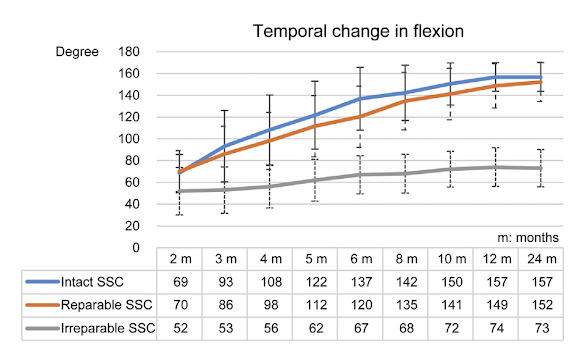
The 32 PPS patients were divided into 3 groups: intact subscapularis (SSC) (11 patients), repairable SSC (16 patients), and irreparable SSC (5 patients). 


They found no significant differences in postoperative ASES scores and shoulder range of motion between the Hamada grade 2 and grade 3 groups or between the non-PPS, moderate PPS, and severe PPS groups.  PPS patients required a longer duration to achieve shoulder elevation 130 degrees; nevertheless, the authors found no significant differences in final outcomes between the non-PPS and PPS groups. 


However, significant differences in postoperative ASES scores were observed between the intact SSC (final ASES =  91) and irreparable SSC groups (final ASES = 56) and between the repairable SSC (final ASES = 92) and irreparable SSC groups (final ASES = 56). There were significant differences in postoperative shoulder elevation (see graph below). The repairable SSC tear group tended to take longer to achieve improvement in shoulder elevation than the intact SSC group, although the final outcomes between the 2 groups did not show a significant difference. 


The patients noted to have anatomic failure of the SCR had excellent shoulder function and no or minimal pain as did patients with partial failure of the subscapularis repair.

The authors concluded that the status of the subscapularis, rather than the Hamada grade or the presence or absence of PPS, influenced the clinical outcomes in this series of SCRs.

Comment: This study demonstrates the importance of the subscapularis integrity in the functional outcomes of reconstruction for irreparable rotator cuff tears. It also demonstrates the potential for reversing pseudoparalysis using superior capsular reconstruction with autologous tensor fascia and the timeframe for recovery.

The application of superior capsular reconstruction, rather than reverse total shoulder, is interesting and requires further clinical investigation of indications, technique and outcomes.

Follow on twitter: https://twitter.com/shoulderarth

Follow on facebook: https://www.facebook.com/frederick.matsen

Follow on LinkedIn: https://www.linkedin.com/in/rick-matsen-88b1a8133/


How you can support research in shoulder surgery Click on this link.

Here are some videos that are of shoulder interest
Shoulder arthritis - what you need to know (see this link)
Shoulder arthritis - x-ray appearance (see this link)
The smooth and move for irreparable cuff tears (see this link)
The total shoulder arthroplasty (see this link).
The ream and run technique is shown in this link.
The cuff tear arthropathy arthroplasty (see this link).
The reverse total shoulder arthroplasty (see this link).

Shoulder rehabilitation exercises (see this link).

This is a non-commercial site, the purpose of which is education, consistent with "Fair Use" as defined in Title 17 of the U.S. Code.          
Note that author has no financial relationships with any orthopaedic companies.


Friday, August 20, 2021

Superior capsular reconstruction with ArthroFlex acellular dermal allograft - does graft failure matter?

Evaluating the role of graft integrity on outcomes: clinical and imaging results following superior capsular reconstruction

These authors sought to evaluate the relationship of clinical outcomes to graft integrity in patients following superior capsular reconstruction (SCR) in 34 patients with minimum 2-year follow-up. Patients underwent an arthroscopic SCR using an acellular dermal allograft (ArthroFlex; Arthrex). In addition to superior capsular reconstruction, 14% of patients underwent subscapularis repairThe biceps tendon was managed by tenodesis in 31% of shoulders and tenotomy in 29% of shoulders, and it was preserved in 31% of shoulders. In the remaining 9% of shoulders, tenodesis had been performed during a prior operation.


Four patients (12%) underwent subsequent surgery (3 reverse total shoulders and 1 latissimus transfer) and were excluded from further analysis. 


The mean percent Simple Shoulder Test (SST) improved 22 to 79, the ASES score from 28 to 80, the SANE from 51 to 74 and the VAS from 6.6 to 1.5. 


21 shoulders had follow up MRIs which revealed graft failure in 62% (13 of 21). 6 grafts failed at the humeral side, 4 failed at the glenoid side, and 3 were midsubstance graft failures. 


The graft failure rate in this study is consistent with that found in other reports: 50% (link) and 55% (link)


Radiographic evidence of graft failure did not have a statistically significant effect on SST, ASES, SANE, or VAS scores.


The authors concluded that graft healing after SCR might not be an independent predictor of success and that clinical improvement in patients undergoing SCR may be due to other aspects of the procedure, including partial rotator cuff repair, debridement, and biceps management. They state, "Given the expense of additional anchors and allograft material, further work will need to be done to better understand the mechanism in which clinical improvements are seen in patients undergoing this complex procedure."


Comment: Another recent article (see this link) reports failure of this graft in spite of active recellularization, revascularization, and remodeling


Good shoulder function in cases of graft failure has been reported previously (see this link and this link)


As pointed out in a recent post (see link), the indications for superior capsular reconstruction in the management of massive cuff tears have yet to be defined. Further clinical research is needed to demonstrate an incremental value for SCR beyond that achieved with lesser procedures, such as partial rotator cuff repair, debridement, and biceps management (see link).


Follow on twitter: https://twitter.com/shoulderarth

Follow on facebook: https://www.facebook.com/frederick.matsen

Follow on LinkedIn: https://www.linkedin.com/in/rick-matsen-88b1a8133/


How you can support research in shoulder surgery Click on this link.


Here are some videos that are of shoulder interest
Shoulder arthritis - what you need to know (see this link)
The smooth and move for irreparable cuff tears (see this link)
The total shoulder arthroplasty (see this link).
The ream and run technique is shown in this link.
The cuff tear arthropathy arthroplasty (see this link).
The reverse total shoulder arthroplasty (see this link).
Shoulder rehabilitation exercises (see this link).


Wednesday, June 9, 2021

Superior capsular reconstruction for massive rotator cuff tears - what do the reviews say?

While there is enthusiasm for the use of superior capsular reconstruction in the treatment of massive, irreparable cuff tears (see link, link, link, link) other reports have shown a bit more modest outcomes  (see link, link, link, link, link, linklink,). 

Thus, it is timely to consider three recent reviews of this procedure.

First: Superior Capsular Reconstruction Indications, Techniques, and Clinical Outcomes

"Despite its rapid growth in popularity and several biomechanical studies evaluating the technique, clinical outcome literature for superior capsular reconstruction remains limited to date."

Second: Superior Capsular Reconstruction for Massive Rotator Cuff Tears A Critical Analysis Review

"Arthroscopic superior capsular reconstruction with fascia lata autograft or humeral dermal allograft is a surgical option, with multiple studies showing statistically significant improvement in short-term outcomes for both pain and function among younger patients with massive irreparable rotator cuff tears. The long-term clinical effectiveness and value have yet to be determined."


"No comprehensive quality-of-life or cost-comparison analyses are available to compare superior capsular reconstruction, reverse total shoulder arthroplasty (rTSA), tendon transfer, and partial rotator cuff repair for the treatment of massive irreparable rotator cuff tears. However, the potential higher cost of superior capsular reconstruction and the lack of long-term clinical outcomes or revision data suggest that either an attempt at repair or primary arthroplasty may be more cost-effective than superior capsular reconstruction."


"Long-term outcome data are essential to determine the role of superior capsular reconstruction for young patients with massive irreparable rotator cuff tears."


"Superior capsular reconstruction using fascia lata autograft may provide a different biomechanical and biological healing environment compared to acellular dermal allograft. Thus, the clinical outcome data between the 2 graft methods should not be generalized."


Third: Outcome Comparison of Graft Bridging and Superior Capsule Reconstruction for Large to Massive Rotator Cuff Tears: A Systematic Review


A systematic review was performed via a comprehensive search of PubMed, Embase, and the Cochrane Library. Studies of Graft Bridging (GB) or Superior Capsular Reconstruction). Twenty-three studies were included in this review.  Overall, both procedures demonstrated improvement of clinical outcomes. When compared with group SCR, group GB had significantly higher mean differences of the Constant-Murley score (41.9 vs 19.8), American Shoulder and Elbow Surgeons score (39.3 vs 33.8), visual analog scale score for pain (4.4 vs 3.4), and active external rotation at side (15.3 vs 9.3). 


No statistically significant difference was detected in the mean difference of active forward flexion, internal rotation, abduction, and graft healing rate between the groups. The complication rates were 0.84% (2 of 238) in group SCR and 0.67% (4 of 593) in group GB.


These authors concluded that graft bridging showed significantly better clinical and functional outcomes postoperatively than SCR, with a similar complication rate. The available fair-quality evidence suggested that GB might be a better choice for large to massive RCT. More high-quality randomized controlled studies are required to further evaluate the relative benefits of the 2 procedures.


Comment: With respect to non-arthritic massive irreparable cuff tears, we recognize that the clinical presentation varies widely from minimal symptoms, to stiffness, to painful crepitance, to pseudoparalysis. Because these tears are usually chronic, a good try at rehab directed at optimizing passive and active motion is indicated (see link). It is impressive to see patients referred for a reverse total shoulder who are improved to the point of satisfaction by this approach. For patients with retained active elevation, a smooth and move procedure (see link) can provide improved comfort and function without the prolonged down time associated with soft tissue reconstruction or arthroplasty.


As can be seen from the reviews summarized above, the indications for, surgical technique and graft choice used, and the results of superior capsular reconstruction differ widely among authors. 


We've much yet to learn about the treatment for the different symptoms associated with irreparable cuff tears.


Here are some videos that are of shoulder interest
Shoulder arthritis - what you need to know (see this link).
How to x-ray the shoulder (see this link).
The total shoulder arthroplasty (see this link).
The ream and run technique is shown in this link.
The cuff tear arthropathy arthroplasty (see this link).
The reverse total shoulder arthroplasty (see this link).
The smooth and move procedure for irreparable rotator cuff tears (see this link).
Shoulder rehabilitation exercises (see this link).
Sunday, March 28, 2021

Superior capsular reconstruction: does graft healing matter?

Graft Healing Does Not Influence Subjective Outcomes and Shoulder Kinematics After Superior Capsule Reconstruction: A Prospective In Vivo Kinematic Study

It has been proposed that superior capsule reconstruction (SCR) improves shoulder stability and function and decreases pain in patients with irreparable rotator cuff tears. 


These authors evaluated the association between graft healing and in vivo kinematics, range of motion (ROM), strength, and patient reported outcome (PROs) in ten patients (8M, 2F, age 63 ± 7 years) with irreparable rotator cuff tear having arthroscopic SCR with dermal allograft. 


Healing was evaluated at five locations as either healed or not healed: anterior and posterior glenoid, anterior and posterior humerus, and posteriorly along the infraspinatus.


Four of the ten patients had complete healing, five had partial healing of the graft while one had complete failure of healing at the glenoid. 


No correlation existed between MRI healing and acromiohumeral distance, scapulo humeral rhythm, strength, range of motion or patient reported outcomes.


The authors concluded that in vivo kinematics changes were small after SCR and not clinically significant, and that improvements in clinical and functional outcomes may occur in absence of full graft healing.


Comment: This small study suggests that the outcome of SCR does not depend on complete graft healing.


It is of interest that these patients with irreparable cuff tears had excellent function preoperatively: 150 degrees of abduction and 151 degrees of flexion. After SCR all patients underwent a standard six-month rehabilitation protocol concentrating on ROM and gentle shoulder strengthening. At one year after surgery abduction averaged 166 degrees and flexion averaged 163 degrees. One wonders if these gains could have been achieved with the 6 month rehab program without the SCR.


Patients having irreparable cuff tears with retained active elevation can be treated with a less invasive approach as shown in this link.


Here are some videos that are of shoulder interest
Shoulder arthritis - what you need to know (see this link).
How to x-ray the shoulder (see this link).
The ream and run procedure (see this link).
The total shoulder arthroplasty (see this link).
The cuff tear arthropathy arthroplasty (see this link).
The reverse total shoulder arthroplasty (see this link).
The smooth and move procedure for irreparable rotator cuff tears (see this link).
Shoulder rehabilitation exercises (see this link).


Sunday, March 21, 2021

Massive, irreparable rotator cuff tears

PROSPECTIVE, RANDOMIZED EVALUATION of LATISSIMUS DORSI TRANSFER and SUPERIOR CAPSULAR RECONSTRUCTION in MASSIVE, IRREPARABLE ROTATOR CUFF TEARS

These authors reviewed forty-two patients at an average age of 62.8 years with massive, irreparable rotator cuff tears that were randomized in two treatment groups. 21 patients underwent arthroscopic assisted latissimus dorsi tendon transfer (LDT) and 21 patients underwent arthroscopic assisted superior capsular reconstruction (SCR). 


At an average of  31 months after surgery both groups displayed improved results in ASES, WORC, Constant and VAS scores.  The SCR group yielded significantly higher improvements in clinical scores.


For the LDT group flexion improved from 95 to 140 degrees

For the SCR group flexion improved from 101 to 162 degrees


For comparison, a series of patients with irreparable rotator cuff tears treated with a much simpler "smooth and move" procedure(see this link) showed improvement in active flexion from 102 to 126 degrees. The technique of the smooth and move procedure for irreparable rotator cuff tears is shown in  this link.


Comment: The treatment of massive irreparable cuff tears needs to be individualized for each patient. While major procedures, such reverse total shoulder, latissimus dorsi tendon transfer, and superior capsular reconstruction can be effective, patients with retained active elevation can be effectively managed by a lesser and safer procedure, the smooth and move, without the down time associated with major reconstructions.


Subscribe to this blog by entering your email in the "subscribe" box to the right.

Here are some videos that are of shoulder interest
Shoulder arthritis - what you need to know (see this link).
How to x-ray the shoulder (see this link).
The ream and run procedure (see this link).
The total shoulder arthroplasty (see this link).
The cuff tear arthropathy arthroplasty (see this link).
The reverse total shoulder arthroplasty (see this link).
The smooth and move procedure for irreparable rotator cuff tears (see this link).
Shoulder rehabilitation exercises (see this link).


Saturday, February 13, 2021

Superior capsular reconstruction - 62% graft failure.

Evaluating the Role of Graft Integrity on Outcomes: Clinical and Imaging Results Following Superior Capsular Reconstruction


These authors evaluated clinical outcomes and graft integrity in patients following superior capsular reconstruction (SCR) in thirty-four consecutive patients.


All patients had a preoperative diagnosis of massive irreparable rotator cuff tear with retraction to the level of the glenoid. Additionally, a preoperative diagnosis of pseudoparesis was present in 23% of shoulders (n=8 of 35 shoulders).


Patients underwent an arthroscopic débridement, decompression, and partial rotator cuff repair with arthroscopic SCR utilizing an acellular dermal allograft.


The mean preoperative scores were SST 21.6 ± 17.6, ASES 28.3 ± 10.1, SANE 50.6 ± 22.1, and VAS 6.6 ± 1.7. 


The mean postoperative outcomes were SST 79.1 ± 19.6, ASES 79.9 ± 17.4, SANE 74.3 ± 18.7, and VAS 1.5 ± 2.2. 


There was statistically significant improvement in SST, ASES, and VAS following SCR.


Torn grafts were defined as having discontinuity from the glenoid to the greater tuberosity on 2 consecutive T2-weighted MRI images in the coronal plane. MRI imaging revealed graft failure in 62% (n=13 of 21) of shoulders. Of the shoulders with graft failure, six grafts failed at the humeral side, four failed at the glenoid side, and three were mid-substance graft failures.


Radiographic evidence of graft healing did not have a statistically significant effect on SST, ASES, SANE, or VAS scores.


The authors concluded that given the high rate of graft failure without a significant difference in clinical outcomes, graft healing after SCR might not be an independent predictor of success. The improved clinical improvement in patients undergoing SCR may be due to other known beneficial aspects of the procedure, including partial rotator cuff repair, débridement, and biceps management.


Comment: This small study may be insufficiently powered to detect the differences in outcome between patients with intact and those with failed SCRs.


Nevertheless, it is worth considering the authors' question: "is the benefit of SCR more related to cuff integrity or to the non-SCR elements of the SCR surgery?".


An alternative approach to the surgical management of irreparable rotator cuff tears in patient with retained active elevation is shown in this link.


Here are some videos that are of shoulder interest
Shoulder arthritis - what you need to know (see this link).
How to x-ray the shoulder (see this link).
The ream and run procedure (see this link).
The total shoulder arthroplasty (see this link).
The cuff tear arthropathy arthroplasty (see this link).
The reverse total shoulder arthroplasty (see this link).
The smooth and move procedure for irreparable rotator cuff tears (see this link).
Shoulder rehabilitation exercises (see this link).

Wednesday, September 9, 2020

Superior capsular reconstruction - what is the failure rate?

Superior capsular reconstruction using a porcine dermal xenograft for irreparable rotator cuff tears: outcomes at minimum two-year follow up.

These authors sought to review their results with arthroscopic superior capsular reconstruction (SCR) using a decellularized porcine dermal xenograft in 56 patients with massive, irreparable rotator cuff tears. While the preoperative and postoperative ranges of motion were measured, these data were not reported. 


Preoperative ASES, subjective shoulder values, and VAS scores were improved at two years ofter surgery. Eleven patients were pseudoparalytic prior to surgery; in five cases pseudoparalysis was reversed after SCR.


The anatomic failure rate in this study is unknown. The authors recognized 14 graft failures (25%) by MRI at a mean follow-up of 34 months; however, followup MRIs were only obtained on symptomatic patients with low scores in patient reported outcomes measures. 


The relationship between anatomic failure and clinical failure was not investigated.


To subscribe to this blog, enter your email in the box to your right that looks like the below


===
How you can support research in shoulder surgery Click on this link.

We have a new set of shoulder youtubes about the shoulder, check them out at this link.

Be sure to visit "Ream and Run - the state of the art" regarding this radically conservative approach to shoulder arthritis at this link and this link

Use the "Search" box to the right to find other topics of interest to you.

You may be interested in some of our most visited web pages  arthritis, total shoulder, ream and runreverse total shoulderCTA arthroplasty, and rotator cuff surgery as well as the 'ream and run essentials'


Wednesday, July 8, 2020

Superior capsular reconstruction - where are we?

Arthroscopic superior capsule reconstruction with Teflon felt synthetic 1 graft for irreparable massive rotator cuff tears: Clinical and radiographic results at minimum 2-year follow-up

These authors, including the originator of the SCR, reviewed their two year minimum outcomes in 35 shoulders having arthroscopic superior capsule reconstruction with Teflon felt synthetic 1 graft for irreparable massive rotator cuff tears:

They reported that SCR using Teflon grafts of either one or three layers significantly improved 

the ASES score by 21, for one-layer graft; and by 31 for three-layer graft.

the VAS score for motion pain by 3.2,  and by 3.0.

and muscle strength in shoulder abduction by 11.9 N,  and by 10.9 N,

Active elevation at final  follow-up was significantly greater in the three-layer-graft group (142° ± 27°) than in the one-layer-graft group (107° ± 42°) (P = 0.006). 

One year after SCR, the acromiohumeral distance in the three-layer-graft group was significantly greater than preoperatively, whereas in the one-layer-graft group it was not. The acromiohumeral distance diminished with time.

On postoperative MRI, none of the patients in the three-layer-graft group had graft tears, while two patients had graft tear and one patient had severe synovitis after one-layer-graft SCR.

Comment: It is of interest that up to now the materials used for SCR have included biological autogenous fascia lata, biological acellular dermal matrix (GraftJacket, ArthroFlex ® SCR), and now the non-biological Teflon graft.

The study compared the results two non-randomized sets of patients operated on during different time intervals: in the first 15 cases (group 1), the synthetic graft was made from one layer (2.9 mm thick) of Teflon felt. The remaining 20 cases (group 2) were treated by SCR by using three layers (8.7 mm thick) of Teflon felt. It is otherwise unclear how patients wound up in each group, thus their comparability is uncertain.

Another issue is that the preoperative active elevation (flexion) for the shoulders treated ranged from 20 to 160 degrees. This is a huge variation. Shoulders with retained active elevation can be well managed with simpler, safer, and less expensive procedures than a SCR (see this link).  

In order to understand the value (effectiveness divided by the cost) of the growing number of different approaches to the irreparable cuff we will need higher quality studies that accurately characterize the preoperative to postoperative change for each patient, stratified by their preoperative shoulder function and pathology. 

=====
To see our new series of youtube videos on important shoulder surgeries and how they are done, click here.

Use the "Search" box to the right to find other topics of interest to you.


You may be interested in some of our most visited web pages  arthritis, total shoulder, ream and runreverse total shoulderCTA arthroplasty, and rotator cuff surgery as well as the 'ream and run essentials'