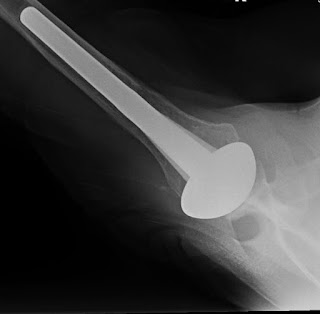
Showing posts with label weight training. Show all posts

Sunday, March 3, 2024

Shoulder arthritis in a young weightlifter and firefighter


A 40 year old weightlifter, firefighter and high school football coach from Florida presented with painful glenohumeral arthritis after a prior arthroscopic instability repair. His Simple Shoulder Test responses are shown below.


Physical examination revealed a stiff shoulder.

His preoperative images are shown below


Wishing to avoid the risks and limitations associated with the polyethylene glenoid component used in conventional total shoulder arthroplasty, he proceeded with a ream and run procedure 10 months ago.

His postoperative radiographs are shown below


With a fully dedicated rehab effort he was able to complete a half-marathon in under six and half hours seven months after surgery. 

At ten months after surgery he had returned to work as a firefighter and sent this report and videos


Comment: This is obviously no ordinary patient, no ordinary shoulder arthritis and no ordinary rehab effort. We be informed by the progressive recovery and long term followup.

You can support cutting edge shoulder research and education that are leading to better care for patients with shoulder problems, click on this link.

Follow on twitter: https://twitter.com/RickMatsen or https://twitter.com/shoulderarth
Follow on facebook: click on this link
Follow on facebook: https://www.facebook.com/frederick.matsen
Follow on LinkedIn: https://www.linkedin.com/in/rick-matsen-88b1a8133/

Here are some videos that are of shoulder interest
Shoulder arthritis - what you need to know (see this link).
How to x-ray the shoulder (see this link).
The ream and run procedure (see this link).
The total shoulder arthroplasty (see this link).
The cuff tear arthropathy arthroplasty (see this link).
The reverse total shoulder arthroplasty (see this link).
The smooth and move procedure for irreparable rotator cuff tears (see this link).
Shoulder rehabilitation exercises (see this link).


Thursday, December 21, 2023

Shoulder arthritis in a 38 year old body builder


A 38 year old weight lifter had activity-limiting pain and stiffness in the right shoulder and these X-rays.


Wishing to avoid the risks and limitations of a plastic glenoid component, he elected to proceed with a ream and run procedure (see this link), which was performed without preoperative CT scans, brachial plexus block, or cement. The patient left the hospital the day after his surgery with an excellent range of assisted flexion.


At three months after his procedure he was hard at work at the rehabilitation program (see this link).


Ten months after his surgery, he sent this email and the video below, which he kindly consented for us to share here.

"We hit the 10 month post op mark today, and I wanted to provide an update before the end of the year. Over the past 4-6 weeks things just started to improve significantly. Strength is returning, mobility has been smooth and continues to be no issues anymore. Here is a clip of me pressing 50 pound dumbbells just this week. Only a little discomfort during and into the evening, but no prolonged pains the next morning. Everything is recovering much faster now following each workout."


You can support cutting edge shoulder research and education that are leading to better care for patients with shoulder problems, click on this link.

Follow on twitter: https://twitter.com/RickMatsen or https://twitter.com/shoulderarth
Follow on facebook: click on this link
Follow on facebook: https://www.facebook.com/frederick.matsen
Follow on LinkedIn: https://www.linkedin.com/in/rick-matsen-88b1a8133/

Here are some videos that are of shoulder interest
Shoulder arthritis - what you need to know (see this link).
How to x-ray the shoulder (see this link).
The ream and run procedure (see this link).
The total shoulder arthroplasty (see this link).
The cuff tear arthropathy arthroplasty (see this link).
The reverse total shoulder arthroplasty (see this link).
The smooth and move procedure for irreparable rotator cuff tears (see this link).
Shoulder rehabilitation exercises (see this link).


Thursday, September 1, 2022

Ream and run - return to the gym - 7 year followup

A 60 year old weight lifter presented with pain and stiffness in his right shoulder. He desired a ream and run procedure to avoid the limitations and risks of the prosthetic glenoid component used in total shoulder arthroplasty. His preoperative x-rays show osteoarthritis with posterior humeral head decentering on a biconcave glenoid


CT scans and preoperative planning were not needed. A general anesthetic was used without a brachial plexus block. At surgery some excessive intraoperative posterior translation was manged with a rotator interval plication.  See How to do a ream and run arthroplasty.

Seven years after his ream and run he reported, 


“I have long since resumed a normal life, essentially forgetting I ever had a problem.


The years leading up to surgery, when I could no longer ride a bike, kayak, rock climb, lift weights or even play the piano because I couldn’t raise my right arm high enough, seem now like just a bad dream.  Before discovering the R&R option, I had consulted two other orthopedic surgeons and had not been encouraged by what they had to say.  Consequently, I let my shoulder problem (osteoarthritis) progress until it was no longer tolerable.  At the end, I was in constant pain, occasionally severe, and a right arm that was virtually useless.


After several months of regular stretching exercises, dedicated work, not without pain, I began to realize the results of the R&R procedure.  A year after surgery, I returned to the gym for the first time in twenty-five years.  It was a new lease on life.  Now, I exercise pretty vigorously three to five times a week, working all muscle groups, with a goal of restoring strength, flexibility and symmetry.  Climbing, biking and kayaking are no problem.  I can’t seem to perform as well in the gym as I did forty years ago, but I’ve been told the problem may be related to being 68 years old, rather than 28.”  


His x-rays at seven years after the ream and run show a secure impaction grafted stem with a regenerated radiographic space between his humeral head and the glenoid


He was able to perform all 12 functions of the Simple Shoulder Test and do pull-ups.


You can support cutting edge shoulder research that is leading to better care for patients with shoulder problems, click on this link.


Follow on twitter: https://twitter.com/shoulderarth

Follow on facebook: click on this link

Follow on facebook: https://www.facebook.com/frederick.matsen

Follow on LinkedIn: https://www.linkedin.com/in/rick-matsen-88b1a8133/

Here are some videos that are of shoulder interest
Shoulder arthritis - what you need to know (see this link).
How to x-ray the shoulder (see this link).
The ream and run procedure (see this link).
The total shoulder arthroplasty (see this link).
The cuff tear arthropathy arthroplasty (see this link).
The reverse total shoulder arthroplasty (see this link).
The smooth and move procedure for irreparable rotator cuff tears (see this link).
Shoulder rehabilitation exercises (see this link).

Monday, August 15, 2022

Bilateral ream and runs in a weight lifter - one year after second side.

This email came in recently from a patient in Ohio, one year after his second sided ream and run.


"I am now 14 month post-op.  I took these videos at a little more than 12 months post-op.  The only setback that I had was not shoulder related but heart related.  6 months after my second surgery  I had a M.I. caused by my "widow maker" being a 100% blocked.  
As for the shoulder, on a rare occasion during some of my exercise I may feel some pain, but nothing that affects my lifting or causes me to stop.  I have to say 90% of the time, I am completely pain free during and after I lift.  If I do feel any pain, it is more of annoyance than anything else."

Here are some screen shots from the videos he sent.


This man is very strongly motivated and desired to have his shoulder arthritis managed in a manner that avoided the risks and limitations associated with a polyethylene glenoid socket replacement.

You can support cutting edge shoulder research that is leading to better care for patients with shoulder problems, click on this link.


Follow on twitter: https://twitter.com/shoulderarth

Follow on facebook: click on this link

Follow on facebook: https://www.facebook.com/frederick.matsen

Follow on LinkedIn: https://www.linkedin.com/in/rick-matsen-88b1a8133/

Here are some videos that are of shoulder interest
Shoulder arthritis - what you need to know (see this link).
How to x-ray the shoulder (see this link).
The ream and run procedure (see this link).
The total shoulder arthroplasty (see this link).
The cuff tear arthropathy arthroplasty (see this link).
The reverse total shoulder arthroplasty (see this link).
The smooth and move procedure for irreparable rotator cuff tears (see this link).
Shoulder rehabilitation exercises (see this link).


Saturday, March 12, 2022

Arthritis surgery for a 70 year old weight lifter/powerlifter - a ten year followup.

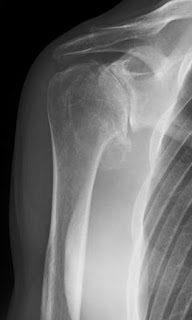
A 70 year old weight lifter presented with pain and stiffness of his right shoulder and these x-rays. He started lifting in 1969. He stated that his arthritis resulted "because of lifting too-heavy-too-long, including a period of Powerlifting competition"


Because he wanted to continue high level workouts in the gym, he elected a ream and run glenohumeral arthroplasty with a standard length humeral stem fixed with impaction grafting. The ream and run technique is shown in this link.


Ten year after surgery he obtained these radiographs, showing a stable arthroplasty.


He has been able to return to his weight workouts in the gym.


He forwarded a workout video celebrating his 80th birthday. This video shows the function of the right shoulder a decade after his ream and run (see this link).

You can support cutting edge shoulder research that is leading to better care for patients with shoulder problems, click on this link.


Follow on twitter: https://twitter.com/shoulderarth

Follow on facebook: click on this link

Follow on facebook: https://www.facebook.com/frederick.matsen

Follow on LinkedIn: https://www.linkedin.com/in/rick-matsen-88b1a8133/


Here are some videos that are of shoulder interest
Shoulder arthritis - what you need to know (see this link).
How to x-ray the shoulder (see this link).
The ream and run procedure (see this link).
The total shoulder arthroplasty (see this link).
The cuff tear arthropathy arthroplasty (see this link).
The reverse total shoulder arthroplasty (see this link).
The smooth and move procedure for irreparable rotator cuff tears (see this link).
Shoulder rehabilitation exercises (see this link).


Friday, August 13, 2021

The inlay glenoid arthroplasty in weight lifters.

Clinical and Radiographic Outcomes of Total Shoulder Arthroplasty With a Nonspherical Humeral Head and Inlay Glenoid in Elite Weight Lifters A Prospective Case Series

These authors point out that weight lifting after total shoulder arthroplasty (TSA) can place significant stresses on prosthetic glenoid implants potentially leading to instability, loosening, and wear. 


They sought to evaluate the clinical and radiographic outcomes of a TSA system with nonspherical humeral head resurfacing and an inlay glenoid in 16 weight lifters (mean ± SD age, 57.2 ± 7.8 years; 15 male) undergoing primary anatomic TSA (n . 17 shoulders, 1 staged bilateral)  for glenohumeral

osteoarthritis.  Exclusion criteria were rotator cuff deficiency, revision TSA, posttraumatic

arthritis, and inflammatory arthritis. 


Follow-up was obtained on all patients at a mean of 38 months (range, 14-63 months). All patients returned to weight lifting at 15.6 ± 6.9 weeks. Compared to the preoperative weight lifting level, at last follow-up patients reported performance at the following level: lighter weight, 1 (6%); same weight, 8 (50%); heavier weight, 7 (44%). The quantitative values for these levels are not provided.


Preoperative eccentric posterior glenoid wear was common (71% Walch B2 classification; 12/17).


Posterior humeral subluxation improved at follow-up according to the Walch index (mean, 55.5% preoperative vs 48.5% postoperative), and contact point ratio (mean, 63.9% preoperative vs 50.1% postoperative). 


Significant pre- to postoperative improvements were seen shoulder outcome scores.


No signs of radiographic loosening were detected in follow-upimages, nor were there any postoperative instability episodes or revision surgeries.


Comment: This article does not report the amount (pounds) of weight being lifted by these patients before and after surgery, so that the loads involved cannot be quantitated.


The authors propose that the inlay glenoid component provides a more stable glenoid arthroplasty than the onlay glenoid commonly used in total shoulder arthroplasty. 


The inlay glenoid does not completely cover the glenoid articular surface as seen in this illustration from the technique guide


and this intraoperative photo


and this post operative film.


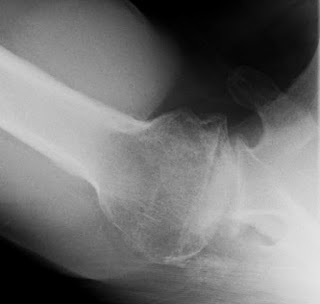
The small surface area of the glenoid component may be an issue. In the figure below from this article, the humeral head is not articulating at all with the prosthetic glenoid component that lies between the two red arrows.


The value of the inset glenoid component is yet to be demonstrated in comparison to the ream and run glenohumeral arthroplasty in which no glenoid component is used (how to do this procedure is seen in this link). See also

Ream and run for shoulder arthritis in a weight lifter


How you can support research in shoulder surgery Click on this link.

Here are some videos that are of shoulder interest
Shoulder arthritis - what you need to know (see this link).
How to x-ray the shoulder (see this link).
The total shoulder arthroplasty (see this link).
The ream and run technique is shown in this link.
The cuff tear arthropathy arthroplasty (see this link).
The reverse total shoulder arthroplasty (see this link).
Shoulder rehabilitation exercises (see this link).
Follow on twitter: Frederick Matsen (@shoulderarth)


Thursday, June 17, 2021

Ream and run for shoulder arthritis in a weight lifter

 A muscular, avid weight lifter developed arthritis in his left shoulder.


After his ream and run procedure, he was actively lifting in the gym.


Three years after his procedure, his radiographs showed excellent healing and stability


Recently he presented with a painful right shoulder with only 90 degrees of active and passive elevation and these radiographs. 


A ream and run procedure was performed.

No preoperative CT or brachial plexus block were used for either procedure.

On the evening of his right shoulder surgery, he was comfortable without narcotic medication and demonstrated his range of motion as shown in the video below.


Comment: Patient selection is one of the most important keys to getting a good result from a ream and run procedure

Here are some videos that are of shoulder interest
Shoulder arthritis - what you need to know (see this link).
How to x-ray the shoulder (see this link).
The total shoulder arthroplasty (see this link).
The ream and run technique is shown in this link.
The cuff tear arthropathy arthroplasty (see this link).
The reverse total shoulder arthroplasty (see this link).
The smooth and move procedure for irreparable rotator cuff tears (see this link).
Shoulder rehabilitation exercises (see this link).

Saturday, September 5, 2020

Canal sparing ream and run arthroplasty for a weight lifter

 A 50 year old avid weight lifter requested a ream and run arthroplasty to avoid the risks and limitations of a plastic glenoid component.

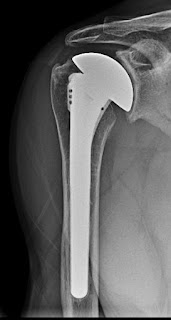
His preoperative films are shown below. They show typical osteoarthritis. Of note is the cortical hypertrophy of the humerus resulting in a small humeral canal.


At surgery, a humeral component with thin (8mm) stem was selected to spare his canal. Reaming of his endosteal cortex was avoided. The component was fixed with impaction autografting yielding a small filling ratio.

His function at 10 months after surgery is shown here


At two years after surgery, the stability of his implant and the regenerated joint spaces can be seen.


Comment: This canal sparing technique preserves the maximum amount of humeral bone stock while simultaneously providing the stability of a standard length stem.


To subscribe to this blog, enter your email in the box to your right that looks like the below


===
How you can support research in shoulder surgery Click on this link.

We have a new set of shoulder youtubes about the shoulder, check them out at this link.

Be sure to visit "Ream and Run - the state of the art" regarding this radically conservative approach to shoulder arthritis at this link and this link

Use the "Search" box to the right to find other topics of interest to you.

You may be interested in some of our most visited web pages  arthritis, total shoulder, ream and runreverse total shoulderCTA arthroplasty, and rotator cuff surgery as well as the 'ream and run essentials'