Showing posts with label instability arthropathy. Show all posts

Friday, February 17, 2023

Why do patients under the age of 50 do less well after anatomic total shoulder arthroplasty?

The reported outcomes of shoulder arthroplasty in patients under the age of fifty years are worse than those in patients over fifty. While a number of factors, such as differences in activity level, patient longevity, and differences in expectations, have been proposed as the reason for this difference, the authors of Comparison of Patients Undergoing Primary Shoulder Arthroplasty Before and After the Age of Fifty explored the possibility that patients under fifty years of age had differences in their pre-arthroplasty self-assessed comfort and function, sex distribution, and specific type of arthritis in comparison to their more senior counterparts. Patients under the age of fifty years were not more likely than those over fifty to be female or to have a lower prearthroplasty self-assessed comfort and function score. However, they did have more complex pathological conditions, such as capsulorrhaphy arthropathy (arthritis after surgery for instability), rheumatoid arthritis, and posttraumatic arthritis. Only 21% of the younger patients had primary degenerative joint disease, whereas 66% of the older patients had that diagnosis.


They suggested that the pathoanatomy in these younger patients can complicate the surgery, the rehabilitation and the outcome of the shoulder arthroplasty. The preoperative diagnosis may have at least as much influence on the outcome of the procedure as does the age of the patient.

Recently, the authors of A History of Shoulder Instability is More Common in Young Patients Undergoing Total Shoulder Arthroplasty sought to evaluate whether a history of shoulder instability was more common in patients under 50 years old undergoing TSA. They identified 489 patients undergoing primary TSA within the Military Health System. 

Patients under 50 years old were matched 1:2 with patients 50 years and older based on sex, race, and military status; the final study population comprised 240 patients. 

The groups differed significantly in type of shoulder arthritis, with the older group having significantly more primary osteoarthritis (78% vs. 51%), while the younger group had significantly more patients with a history of shoulder instability (48% vs. 12%), prior ipsilateral shoulder surgery of any type (74% vs. 34%), and prior ipsilateral shoulder stabilization (31% vs. 5%). In the resultant logistic regression model, a history of shoulder instability (OR 5.0) and a history of any prior ipsilateral shoulder surgery (OR 3.5) were associated with TSA prior to the age of 50 years old.

Comment: From the foregoing, it is evident that the shoulder pathoanatomy of young patients having shoulder arthroplasty is different from that of older patients - a fact that may contribute to inferior results in these individuals after shoulder joint replacement.

Shoulder instability and its treatment can predispose the shoulder to arthritis observed in young patients. Below are some of the many reasons why this can happen.

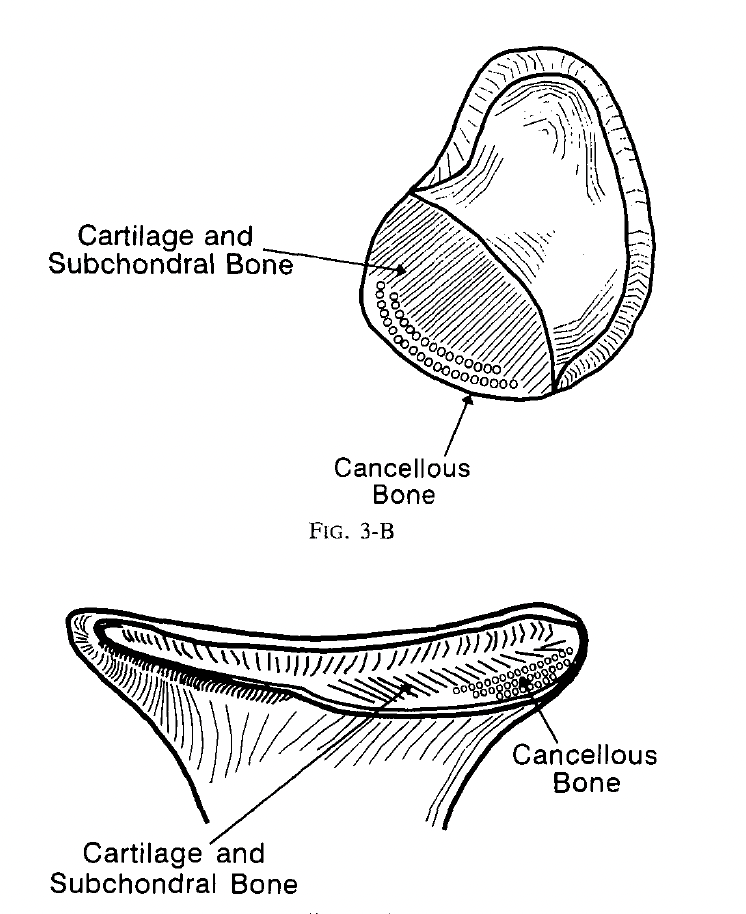
Recurrent instability can contribute to the development of glenohumeral arthritis from the forced translation of the humeral head over the lip of the glenoid can wear the articular cartilage

exposing the bone beneath

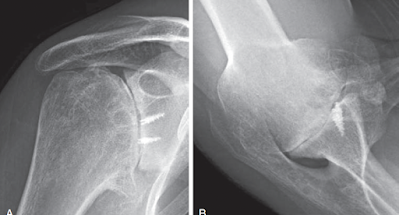
Surgery performed to manage instability can risk secondary arthritis from overtightening, leading to pathological translation and eccentric wear of cartilage (capsulorrhaphy arthropathy).


The use of pain pumps for the intra-articular infusion of local anesthetics after instability surgery can lead to chondrolysis (see Published evidence demonstrating the causation of glenohumeral chondrolysis by postoperative infusion of local anesthetic via a pain pump).


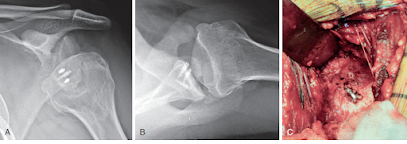
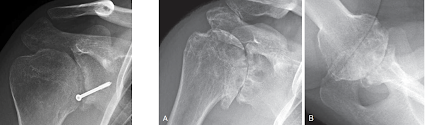
Prominent suture anchors used in instability surgery can lead to anchor arthropathy


Cutibacterium infection after instability surgery can lead to septic arthritis


In contrast to the situation with straightforward osteoarthritis, these conditions can complicate arthroplasty surgery and lead to suboptimal outcomes because of pathological alterations in bone and soft tissue quality and heightened risk of complications, such as periprosthetic infection. 

Recognizing factors such as these can help patients and surgeons understand some of the differences in shoulder arthritis in younger patients and their effect on the success of joint replacement.

You can support cutting edge shoulder research that is leading to better care for patients with shoulder problems, click on this link.

Follow on twitter: https://twitter.com/shoulderarth
Follow on facebook: click on this link
Follow on facebook: https://www.facebook.com/frederick.matsen
Follow on LinkedIn: https://www.linkedin.com/in/rick-matsen-88b1a8133/

Here are some videos that are of shoulder interest
Shoulder arthritis - what you need to know (see this link).
How to x-ray the shoulder (see this link).
The ream and run procedure (see this link).
The total shoulder arthroplasty (see this link).
The cuff tear arthropathy arthroplasty (see this link).
The reverse total shoulder arthroplasty (see this link).
The smooth and move procedure for irreparable rotator cuff tears (see this link).
Shoulder rehabilitation exercises (see this link).


Tuesday, July 23, 2019

Arthritis after shoulder dislocations = use of the reverse total shoulder

Reverse shoulder arthroplasty for instability arthropathy

These authors conducted a retrospective cohort of 25 patients having a reverse total shoulder for arthritis after multiple dislocations or after a procedure for glenohumeral instability with a mean follow-up of 6.6 years.  Eighty percent of the patients had a prior surgery for instability (36% of Latarjet or Bristow (7 patients) and capsular surgery for the others) and 20% had multiple closed reduction in their history. Mean delay between the initial procedure or first dislocation and the surgery was 50.3 years (SD 13.48 years). Thirteen percent of the 25 patients had a failed history of cuff repair (3 patients); an intact cuff was found for the others. Main risks factors for shoulder instability found were alcoholism in 15.4%, dementia in 7.7%, and Parkinson disease in 7.7% of the cases.

Active anterior elevation increased from 70° to 140° (p < 0.01) and external rotation from 9° to 21° (p = 0.02). The adjusted CS increased from 38 to 98 (p < 0.01). 

Two early post-operative complications were collected: one superficial infection and one spine fracture perhaps related to a long superior baseplate screw. 


At the latest follow-up,  38.10% had glenoid spurs, and 55% had scapular notching (see above x-ray).

These authors demonstrate that a reverse total shoulder can be an effective procedure for the management of post instability arthropathy. It is of interest that the average time from first dislocation to the shoulder arthroplasty was 50 years.

Here is a related article

Shoulder arthroplasty after prior anterior stabilization procedures: do reverses have better outcomes?

These authors compared the outcomes of 15 total shoulder arthroplasties (TSA) and 10 reverse total shoulder arthroplasties (RTSA)  after anterior stabilization surgical procedures. The TSA group’s mean age at surgery was 54.9 years, with an average follow-up period of 4.0 years. The RTSA group’s mean age was 65.4 years, with an average followup period of 3.3 years.

In the TSA group, 4 patients underwent prior bony procedures (27%), all of which were Bristow procedures. One underwent multiple other non-arthroplasty shoulder surgical procedures, and another underwent 4 previous arthroscopic surgical procedures. The remaining 11 patients underwent previous soft-tissue procedures that included the following: 7 with arthroscopic anterior labral repairs and 4 with open anterior capsular reconstructions.

In the RTSA group, 4 prior bony procedures (40%) were performed: 3 were Bristow procedures (1 patient also underwent a prior open rotator cuff repair) and 1 was a glenoid osteotomy. The remaining 6 patients underwent previous softtissue procedures that included the following: 3 with open anterior labral and capsular repairs (one of these with a total of 3 open reconstructive procedures), 2 with arthroscopic labral repairs, and 1 with a thermal capsulorrhaphy for instability with rotator cuff repair in the same setting. 

In the TSA group, all the subscapularis tendons were deemed of adequate quality in the operative reports.
In the RTSA group, 3 subscapularis tendons were intact, 3 were poor quality, 2 were scarred, and 1 was deficient; in 1 case, the tendon quality was not recorded in the operative report. The intact subscapularis tendons were repaired. One of the poor-quality tendons and one of the scarred tendons were repaired using suture. The remaining subscapularis tendons were left as tenotomies.

In the TSA group the rotator cuff tendons were documented as being of adequate quality in all patients.
In the RTSA group, the supraspinatus was intact in 2, partially torn or poor quality in 3, and absent (or with a full-thickness tear) in 4. The infraspinatus was intact in 5, poor quality in 1, and absent (or with a full-thickness tear) in 3. The teres minor was intact in 6, partially torn or poor quality in 2, and absent in 1. 

The Simple Shoulder Test scores improved from averages of 3.9 to 8.9 in the TSA group and from 3.4 to 11.2 in the RTSA group. 

There were no complications or re operations in the RTSA group. TSA patients had a 33% complication rate and a 20% reoperation rate. 2 TSA patients underwent revision to RTSA. One TSA was converted to RTSA after aseptic glenoid loosening, and one was converted to RTSA because of subsequent rotator cuff failure. One TSA patient had a dislocation, which was treated with closed reduction and did not require further surgery. 

Comment: Glenohumeral arthritis developing after prior surgery for anterior instability - "capsulorrhaphy arthropathy" - can be complicated by subscapularis, rotator cuff, glenoid bone deficiencies, and residual glenoid hardware. Each of these factors can complicate the surgeon's ability to achieve solid glenoid component fixation and a stable anatomic arthroplasty. It is of interest that the surgeons elected TSA in patients a decade younger than those having RTSA. The soft tissues were more compromised in the RTSA group.

Even though this is a small case series of patients that are dissimilar in some important ways, it does point out the challenges of attempting an anatomic TSA and the potential benefit of the RTSA in managing the complex pathology of arthritis after a prior instability repair.

=====
We have a new set of shoulder youtubes about the shoulder, check them out at this link.

Be sure to visit "Ream and Run - the state of the art" regarding this radically conservative approach to shoulder arthritis at this link and this link

Use the "Search" box to the right to find other topics of interest to you.


You may be interested in some of our most visited web pages arthritis, total shoulder, ream and runreverse total shoulderCTA arthroplasty, and rotator cuff surgery as well as the 'ream and run essentials'