Showing posts with label lucent lines. Show all posts

Friday, September 28, 2012

The early migration of a partially cemented fluted pegged glenoid component using radiostereometric analysis JSES

JSES recently published: The early migration of a partially cemented fluted pegged glenoid component using radiostereometric analysis

The authors conducted a very careful study using radiostereometric analysis and two-year post op CT scans to track the motion of a glenoid component relative to the glenoid bone in eleven shoulders. They found that focal radiolucency around the central peg as shown on this CT scan
was associated with rapid early migration of the glenoid component in six of the eleven cases. When bone grew into the flutes of the central peg, migration did not occur, but when it did not, the component was at risk for migration.

While the clinical results for these shoulders showed significant improvement over the preoperative ASES, Constant and pain scores, the findings of this study raise concerns about the longevity of the glenoid components. 

The authors point to three other reports that are of interest in this regard, each of which pointed to the lack of bone ingrowth in some cases:

Bone presence between the central peg's radial fins of a partially cemented pegged all poly glenoid component suggest few radiolucencies.

Clinical and radiographic analysis of a partially cemented glenoid implant: five-year minimum follow-up


The findings of the authors of the current JSES report are of concern. I know them to be excellent surgeons; it is doubtful that the results are attributable to technical concerns. The illustrations in the manuscript show excellent positioning of the components.  The patients all had osteoarthritis (not RA) and had an average age of 69 years and that nine of the eleven were women, the point being that the authors' findings can probably not be attributed to inflammatory arthritis or to high levels of physical activity. Yet as the authors point out in referring to In vivo measurement of shoulder joint loads during activities of daily living, the shoulder is a major load-bearing joint even in the absence of 'high levels of physical activity'.


So, because the  glenoid component remains the leading cause of failure, we take time to explain the risk of this complication to patients considering a total shoulder and continue to explore the application of the ream and run procedure for carefully selected patients with osteoarthritis.


----


If you have suggestions for topics you'd like us to address in this blog, please send an email to
shoulderarthritis@uw.edu

Use the "Search the Blog" box to the right to find other topics of interest to you.

You may be interested in some of our most visited web pages including:shoulder arthritis, total shoulder, ream and run, reverse total shoulder, CTA arthroplasty, and rotator cuff surgery.

See the countries from which our readers come on this post.


Thursday, February 23, 2012

Glenoid component fixation. Vacuum assist glenoid fixation: does this technique lead to a more durable glenoid component? JSES

JSES October 2011 published an article Vacuum assist glenoid fixation: does this technique lead to a more durable glenoid component? in which suction is applied to the glenoid vault as a means of removing fluid trapped within the glenoid vault and increasing the amount of cement in the glenoid bone for fixation of a glenoid component. They found that using a special device (that is no longer available) to apply suction to the bone the amount of cement in the glenoid was increased and the number of radiolucent zones were diminished. Of note, however, is the observation that even with this method, the authors had 33% radiolucent lines on postoperative x-rays using the Bigliani-Flatow system.

As we have pointed out in a previous post, more cement can generate more heat in the glenoid bone, risking the possibility of thermal damage to the bone, so more cement may not be the goal.

We use a different approach to the removal of fluid from the prepared glenoid bone, employing a carbondioxide spray just before the cement is pressurized.
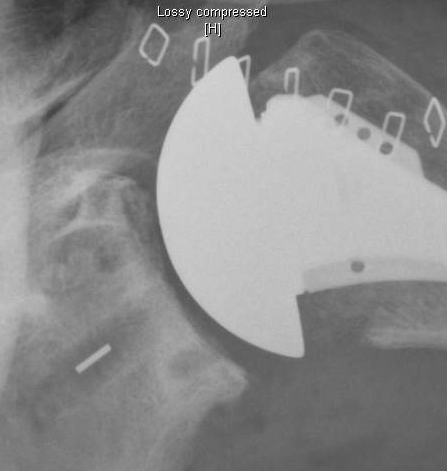
The consistent result is the absence of radiolucent lines with a minimal amount of cement as shown in the radiograph below.


--

Use the "Search the Blog" box to the right to find other topics of interest to you.

You may be interested in some of our most visited web pages including: shoulder arthritis, total shoulder, ream and run, reverse total shoulder, CTA arthroplasty, and rotator cuff surgery.

Saturday, January 7, 2012

Glenoid component lucent lines and loosening, JSES December 2011

Collin et al have provided a ten year follow-up on all polyethylene glenoid components in total shoulder arthroplasty. The authors state "Glenoid component loosening remains the most common reason for failure and revision surgery."

The shoulder arthroplasties in this study were performed by surgeons with a very high level of expertise, Gilles Walch and Pascal Boileau. While the principal purpose was to compare the track record of flat-backed versus concave backed cemented components, no significant differences were found. At 10 year followup, 20% of the glenoid components had possible loosening and 35% had definite loosening. The presence of glenoid loosening was associated with lower shoulder comfort and function by the Constant score. The authors noted that when radiolucent lines were present on the immediate post-operative films, these lucencies tended to progress. Younger patients (<60 years) tended to have a greater rate of progression than older patients. Glenoid components placed in the dominant shoulder had a greater tendency to have progressive lucencies than those in non-dominant shoulders.

This report suggests that active use and surgical technique are major factors determining the longevity of glenoid components. There was no mention of the results of cultures taken at the time of revision. The cases shown in Figures 6 &  7 (reproduced below) would seem suspect for the presence of an organism such as P. acnes.


 Note loss of alignment of metal markers in the glenoid and fragmentation of cement with osteolysis

Note massive osteolysis and fragmentation of cement.
--


If you have suggestions for topics you'd like us to address in this blog, please send an email to

Use the "Search the Blog" box to the right to find other topics of interest to you.

You may be interested in some of our most visited web pages including:shoulder arthritis, total shoulder, ream and run, reverse total shoulder, CTA arthroplasty,  and rotator cuff surgery.