Showing posts with label short stem. Show all posts

Saturday, December 28, 2024

Reverse total shoulder: what is the ideal humeral stem?

In contrast to the situation in an anatomic shoulder arthroplasty (below left), the center of rotation (center of yellow circle) in a reverse total shoulder (below right) is not closely aligned with the humeral medullary canal (red line). This results in a rotational moment arm (blue line) and a bending force each of which can contribute to loosening of the humeral stem in the humeral canal.


These loosening factors need be resisted by secure and durable fixation of the prosthesis to bone.

Recently there has been interest in short stemmed reverse humeral components.

However the short stem places the implant at risk for shift in component position as shown below.


Some have tried to manage this tendency for loosening by using tight fitting components, but these can increase the risk of stress shielding as shown below.


And can be difficult to revise in case of malposition, infection or fracture.


I found this recent article co-authored by Patrick Denard of relevance: Volumetric Humeral Canal Fill Ratio Effects Primary Stability and Cortical Bone Loading in Short and Standard Stem Reverse Shoulder Arthroplasty: A Biomechanical and Computational Study

The authors used cadaveric specimens to evaluate the effect of three-dimensional volumetric humeral canal fill ratios of reverse shoulder arthroplasty short and standard stems on the biomechanical stability and bone deformations in the proximal humerus. 

They compared standard stems inserted with low and high filling ratios and short stems inserted with low and high filling ratios


The specimens were cyclically loaded while optical recording allowed for spatial implant tracking and the quantification of cortical bone deformations in the proximal humerus. 

Both short and standard-length stem RSA humeral components implanted with a low canal filling ratio maintain dynamic bone loading in the medial calcar of the humerus similar to the native bone tested. This dynamic bone loading is desirable in the prevention of bone losss from stress shielding. Thus high canal fill ratios ( > 0.72) may correlate with the severity of bone resorption in the clinical setting.

However, short stems implanted with a low filling ratio (< 0.72have an increased risk for implant tilt and subsidence compared to those inserted with high filling ratios or standard length stems. Short stems inserted with higher filling ratios and standard length stems implanted with low or high filling ratios demonstrated higher primary stability.

 
A conclusion from the foregoing is that short stems are at risk for stress shielding if they are inserted with high filling ratios, and at risk for loosening (tilt and subsidence) if they are inserted with low filling ratios. 

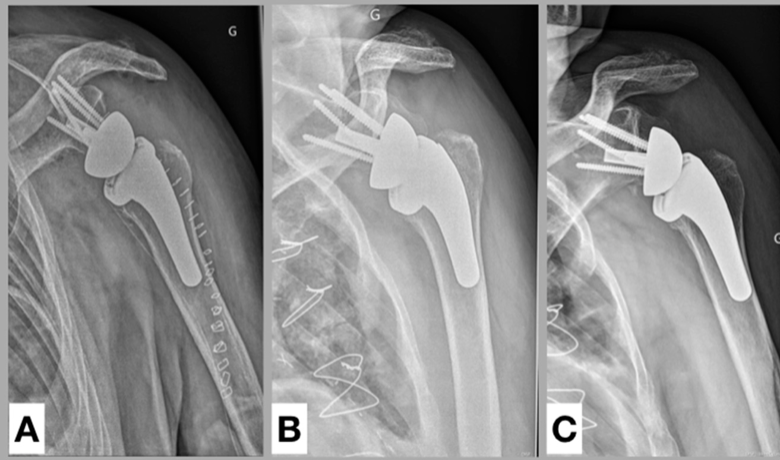
So, one can reduce the risks of stress shielding and component loosening through the use of a standard length smooth stem inserted with a low filling ratio as seen in the x-ray below with a stable humeral component and no bone resorption two years after reverse total shoulder arthroplasty. Secure fixation is achieved through impaction autografting.

You can support cutting edge shoulder research that is leading to better care for patients with shoulder problems, click on this link

Follow on twitter/X: https://x.com/RickMatsen

Here are some videos that are of shoulder interest
Shoulder arthritis - what you need to know (see this link).
How to x-ray the shoulder (see this link).
The ream and run procedure (see this link).
The total shoulder arthroplasty (see this link).
The cuff tear arthropathy arthroplasty (see this link).
The reverse total shoulder arthroplasty (see this link).
The smooth and move procedure for irreparable rotator cuff tears (see this link)
Shoulder rehabilitation exercises (see this link). 


Friday, December 1, 2023

Short stemmed humeral components - do they solve old problems or create new ones?

From a recent article, Symptomatic aseptic loosening of a short humeral stem following anatomic total shoulder arthroplasty we read that the rate of aseptic humeral component loosening with standard-length stems is very low, 0.3%, and that for 184 shoulders receiving total shoulder arthroplasty with a short humeral stem12.5% (1 out of 8) presented with a painful shoulder and radiographic concern for potential humeral loosening at a mean follow-up of only 1.5 years. 7.1% (1 out of 11) underwent revision shoulder arthroplasty where a loose stem was confirmed. 
Thus the question, "Short stemmed humeral components - do they solve old problems or create new ones?"

The intramedullary anatomy of the proximal humerus is irregular and highly variable among patients. 

 As a result, no short stem humeral implant design can be expected to conform to it.


A Radiographic Analysis of Proximal Humeral Anatomy in Patients with Primary Glenohumeral Arthritis and Implications for Press-Fit Stem Length  pointed out that short stems in total shoulder arthroplasty are associated with higher rates of malalignment and loosening compared to standard length stems. A study of CT scans on 99 consecutive patients undergoing shoulder arthroplasty documented this variability. The chart below plots the difference between the anteroposterior and mediolateral dimensions of the canal as a function of the distance down the humerus from the greater tuberosity.

As shown in Short stem humeral components in reverse shoulder arthroplasty: stem alignment influences the neck-shaft angle this inconstant anatomy can result in variable positioning of a short stemmed component in the canal. 

Similar findings are reported in Short Humeral Stems in Shoulder Arthroplasty


This can result in variable positioning of the proximal aspect of the component as well as point loading of the diaphysial canal (red arrows).


Lack of a good fit in the variable humeral canal can result in high rates of loosening of short stemmed humeral components as demonstrated in Radiographic evaluation of short-stem press-fit total shoulder arthroplasty: short-term follow-upSymptomatic aseptic loosening of a short humeral stem following anatomic total shoulder arthroplasty assessed 184 shoulders that received TSA with a grit-blasted, rectangular short humeral stem without ingrowth coating.  The rate of symptomatic aseptic humeral loosening in this series was 10.9%, with 5.4% undergoing revision surgery. Note the components below have subsided into varus with lateral diaphysial erosion.


Subsidence of Uncemented Short Stems in Reverse Shoulder Arthroplasty-A Multicenter Study reviewed 139 patients at a minimum follow-up of 12 months. The average subsidence was 1.4 mm. Subsidence of >5 mm was present in 15 patients (11%). Note once more that the component has subsided into varus with lateral diaphysial erosion.


It appears that without the stabilizing effect of a standard length stem, loading of a short stemmed component can cause it to collapse into varus.


Attempts to obtain secure press-fit fixation of a short stemmed component in the humeral canal can increase the risk of periposthetic fractures as seen in Surgical fixation of periprosthetic humeral shaft fracture about a short-stem anatomic total shoulder arthroplasty with a proximal humeral locking plate: surgical technique and report of 3 cases

Lack of evenly distributed loading of the humerus by the stem can result in stress shielding. 


Mid-term radiological results of a cementless short humeral component in anatomical and reverse shoulder arthroplasty found that in 100 shoulder arthroplasties evaluated at a mean of 3.8 years,  greater tuberosity stress shielding was noted in 14 shoulders and medial calcar resorption was noted in 23 shoulders.

Mid-term results of anatomical total shoulder arthroplasty for primary osteoarthritis using a short-stemmed cementless humeral component found that 40% of the shoulders developed substantial bone loss in the proximal humerus between four and seven years of follow-up.

Proximal humeral bony adaptations with a short uncemented stem for shoulder arthroplasty: a quantitative analysis reported a retrospective study of 183 shoulder arthroplasties evaluated at 2-year follow-up.  Medial cortical narrowing was found in 72.6% of cases and was severe (>50%) in 4.4%. Medial metaphysis thinning was found in 46.4% of cases and was severe in 3.3%. Lateral metaphysis thinning was found in 9.8% of cases and was severe in 2.8%. 


The design of the short stem can have a dramatic effect on stress shielding. Radiographic changes differ between two different short press-fit humeral stem designs in total shoulder arthroplasty found that the rate of medial calcar osteolysis varied from 71% to 28.5% between two different stem designs.


Clinical and radiographic outcomes after total shoulder arthroplasty with an anatomic press-fit short stem identified 118 TSAs completed with press-fit short stem and minimum 2-year follow-up; 85 of these patients had a grit-blasted (GB) short stem placed, whereas 33 patients had short stems with proximal porous coating (PPC). 


3 female patients with GB stems had gross loosening of their humeral components before 1 year. Radiolucent lines around the humeral component were found in 5.9%. Osseous resorption at the medial cortex was noted in 9.3%. Of patients with PPC stems, no patients were observed to have radiolucent lines compared with 8.2% in the GB group,


If the quality of bone of the proximal humerus is sufficient for fixation, a thinner short stem has a reduced risk of stress shielding because of the smaller filling ratio (see The effect of short-stem humeral component sizing on humeral bone stress and The effects of length and width of the stem on proximal humerus stress shielding in uncemented primary reverse total shoulder arthroplasty and Implications of humeral short-stem diametral sizing on implant stability)


However, as pointed out above in Short stem humeral components in reverse shoulder arthroplasty: stem alignment influences the neck-shaft angle, smaller short stems are more likely to be malaligned.

All of the above relates to the challenges in alignment in the AP plane. However, there are problems with controlling the position of the stem in the axillary plane as well. In the case below, one can see that posterior displacement of the stem in the humeral canal as well as posterior angulation of the implant have combined to yield posterior decentering of the head in the glenoid.


Comment: A wide variety of short stem humeral components are on the market, some of which are shown below. As can be seen, they come in a wide variety of stem shapes, stem sizes and stem surfaces.


It has been suggested that these short stemmed humeral components have the advantages of more bone stock preservation, less stress shielding, less diaphyseral stress risers, lower risk of fracture, easier component extraction during revision, and better humeral head positioning that is independent of the orthopaedic humeral axis. (see Short Humeral Stems in Shoulder Arthroplasty). 

The question is "which short stem design is being compared to what standard stem?" In the figure below one can consider the amount of bone removed, the potential for stress shielding, the presence of stress risers, the potential fracture risk, the potential ease of prosthesis exchange, and the humeral head component positioning for two short stemmed designs (left and right) in comparison to a smooth standard length stem inserted with impaction autografting (center).

 
The goal of this post is to call attention to the special considerations that relate to the use of a short stemmed humeral component, recognizing that its fit, stability and loading of the humeral canal are all different than those for a standard length stem.

You can support cutting edge shoulder research and education that are leading to better care for patients with shoulder problems, click on this link.

Follow on twitter: https://twitter.com/RickMatsen or https://twitter.com/shoulderarth
Follow on facebook: click on this link
Follow on facebook: https://www.facebook.com/frederick.matsen
Follow on LinkedIn: https://www.linkedin.com/in/rick-matsen-88b1a8133/

Here are some videos that are of shoulder interest
Shoulder arthritis - what you need to know (see this link).
How to x-ray the shoulder (see this link).
The ream and run procedure (see this link).
The total shoulder arthroplasty (see this link).
The cuff tear arthropathy arthroplasty (see this link).
The reverse total shoulder arthroplasty (see this link).
The smooth and move procedure for irreparable rotator cuff tears (see this link).
Shoulder rehabilitation exercises (see this link).


Thursday, December 30, 2021

How should the humeral component be secured in reverse total shoulder arthroplasty?

Are Short Press-Fit Stems Comparable to Standard Length Cemented Stems in Reverse Shoulder Arthroplasty? A Prospective Randomized Clinical Trial

These authors note "there has been a trend away from standard length cemented humeral implants to press-fit stems, and recently to shorter stem implants, " but minimal literature to support this trend.


The goal of their study was to compare clinical outcomes and implant migration between cemented standard length humeral stems and press-fit short stems using radio-stereometric analysis in 41 shoulders randomized to receive each of the two stems. 


Following surgery, the shoulders were imaged sequentially with stereo x-rays.


At six months, one year, and two years postoperatively, press-fit short stems migrated significantly more than cemented stems along the superior-inferior translation axis.


They noted stress shielding at the proximal medial calcar (solid arrow), and increased sclerosis at the medial metaphyseal diaphyseal junction (dashed arrow) with the use of press-fit stems (below).


The authors did not detect a significant difference in the clinical outcomes between the two types of stem fixation.


Comment: The are many different designs of reverse humeral stems with different approaches to lateralization and fixation. 


Our favored approach is shown in this link. It enables secure prothesis alignment in the proximal humerus so that subsidence is minimized


and cementless fixation of a relatively thin stem using impaction autografting. 


so that stress shielding is avoided.


See also Avoiding stress shielding around the humeral implant - are short stems the answer or the problem? 


Follow on facebook: https://www.facebook.com/frederick.matsen

Follow on LinkedIn: https://www.linkedin.com/in/rick-matsen-88b1a8133/


How you can support research in shoulder surgery Click on this link.

Here are some videos that are of shoulder interest
Shoulder arthritis - what you need to know (see this link)
Shoulder arthritis - x-ray appearance (see this link)
The smooth and move for irreparable cuff tears (see this link)
The total shoulder arthroplasty (see this link).
The ream and run technique is shown in this link.
The cuff tear arthropathy arthroplasty (see this link).
The reverse total shoulder arthroplasty (see this link).


Wednesday, December 22, 2021

Avoiding stress shielding around the humeral implant - are short stems the answer or the problem?

Short stem humeral implants have been introduced to the market based on the proposition that they are "bone preserving". One might ask:

Do they require less bone removal than a standard stemmed implant? 

Do they result in less stress shielding and adaptive bone loss than a standard stemmed implant?

Because short stems achieve fixation through a snug fit of the prosthesis in the proximal humerus, stress shielding is commonly observed (see 

Radiographic changes differ between two different short press-fit humeral stem designs in total shoulder arthroplasty and 

Postoperative radiographic findings of an uncemented convertible short stem for anatomic and reverse shoulder arthroplasty and 

Radiologic bone adaptations on a cementless short-stem shoulder prosthesis).

The challenge with short stems is to achieve fixation without stress shielding. See examples of stress shielding with short stemmed components below.


The authors of The effect of humeral implant thickness and canal fill on interface contact and bone stresses in the proximal humerus studied the effects of implant thickness and canal fill on load transfer, contact, and stress shielding in a finite element study comparing three generic short-stem implant models with different cross-sectional thickness (thinner ( 8 mm), medium (12 mm),  and thicker (16 mm).


 They determined (1) the amount of bone-to-implant contact, (2) changes in cortical and trabecular bone stresses from the intact state, and (3) changes in cortical and trabecular strain energy densities which can predict bone remodeling or stress shielding.

They found that the thinner implant with the lowest canal fill ratio produced significantly lower changes in stress from the intact state in both cortical and trabecular bone. In addition, the thinner implant resulted in a substantially lower volume of bone predicted to stress shield and resorb when compared with the medium and thicker stems.


They concluded that thinner implants and lower canal fill may be beneficial over thicker sizes, provided equal initial fixation can be achieved. The thinner implant has a greater degree of load sharing and increases the mechanical load placed on surrounding bone, reducing the risk of stress shielding and bone resorption.


The question becomes "how is fixation of a thin stem achieved?". Furthermore, if a thin stem is used, what is the advantage of a short stem? The amount of bone removed is the same for both as pointed out in Anatomic short-stem humeral component in total shoulder arthroplasty: a retrospective analysis.


With a standard length stem, impaction autografting can be used to achieve secure fixation of a thin stem on one hand and avoid problems with stress shielding on the other. 


The authors of Radiographic outcomes of impaction-grafted standard-length humeral components in total shoulder and ream-and-run arthroplasty: is stress shielding an issue? evaluated humeral stress shielding after shoulder arthroplasty performed with a smooth, standard-length humeral stem fixed with impaction autografting.


Prior to placement of the final component, cancellous autograft harvested from the humeral head was placed in the humeral canal and pressed into place using a humeral impactor with the same stem geometry as the implant. Autograft was progressively inserted until the impactor fit tightly within the humerus. The final uncoated, smooth, stemmed, fixed-angle humeral component with the desired head geometry was then driven into the prepared canal. 
At two years after surgery, the radiographic appearances were evaluated by an independent experienced shoulder surgeon from another institution not involved in the care of these patients.  The metaphysical and diaphysial filling ratios were measured as shown below.


The filling ratios were small, showing a substantial preservation of bone stock.

The overall radiographic results are shown below


These authors concluded that the independent assessment of the 2-year radiographic and clinical outcomes of a conventional smooth humeral stem inserted with impaction autografting demonstrated the clinical utility of this bone-preserving approach to humeral component fixation with minimal complications; good clinical outcomes; and low rates of bone loss, component subsidence, and shift in position.

Impaction allografting is a useful method for addressing failed prior short stem humeral component fixation - no additional bone is removed


Several other articles are of relevance. The authors of Cementless Curved Short Stem Shoulder Prostheses with a Proximal Porous Coating: Ingrowth Properties at 2-5 Years Radiological Follow-up with Clinical Correlation found a strong correlation between filling ratio and bone loss.


Symptomatic Aseptic Loosening of a Short Humeral Stem Following Anatomic Total Shoulder Arthroplasty

These authors point out that the rate of aseptic humeral component loosening with standard-length stems is low (0.3%) and that presence of humeral loosening gives rise to concern for periprosthetic shoulder infection.


They conducted a retrospective multi-institutional review of anatomic total shoulders performed with a  grit-blasted, rectangular short humeral stem without ingrowth coating.


Twenty-three (12.5%) patients presented with a painful shoulder and met the authors' criteria for humeral loosening at a mean follow-up of 1.5 years (range: 1.5 months – 3.4 years); half had gross humeral subsidence. Thirteen (7.1%) of these underwent revision shoulder arthroplasty where a loose stem was confirmed. 


The rate of symptomatic aseptic humeral loosening in this series was 10.9% (20/184) with 5.4% undergoing revision surgery. Patients with symptomatic aseptic humeral loosening were more likely to be male (90.5%) than those patients without symptoms (52.8%; p<0.001). Of the 105 male shoulders included in this cohort, 19 (18.0%; 19/105) developed symptoms and radiographic findings concerning for aseptic loosening. Ten (9.5%; 10/105) had a revision for aseptic loosening.


The authors concluded that the early humeral loosening rate for this stem design "far outpaces previously reported rates and this study likely under-reports the true incidence of clinically-significant loosening as it only contains limited short-term follow-up". 


Comment: Based on the above information, short stemmed humeral components do not provide added value in comparison to impaction autografted thinner standard length humeral stems.

=====

Follow on facebook: https://www.facebook.com/frederick.matsen

Follow on LinkedIn: https://www.linkedin.com/in/rick-matsen-88b1a8133/


How you can support research in shoulder surgery Click on this link.

Here are some videos that are of shoulder interest
Shoulder arthritis - what you need to know (see this link)
Shoulder arthritis - x-ray appearance (see this link)
The smooth and move for irreparable cuff tears (see this link)
The total shoulder arthroplasty (see this link).
The ream and run technique is shown in this link.
The cuff tear arthropathy arthroplasty (see this link).
The reverse total shoulder arthroplasty (see this link).