Showing posts with label subscapularis repair. Show all posts

Thursday, February 26, 2026

Is this subscapularis reconstructable?

A 64 year old female presented with chronic right shoulder dysfunction and pain after an injury playing tennis in 2022, where she hit an overhead ball and felt a pop in her shoulder. She then had a recurrent injury in 2025 with a similar mechanism playing pickleball and was diagnosed with a rotator cuff tear. She had participated in PT and got some functionality back but remained weak, and then had a fall biking which further reduced the function of her shoulder. She complained of anterior shoulder pain and an inability to perform overhead activity due to weakness. Her exam revealed full active motion, but substantial weakness of belly press and lumbar lift-off. Passive external rotation was to 90 degrees. There was a palpable defect in the subscapularis. Plain radiographs were normal. MRI images are shown below.


In spite of our lack of optimism regarding the reconstructability of this chronic tear, the patient asked for an exploration and repair or reconstruction if possible.

At surgery the upper half of the subscapularis was detached of poor quality. With care to protect the axillary nerve, dissection of the lower half of the subscapularis was carried out  freeing it from the inferior capsule, and releasing the anterior capsule from the glenoid.

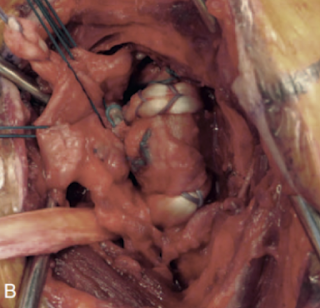
After this 360 degree release, excellent quality (> 1 cm thick) tendon with subjacent capsule could be easily approximated to the entire footprint at the lesser tuberosity. Six FiberWire sutures were passed through the lesser tuberosity and the tendon. The long head tendon of the bicep was incorporated in the repair. After securing the tendon, the shoulder externally rotated to 30 degrees with a firm endpoint. 


I thought you might find this interesting.


Building Back

Marsh Wren reconstructing nest

Montlake Fill
2010


Here are some videos that are of shoulder interest
Shoulder arthritis - what you need to know (see this link).
How to x-ray the shoulder (see this link).
The ream and run procedure (see this link)
The total shoulder arthroplasty (see this link)
The cuff tear arthropathy arthroplasty (see this link).
The reverse total shoulder arthroplasty (see this link).
The smooth and move procedure for irreparable rotator cuff tears (see this link)
Shoulder rehabilitation exercises (see this link). 


Sunday, August 6, 2023

Updated: Anatomic shoulder arthroplasty: the subscapularis at risk


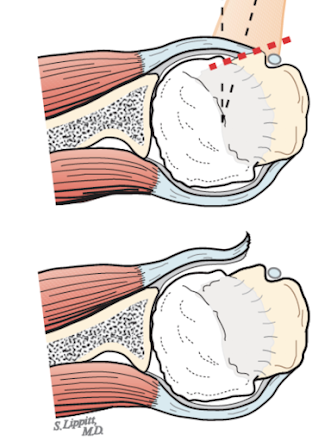
The surgical exposure of the joint for anatomic shoulder arthroplasty almost always requires subscapularis tenotomy (A) or detachment of the subscapularis tendon from the humerus using a peel (B) or a lesser tuberosity osteotomy (C). 

At the conclusion of the procedure the tendon is repaired securely


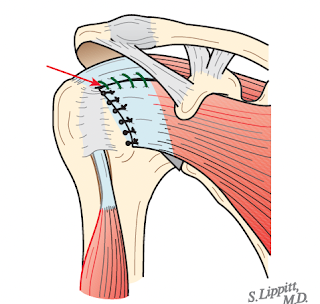
The subscapularis reattachment can be reinforced by a plication of the rotator interval (arrow).


Surgical repair of the subscapularis cannot duplicate the robustness of the complex two-layer normal subscapularis insertion. The deep layer is composed of parallel longitudinal collagen fibers inserting onto the lesser tuberosity flush with the cartilage. The superficial layer is thicker and composed of interdigitated collagen bundles inserting onto the lesser and the greater tuberosity after splitting into two bands, one lining the floor of the bicipital groove, and the other extending over the long head of the biceps tendon across the groove; see Tendons, ligaments, and capsule of the rotator cuff. Gross and microscopic anatomy


and Histologic characteristics of the subscapularis tendon from muscle to bone: reference to subscapularis lesions


In that glenohumeral arthritis is usually associated with a prolonged period of preoperative shoulder stiffness and disuse, many patients can be expected to have abnormal subscapularis structure and function at the time of joint replacement.

For the reasons stated above, it is not surprising that many patients fail to regain normal subscapularis function after shoulder arthoplasty (see The return of subscapularis strength aftershoulder arthroplasty).

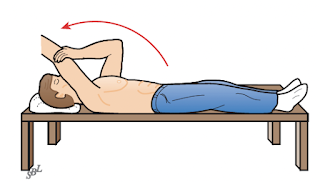
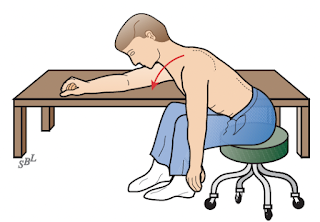
For the first few months after surgery, the application of passive and active loads to the subscapularis repair can cause its failure. Thus it is recommended that the exercises shown below are avoided for this period.


Even after the first few months, certain exercises put the subscapularis at - perhaps unexpected - risk. 
To help see why, consider our high school physics lesson in equilibrium: 
force 1 times moment arm 1 = force 2 times moment arm 2


In the "fly" shown below,  the subscapularis is subjected to substantially greater loads than the force applied by the hand.

This is because the moment arm for the hand force is many times the moment arm of the subscapularis load opposing it.


Even with the commonly prescribed external rotation stretch, the hand force moment is many times the subscapularis load moment, magnifying the load on the subscapularis tendon


Muscular individuals may be especially at risk for early post operative subscapularis failure because seemingly minor events or accidents may produce enough force to damage the repair.

A recent article, Functional and Radiographic Results of Anatomic Total Shoulder Arthroplasty in the Setting of Subscapularis Dysfunction: 5-year Outcomes Analysis  identified 668 patients having two year followup after anatomic total shoulder arthroplasty; the subscapularis was managed with either a peel or a lesser tuberosity osteotomy. Postoperatively, the patients were placed in a sling for six weeks with pendulum exercises three times per day.

34 of these patients (5%) demonstrated subscapularis dysfunction as manifested by the inability to hold the hand on the belly while the elbow was placed anterior to the plane of the body. 

Notably this physical examination test was used rather than ultrasound, MRI or contrast CT, each of which can be difficult to interpret after shoulder arthroplasty because of the metal artifact.

In comparison to those without subscapularis dysfunction, patients with subscapularis dysfunction demonstrated worse postoperative Simple Shoulder Test, SANE, VAS Function, VAS Pain, and ASES scores, as well as lower rates of satisfaction and worse active range of motion. Only 47% of the patients could reach the small of their back compared to 85% with normal subscapularis function.

Patients with subscapularis dysfunction had higher rates of anterior subluxation (see example below) 

as well as higher rates of revision. 

In spite of the poorer outcomes in patients with subscapularis dysfunction, most of these patients were improved in comparison to their preoperative status. 

Notably, when subscapularis failure was suspected during the early postoperative period, the authors did not immediately recommend revision surgery, rather waiting to see if function and comfort will improve. 

Comment: It can be concluded that (a) a robust subscapularis repair and (b) protection of the repair during healing are of great importance to assure the optimal outcome from anatomic arthroplasty.

Re-repair is a consideration if there is evidence of tendon failure, especially if there has been a sudden event soon after arthroplasty. The authors of Clinically significant subscapularis failure after anatomic shoulder arthroplasty: is it worth repairing? compared minimum 1 year results with subscapularis failure after anatomic arthroplasty having subscapularis re-repairs to those having conversion to reverse total shoulder. Patients having re-repair were significantly younger than patients who underwent revision to reverse shoulder arthroplasty (mean age, 59.3 years vs. 70.3 years, had a better comorbidity profile, and had a more acute presentation (mean time between injury and surgery, 9.1 weeks vs. 28.5 weeks. 


Patients who underwent subscapularis re-repair also had a significantly higher reoperation rate (52.9% vs. 0.0%); this is expected in that older patients are unlikely to want or have a revision of a reverse total shoulder within the first year after the procedure, whereas younger patients having an attempted re-repair may consider another surgery. It is apparent that re-repair of a failed subscapularis is more likely to fail than the original repair performed at shoulder arthroplasty because the diagnosis is often delayed and the quality of the tissue is poorer.

At final follow-up, functional outcomes scores and patient satisfaction rates were not significantly different between treatment groups.

The biggest challenge lies in the management of the young strong patient having subscapularis failure after anatomic total or ream and run arthroplasty. These patients are often in their 30s or 40s and want to avoid conversion to a reverse total shoulder because of their young age and activity expectations.

In these cases, reinforcing the repair with a tendon graft becomes a consideration (see The subscapularis: anatomy, failure and reconstruction and The subscapularis).

Thanks to Mihir Sheth, UW shoulder fellow, for his help in preparing this post.

You can support cutting edge shoulder research that is leading to better care for patients with shoulder problems, click on this link.

Follow on twitter (X): https://twitter.com/shoulderarth
Follow on facebook: click on this link
Follow on facebook: https://www.facebook.com/frederick.matsen
Follow on LinkedIn: https://www.linkedin.com/in/rick-matsen-88b1a8133/

Here are some videos that are of shoulder interest
Shoulder arthritis - what you need to know (see this link).
How to x-ray the shoulder (see this link).
The ream and run procedure (see this link).
The total shoulder arthroplasty (see this link).
The cuff tear arthropathy arthroplasty (see this link).
The reverse total shoulder arthroplasty (see this link).
The smooth and move procedure for irreparable rotator cuff tears (see this link).
Shoulder rehabilitation exercises (see this link).

Thursday, August 18, 2022

The subscapularis - the limerick

A patient recently sent this limerick - surely worth sharing:


 LIMERICK FOR SUBSCAPULARIS 


This muscle is hidden from sight 

It's working for you day and night 

When you stumble and fall 

And it won't work at all 

Who knows if it can be put right?


Failure of the subscapularis after shoulder arthroplasty is a clinically important complication that can substantially compromise the comfort and function of the shoulder. 

Take down and repair

Like most complications, subscapularis failure is better prevented than treated. Our approach includes takedown using a careful subscapularis peel, keeping the subjacent capsule intact to the tendon.

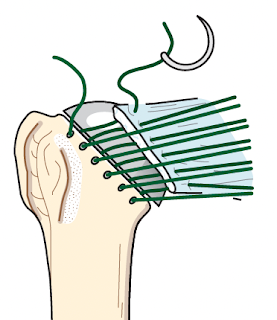
After the arthroplasty, the subscapularis tendon and subjacent capsule are repaired to the humerus using at least 6 sutures passed through secure drill holes at the margin of the humeral head cut.
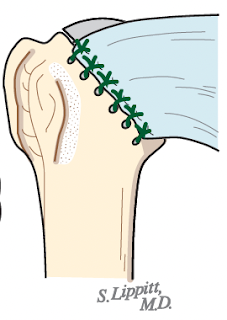


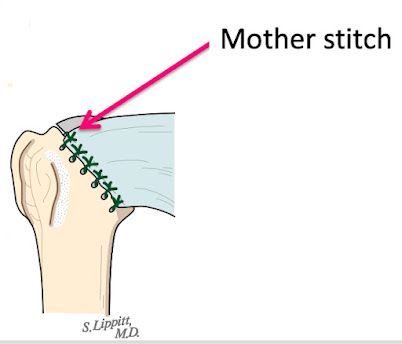
The superior band of the subscapularis, also known as the upper rolled border, is the major strength of the subscapularis. The suture laced through it at the time of repair carries a disproportionately high percent of the total tendon load when the arm is externally rotated (see this link). We refer to this most important suture as the Mother Stitch.


This repair can be reinforced with a rotator interval plication.


During the first two months after shoulder arthroplasty, we are careful to have the patient stretch in flexion


but NOT in external rotation to avoid stressing the repair.


Diagnosing failure

Because post operative MRIs and sonograms after shoulder arthroplasty can be difficult to interpret, the diagnosis of subscapularis failure is often best made from 

(1) history - force on the repaired tendon within the first two months after surgery resulting from

    a fall on the arm, 

    a sudden or unexpected stretch in external rotation beyond the handshake position 

    a forceful internal rotation (e.g. while restraining a dog chasing a squirrel)

(2) physical exam

    increased external rotation from what was recorded in the operating room at the close of the case


    weakness of belly press with the arm out to the side


(3) radiographs
    
    anterior subluxation of the humeral head on the glenoid seen on the axillary "truth" view of the left shoulder


Reconstruction


    When diagnosed early after injury, the subscapularis can often be reconstructed with a hamstring allograft passed through drill holes in the lesser tuberosity laterally.


and through the residual tendon medially


Securing the graft back to the tuberosity reinforces the subscapularis attachment to the humerus


and restores stability to the joint.

Here's a variation of the method used in a case last week, this time on the right shoulder.  The graft was first passed through the lower hole in the tuberosity, then up through the subscapularis tendon, then back down through the subscapularis tendon and then out the upper hole in the lesser tuberosity. In this case the graft was used to back up a standard repair of the subscapularis tendon to the humeral neck cut.


The two limbs of the graft passed through the lesser tuberosity were then tied to each other and secured with locking sutures.

An alternative to attempting reconstruction of a torn subscapularis is to consider a reverse total shoulder.
This option is discussed in this link.


An article on subscapularis failure was recently published:

Failure rates and outcomes after anatomic total shoulder arthroplasty are equivalent irrespective of subscapularis repair technique

They conducted a retrospective study of patients who underwent primary anatomic TSA with subscapularis tenotomy using either transosseous repair (TOR #=192) or direct primary tendon repair (PTR #=114) of a subscapularis tenotomy. 


The "primary outcome studied was clinical subscapularis failure, defined as anterior subluxation of the glenohumeral joint as seen on axillary lateral radiographs with accompanying clinical decompensation, including pain and loss of active forward elevation and internal rotation.""Patients were not routinely screened by ultrasound or MRI to evaluate subscapularis integrity. Additionally, internal rotation strength testing was based on manual muscle testing. Clinical assessment of internal rotation strength is fairly subjective and limited because nearly all of the patients had 4/5 or 5/5 internal rotation strength." Substantial emphasis was placed on the patient's response to a question from the ASES score which asks about the ability to perform functional internal rotation activities such as putting on a bra or washing the back. Of note only 41.4% of the TOR group and 33.3% of the PTR group responded with “not difficult.”


Subscapularis failure was recognized in 13 patients (4.2% among the TOR group and 4.4% among the PTR group). Reoperation was performed in 18 patients. Subscapularis failures, complications not requiring surgery, and reoperations were not significantly different between the two groups. 


Comment: In this retrospective study of an institutional database it appears that the patients in this series may not have been routinely and systematically examined for subscapularis failure, but rather the diagnosis was inferred from radiographs and from ASES scores. It is therefore possible that the rate of subscapularis failure was underestimated.


You can support cutting edge shoulder research that is leading to better care for patients with shoulder problems, click on this link.


Follow on twitter: https://twitter.com/shoulderarth

Follow on facebook: click on this link

Follow on facebook: https://www.facebook.com/frederick.matsen

Follow on LinkedIn: https://www.linkedin.com/in/rick-matsen-88b1a8133/

Here are some videos that are of shoulder interest
Shoulder arthritis - what you need to know (see this link).
How to x-ray the shoulder (see this link).
The ream and run procedure (see this link).
The total shoulder arthroplasty (see this link).
The cuff tear arthropathy arthroplasty (see this link).
The reverse total shoulder arthroplasty (see this link).
The smooth and move procedure for irreparable rotator cuff tears (see this link).
Shoulder rehabilitation exercises (see this link).

Thursday, October 21, 2021

Subscapularis and shoulder arthroplasty: repair, failure and reconstruction

Failure of the subscapularis after shoulder arthroplasty is a clinically important complication that can substantially compromise the comfort and function of the shoulder. 

Take down and repair

Like most complications, subscapularis failure is better prevented than treated. Our approach includes takedown using a careful subscapularis peel, keeping the subjacent capsule intact to the tendon.

After the arthroplasty, the subscapularis tendon and subjacent capsule are repaired to the humerus using at least 6 sutures passed through secure drill holes at the margin of the humeral head cut.


The superior band of the subscapularis, also known as the upper rolled border, is the major strength of the subscapularis. The suture laced through it at the time of repair carries a disproportionately high percent of the total tendon load when the arm is externally rotated (see this link). We refer to this most important suture as the Mother Stitch.


This repair can be reinforced with a rotator interval plication.


During the first two months after shoulder arthroplasty, we are careful to have the patient stretch in flexion


but NOT in external rotation to avoid stressing the repair.


Diagnosing failure

Because post operative MRIs and sonograms after shoulder arthroplasty can be difficult to interpret, the diagnosis of subscapularis failure is often best made from 

(1) history - force on the repaired tendon within the first two months after surgery resulting from

    a fall on the arm, 

    a sudden or unexpected stretch in external rotation beyond the handshake position 

    a forceful internal rotation (e.g. while restraining a dog chasing a squirrel)

(2) physical exam

    increased external rotation from what was recorded in the operating room at the close of the case


    weakness of belly press with the arm out to the side


(3) radiographs
    
    anterior subluxation of the humeral head on the glenoid seen on the axillary "truth" view of the left shoulder


Reconstruction

    When diagnosed early after injury, the subscapularis can often be reconstructed with a hamstring allograft passed through drill holes in the lesser tuberosity laterally.


and through the residual tendon medially


Securing the graft back to the tuberosity reinforces the subscapularis attachment to the humerus


and restores stability to the joint.

Here's a variation of the method used in a case last week, this time on the right shoulder.  The graft was first passed through the lower hole in the tuberosity, then up through the subscapularis tendon, then back down through the subscapularis tendon and then out the upper hole in the lesser tuberosity. In this case the graft was used to back up a standard repair of the subscapularis tendon to the humeral neck cut.


The two limbs of the graft passed through the lesser tuberosity were then tied to each other and secured with locking sutures.

An alternative to attempting reconstruction of a torn subscapularis is to consider a reverse total shoulder.
This option is discussed in this link.


An article on subscapularis failure was recently published:

Failure rates and outcomes after anatomic total shoulder arthroplasty are equivalent irrespective of subscapularis repair technique

They conducted a retrospective study of patients who underwent primary anatomic TSA with subscapularis tenotomy using either transosseous repair (TOR #=192) or direct primary tendon repair (PTR #=114) of a subscapularis tenotomy. 


The "primary outcome studied was clinical subscapularis failure, defined as anterior subluxation of the glenohumeral joint as seen on axillary lateral radiographs with accompanying clinical decompensation, including pain and loss of active forward elevation and internal rotation.""Patients were not routinely screened by ultrasound or MRI to evaluate subscapularis integrity. Additionally, internal rotation strength testing was based on manual muscle testing. Clinical assessment of internal rotation strength is fairly subjective and limited because nearly all of the patients had 4/5 or 5/5 internal rotation strength." Substantial emphasis was placed on the patient's response to a question from the ASES score which asks about the ability to perform functional internal rotation activities such as putting on a bra or washing the back. Of note only 41.4% of the TOR group and 33.3% of the PTR group responded with “not difficult.”


Subscapularis failure was recognized in 13 patients (4.2% among the TOR group and 4.4% among the PTR group). Reoperation was performed in 18 patients. Subscapularis failures, complications not requiring surgery, and reoperations were not significantly different between the two groups. 


Comment: In this retrospective study of an institutional database it appears that the patients in this series may not have been routinely and systematically examined for subscapularis failure, but rather the diagnosis was inferred from radiographs and from ASES scores. It is therefore possible that the rate of subscapularis failure was underestimated.


Follow on twitter: https://twitter.com/shoulderarth

Follow on facebook: https://www.facebook.com/frederick.matsen

Follow on LinkedIn: https://www.linkedin.com/in/rick-matsen-88b1a8133/


How you can support research in shoulder surgery Click on this link.

Here are some videos that are of shoulder interest
Shoulder arthritis - what you need to know (see this link)
Shoulder arthritis - x-ray appearance (see this link)
The smooth and move for irreparable cuff tears (see this link)
The total shoulder arthroplasty (see this link).
The ream and run technique is shown in this link.
The cuff tear arthropathy arthroplasty (see this link).
The reverse total shoulder arthroplasty (see this link).

Shoulder rehabilitation exercises (see this link).

This is a non-commercial site, the purpose of which is education, consistent with "Fair Use" as defined in Title 17 of the U.S. Code.          
Note that author has no financial relationships with any orthopaedic companies.