Showing posts with label resurfacing. Show all posts

Tuesday, July 19, 2016

Failed resurfacing with mini glenoid component

We had the opportunity to see a patient whose glenohumeral arthritis


was treated in another state with a humeral head resurfacing with a mini glenoid component.

Eight months later, the shoulder was increasingly painful; x-rays showed evidence of loosening of the glenoid component.

Two months later the glenoid was removed by the original surgeon.

The shoulder continued to be stiff and painful. The patient presented to our service. After discussion of the alternatives and the possibility of low grade infection, we performed a revision with multiple tissue and explant cultures, all of which were fortunately negative.


Three months after the revision the patient reports that the discomfort has yet to completely resolve.
The patient's therapist reported
AAROM flexion 165* (able to consistently achieve)
AAROM abduction 160* (limited at times to 90*)
AAROM Internal Rotation in Abduction 40*
AAROM External Rotation in Abduction 60*

We'll keep you posted!

===

Use the "Search" box to the right to find other topics of interest to you.

You may be interested in some of our most visited web pages including:shoulder arthritis, total shoulder, ream and run, reverse total shoulder, CTA arthroplasty, and rotator cuff surgery as well as the 'ream and run essentials'


Wednesday, September 3, 2014

Failed resurfacing revised to an impaction grafted hemiarthroplasty.

A gentleman in his sixties presented to us  7 months status post a left shoulder resurfacing with a hemicap. He states that he has continued to have moderate to severe pain and stiffness in his shoulder that is worse than preop. He has been to 30-40 PT sessions without relief. He noted that his shoulder 'clicked' painfully on certain motion.
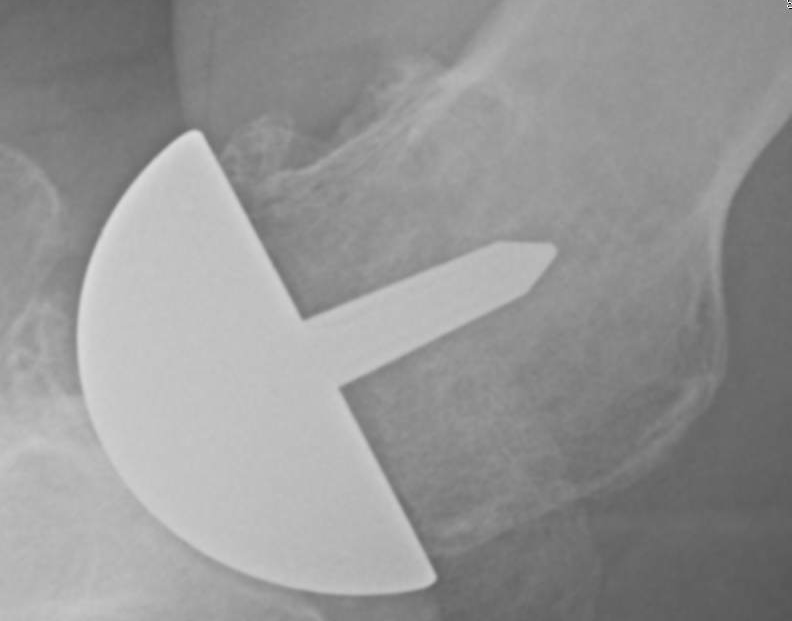
His x-rays at the time of his initial clinic visit are shown below. There is a suggestion of incomplete seating of the hemicap, lucency around the central peg, and varus positioning.


He desired revision arthroplasty. Specimens for culture were obtained before antibiotic administration. The resurfacing prosthesis was grossly loose and the bone beneath it very soft. A hemiarthroplasty was inserted using Vancomycin allograft. He is on the yellow protocol pending the results of culture.


Comment: While we do not use the resurfacing prosthesis in our practice, we have had the chance to revise a fair number of these procedures performed elsewhere. Those coming for revision have had problems of malposition, overstuffing, loosening, infection and stiffness.

===

Check out the new Shoulder Arthritis Book - click here.


To see the topics covered in this Blog, click here

Use the "Search" box to the right to find other topics of interest to you.

You may be interested in some of our most visited web pages including:shoulder arthritis, total shoulder, ream and run, reverse total shoulder, CTA arthroplasty, and rotator cuff surgery as well as the 'ream and run essentials'


Monday, July 8, 2013

Partial humeral head resurfacing - Arthrosurface


The concept behind partial humeral head resurfacing arthroplasty is to use a tack-like device to manage a humeral head defect. These authors report on 39 shoulders with focal chondral defects of the humeral head treated with partial resurfacing arthroplasty. Almost all had had prior surgical procedures on the shoulder. Many had other pathologies in addition to the loss of cartilage. These individuals were young (45.6 years (range, 27-76 years)). 

Of these 39 shoulders only 25 showed functional improvement. Six patients required revision and another 4 were recommended to have revision.


While this procedure attempts to preserve as much of the native humeral head as possible, the problems are (1) it is uncommon to have to have only a small part of the articular surface affected by arthritis, (2) with segmental damage from avascular necrosis, the underlying bone is not normal and may compromise the quality of Arthrosurface fixation, and (3) the mechanical properties of the metal joint surface are in marked contrast to that of the surrounding articular cartilage.


===
To see the topics covered in this Blog, click here


Use the "Search" box to the right to find other topics of interest to you.

You may be interested in some of our most visited web pages including:shoulder arthritis, total shoulder, ream and run, reverse total shoulder, CTA arthroplasty, and rotator cuff surgery as well as the 'ream and run essentials'


See from which cities our patients come.


See the countries from which our readers come on this post.

Wednesday, April 10, 2013

Humeral resurfacing for arthritis - the shoulder cap


A ‘resurfacing’ humeral arthroplasty is one in which the humeral head is shaped to receive a metal surface placed on the bone without a stem down the medullary canal. The thought is that this represents a ‘conservative’ approach to shoulder arthroplasty in that it requires resection of less humeral bone than a conventional humeral arthroplasty. 

This is an observational case series study reporting the functional and radiological outcome of a resurfacing arthroplasty in shoulders with a  during a mean follow-up of 4 years for 102 consecutive patients with osteoarthritis (OA-47.1%), rheumatoid arthritis (RA–40.2%), rotator cuff arthropathy (RCA–8.8%), and avascular necrosis (AVN–3.9%).

They found that the highest patient satisfaction and lowest pain levels were achieved with shoulders with the diagnosis of avascular necrosis. Osteoarthritis and rheumatoid arthritis were less good and rotator cuff tear arthropathy did least well.

The complication rate in this series was high. One patient had a postoperative infection, another had radiological signs of osteolysis. Thirteen patients (12.9%) were revised in the group having the standard prosthesis: 6 with RA (1 to hemiarthroplasty, 3 to total arthroplasty, and 2 to reverse), three with OA (1 to hemiarthroplasty and 2 to total arthroplasty), and 4 with cuff tear arthropathy (all revised to reverse arthroplasty). There were 6 out of 11 revisions in the extended head prosthesis group;  2 were to reverse arthroplasty, 1 to hemiarthroplasty due to excessive glenoid wear and impossible glenosphere implantation, and 3 patients are awaiting reverse arthroplasty. There are 8 additional shoulders with extended heads that are planned for revision.

We are unsure of the role that this prosthesis should play in the management of glenohumeral arthritis. Almost all shoulders with arthritis (with the exception of early AVN) have changes to the glenoid as well as the humeral articular surfaces. This prosthesis alone does not address the glenoid side and, furthermore, retaining the extra bone blocks good access to the glenoid for either a ream and run or a total shoulder. 

The unresolved glenoid changes are demonstrated in the x-rays shown below on a patient who presented to us for revision who had pain and stiffness after a humeral resurfacing.


===
Use the "Search" box to the right to find other topics of interest to you.

You may be interested in some of our most visited web pages including:shoulder arthritis, total shoulder, ream and run, reverse total shoulder, CTA arthroplasty, and rotator cuff surgery.


See from which cities our patients come.


See the countries from which our readers come on this post.


Wednesday, December 26, 2012

Pain and function in eight hundred and fifty nine patients comparing shoulder hemiprostheses, resurfacing prostheses, reversed total and conventional total prostheses

Pain and function in eight hundred and fifty nine patients comparing shoulder hemiprostheses, resurfacing prostheses, reversed total and conventional total prostheses.

This paper summarizes the results of questionnaires sent to patients registered in the Norwegian Arthroplasty Register with four different types of shoulder arthroplasty. Outcomes were characterized with the Oxford Shoulder Score and the EuroQol.

Noting that this was not a matched or controlled study, the authors found that conventional total shoulders provided the best improvement in pain, function and QoL in patients with osteoarthritis. Reverse prostheses yielded best results in patients with rheumatoid arthritis and post-traumatic arthritis, presumably because the cuff status in many patients with these conditions is compromised. Hemiarthroplasty or resurfacing without attention to the glenoid side of the arthritic joint yielded the worst results in each diagnostic group.

The authors assessed the weaknesses of the study, including a response rate of 65%, the retrospective collection of preoperative scores (2 to 16 years earlier), and the non-random allocation of prosthesis type (i.e. is it possible that total shoulder arthroplasty was preferentially performed on patients with the simplest of shoulder pathologies?).

It is of interest that the numbers of each procedure are quite different: 408 hemiprostheses, only 86 total shoulders, 195 resurfacings, and 170 reverse total shoulders. Seventy percent of the cases apparently did not have a glenoid arthroplasty. In that this report is based on a registry, one would wonder what factors, perhaps including surgeon experience, went in to the selection of the prosthesis used in each case. It would be of interest to know the distribution among the four types of surgery in the 1,865 patients enrolled in the registry in that this would provide a view of the nature of arthroplasty practice in Norway.

--

Use the "Search" box to the right to find other topics of interest to you.

You may be interested in some of our most visited web pages including:shoulder arthritis, total shoulder, ream and run, reverse total shoulder, CTA arthroplasty,  and rotator cuff surgery.


Saturday, December 22, 2012

Resurfacing humeral prosthesis: do we really reconstruct the anatomy?

Resurfacing humeral prosthesis: do we really reconstruct the anatomy?


One of the options for reconstructing an arthritic humeral head is a resurfacing prosthesis. The goal is to resurface the humeral articular surface while preserving the remainder of the proximal humerus. Because of the retention of much of the humeral head and anatomic neck, access to the glenoid to address the glenoid articular surface is compromised. As a result, most resurfacings are done has hemiarthroplasties, even though in most cases of glenohumeral arthritis both the humeral and glenoid articular surfaces are involved. As pointed out in a previous post, hemiarthroplasty or resurfacing do not restore the desired glenohumeral contact.

In this article the authors reviewed 64 shoulders with at least two years followup after resurfacing for primary osteoarthritis in 26, secondary osteoarthritis in 21, avascular necrosis in 4, rheumatoid arthritis in 4, dysplasia in 4, and for others indications in 5.

According to the Walch et al classification, 45 shoulders had central wear (A) and 14 and eccentric wear (B) while 5 had dysplastic glenoids.

The followup Constant score averaged 68 ± 20 points (range 29-100). Quick-DASH score averaged 28 ± 21 points (range, 0-88 points). Neer ratings were very satisfactory in 28 shoulders, satisfactory in 16, and nonsatisfactory in 20.

Postoperative radiographs showed showed a tendency to glenoid wear which appeared to correlate with with reappearance of pain.

The authors conclude that a resurfacing shoulder implant without glenoid resurfacing
leads to glenoid wear.

Thus the question in resurfacing is less about reconstructing humeral anatomy and more about care of the glenoid side of the arthritic glenohumeral joint.

--

Use the "Search" box to the right to find other topics of interest to you.

You may be interested in some of our most visited web pages including:shoulder arthritis, total shoulder, ream and run, reverse total shoulder, CTA arthroplasty,  and rotator cuff surgery.


Saturday, October 1, 2011

Resurfacing (CAP) vs a stemmed humeral component.

Patients ask about a humeral resurfacing prosthesis, sometimes known as a CAP as an alternative to a stemmed humeral component. Our preference is usually for the stemmed component because in our hands (1) the fixation to the humerus is better, (2) there is greater ability to adjust the position of the joint surface in balancing soft tissue tension, (3) resecting the entire humeral head provides necessary access to manage the glenoid, which is the critical aspect of many shoulder reconstructions, and (4) retaining the additional bone does not offer any advantages should subsequent surgeries be necessary.


--

Use the "Search the Blog" box to the right to find other topics of interest to you.

You may be interested in some of our most visited web pages including:shoulder arthritis, total shoulder, ream and run, reverse total shoulder, CTA arthroplasty,  and rotator cuff surgery.

Wednesday, August 10, 2011

Shoulder arthritis articles from July issue of the JSES - cementing, loosening, venous thromboembolism, resurfacing, revision arthroplasty, hemophilia, arthritis in Korea,

The July issue of JSES has several articles of interest.
The first is a study in cadavers: Bone cement penetration pattern and primary stability testing in keeled and pegged glenoid components points out that the more osteoporotic the bone of the glenoid, the more cement can be pressurized into it. While this result is intuitive (porous bone accepts more cement), it has some important implications. As we've show previously, more cement generates more heat as it sets up and more heat can kill bone and dead bone can contribute to loosening of the component. From the figures in this article, it appears that the authors vigorously reamed the bone of the glenoid, perhaps removing much of the firmer cortical bone that lies at the joint surface. We strive to preserve as much of this bone as possible in all cases, but especially in those with soft bone.

A second issue is that these authors state that they tested "primary" stability of the component. But rather than studying the common failure mode: the 'rocking horse', they used direct pull-out, which is a mechanism that is not possible in the living shoulder.

Further, in these 'stability' tests, they found that the components were pulled out of the cement mantle. As the examples below of the many loose glenoids I've retrieved show, this is not the mode of failure in living patients. Instead, glenoid components fail in the clinical situation at the cement-bone interface because the bone around the cement gives way.


Finally, there is a lot to be said about cement technique. The authors state that they used "3rd generation" cementing technique.  Cementing in a cadaver without bleeding is quite different than cementing in a living, bleeding bone. Cement pressurization is easier in cylindrical holes for a pegged component rather than an irregular keel hole. Placing cement on the surface of the bone beneath the prosthesis may offer greater 'initial' stability in cadavers, but this thin layer of cement is subject to fatigue cracking in the living patient.

The bottom line is that even though this is a well-done cadaver study, the clinical application of such cadaver studies must be made cautiously.

---
Next an article entitled, The prevalence of shoulder osteoarthritis in the elderly Korean population: association with risk factors and function, showed that in Korea the risk of OA increased with age and with the co-existence of knee arthritis.

---
Our UK colleagues found that Venous thromboembolic events are rare after shoulder surgery: analysis of a national database. Specifically after total shoulder replacement, the rates of deep venous thrombosis, pulmonary embolism, and death within 90 days were, respectively, 0%, 0.2%, and 0.22%. These rates were not changed by the implementation of thromboembolic prophylaxis. As a result the authors suggest that such prophylaxis may not be necessary.

---
Long-term results and patient satisfaction after shoulder resurfacing provided a minimum of 20 year or until death followup on 61 patients having either hemi resurfacing or total resurfacing procedures.  The satisfaction rate was reported to be high; 7 patients were lost to followup. Twelve of the 41 total resurfacing prostheses showed radiolucent lines but only three had revision surgery for glenoid component loosening.

---
Results of revision from hemiarthroplasty to total shoulder arthroplasty utilizing modular component systems pointed out that it is often possible to revise a painful modular humeral hemiarthroplasty to a total shoulder by removing the humeral head aspect of the humeral component, inserting a glenoid component, and then replacing the humeral head component.

---
Finally, Shoulder arthroplasty in hemophilic arthropathy demonstrated that satisfactory results could be obtained with this complex condition, but that the support of a hematologist was recommended.


--

Use the "Search the Blog" box to the right to find other topics of interest to you.

You may be interested in some of our most visited web pages including: shoulder arthritis, total shoulder, ream and run, reverse total shoulder, CTA arthroplasty, and rotator cuff surgery.