Thursday, February 23, 2012

Glenoid component fixation. Vacuum assist glenoid fixation: does this technique lead to a more durable glenoid component? JSES

JSES October 2011 published an article Vacuum assist glenoid fixation: does this technique lead to a more durable glenoid component? in which suction is applied to the glenoid vault as a means of removing fluid trapped within the glenoid vault and increasing the amount of cement in the glenoid bone for fixation of a glenoid component. They found that using a special device (that is no longer available) to apply suction to the bone the amount of cement in the glenoid was increased and the number of radiolucent zones were diminished. Of note, however, is the observation that even with this method, the authors had 33% radiolucent lines on postoperative x-rays using the Bigliani-Flatow system.

As we have pointed out in a previous post, more cement can generate more heat in the glenoid bone, risking the possibility of thermal damage to the bone, so more cement may not be the goal.

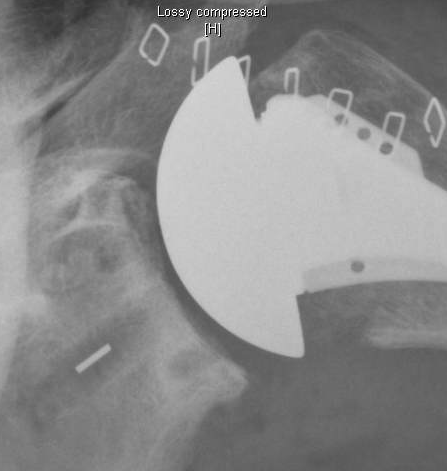
We use a different approach to the removal of fluid from the prepared glenoid bone, employing a carbondioxide spray just before the cement is pressurized.
The consistent result is the absence of radiolucent lines with a minimal amount of cement as shown in the radiograph below.


--

Use the "Search the Blog" box to the right to find other topics of interest to you.

You may be interested in some of our most visited web pages including: shoulder arthritis, total shoulder, ream and runreverse total shoulderCTA arthroplasty, and rotator cuff surgery.

Tuesday, February 21, 2012

Efficacy of Autologous Platelet-Rich Plasma Use for Orthopaedic Indications JBJS

Two recent JBJS publications, Efficacy of Autologous Platelet-Rich Plasma Use for Orthopaedic Indications: A Meta-Analysis and Platelet-Rich Plasma Differs According to Preparation Method and Human Variability are relevant to the rapidly increasing interest in PRP for the management of musculoskeletal disorders. In short, the first article reports that in spite of 33 high quality studies, there remains uncertainty about the effectiveness of PRP in the management of disorders such as rotator cuff injuries - basically, the results were just too variable to determine if there was or was not a beneficial effect.
The second article indicates that the different preparations of PRP are quite variable.

We'll have to continue to observe this evolving area to see what sorts out as more high quality studies with the different preparations become available. 

--

Use the "Search the Blog" box to the right to find other topics of interest to you.

You may be interested in some of our most visited web pages including: shoulder arthritis, total shoulder, ream and runreverse total shoulderCTA arthroplasty, and rotator cuff surgery.


Monday, February 20, 2012

Biological glenoid resurfacing for glenohumeral osteoarthritis


“Biological glenoid resurfacing for glenohumeral osteoarthritis” refers to a groups of procedures in which a biological material (anterior capsule autograft, Achilles tendon allograft, fascia lata allograft, lateral meniscus allograft, or a biological scaffold material is interposed between a humeral prosthesis and the bone of the glenoid.  While the concept may have some appeal, it seems unlikely that the interposed material will heal to and actually resurface the glenoid and unlikely that the interposed material will survive the substantial grinding loads applied by the hard opposing surfaces of metal and bone. So, we’ve not used this form of treatment for patients with glenohumeral arthritis.

Thus it was of interest to receive these two emails less than one week apart:

(1) “I am reaching out to you on behalf of my husband who has a failed shoulder replacement.  ….. The original replacement was with Dr. xxx and could be considered a partial replacement, as the humeral head was replaced with titanium, but the socket was cleaned out and a donor meniscus was used in the socket.” 

(2) “I had a shoulder replacement a few years ago using cadaver meniscus. I really wanted the ream and run, and had done extensive research on the various options, but the doctor said he had better results with this procedure and that I would be able to do anything with no limitations. In reality, I’m very limited in what I can do. I have always been extremely active, lifting, running, doing all the house and yard work, etc. Now, I can’t hammer a nail or rake the leaves. Anyway, this shoulder makes the worst noises, and doesn’t feel at all very tight.”

Of course any operation can have a poor outcome, but these two emails prompted interest in the October 2011 review article in JSES entitled “biological glenoid resurfacing for glenohumeral osteoarthritis”.  In this review the authors reviewed the published evidence in support of biological resurfacing. They found seven articles meeting their inclusion criteria. The patients were a demanding group: average age of 46 years, half having had previous surgery, and predominantly male gender. Mean follow-up was 4 years.  On average patients had improved comfort and function. 26% had reoperations.

In consideration of the recognized difficulties in achieving a good result in young male patients with their diverse types of arthritis, multiple prior surgeries, these results appear reasonable; however, no data are presented comparing this procedure to other surgeries in similar patients.

Our preference for the treatment of glenohumeral arthritis in active individuals who wish to avoid the risk of failure of the plastic glenoid component in total shoulder arthroplasty remains the ream and run procedure. In previous posts we have documented the results in younger individuals. In contrast to the situation with biological resurfacing, the ream and run avoids concern about the failure of a piece of devitalized tissue inserted between a metal prosthesis and the bone of the glenoid.

--

Use the "Search the Blog" box to the right to find other topics of interest to you.

You may be interested in some of our most visited web pages including: shoulder arthritis, total shoulder, ream and runreverse total shoulderCTA arthroplasty, and rotator cuff surgery.


Sunday, February 19, 2012

Trends in Rotator Cuff Repair - JBJS

The February 2012 issue of the JBJS presents "National Trends in Rotator Cuff Repair" points to a 600% increase in the unadjusted number of arthroscopic rotator cuff repairs and a 34% increase in the number of open cuff repairs in the decade from 1996 to 2006.  The adjusted rate increases were 530% and 21% respectively. In their discussion the authors note that recent studies have failed to demonstrate a difference in functional outcome or complications between arthroscopic and open repairs and that arthroscopic repair has a 'steep learning curve'.

The reasons for this abrupt increase in arthroscopic cuff repairs are not clear. We know that there is increasing use of sophisticated imaging techniques such as contrast MRI or shoulder ultrasound that can reveal defects in the rotator cuff tendons, even when the shoulder is asymptomatic or minimally symptomatic. We know that each year more surgeons are trained in arthroscopic cuff repair and actively seek patients to whom this technology may be applied.

So what would be really important to know (but not knowable from this study) about the increased number of patients getting arthroscopic cuff repairs is (1) what were the indications for attempted repair of the cuff defect (other than 'because it's there)? (2) what were the acuity and sizes of the defects? and (3) what were the outcomes in terms of cuff integrity and improvement in comfort and function after cuff repair? Only with this information can we determine if this increase means that more patients are getting the care they need or if simply more patients are getting arthroscopic surgery on their rotator cuff.


--

Use the "Search the Blog" box to the right to find other topics of interest to you.

You may be interested in some of our most visited web pages including: shoulder arthritis, total shoulder, ream and runreverse total shoulderCTA arthroplasty, and rotator cuff surgery.

Saturday, February 18, 2012

Postarthroscopic Glenohumeral Chondrolysis PAGCL JAAOS

The February 2012 JAAOS published an article on Postarthroscopic Glenohumeral Chondrolysis. This article points out, once again, that glenohumeral chondrolysis is the devastating and irreversible destruction of the articular cartilage of the shoulder joint, often in young (average age in the late 20's) active individuals having shoulder arthroscopy for the treatment of non-degenerative conditions, such as instability or 'SLAP' tears. In that once it has been initiated, the destruction of cartilage cannot be stopped or reversed, it is essential that the causes of chondrolysis be identified so that the condition can be prevented by avoiding each of the causational factors. As we have described in a previous post the evidence linking pain pumps to the irreversible destruction of articular cartilage from chondroysis is clear.

Against this background it is curious that the authors state that 'no cause of PAGCL has been confirmed and the associations are mostly speculative'. We note that one of the authors of this article discloses that he or an immediate family member serves as a paid consultant to Styker, a manufacturer of pain pumps used for the post arthroscopic infusion of local anesthetics.

The authors borrow photographs from a recent article, Risk Factors for Chondrolysis of the Glenohumeral Joint, A study of 375 shoulder arthroscopic procedures in the practice of an individual community surgeon. This article clearly demonstrates the role of post-arthroscopic infusion of local anesthetics via pain pumps in the causation of glenohumeral chondrolysis, yet they omit this article from their discussion of the causes of this condition.

The causation of chondrolysis is now clearly established as shown in this post.

--

Use the "Search the Blog" box to the right to find other topics of interest to you.

You may be interested in some of our most visited web pages including: shoulder arthritis, total shoulder, ream and runreverse total shoulderCTA arthroplasty, and rotator cuff surgery.

Brachial Plexus Blocks for Upper Extremity Surgery - JAAOS

The January issue of JAAOS publishes an article on brachial plexus blocks by Andrew Green and co-authors. This is a comprehensive review of the relevant anatomy, possible applications, technical considerations.  The authors quote the article by UW shoulder fellow Lenters et al. pointing to a substantial complication rate which, although lower in the hands of anesthesiologists experienced in the technique, was still significant for those who had performed many of them.

As we have discussed in a previous post, we avoid plexus blocks in most cases because of the potential for serious and possibly long term complications that are not seen with general anesthesia. As the authors state, "permanent <nerve> injury can result in substantial disability."  Even though the rate of these injuries is low, we are aware of a number of cases where career-ending neuropathies have occurred in surgeons and engineers and where previously independent individuals became dependent because of irreversible loss of function.

The authors also mention phrenic nerve palsy 'in almost all patients with interscalene block'. Our observations are similar and note that for many individuals with sleep apnea, COPD, or other respiratory conditions, even the transient loss of half of their pulmonary function can be critical.

The authors also describe other systemic complications, pneumothorax, vascular puncture, and the risks of indwelling catheters.

The proponents of blocks point to the value of postoperative analgesia. Our experience is that with shoulder arthritis surgery the use of blocks only delays the onset of pain until the block wears off in the evening or the wee hours of the morning when the nurse/patient ratio is lower.

So, again, after a rather prolonged use of blocks, we no longer find that the advantages outweigh the disadvantages and have discontinued their routine use.


--

Use the "Search the Blog" box to the right to find other topics of interest to you.

You may be interested in some of our most visited web pages including: shoulder arthritis, total shoulder, ream and runreverse total shoulderCTA arthroplasty, and rotator cuff surgery.

Thursday, February 2, 2012

Polyethylene glenoid component for total shoulders - JBJS


In the February Journal of Bone and Joint Surgery, our colleagues Wirth, Rockwood, Iannotti et al have published a Level IV study on 44 shoulders with primary or secondary arthritis having total shoulder arthroplasty with a new design of all polyethylene glenoid component that has flanges on the central peg.  


The authors were careful to disclose consultancy, speakers bureau, patents, royalties, employment, stock/stock option relationships with the company that makes this glenoid prosthesis, DePuy.

These authors have been avid students of the problems patients experience with total shoulders, having reported previously that component loosening accounted for a large percentage of the complications reported for shoulder arthroplasty. Like many others, these authors again identify glenoid component loosening as ‘the foremost cause of medium and long-term failure of shoulder replacements’. 

The authors used the method we published previously for evaluating the x-rays of these shoulders. Initial post-operative x-rays showed 35 of 44 shoulders had a perfect radiolucency grade (80%). At a mean of three years the number of shoulders with a perfect radiolucency grade had diminished to 20 (45%). Three of the shoulders had glenoid osteolysis. The 24 shoulders with glenoid retroversion had poorer glenoid fixation than the 20 shoulders without glenoid retroversion. 

Although there are no direct comparisions to other arthroplasty systems, this glenoid component may have the advantages of using pegs over keels, pegs offset in the superior/inferior and anteroposterior directions, a central peg with flanges to provide initial fixation, and the need for minimal cement.  It is the component we use here at the University of Washington for total shoulder arthroplasty.

It is concern that even though all of these arthroplasties were performed by the individual surgeon inventor who has extensive experience in this procedure, the radiographic results appear to have worsened over the relatively short mean followup period of three years. We look forward to the medium and long term results with this innovative prosthesis.

In this study, seven of the original 51 shoulders (14%) were lost to followup. For the remainder, mean SST scores improved from 3 to 9.  It is of interest that the improvement in shoulder comfort and function in this series of total shoulder arthroplasties, as indicated by the Simple Shoulder Test, are essentially the same as those that have been achieved with the ream and run procedure that avoids the risks associated with glenoid component failure (SST results with ream and run).

Finally, this paper points out that 33,000 of these glenoid components have been installed whereas outcome information is only available (from this and two other papers) on 100 or 0.3% of them. It is worthwhile considering the 'external validity question':  how generalizable is this sample of surgeries carried out by experts in the field to the remaining 29,900 or 99.7% of the arthroplasties for which the results are unavailable?  This comment is not a specific critique of this paper, but rather a reflection on how little we know about the results of shoulder arthroplasty across the country and world, especially since such a large percentage are performed by 'occasional' shoulder arthroplasty surgeons.


--

Use the "Search the Blog" box to the right to find other topics of interest to you.

You may be interested in some of our most visited web pages including: shoulder arthritis, total shoulder, ream and runreverse total shoulderCTA arthroplasty, and rotator cuff surgery.