Showing posts with label biological resurfacing. Show all posts

Tuesday, March 8, 2016

Shoulder arthritis in young patients - is 'biological resurfacing' useful?

Biologic resurfacing arthroplasty with acellular human dermal allograft and platelet-rich plasma (PRP) in young patients with glenohumeral arthritis-average of 60 months of at mid-term follow-up.

These authors point to the challenge of treating young patients with glenohumeral arthritis - individuals with high expectations for comfort, function, and longevity.

These authors state, "The treatment of young patients with symptomatic glenohumeral arthritis has been challenging. Total shoulder arthroplasty (TSA) can be associated with accelerated glenoid loosening, eccentric polyethylene wear, and multiple revision surgeries."

As an alternative to total shoulder arthroplasty, they report on patients (age 50±9 years) having hemiarthroplasty and biologic resurfacing of the glenoid with acellular human dermal allograft (GraftJacket MaxForce Extreme) soaked in platelet-rich plasma.   


Ten of 47 patients were satisfied, 28 of 47 patients were highly satisfied (28/47). Five shoulders were revised to anatomic total shoulder arthroplasty. Three cases were revised because of persistent pain. One patient was had a single-stage revision to TSA for infection. Another patient had an intraoperative humeral shaft fracture requiring revision with long-stem prosthesis and eventually underwent revision to TSA. There were 6 additional patients who had poor functional outcomes.

Comment:  Young patients with shoulder arthritis present particular challenges. As emphasized here, the most common types of arthritis are different for older and younger patients(Saltzman JBJS 2010). 

These authors sought to avoid the use of a prosthetic glenoid by inserting another foreign material, GraftJacket. The incremental cost and operating time for this procedure in comparison to hemiarthroplasty or total shoulder is not provided.  It is not apparent that the complication and revision rates are lower or that the outcomes are better for this procedure in comparison to the alternatives of the ream and run or total shoulder arthroplasty in similar patients.

===


Check out the new Shoulder Arthritis Book - click here.


Use the "Search" box to the right to find other topics of interest to you.

You may be interested in some of our most visited web pages including:shoulder arthritis, total shoulder, ream and run, reverse total shoulder, CTA arthroplasty, and rotator cuff surgery as well as the 'ream and run essentials'


Thursday, July 23, 2015

Shoulder arthritis in the young - biological resurfacing has a high failure rate

Unacceptable failure of hemiarthroplasty combined with biological glenoid resurfacing in the treatment of glenohumeral arthritis in the young

These authors used GraftJacket for glenoid resurfacing combined with humeral resurfacing or a stemmed hemiarthroplasty in 6 patients with a mean age of 47 years (34-57 years). Before GraftJacket was available, they treated 5 patients with a meniscal allograft and 6 with capsular interposition arthroplasty.

At a mean of 16 months (9-22 months) after the GraftJacket was implanted, 5 of the 6 patients were revised to a total shoulder arthroplasty or a reverse total shoulder arthroplasty. The sixth patient was dissatisfied but declined further surgery. The mean relative, preoperative Constant score decreased from 35% (range, 13%-61%) to 31% (range, 15%-43%) at revision or latest follow-up.

Of the 5 patients with meniscal allograft, 3 underwent revision at a mean of 22 months (range, 12-40 months), and 4 of the 6 patients with capsular interposition were revised at a mean of 34 months (range, 23-45 months). The mean relative Constant scores preoperatively and at revision or latest follow-up were 44% (range, 19%-68%) and 58% (range, 9%-96%) for the meniscal allograft patients and 47% (range, 38%-62%) and 63% (range, 32%-92%) for the capsular interposition cases.

Interestingly, only 3 of these patients had B2 glenoids.

Comment: We have previously documented that shoulder arthritis in young individuals is challenging for three reasons: (1) more complex pathology (AVN, chondrolysis, post-surgical arthritis, post-traumatic arthritis, etc), (2) greater patient expectations, and (3) greater longevity of the patient.  Almost all of these patients were under 50 years of age. 13 had dislocation arthropathy, one had static posterior subluxation, one had post traumatic AVN, 13 had a history of instability. Many had had prior surgery for instability. Their Table II shows that many of these surgeries were big: bone block procedures, Latarjet procedures, glenoid osteotomies, and humeral rotational osteotomies!

Understandably surgeons are searching for approaches to shoulder arthroplasty that are more durable than a total shoulder with its recognized rate of glenoid component failure and its obligatory sacrifice of glenoid bone stock. To whit, a quote from these authors "glenoid component loosening has remained a major concern and accounts for 32% of the complications after TSA, occurring in up to
44% of patients and leading to revision in at least 0.8% of TSAs per year."
The concept of interposing a human dermal collagen allograft, allograft meniscus or capsule in between the humeral head and the glenoid reminds us of a mortar and pestle

The interposed tissue cannot be expected to hold up against a pestle applying a force of approximately one times body weight.

In recognizing the high failure rate of interposition on one hand and the high failure rate of polyethylene glenoid components in young patients on the other , the authors (somewhat strangely) state "New alternative techniques with the potential to preserve the original glenoid bone stock, such as osteochondral glenoid allograft".  It is not clear that a glenoid allograft preserves original glenoid bone stock.

In our practice we continue to manage patients with the conditions described in this article using the ream and run procedure, in that the ream and run is free of the risks of biological interposition or a plastic glenoid and in that it preserves glenoid and humeral bone stock. The results of this procedure in a large series are well documented - see this link.


====

Use the "Search" box to the right to find other topics of interest to you.


You may be interested in some of our most visited web pages including:shoulder arthritis, total shoulder, ream and run, reverse total shoulder, CTA arthroplasty, and rotator cuff surgery as well as the 'ream and run essentials'

See from which cities our patients come.

See the countries from which our readers come on this post.


Sunday, August 31, 2014

Biologic resurfacing of the glenoid with humeral head resurfacing - poor results

Biologic resurfacing of the glenoid with humeral head resurfacing for glenohumeral arthritis in the young patient.

These authors reviewed the results of 16 patients having humeral head arthroplasty with soft tissue interposition grafting of the glenoid with a minimum follow-up time of 2 years, unless revision surgery was required.

There were 12 male and 4 female patients with a mean age of 36.1 years (range, 14-45 years). Preoperative indications for surgery included glenohumeral arthritis in 11, glenohumeral
chondrolysis in 3, instability arthropathy in 1 and capsulorrhaphy arthropathy after a Bristow procedure in 1.

The humeral head was replaced with a standard Tornier hemiarthroplasty prosthesis or an Arthrosurface humeral head resurfacing implant. Seven glenoids were resurfaced using a GraftJacket acellular, allograft human dermal matrix–based scaffold and 9 with an Achilles tendon allograft.

At a mean follow-up of 60 months, the patients showed improvement in the visual analog scale score for pain from 8.1 to 5.8 and the American Shoulder and Elbow Surgeons score improved from 23.2 to 57.7 (P < .05). However, conversion to a total shoulder arthroplasty was performed in 7 patients (44%) at a mean of 36 months. The authors concluded that because of the limited improvement in patient outcomes and the high revision rate, biologic resurfacing of the glenoid with humeral head resurfacing should be used with caution.

Comment: Young patients with shoulder arthritis present a tough challenge, first of all because they have more complex pathologies, second because they have high expectations and third because the requirement for durability is so much greater. There is no perfect procedure for these folks. In our practice, we considering discussing the possibility of a ream and run procedure with well-motivated, non-smoking, non-depressed young patients who are not on substantial narcotics.

Another point worth making is that we find that a well positioned AP in the plane of the scapula and a true axillary view as shown in a prior post are more useful than x-rays such as those shown below in assessing shoulder pathology before surgery and the glenohumeral anatomy after surgery.


===


To see the topics covered in this Blog, click here

Use the "Search" box to the right to find other topics of interest to you.

You may be interested in some of our most visited web pages including:shoulder arthritis, total shoulder, ream and run, reverse total shoulder, CTA arthroplasty, and rotator cuff surgery as well as the 'ream and run essentials'


To see other similar posts, click on the label of interest below.

Sunday, March 30, 2014

Biologic resurfacing of the glenoid - high failure rate

The high failure rate of biologic resurfacing of the glenoid in young patients with glenohumeral arthritis.

These authors evaluated 45 patients (mean age 42) having biologic resurfacing of the glenoid using a lateral meniscus allograft or human acellular dermal tissue matrix; 41 were available for follow-up at a mean of 2.8 years. Lateral meniscal allograft resurfacing was used in 31 patients and human acellular dermal tissue matrix interposition in 10. 29 patients had primary osteoarthritis, 7 had post traumatic arthritis, 7 had capsulorraphy arthropathy, 1 had chondrolysis, and 1 had avascular necrosis of the humeral head.

Failure was defined as conversion to a total or reverse total shoulder arthroplasty, a recommendation for this conversion, revision surgery for graft removal, or poor comfort and function after the procedure.

The overall clinical failure rate was 51.2%. The lateral meniscal allograft cohort had a failure rate of 45.2%, with a mean time to failure of 3.4 years. Human acellular dermal tissue matrix interposition had a failure rate of 70.0%, with a mean time to failure of 2.2 years. Note that a followup time limited to 2 years would have missed over half of these failures.

Comment: Biological resurfacing has been the topic of a number of prior posts:
These articles indicate that it is a technically demanding procedure based on the hope that the interpositional material will remain fixed to the glenoid and endure under the forces applied by the prosthetic humeral head on the underlying glenoid bone. These articles indicate that this hope is often not realized.

For selected patients, the ream and run procedure may be a better option.

===

Check out the new Shoulder Arthritis Book - click here.


To see the topics covered in this Blog, click here

Use the "Search" box to the right to find other topics of interest to you.

You may be interested in some of our most visited web pages including:shoulder arthritis, total shoulder, ream and run, reverse total shoulder, CTA arthroplasty, and rotator cuff surgery as well as the 'ream and run essentials'


Saturday, February 1, 2014

Interpositional biologic resurfacing then infection then ream and run

A patient came to us after having had a biological inter positional arthroplasty elsewhere about a year previously. A couple of months post operatively he had pain, swelling and redness afterwards that responded to a 10 day course of antibiotics that resolved his acute symptoms. However his shoulder continued to be stiff and painful. He presented to us without symptoms of infection and the x-rays and MRI shown below.


Being suspicious of a persistent infection, we obtained cultures while performing a ream and run procedure. 


He was placed on antibiotics after surgery. Two of the three cultures of tissue removed from over his glenoid grew out Propionibacterium.  He will remain on IV antibiotics for 6 weeks followed by a year of oral antibiotics. 

One might ask (1) why did the third culture from his glenoid tissue not grow out? and (2) where did the Propionibacterium come from?

His early rehab is going well. Stay tuned.

===

To learn more about shoulder arthritis and what can be done about it, see the Shoulder Arthritis Book.

To learn more about the rotator cuff, see the Rotator Cuff Book

Consultation for those who live a distance away from Seattle.

**Check out the new Shoulder Arthritis Book - click here.**

Click here to see the new Rotator Cuff Book

To see the topics covered in this Blog, click here

Use the "Search" box to the right to find other topics of interest to you.

You may be interested in some of our most visited web pages including:shoulder arthritis, total shoulder, ream and run, reverse total shoulder, CTA arthroplasty, and rotator cuff surgery as well as the 'ream and run essentials'


Monday, January 27, 2014

Biological resurfacing with Graftjacket or Achilles tendon and Hemiarthroplasty or Arthrosurface in young patients with shoulder arthritis


Biologic resurfacing of the glenoid with humeral head resurfacing for glenohumeral arthritis in the young patient

These authors explored resurfacing of the glenoid with an interposition soft tissue graft in conjunction with humeral head arthroplasty as an option to improve glenohumeral arthritis in young patients while avoiding the potential complications associated with total shoulder arthroplasty.

They performed a multicenter review of 16 patients who had undergone humeral head arthroplasty with soft tissue interposition grafting of the glenoid. Patient age averaged 36.1 years (range, 14-45 years).All patients had a minimum follow-up time of 24 months, unless revision surgery was required because of failure of the procedure.

16 patients had a mean follow-up of 60 months. 7 patients (44%) required revision to a total shoulder at a mean of 36 months.

The authors conclude that because of the limited improvement in patient outcomes and the high revision rate, biologic resurfacing of the glenoid with humeral head resurfacing is no longer their primary treatment option for young patients and should be used with caution. These results are similar to those presented in another recent article.

Comment: We continue offer a ream and run procedure to carefully selected active patients who desire a level of activity beyond that recommended for a total shoulder arthroplasty.

===
Consultation for those who live a distance away from Seattle.

**Check out the new (under construction) Shoulder Arthritis Book - click here.**

To see the topics covered in this Blog, click here

Use the "Search" box to the right to find other topics of interest to you.

You may be interested in some of our most visited web pages including:shoulder arthritis, total shoulder, ream and run, reverse total shoulder, CTA arthroplasty, and rotator cuff surgery as well as the 'ream and run essentials'

See from which cities our patients come.

See the countries from which our readers come on this post.

Sunday, January 26, 2014

Can the glenoid be reamed after a biological resurfacing? Hemicap. Copeland. Ream and Run.

This email came in yesterday: "I had a hemiarthroplasty of my shoulder last February with a hemicap and the glenoid was biological resurfaced. Unfortunately my shoulder, at times, is still in significant amount of pain and stiff. My questions are: Is it possible to have the glenoid reamed after a biological resurfacing? Also, can the procedure be done with a hemicap or does the humeral head have to have a spherical resurfacing like a copeland?"

First, a few illustrations to clarify the situation. 

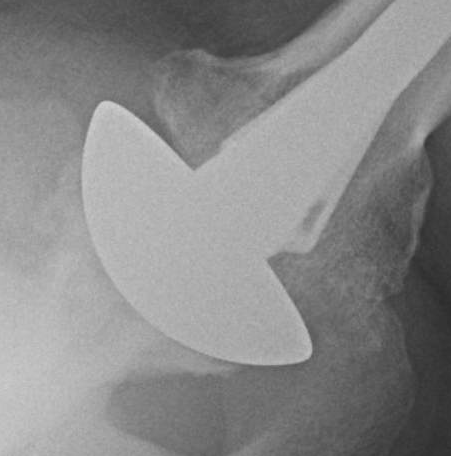
Here is an x-ray of a hemicap from the manufacturer's brochure. Note that only part of the humeral joint surface is covered, in this illustration the joint space is not congruent, and the inferior humeral osteophyte appears to be contacting the inferior glenoid.


Here is an x-ray after a ream and run procedure, in which the glenoid has been reamed to match the curvature of the new humeral head which is fixed without cement in the shaft of the humerus. The only bone that is removed in this procedure is that of the arthritic humeral head. The bone removed is used to help achieve a tight fit of the stem in the humeral shaft. Note the dark space between the humeral head and the glenoid where a new soft tissue layer has regenerated.

In answer to the question posed in the email, yes we have been able to ream the glenoid in cases of failed resurfacing. In these cases we routinely obtain cultures in that there seems to be a rather high rate of culture positivity for Propionibacterium in failed arthroplasties. In fact, here is a post of such a case after a Copeland arthroplasty.

In the ream and run procedure, we use a stemmed humeral component as shown in the x-ray above because it gives maximal security of fixation and maximal flexibility of head size, curvature, and position.

===
Consultation for those who live a distance away from Seattle.

Check out the new Shoulder Arthritis Book - click here.

Click here to see the new Rotator Cuff Book

To see the topics covered in this Blog, click here

Use the "Search" box to the right to find other topics of interest to you.

You may be interested in some of our most visited web pages including:shoulder arthritis, total shoulder, ream and run, reverse total shoulder, CTA arthroplasty, and rotator cuff surgery as well as the 'ream and run essentials'


Monday, July 1, 2013

Biological interposition for shoulder arthritis in patients under 50


Clinical outcomes of hemiarthroplasty and biological resurfacing in patients aged younger than 50 years

Because of the risk of glenoid component failure in younger and more active individuals, there has been an interest in exploring alternatives to total shoulder arthroplasty. These authors report on 44 patients younger than 50 years of age, 23 having hemiarthroplasty alone (HA) and 21 having hemiarthroplasty with biological resurfacing (BR) of the glenoid using an interposed graft, such as a meniscus allograft (although it is not clear whether other types of graft, such as joint capsule, graft jacket, autogenous fascia lata, and Achilles allograft were used as well).

At a mean follow-up of 3.7 years, six of 23 patients in the hemiarthroplasty and 12 of 21 patients in the biological resurfacing group had either revision surgery or an American Shoulder and Elbow Surgeons score <50.

The young age of these patients is of great interest. The 20 shoulders available for follow-up in the HA group were a mean age of 33.9 ± 9.4 years (range, 16.8-49.6 years). The 20 shoulders available for follow-up in the BR group were a mean age of 37.7 ± 8.9 years (range, 19.0-53.7 years).

It is also of interest that many of these patients had prior surgery. Ten HA patients had no prior surgery, and 10 were noted to have had at least 1 prior surgery. These operations included arthroscopic debridement (n = 7), stabilization (n = 10), superior labrum anterior posterior repair (n = 2), resection for chondroblastoma (n = 1), and bony glenoid reconstruction (n = 1). Eight BR patients had undergone no prior surgery, with 12 patients noted to have had at least 1 prior surgery, which included stabilization for recurrent instability (n = 15), arthroscopic debridement (n = 5), loose body removal (n = 2) and thermal capsulorrhaphy (n = 1).

Many of these patients had diagnoses other than primary osteoarthritis. Primary indications for surgery in the HA group were avascular necrosis (AVN; n = 7), post-traumatic degenerative joint disease (DJD; n = 5), postsurgical DJD (n = 2), primary osteoarthritis (OA; n = 1), chondroblastoma (n = 1), glenoid dysplasia (n = 1), and rheumatoid arthritis (RA; n = 2).  Primary indications for surgery in the BR were postcapsulorrhaphy DJD (n = 10), OA (n = 6), and AVN (n = 1). 

These demographics drive home the point that young individuals with arthritis are quite different than the usual patients having shoulder arthroplasty. There is no 'ideal' treatment for these patients. While some may have avascular necrosis without glenoid pathology in which case hemiarthroplasty alone may be selected, this is unusual. When the glenoid is altered, especially if there is posterior glenoid erosion, some type of glenoid arthroplasty - either a ream and run or a total shoulder - may need to be considered. This report and others point out that 'biological resurfacing' may not be the procedure of choice.

====
To see the topics covered in this Blog, click here


Use the "Search" box to the right to find other topics of interest to you.

You may be interested in some of our most visited web pages including:shoulder arthritis, total shoulder, ream and run, reverse total shoulder, CTA arthroplasty, and rotator cuff surgery as well as the 'ream and run essentials'


See from which cities our patients come.


See the countries from which our readers come on this post.


Saturday, March 16, 2013

Foreign body reaction to glenoid resurfacing with GraftJacket

Foreign Body Reaction to Acellular Dermal Matrix Allograft in Biologic Glenoid Resurfacing

There has been interest in biologic glenoid resurfacing for young patients with glenohumeral arthritis. Some have advocated the use of an acellular dermal matrix (GraftJacket) as a biological interposition between the humeral head prosthesis and glenoid bone. 

These authors present two cases of young women patients having a shoulder resurfacing + a GraftJacket interposition. Interestingly, one of the two had chondrolysis from a pain pump inserted at a prior procedure.

These two shoulders had a foreign body giant cell reaction that required revision surgery. At revision both shoulders had a well-fixed humeral component and a dense, erythematous, synovitic membrane overlying the glenoid. Pathology specimens showed a reactive synovium, chronic inflammation, and foreign body giant cell reaction. After débridement and conversion to total shoulder arthroplasty, both patients continued to be pain-free at greater than 1-year followup.

The authors opine: "Given the lack of data to indicate an advantage to biologic resurfacing of the glenoid over hemiarthroplasty alone, resurfacing should not introduce significant additional surgical complications."

It is difficult to imagine how an interpositional graft could hold up between a metal humeral head and a bony glenoid.
===
Use the "Search" box to the right to find other topics of interest to you.

You may be interested in some of our most visited web pages including:shoulder arthritis, total shoulder, ream and run, reverse total shoulder, CTA arthroplasty, and rotator cuff surgery.


See from which cities our patients come.


See the countries from which our readers come on this post.

Monday, February 20, 2012

Biological glenoid resurfacing for glenohumeral osteoarthritis


“Biological glenoid resurfacing for glenohumeral osteoarthritis” refers to a groups of procedures in which a biological material (anterior capsule autograft, Achilles tendon allograft, fascia lata allograft, lateral meniscus allograft, or a biological scaffold material is interposed between a humeral prosthesis and the bone of the glenoid.  While the concept may have some appeal, it seems unlikely that the interposed material will heal to and actually resurface the glenoid and unlikely that the interposed material will survive the substantial grinding loads applied by the hard opposing surfaces of metal and bone. So, we’ve not used this form of treatment for patients with glenohumeral arthritis.

Thus it was of interest to receive these two emails less than one week apart:

(1) “I am reaching out to you on behalf of my husband who has a failed shoulder replacement.  ….. The original replacement was with Dr. xxx and could be considered a partial replacement, as the humeral head was replaced with titanium, but the socket was cleaned out and a donor meniscus was used in the socket.” 

(2) “I had a shoulder replacement a few years ago using cadaver meniscus. I really wanted the ream and run, and had done extensive research on the various options, but the doctor said he had better results with this procedure and that I would be able to do anything with no limitations. In reality, I’m very limited in what I can do. I have always been extremely active, lifting, running, doing all the house and yard work, etc. Now, I can’t hammer a nail or rake the leaves. Anyway, this shoulder makes the worst noises, and doesn’t feel at all very tight.”

Of course any operation can have a poor outcome, but these two emails prompted interest in the October 2011 review article in JSES entitled “biological glenoid resurfacing for glenohumeral osteoarthritis”.  In this review the authors reviewed the published evidence in support of biological resurfacing. They found seven articles meeting their inclusion criteria. The patients were a demanding group: average age of 46 years, half having had previous surgery, and predominantly male gender. Mean follow-up was 4 years.  On average patients had improved comfort and function. 26% had reoperations.

In consideration of the recognized difficulties in achieving a good result in young male patients with their diverse types of arthritis, multiple prior surgeries, these results appear reasonable; however, no data are presented comparing this procedure to other surgeries in similar patients.

Our preference for the treatment of glenohumeral arthritis in active individuals who wish to avoid the risk of failure of the plastic glenoid component in total shoulder arthroplasty remains the ream and run procedure. In previous posts we have documented the results in younger individuals. In contrast to the situation with biological resurfacing, the ream and run avoids concern about the failure of a piece of devitalized tissue inserted between a metal prosthesis and the bone of the glenoid.

--

Use the "Search the Blog" box to the right to find other topics of interest to you.

You may be interested in some of our most visited web pages including: shoulder arthritis, total shoulder, ream and run, reverse total shoulder, CTA arthroplasty, and rotator cuff surgery.